

Data Preprocessing for Machine Learning: Cleaning, Scaling, and Transforming Data
 Suyash Raizada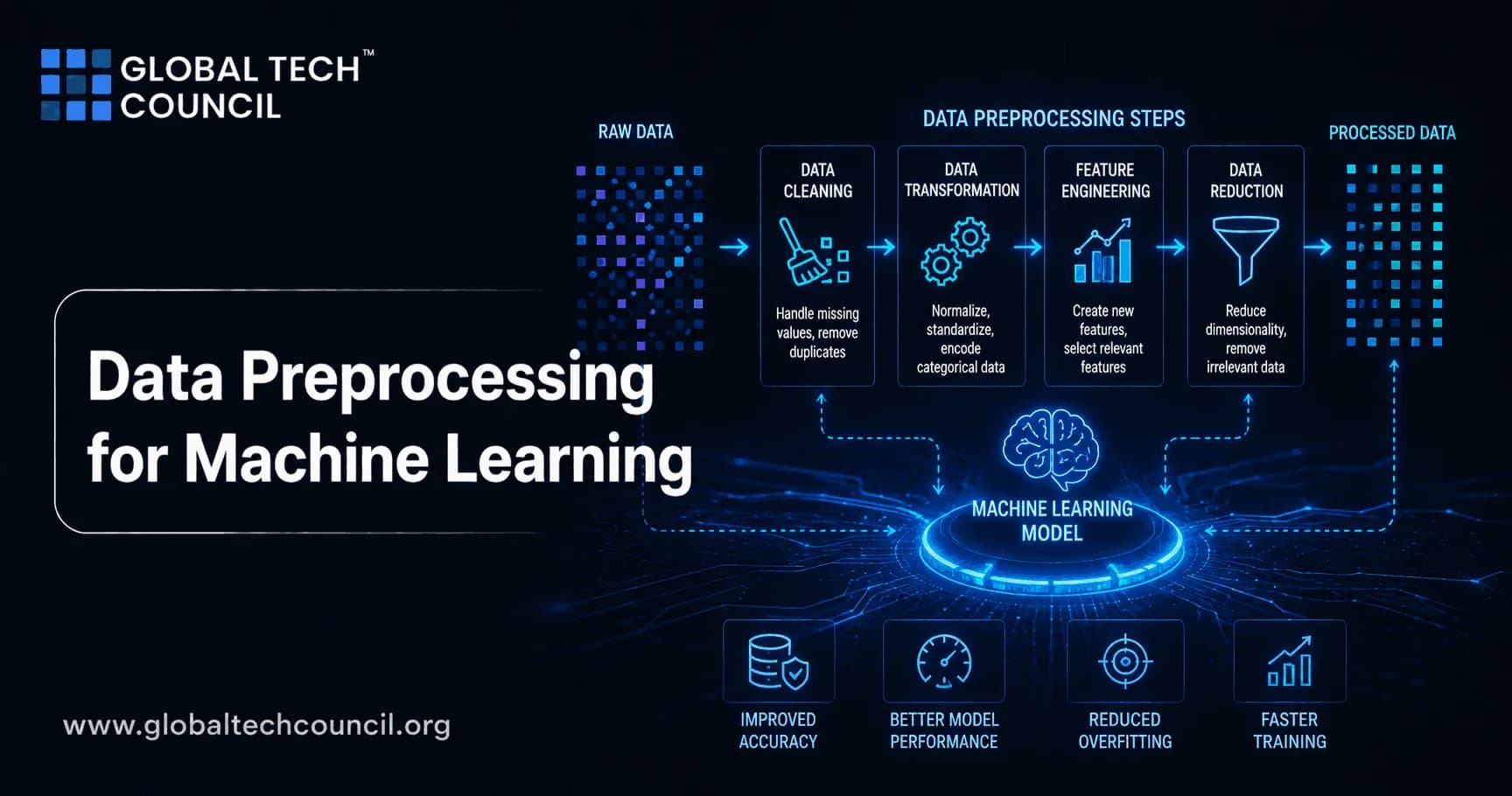
Data preprocessing for machine learning is the work that turns messy operational data into model-ready input. Skip it and your model may still train, but the score you see in a notebook will often collapse in production. Bad null handling, leaked scalers, inconsistent category encoding, and careless feature engineering are the usual culprits.
In real projects, preprocessing is not just a notebook chore. It is part of the machine learning pipeline, part of MLOps, and increasingly part of AI governance. The EU AI Act, in Article 10, explicitly refers to data preparation operations such as annotation, labelling, cleaning, updating, enrichment, and aggregation for high-risk AI systems. That matters. Your preprocessing choices affect accuracy, fairness, auditability, and compliance.

Effective data preprocessing forms the foundation of every successful machine learning project. A Certified Machine Learning Expert credential helps professionals develop practical expertise in data preparation, feature engineering, model evaluation, and training workflows, enabling them to build reliable machine learning pipelines that perform consistently in real-world environments.
What data preprocessing actually includes
Data preprocessing is the structured process of cleaning, scaling, transforming, and organizing raw data before model training. It usually covers:
Checking schema, types, ranges, and distributions
Handling missing values, duplicates, outliers, and invalid records
Encoding categorical variables into numerical representations
Scaling numerical features through normalization or standardization
Creating, selecting, or reducing features
Splitting data into training, validation, and test sets without leakage
Order matters more than beginners expect. Fit your preprocessing steps only on the training data, then apply the learned parameters to validation and test data. This is the certification exam question that catches people: you do not scale the whole dataset before the split. That leaks information from the test set into training.
As machine learning systems move from development into production, preprocessing becomes a repeatable operational process rather than a one-time task. A Certified MLOps Expert credential helps professionals build practical skills in pipeline automation, data versioning, reproducible workflows, deployment, and continuous monitoring to ensure preprocessing remains consistent throughout the ML lifecycle.
Data cleaning: fix the dataset before the model sees it
Data cleaning deals with missing values, inconsistent records, duplicates, wrong data types, impossible values, and noise. It sounds basic. It is not.
A model trained on dirty data can learn the wrong pattern with impressive confidence. A fraud model may treat missing income as a signal of fraud because one batch job failed for a particular region. A churn model may learn that every customer signed up on January 1 because an old CRM exported unknown dates as 1970-01-01. These are not academic edge cases. They show up constantly.
Start with schema and distribution checks
Before imputing anything, inspect the data:
Are numeric columns stored as strings because of commas or currency symbols?
Do dates use mixed formats such as MM/DD/YYYY and DD/MM/YYYY?
Are category labels duplicated through casing, such as SME, sme, and S.M.E.?
Do values violate business rules, such as negative age or delivery before order date?
Has the class distribution changed since the last training run?
Use tools like pandas profiling checks, Great Expectations, TensorFlow Data Validation, or custom SQL tests. The tool is less important than the habit: define what valid data means, then enforce it.
Handle missing values deliberately
Missing data has causes. Treat them differently.
Drop rows when missingness is rare and the sample size is large enough.
Drop columns when a feature is mostly empty and adds little domain value.
Impute values using median, mean, mode, or model-based methods when preserving rows is important.
Add missingness indicators when the absence of a value may carry information.
For skewed numeric data, median imputation is often safer than mean imputation. For categorical data, a separate Unknown label can be useful, but be careful in regulated settings. If Unknown maps strongly to a protected group because of collection gaps, you have a bias problem, not just a preprocessing one.
A practical warning: many scikit-learn estimators still reject NaN values. If you pass missing values into LogisticRegression, you can hit ValueError: Input X contains NaN. LogisticRegression does not accept missing values encoded as NaN natively. Some estimators, such as HistGradientBoostingClassifier, handle missing values on their own, but do not assume every model can.
Outliers and duplicates need context
Outliers are not automatically errors. A transaction of $25,000 may be fraud, a corporate purchase, or a data entry mistake. Removing it blindly can erase the signal you need.
Use domain rules first. Then use statistical checks such as interquartile range, z-scores, winsorization, or log transforms. For duplicates, separate true duplicate rows from repeated real-world events. Two identical purchases may be valid. Two identical patient records with different IDs may not be.
Feature scaling: normalization vs standardization
Feature scaling puts numerical variables on comparable scales. It is essential for algorithms that depend on distance, gradients, or variance.
Scaling matters for:
k-nearest neighbors
k-means clustering
support vector machines
linear and logistic regression with regularization
principal component analysis
neural networks
Tree-based models such as decision trees, random forests, and gradient boosting are usually less sensitive to scaling. To be blunt, scaling every feature before a random forest is often pointless. It may still help if the pipeline also feeds other models, but do not pretend it is always required.
Normalization with min-max scaling
Normalization, often called min-max scaling, rescales values into a fixed range, commonly 0 to 1. It is useful when you know the approximate bounds of the data and need inputs within a narrow interval.
Neural networks and distance-based methods often benefit from normalization. The risk is outlier sensitivity. If one customer has an unusually high income, min-max scaling can compress the rest of the column into a tiny range.
Standardization with z-score scaling
Standardization transforms a feature to mean 0 and standard deviation 1. It is a strong default for linear models, logistic regression, SVMs, PCA, and many regularized models.
Use StandardScaler in scikit-learn when you want this behavior. But fit it only on the training set. In a proper workflow, place the scaler inside a Pipeline or ColumnTransformer so cross-validation does not leak validation data into preprocessing.
Data transformation and feature engineering
Data transformation changes feature representation so algorithms can use the data correctly. Feature engineering adds domain knowledge to improve signal quality.
Encode categorical variables correctly
Most machine learning models need numeric input. Common encoding methods include:
One-hot encoding for nominal categories such as country, product type, or browser
Ordinal encoding for ordered categories such as low, medium, high
Target encoding for high-cardinality categories, used carefully with cross-validation to avoid leakage
One version-specific detail: in scikit-learn 1.2, OneHotEncoder introduced sparse_output to replace the older sparse parameter. If you copy old code into a newer environment, warnings or failures can appear. That is a boring detail until it breaks your training job five minutes before a demo.
Transform skewed variables
Some variables have long tails: income, transaction amount, claim size, session duration. A log transform such as log1p can make patterns easier for linear models to learn. Box-Cox and Yeo-Johnson transformations can also help, depending on whether values include zero or negatives.
For risk scoring, binning can improve interpretability. Equal-width binning splits the value range into fixed intervals. Equal-frequency binning creates bins with roughly similar counts. Use binning when explainability matters, but do not overdo it. Too many bins recreate the original noise.
Reduce dimensions when features explode
High-dimensional data can make models slow, unstable, and harder to interpret. This happens often after one-hot encoding, or when working with text and sensor data.
Options include:
Dropping redundant or highly correlated variables
Using PCA for numerical features when interpretability is less critical
Applying feature selection based on mutual information, regularization, or model importance
Grouping rare categories before one-hot encoding
Multicollinearity is especially important for linear and logistic regression. If two features explain almost the same thing, coefficient estimates can become unstable even when prediction accuracy looks acceptable.
Build preprocessing into a repeatable ML pipeline
Notebook-only preprocessing fails when data changes. Production ML needs repeatable, versioned, testable preprocessing.
A dependable pipeline should include:
Data validation: check schema, ranges, null rates, and category drift.
Train-validation-test split: split before fitting imputers, scalers, encoders, or feature selectors.
Column-specific preprocessing: apply numeric and categorical transformations separately.
Model training: keep preprocessing and model steps together in one pipeline object when possible.
Monitoring: compare production data distributions with training distributions.
Documentation: record why values were dropped, imputed, grouped, or transformed.
This is where preprocessing connects to governance. If your organization builds healthcare, finance, hiring, insurance, or safety-related AI systems, you need traceability. You should be able to answer: which records were removed, which values were imputed, which labels were updated, and which transformations were applied during the model run.
Implementing robust preprocessing pipelines at scale also requires expertise in cloud infrastructure, software engineering, cybersecurity, and automation. A Deep Tech Certification helps professionals strengthen these advanced technical capabilities, making it easier to design secure, scalable, and production-ready machine learning systems that can support enterprise AI initiatives.
Common mistakes to avoid
Scaling before splitting: this leaks test-set information.
Imputing with global statistics: fit imputers only on training data.
Encoding categories inconsistently: unseen categories in production can break poorly designed pipelines.
Removing outliers without domain review: you may delete the rare cases your model must detect.
Creating too many weak features: more columns can mean more noise, not more signal.
Ignoring imbalance: for fraud or anomaly detection, accuracy can be a misleading metric.
Where preprocessing is heading
Data preprocessing for machine learning is becoming more automated, but not fully hands-off. Cloud platforms and MLOps tools increasingly ship reusable components for cleaning, scaling, augmentation, bias checks, and data validation. That is useful. Still, automation cannot decide whether a missing lab result means not tested, test failed, or data not transferred. That takes domain judgment.
Expect more emphasis on auditable transformations, synthetic data generation, bias testing, and feature stores. Also expect stricter review of preprocessing for high-risk AI systems, because regulators now treat data preparation as part of system governance.
What to learn next
If you want to build reliable ML systems, practice preprocessing as an engineering discipline, not a one-time cleanup step. Build a small scikit-learn pipeline with ColumnTransformer, SimpleImputer, StandardScaler, and OneHotEncoder. Then test it with new categories, missing values, and shifted distributions.
For a structured path, pair hands-on projects with Global Tech Council certification programs in machine learning, data science, and AI. Focus on pipelines, feature engineering, model evaluation, and governance. Those are the skills that separate a working ML practitioner from someone who only knows how to call fit().
Along with technical proficiency, successful AI initiatives depend on professionals who can communicate project outcomes and align technical decisions with organizational priorities. A Marketing & Business Certification helps build these business-focused skills, enabling practitioners to present machine learning solutions more effectively and support informed strategic decision-making.
FAQs
1. What is data preprocessing in machine learning?
Data preprocessing is the process of preparing raw data before training a machine learning model. It involves cleaning, organizing, transforming, and validating data so that algorithms can learn meaningful patterns more effectively and produce reliable predictions.
2. Why is data preprocessing important?
High-quality data is essential for building accurate and reliable machine learning models. Proper preprocessing helps reduce errors, improve model performance, minimize bias caused by poor-quality data, and create consistent inputs for both training and production environments.
3. What are the main steps in data preprocessing?
Typical preprocessing steps include data collection, data cleaning, handling missing values, removing duplicates, detecting outliers, encoding categorical variables, scaling numerical features, feature engineering, feature selection, and splitting data into training, validation, and testing datasets.
4. What is data cleaning?
Data cleaning is the process of identifying and correcting issues such as missing values, duplicate records, inconsistent formatting, incorrect labels, and invalid entries. Clean datasets help machine learning algorithms learn genuine relationships instead of misleading patterns caused by poor data quality.
5. How should missing values be handled?
Missing values may be removed, imputed using statistical methods such as the mean, median, or mode, or estimated using more advanced machine learning techniques. The most appropriate strategy depends on the amount of missing data, the dataset characteristics, and the business context.
6. Why is duplicate data removal important?
Duplicate records can distort statistical analyses, bias machine learning models, and inflate the apparent size of a dataset. Removing unnecessary duplicates helps ensure that models learn from representative observations rather than repeated examples.
7. What are outliers, and how should they be managed?
Outliers are observations that differ substantially from the majority of the data. They should be investigated carefully because they may represent valid rare events, measurement errors, or data entry mistakes. Decisions about retaining or removing outliers should be guided by domain knowledge and analytical objectives.
8. What is feature scaling?
Feature scaling adjusts numerical variables so they operate on comparable ranges. Scaling is particularly important for algorithms that rely on distances or gradient-based optimization, including support vector machines, k-nearest neighbors, neural networks, and clustering methods.
9. What is the difference between normalization and standardization?
Normalization typically rescales data to a fixed range, such as 0 to 1, while standardization transforms features to have approximately zero mean and unit variance. The preferred technique depends on the algorithm, feature distributions, and project requirements.
10. How are categorical variables encoded?
Categorical variables are converted into numerical representations using methods such as one-hot encoding, ordinal encoding, target encoding, or binary encoding. The appropriate encoding approach depends on whether categories have a natural order and the requirements of the chosen machine learning algorithm.
11. What is feature engineering?
Feature engineering involves creating new variables or modifying existing ones to improve a model's ability to learn useful patterns. Examples include combining features, extracting date-related information, generating interaction terms, and applying domain-specific transformations.
12. What is feature selection?
Feature selection identifies the most relevant variables for model training while removing redundant or irrelevant features. This process can improve model performance, reduce computational complexity, enhance interpretability, and lower the risk of overfitting.
13. Why should data be split before preprocessing?
Training, validation, and testing datasets should generally be defined before fitting preprocessing transformations to avoid data leakage. Preprocessing steps such as scaling or imputation are typically learned from the training data and then applied consistently to validation and test datasets.
14. What is data leakage?
Data leakage occurs when information from validation or test data unintentionally influences the training process. Leakage can produce overly optimistic evaluation results and lead to models that perform poorly when deployed on truly unseen data.
15. Which Python libraries are commonly used for data preprocessing?
Popular libraries include Pandas, NumPy, Scikit-learn, SciPy, Feature-engine, TensorFlow, PyTorch, Polars, and category_encoders. These tools provide capabilities for cleaning, transforming, encoding, scaling, validating, and preparing datasets for machine learning workflows.
16. What are common preprocessing mistakes?
Common mistakes include failing to handle missing values, ignoring duplicate records, applying inconsistent preprocessing across datasets, introducing data leakage, overlooking outliers, using unsuitable scaling methods, and neglecting to document preprocessing steps for reproducibility.
17. What are best practices for data preprocessing?
Best practices include understanding the data thoroughly, documenting every transformation, using reproducible preprocessing pipelines, validating data quality, applying transformations consistently, preventing data leakage, monitoring feature distributions, and collaborating with domain experts when making preprocessing decisions.
18. How does data preprocessing fit into MLOps?
In MLOps, preprocessing is integrated into automated data pipelines to ensure consistency between training and production environments. Version-controlled preprocessing workflows improve reproducibility, simplify deployment, and reduce errors caused by manual data preparation.
19. What trends are shaping data preprocessing in 2025-2026?
Emerging trends include automated feature engineering, AI-assisted data quality assessment, synthetic data generation, real-time preprocessing pipelines, privacy-preserving data preparation, feature stores, streaming data transformations, and tighter integration with cloud-native MLOps platforms.
20. What is the future of data preprocessing in machine learning?
Data preprocessing will remain a critical part of the machine learning lifecycle despite advances in automated AI systems. While modern foundation models can reduce some manual preprocessing requirements for specific tasks, structured data applications will continue to depend on careful cleaning, transformation, validation, and governance to produce trustworthy results. After all, even the most sophisticated machine learning model cannot reliably learn from data that arrived looking like it survived a very chaotic spreadsheet adventure.
Related Articles
View All
Machine Learning
Machine Learning for Predictive Analytics: Turning Data into Forecasts
Learn how machine learning for predictive analytics turns historical and real-time data into forecasts for finance, healthcare, retail, IoT, and operations.

Machine Learning
Machine Learning vs Data Science: Roles, Skills, and Career Paths
Compare machine learning vs data science across responsibilities, skills, tools, career paths, and certifications so you can choose the right AI career track.

Machine Learning
How Machine Learning Works: From Data to Predictions
Learn how machine learning works from problem definition and data preparation to model training, evaluation, deployment, MLOps, and governance.
Trending Articles
The Role of Blockchain in Ethical AI Development
How blockchain technology is being used to promote transparency and accountability in artificial intelligence systems.
AWS Career Roadmap
A step-by-step guide to building a successful career in Amazon Web Services cloud computing.
Top 5 DeFi Platforms
Explore the leading decentralized finance platforms and what makes each one unique in the evolving DeFi landscape.