

The Future of Machine Learning: Trends, Opportunities, and Challenges
 Suyash Raizada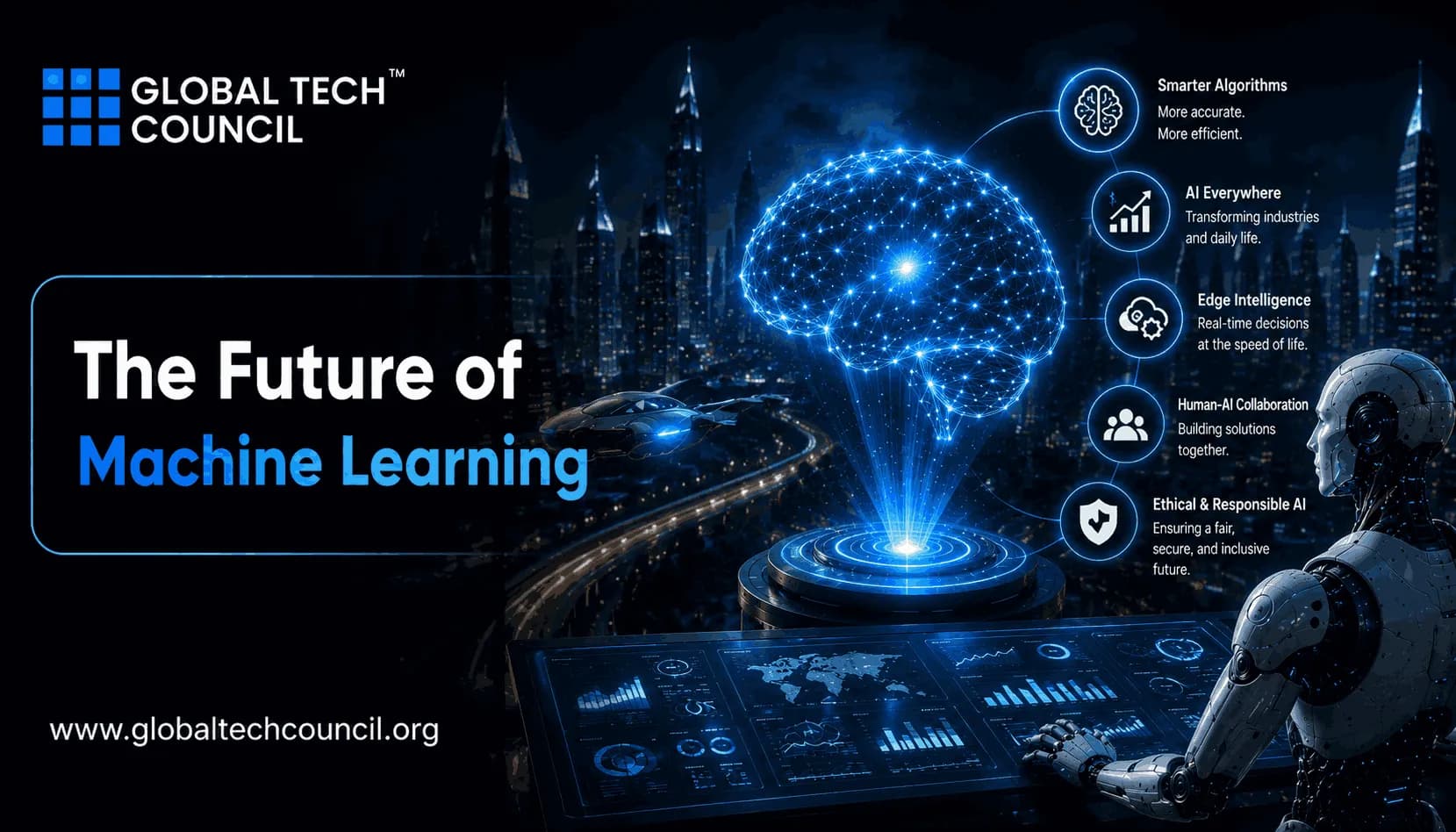
The future of machine learning is not just bigger models. It is cheaper inference, stricter governance, edge deployment, AutoML, MLOps discipline, and a sharper split between teams that can ship reliable systems and teams stuck in notebook experiments. If you work in data science, software engineering, cybersecurity, IoT, or enterprise technology, this shift will affect the tools you use and the skills employers expect.
Machine learning has moved from proof-of-concept projects into healthcare diagnostics, fraud detection, demand forecasting, predictive maintenance, document processing, and recommendation systems. Grand View Research estimated the global machine learning market at $55.8 billion in 2024 and projected $282.13 billion by 2030, with a 30.4 percent compound annual growth rate from 2025 to 2030. Other trackers put the 2024 figure higher, closer to $80 billion, with 2030 projections above $500 billion. Forecasts differ, but the direction is not in doubt.

As machine learning continues to evolve across industries, professionals need a strong understanding of model development, evaluation, deployment, and production best practices. A Certified Machine Learning Expert credential helps build these practical skills, preparing learners to implement reliable machine learning solutions that can adapt to changing business and technical requirements.
Why the future of machine learning looks different now
For years, ML work followed a fairly predictable path: collect data, train a supervised model, evaluate accuracy, deploy an API, monitor occasionally. That pattern still exists. It is no longer the whole job.
Modern ML systems are becoming integrated products. A fraud model may combine gradient boosted trees, graph features, human review queues, drift alerts, and regulatory audit logs. A customer support system may combine a foundation model, retrieval augmented generation, policy filters, and human escalation. A factory defect detector may run on an edge device because cloud latency is unacceptable.
This is where many teams struggle. The model is the easy part. The production system is the hard part.
Key machine learning trends shaping the next decade
1. Foundation models will become standard building blocks
Generative AI and foundation models have changed how organizations think about ML. Instead of training every model from scratch, teams increasingly adapt pretrained models through fine-tuning, retrieval augmented generation, prompt engineering, and domain-specific evaluation.
This does not mean every project needs a large language model. To be blunt, many classification and forecasting problems are still better served by XGBoost, LightGBM, logistic regression, or a compact neural network. A 7 billion parameter model is usually a bad fit for predicting churn from tabular CRM data. Use the simplest model that meets the business, latency, privacy, and maintenance requirements.
2. AutoML and low-code tools will change the beginner workload
AutoML platforms now automate preprocessing, feature selection, model search, and hyperparameter tuning. This helps analysts test ideas faster and lets domain experts participate without writing full ML pipelines by hand.
Still, AutoML does not remove the need for ML judgment. It cannot decide whether your target variable leaks future information. It will not know that a hospital readmission model trained on billing codes may encode unequal access to care. You still need to understand evaluation design, data quality, and bias.
As organizations increasingly combine machine learning with broader AI capabilities, professionals benefit from understanding how predictive models, intelligent automation, and modern AI systems work together. A Certified AI & Machine Learning Expert credential helps develop this broader perspective, enabling practitioners to build AI solutions that balance technical performance with practical business needs.
A common trap: teams celebrate a high validation score, then discover the split was random when it should have been time-based. In forecasting, cybersecurity detection, and finance, that mistake can make a weak model look brilliant.
3. Edge ML and on-device inference will expand
Edge ML is growing because not every decision can wait for a cloud round trip. Phones, cameras, industrial sensors, vehicles, and IoT devices increasingly run models close to where data is created. The benefits are practical:
Lower latency: useful for safety, robotics, and real-time quality inspection.
Better privacy: sensitive data can stay on the device.
Lower bandwidth cost: raw video or sensor streams do not need constant upload.
Resilience: devices can continue operating during weak network connectivity.
Expect more work around quantization, pruning, knowledge distillation, and hardware-aware model design. TensorFlow Lite, ONNX Runtime, Core ML, and PyTorch Mobile deployment patterns will matter for developers who want to work on IoT and embedded AI systems.
4. Continuous learning and drift monitoring will become non-negotiable
Static models decay. Customer behavior changes. Fraud tactics shift. Sensors age. Supply chains break. If your model sees a different distribution in production than it saw during training, performance can fall quietly.
Future ML systems will need continuous monitoring for data drift, concept drift, calibration errors, and data pipeline failures. MLOps will move from a specialist concern to a standard engineering practice.
Practitioner detail: a small library change can break a pipeline if you are not testing it. In scikit-learn 1.2, OneHotEncoder renamed the sparse parameter to sparse_output, and older code later failed in newer environments. That is not a research problem. It is a release engineering problem, and it is exactly why version pinning and reproducible training jobs matter.
5. Hybrid and physics-informed models will gain ground
Not every domain should rely on pure pattern matching. In engineering, logistics, energy, climate modeling, and manufacturing, teams often know physical rules or business constraints before training begins. Hybrid models combine neural networks with statistical methods, symbolic rules, optimization, or physics-based constraints.
This trend is healthy. It pushes ML away from black-box guessing and toward systems that respect domain knowledge. If a model predicts a physically impossible result, a higher accuracy score on a benchmark will not save it in production.
Opportunities for enterprises
The future of machine learning creates clear opportunities for organizations that treat ML as an operating capability, not a one-off experiment.
Healthcare: diagnostic support, triage, medical imaging workflows, risk prediction, and operational scheduling.
Finance: fraud detection, credit risk, anti-money laundering monitoring, portfolio analytics, and compliance review.
Retail and e-commerce: recommendations, dynamic pricing, inventory forecasting, personalization, and customer segmentation.
Manufacturing: predictive maintenance, visual inspection, process optimization, and anomaly detection from sensor data.
Cybersecurity: malware classification, phishing detection, user behavior analytics, and alert prioritization.
The best enterprise use cases share three traits: the decision is repeated often, data is available at reasonable quality, and a wrong prediction has a known recovery path. If those conditions are missing, start smaller.
Opportunities for professionals
For professionals, the opportunity is not limited to model training. The market needs people who can connect ML to real systems.
ML engineers who can build training pipelines, APIs, feature stores, and deployment workflows.
Data scientists who can frame problems, test assumptions, and evaluate models beyond headline accuracy.
MLOps specialists who understand monitoring, model registries, CI/CD, reproducibility, and rollback plans.
AI governance professionals who can document risks, evaluate fairness, and support compliance.
Edge AI developers who can optimize models for constrained hardware.
If you are planning a learning path, pair core ML theory with production practice. The Global Tech Council machine learning certification catalog gives readers structured training in supervised learning, unsupervised learning, deep learning fundamentals, feature engineering, model evaluation, and MLOps. If you want adjacent skills, the Council also runs programs in artificial intelligence, data science, cybersecurity, programming, and IoT.
Building production-ready machine learning systems also requires expertise in cloud computing, MLOps, distributed infrastructure, automation pipelines, and scalable AI platforms. A Deep Tech Certification helps professionals strengthen these advanced technical capabilities, making it easier to deploy, monitor, and optimize enterprise-grade machine learning applications.
The hardest machine learning challenges ahead
Data quality is still the bottleneck
Bad labels, missing values, duplicate records, skewed sampling, and hidden leakage ruin models. They also waste compute. A clean baseline trained on well-understood features often beats a complex model trained on messy data. Boring work wins here.
Governance and regulation will shape deployment
ML systems increasingly affect credit, hiring, healthcare, insurance, policing, and critical infrastructure. That brings scrutiny. The EU AI Act entered into force in 2024 and introduces risk-based obligations that phase in over time. The NIST AI Risk Management Framework 1.0 gives organizations a practical structure for mapping, measuring, managing, and governing AI risk.
Expect more documentation, model cards, audit trails, human oversight, and post-deployment monitoring. If your team cannot explain what data was used, how performance was measured, and what risks were considered, the model is not ready for a sensitive workflow.
Compute and energy costs will matter
Inference costs are falling for many workloads, but total resource consumption keeps rising as adoption grows. Large models need GPUs, memory, power, cooling, and skilled operators. Efficiency will become a design requirement, not a nice extra.
Smaller models, sparsity, mixture of experts, caching, batching, quantization, and retrieval-based designs can cut cost. The right architecture is the one that meets the service-level requirement at the lowest acceptable risk and cost.
What should you learn next?
If you want to prepare for the future of machine learning, build a practical stack in this order:
Study supervised learning, unsupervised learning, model validation, and feature engineering.
Train models with scikit-learn, XGBoost, PyTorch, or TensorFlow.
Deploy a model as an API and monitor it for drift and latency.
Add governance: version data, document assumptions, test fairness, and define rollback steps.
Explore one specialization: edge ML, MLOps, NLP, computer vision, cybersecurity ML, or responsible AI.
Do one concrete project next. Build a demand forecasting model with a time-based split, log experiments with MLflow, package the model behind a FastAPI endpoint, and track prediction drift for 30 days. That single project will teach you more than another passive tutorial.
When you are ready to validate your skills, review the Global Tech Council machine learning and AI certification options and choose the path that matches your role. Developers should prioritize MLOps and deployment. Analysts should focus on evaluation and feature engineering. Enterprise leaders should study governance, risk, and practical use case selection.
Technical expertise is only one part of delivering successful AI initiatives. Organizations also benefit from professionals who understand how machine learning investments align with business strategy, customer value, and long-term growth. A Marketing & Business Certification helps develop this business perspective, enabling practitioners to connect technical innovation with measurable organizational outcomes.
FAQs
1. What is the future of machine learning?
The future of machine learning is expected to involve broader adoption across industries, improved model efficiency, stronger AI governance, and deeper integration with cloud, edge computing, and automation technologies. Advances in foundation models, multimodal AI, and domain-specific machine learning are likely to expand both commercial and scientific applications.
2. Why is machine learning becoming more important?
Organizations are generating larger volumes of data than ever before and increasingly rely on machine learning to identify patterns, automate decisions, improve efficiency, and support innovation. As computing power and AI tools become more accessible, machine learning is becoming a core capability for many businesses.
3. What are the biggest machine learning trends in 2025-2026?
Major trends include generative AI, multimodal foundation models, agentic AI, edge AI, small language models (SLMs), explainable AI, synthetic data, federated learning, AI governance, energy-efficient model architectures, and increased adoption of MLOps for production AI systems.
4. How will generative AI influence machine learning?
Generative AI is expanding the capabilities of machine learning by enabling models to create text, images, audio, video, software code, and other content. It is also accelerating software development, customer support, scientific research, content creation, and business automation while increasing demand for responsible AI practices.
5. What role will foundation models play?
Foundation models are expected to remain central to modern AI development by providing reusable pretrained models that can be adapted for numerous downstream tasks. This approach reduces development time and enables organizations to build specialized AI applications without training every model from scratch.
6. How is edge AI shaping the future of machine learning?
Edge AI allows machine learning models to run directly on devices such as smartphones, industrial equipment, medical devices, drones, and autonomous vehicles. Processing data closer to its source can reduce latency, improve privacy, lower bandwidth requirements, and support real-time decision-making.
7. What industries are expected to benefit most?
Healthcare, finance, manufacturing, retail, logistics, transportation, agriculture, education, cybersecurity, telecommunications, energy, government, scientific research, and media are expected to continue expanding their use of machine learning for automation, prediction, optimization, and decision support.
8. How will machine learning transform healthcare?
Machine learning is expected to support medical imaging, personalized treatment planning, drug discovery, hospital operations, disease risk prediction, and clinical decision support. Healthcare implementations typically require rigorous validation, regulatory compliance, privacy protections, and ongoing human oversight.
9. How will businesses use machine learning in the future?
Businesses are expected to apply machine learning to customer service, supply chain optimization, demand forecasting, fraud detection, predictive maintenance, intelligent search, marketing personalization, financial planning, cybersecurity, and operational automation to improve efficiency and decision-making.
10. What opportunities will machine learning create for professionals?
Growing adoption is expected to increase demand for machine learning engineers, data scientists, MLOps engineers, AI researchers, AI product managers, AI governance specialists, data engineers, AI security professionals, and domain experts who can bridge technical and business requirements.
11. What technical challenges does machine learning face?
Common technical challenges include model drift, data quality issues, scalability, computational costs, energy consumption, bias, explainability, reproducibility, secure deployment, and maintaining reliable performance as real-world conditions evolve.
12. What ethical challenges are associated with machine learning?
Ethical considerations include fairness, transparency, accountability, privacy protection, informed consent, intellectual property, cybersecurity, and preventing harmful or discriminatory outcomes. Many organizations are adopting responsible AI frameworks and governance processes to address these concerns.
13. How will AI regulation affect machine learning?
Governments and regulatory bodies are continuing to develop frameworks addressing AI safety, transparency, privacy, risk management, and accountability. Organizations deploying machine learning should monitor applicable laws, industry standards, and official guidance relevant to their jurisdictions and use cases.
14. What role will MLOps play in the future?
MLOps is expected to become increasingly important for managing the entire machine learning lifecycle, including data pipelines, model training, deployment, monitoring, retraining, governance, and collaboration between data science and engineering teams.
15. How will machine learning become more accessible?
Low-code and no-code AI platforms, cloud-based machine learning services, open-source frameworks, pretrained foundation models, and AutoML solutions are making machine learning more accessible to organizations and professionals with varying levels of technical expertise.
16. Will machine learning replace human jobs?
Machine learning is likely to automate certain repetitive or data-intensive tasks while creating new roles focused on AI development, governance, oversight, integration, and strategy. The overall impact will vary by industry, occupation, regulatory environment, and how organizations choose to implement AI technologies.
17. What skills will be most valuable for future machine learning careers?
Key skills include Python programming, mathematics, statistics, deep learning, cloud computing, MLOps, data engineering, software development, cybersecurity awareness, AI ethics, domain expertise, communication, and the ability to collaborate across multidisciplinary teams.
18. What are best practices for preparing for the future of machine learning?
Professionals and organizations should invest in continuous learning, build practical AI projects, strengthen data governance, adopt responsible AI principles, monitor evolving regulations, evaluate models rigorously, and establish processes for ongoing model maintenance and performance monitoring.
19. How should organizations plan long-term machine learning strategies?
Organizations should align machine learning initiatives with business objectives, prioritize high-value use cases, ensure data quality, establish governance frameworks, invest in scalable infrastructure, develop workforce skills, and measure outcomes using clearly defined performance and risk metrics.
20. What is the long-term outlook for machine learning?
Machine learning is expected to remain one of the foundational technologies driving digital transformation, scientific discovery, and intelligent automation over the coming years. Continued advances in algorithms, computing infrastructure, multimodal AI, responsible governance, and human-AI collaboration will likely expand its capabilities while increasing the importance of transparency, security, and ethical deployment. The future will belong less to organizations that simply adopt machine learning and more to those that deploy it thoughtfully, because even the smartest model still appreciates a little human common sense now and then.
Related Articles
View All
Machine Learning
Machine Learning in Healthcare: Applications, Benefits, and Challenges
Learn how machine learning in healthcare improves diagnostics, remote monitoring, drug discovery, and operations while raising data, bias, security, and regulatory challenges.

Machine Learning
Machine Learning Certifications and Career Paths in 2026: Skills, Roles, and Salary Trends
Explore machine learning certifications and career paths in 2026, including in-demand skills, generative AI roles, and salary trends. Learn how to select certifications that map to real deployment work.

Machine Learning
Machine Learning Trends That Will Transform The World in 2021
Evolution is inevitable, whether it is human or technology, the changes in them are transforming human life as well. Machine learning and artificial intelligence have crossed the boundaries of science fiction books, and it has become a part of our reality. Machine learning works on data, and based…
Trending Articles
The Role of Blockchain in Ethical AI Development
How blockchain technology is being used to promote transparency and accountability in artificial intelligence systems.
AWS Career Roadmap
A step-by-step guide to building a successful career in Amazon Web Services cloud computing.
Top 5 DeFi Platforms
Explore the leading decentralized finance platforms and what makes each one unique in the evolving DeFi landscape.