

Machine Learning vs Data Science: Roles, Skills, and Career Paths
 Suyash Raizada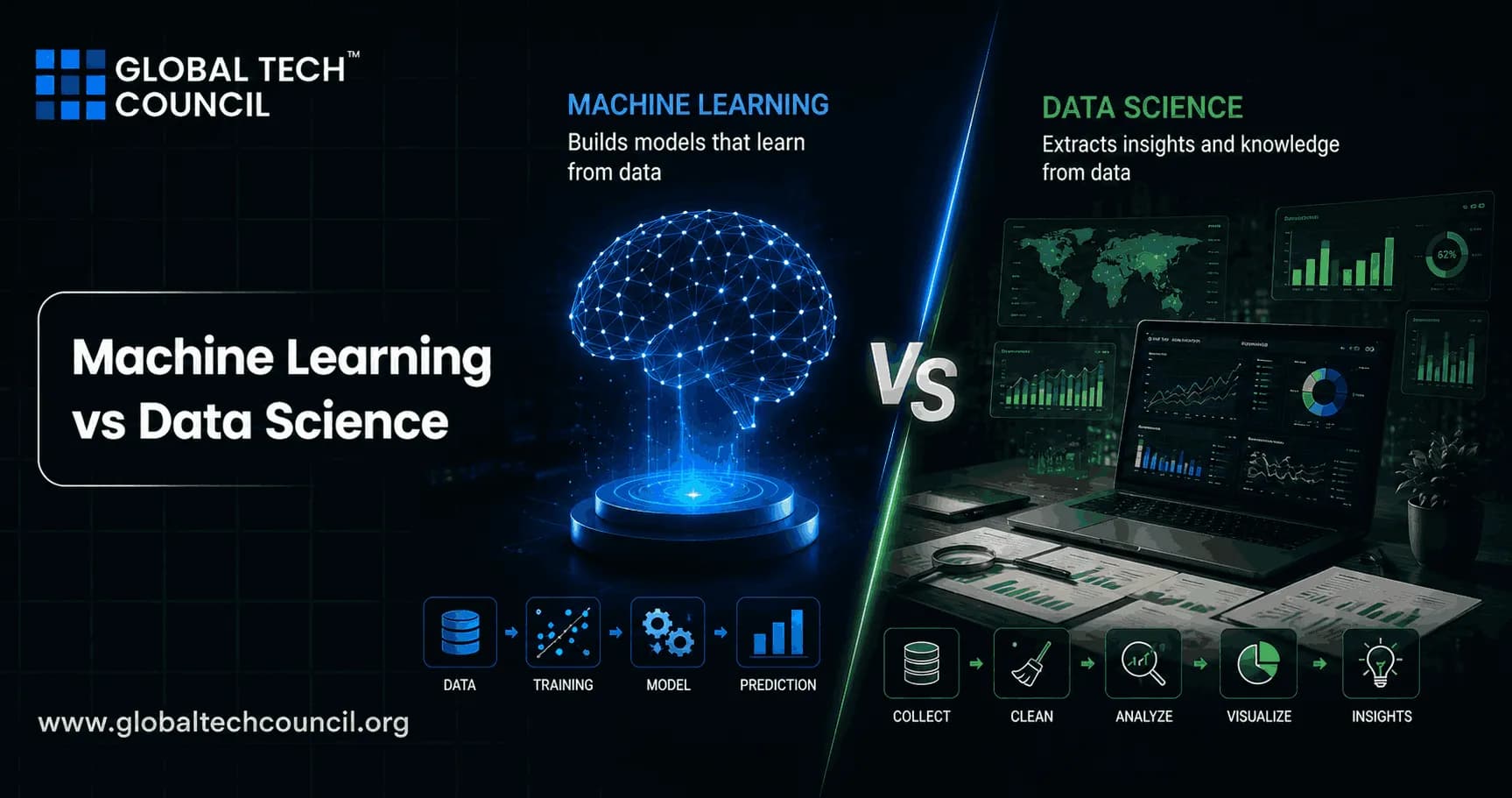
Machine Learning vs Data Science is a common career question because the two fields sit close together, use many of the same tools, and often share the same datasets. The difference is practical. Data science turns data into decisions. Machine learning turns data into systems that make predictions or automate actions at scale.
If you like messy business questions, experiments, statistics, and explaining trade-offs to stakeholders, data science may fit you better. If you prefer production code, model APIs, latency targets, monitoring, and infrastructure, machine learning engineering is usually the better path. Both are strong careers. They reward different habits.

Regardless of which path you choose, building practical skills is just as important as learning theory. A Certified Machine Learning Expert credential helps professionals develop a strong foundation in model development, evaluation, deployment, and real-world machine learning workflows, making it easier to contribute across modern AI-driven organizations.
Machine Learning vs Data Science: The Core Difference
Data science focuses on pulling useful insight from structured and unstructured data. A data scientist might investigate why customer churn increased, whether a product change improved conversion, or which operational metric predicts delayed delivery. The output is often a model, dashboard, experiment readout, or recommendation.
Machine learning, in a career context, usually means machine learning engineering. An ML engineer builds systems that train, serve, monitor, and improve models in real environments. The output is often a working service: a fraud detector, recommender, ranking model, document classifier, or computer vision pipeline.
A simple way to separate them: data scientists own the question and the evidence, while machine learning engineers own the production behavior of the model. In healthy teams, they work together rather than compete.
What Data Scientists Do Day to Day
Data scientists spend much of their time turning unclear questions into measurable analysis. The job is not just running fit() on a model. It is deciding whether the question is worth modeling at all.
Typical data science responsibilities
Collect, clean, and join data from databases, logs, spreadsheets, APIs, and third-party sources.
Use SQL and Python libraries such as Pandas, NumPy, Matplotlib, and Seaborn for analysis.
Run exploratory data analysis to find distributions, outliers, missing values, and suspicious patterns.
Build statistical or predictive models for churn, risk, demand, pricing, segmentation, or forecasting.
Design A/B tests and interpret results using confidence intervals, p-values, power, and practical effect size.
Create dashboards in Tableau, Power BI, Looker, or similar BI tools.
Explain findings to product, finance, marketing, operations, or leadership teams.
The hidden skill is judgment. A junior analyst may report that a campaign improved conversion by 4 percent. A strong data scientist asks whether the sample was randomized, whether returning users were overrepresented, and whether the lift survives a holdout analysis.
What Machine Learning Engineers Do Day to Day
Machine learning engineers take models beyond notebooks. That changes the work. Accuracy still matters, but so do p95 latency, memory use, test coverage, retraining cadence, feature freshness, rollback plans, and logging.
Typical machine learning engineering responsibilities
Build training and inference pipelines from data ingestion to deployment.
Use frameworks such as scikit-learn, PyTorch, TensorFlow, XGBoost, and Hugging Face Transformers.
Package models behind APIs using FastAPI, Flask, gRPC, or cloud-native serving tools.
Containerize workloads with Docker and deploy through Kubernetes, managed cloud services, or CI/CD systems.
Monitor drift, data quality, latency, throughput, and prediction distribution changes.
Optimize models through pruning, quantization, batching, caching, or feature reduction.
Work with data engineers and software engineers to keep feature pipelines reliable.
Here is a real beginner trap. A model that scores well in a notebook can fail in production because a category appears at inference time that was never seen during training. In scikit-learn, OneHotEncoder can throw ValueError: Found unknown categories ... during transform unless you set handle_unknown='ignore'. That small parameter can be the difference between a stable API and a 2 a.m. incident.
While machine learning engineers focus on deploying and maintaining production models, many organizations also value professionals who can bridge software development with analytics and data-driven applications. A Certified Data Science Developer® credential helps strengthen these practical development skills, enabling professionals to build scalable data solutions that support both analytics and machine learning initiatives.
Shared Skills: Where the Two Paths Overlap
The overlap is large, especially early in your career. You need enough math to understand models, enough programming to work with data, and enough skepticism to avoid fooling yourself.
Python: still the common language for both paths. Python 3.12, Pandas, NumPy, scikit-learn, and Jupyter are common starting points.
SQL: essential. If you cannot write joins, window functions, and aggregations, both jobs become harder.
Statistics: probability, distributions, hypothesis testing, regression, bias, variance, and sampling.
Machine learning basics: supervised learning, unsupervised learning, train-test splits, cross-validation, leakage, metrics, and calibration.
Cloud and data platforms: AWS, Azure, Google Cloud, Spark, and data warehouses such as BigQuery, Snowflake, or Redshift often appear in job descriptions.
Responsible AI: bias, privacy, explainability, monitoring, and governance. The NIST AI Risk Management Framework 1.0 is a useful reference for organizations building AI controls.
If you are building your foundation, Global Tech Council's Certified Python Developer™ can support the programming side, while the Certified Artificial Intelligence (AI) Expert™ covers broader AI concepts.
Data Scientist Skills That Matter Most
Data scientists are judged less by how complex their model is and more by whether the analysis changes a decision. A plain logistic regression with clean reasoning often beats a poorly explained neural network.
Experimental design: A/B testing, causal thinking, sample sizing, and metric selection.
Data storytelling: writing a clear narrative with charts that answer the question, not decorate the slide.
Business context: knowing which metric matters. Revenue, retention, margin, risk, and fairness can point in different directions.
Feature engineering: converting raw events, time windows, categorical values, and text into usable signals.
Visualization: Matplotlib, Seaborn, Plotly, Tableau, or Power BI.
To be blunt, if you dislike talking to stakeholders, data science may frustrate you. The best data scientists ask sharp questions before touching the dataset.
For structured learning, look at Global Tech Council's Certified Data Science Developer® and analytics-focused training resources.
Machine Learning Engineer Skills That Matter Most
ML engineers need stronger software engineering instincts. A notebook is not a system. You need versioned data, repeatable training, tests, deployment automation, and monitoring.
Software engineering: Git, unit tests, integration tests, API design, packaging, and code review.
MLOps: MLflow, Kubeflow, Docker, Kubernetes, model registries, CI/CD, and drift monitoring.
Deep learning: PyTorch, TensorFlow, CNNs, transformers, embeddings, and GPU-aware training.
Performance engineering: latency, throughput, memory, batch inference, streaming inference, and cost control.
Data pipelines: feature stores, orchestration, schema checks, and reproducible preprocessing.
One practical example. A transformer model may look impressive in a demo but be the wrong choice for a high-volume endpoint if a gradient boosted tree gives similar F1 with 20 ms latency. Choose the smaller model when the business problem allows it.
Global Tech Council's Certified Machine Learning Expert™ maps to this track, especially if you want structured coverage of algorithms, model development, and applied ML concepts.
Generative AI Is Changing Both Roles
Generative AI has blurred the line between machine learning and data science, but it has not erased it. Data scientists now use large language models to classify feedback, summarize survey responses, and speed up exploratory analysis. ML engineers build retrieval-augmented generation systems, fine-tuning workflows, guardrails, evaluation pipelines, and model monitoring.
Do not treat prompt engineering as a full career plan. Learn it, yes. But pair it with evaluation, retrieval, vector databases, privacy controls, and deployment skills. In production LLM systems, the hard problems are usually data quality, hallucination testing, access control, latency, and cost.
As AI systems become more sophisticated, professionals also benefit from understanding cloud infrastructure, MLOps, distributed computing, automation, and enterprise AI architectures. A Deep Tech Certification helps build expertise across these advanced technologies, preparing practitioners to develop and manage modern AI and machine learning solutions at scale.
Career Paths: Data Science
A typical data science path starts close to reporting and analysis, then moves toward modeling, experimentation, and leadership.
Data Analyst or Junior Data Scientist: SQL, dashboards, basic Python, data cleaning, reporting.
Data Scientist: end-to-end analysis, predictive models, experiment design, stakeholder recommendations.
Senior or Lead Data Scientist: project ownership, mentoring, advanced modeling, metric strategy.
Principal Data Scientist or Head of Data Science: technical direction, governance, hiring, executive communication.
Specializations include business intelligence, product analytics, marketing science, quantitative research, risk analytics, and decision science.
Career Paths: Machine Learning Engineering
Many ML engineers start as software engineers, data engineers, or data scientists. That background matters because production ML sits at the intersection of code, data, and modeling.
Junior ML Engineer or ML Developer: implement models, maintain pipelines, reproduce experiments.
Machine Learning Engineer: train, deploy, and monitor models for product features.
Senior ML Engineer: own architecture, performance, reliability, and technical mentoring.
ML Architect, Principal ML Engineer, or Director of Machine Learning: set platform strategy, standards, and long-term model lifecycle practices.
If you enjoy systems design interviews more than dashboard reviews, this path will likely feel more natural.
Which Career Should You Choose?
Choose data science if you like statistics, discovery, experimentation, and decision support. You should be comfortable saying, the data does not support that claim, even when the room wants a different answer.
Choose machine learning engineering if you like building dependable software with models inside it. You should care about tests, deployment, logs, and what happens when the input distribution changes on a Friday night.
If you are undecided, build two small projects.
Data science project: analyze churn or pricing data, run EDA, test hypotheses, build a simple model, and present a business recommendation.
ML engineering project: train a model, wrap it in a FastAPI endpoint, containerize it with Docker, add logging, and monitor prediction drift.
The project you keep improving after it already works is your clue.
Next Step
Start with the shared base: Python, SQL, statistics, and core machine learning. Then choose your first serious credential based on the work you want to do. Pick the Certified Data Science Developer® if you want analytics, experiments, and decision science. Pick the Certified Machine Learning Expert™ if your goal is model building, deployment, and ML systems. Build one portfolio project alongside the course, because hiring teams trust working evidence.
Technical expertise creates opportunities, but long-term career success also depends on understanding how technology supports business objectives and customer value. A Marketing & Business Certification helps professionals develop this broader perspective, enabling them to align data science and machine learning projects with organizational strategy, measurable outcomes, and sustainable business growth.
FAQs
1. What is the difference between machine learning and data science?
Data science is a broad interdisciplinary field focused on extracting insights from data using statistics, programming, visualization, and domain expertise. Machine learning is a specialized branch within artificial intelligence and data science that develops algorithms capable of learning patterns from data to make predictions or automate decisions.
2. What does a data scientist do?
A data scientist collects, cleans, analyzes, and interprets data to solve business problems. Their responsibilities often include exploratory data analysis, statistical modeling, data visualization, experimentation, communicating findings, and, in some cases, building machine learning models.
3. What does a machine learning engineer do?
A machine learning engineer designs, builds, deploys, and maintains machine learning systems in production. Their work typically focuses on model development, software engineering, MLOps, model optimization, scalability, monitoring, and integrating AI models into applications and business systems.
4. How are machine learning and data science related?
Machine learning is one of the many tools used within data science. While data scientists may use machine learning models to generate predictions, they also rely on statistics, business analysis, and data visualization to answer questions and support decision-making.
5. Which skills are required for data science?
Core data science skills include statistics, probability, SQL, Python or R programming, data cleaning, exploratory data analysis, visualization tools, communication, business understanding, and familiarity with cloud platforms and analytics frameworks.
6. Which skills are required for machine learning?
Machine learning professionals typically need Python programming, linear algebra, calculus, probability, statistics, machine learning algorithms, deep learning fundamentals, software engineering practices, model deployment, MLOps, cloud computing, and version control.
7. What programming languages are commonly used?
Python is the most widely used language for both machine learning and data science due to its extensive ecosystem of libraries. Other commonly used languages include R, SQL, Java, Scala, Julia, and C++, depending on the role and project requirements.
8. Which tools are commonly used in machine learning and data science?
Popular tools include Jupyter Notebook, TensorFlow, PyTorch, scikit-learn, Pandas, NumPy, Apache Spark, MLflow, Docker, Kubernetes, Git, Tableau, Power BI, Google Cloud, Microsoft Azure, and Amazon Web Services (AWS).
9. What industries hire machine learning and data science professionals?
Professionals work across healthcare, finance, retail, manufacturing, cybersecurity, telecommunications, transportation, education, energy, agriculture, government, entertainment, logistics, and technology companies that rely on data-driven decision-making.
10. What educational background is helpful?
Many professionals have degrees in computer science, mathematics, statistics, engineering, economics, physics, or related quantitative disciplines. However, practical experience, technical portfolios, certifications, and demonstrated project work are increasingly valued alongside formal education.
11. Is coding more important in machine learning than data science?
Both fields require programming, but machine learning engineering often involves deeper software engineering and production deployment skills. Data science generally places greater emphasis on statistical analysis, data exploration, visualization, and communicating insights to stakeholders.
12. What are common career paths in data science?
Typical career paths include Data Analyst, Business Intelligence Analyst, Data Scientist, Senior Data Scientist, Analytics Manager, Principal Data Scientist, Director of Data Science, and Chief Data Officer, although titles and responsibilities vary by organization.
13. What are common career paths in machine learning?
Common progression includes Machine Learning Engineer, AI Engineer, Deep Learning Engineer, Computer Vision Engineer, NLP Engineer, MLOps Engineer, AI Solutions Architect, Principal Machine Learning Engineer, and AI Engineering Manager.
14. Which career offers more opportunities?
Both fields continue to experience strong demand as organizations adopt AI and data-driven technologies. Employment opportunities vary by industry, location, business needs, and an individual's technical skills, practical experience, and specialization.
15. What are the biggest challenges in each field?
Data scientists often face challenges related to data quality, stakeholder communication, and translating business questions into analytical solutions. Machine learning engineers commonly address model deployment, scalability, monitoring, infrastructure management, model drift, and production reliability.
16. Can someone transition from data science to machine learning?
Yes. Many professionals move from data science into machine learning by strengthening their knowledge of algorithms, deep learning, software engineering, cloud computing, and MLOps. Experience with production systems and scalable model deployment is particularly valuable during this transition.
17. What trends are shaping machine learning and data science careers in 2025-2026?
Major trends include generative AI, multimodal foundation models, responsible AI, explainable AI, MLOps automation, synthetic data, edge AI, privacy-enhancing technologies, AI governance, and increasing demand for professionals who combine technical expertise with strong business understanding.
18. What are best practices for building a successful career?
Develop strong programming and mathematical foundations, build practical projects, contribute to open-source initiatives where appropriate, learn cloud platforms, create a professional portfolio, improve communication skills, stay current with emerging technologies, and continue learning as tools and best practices evolve.
19. How should beginners choose between machine learning and data science?
Beginners should consider their interests and preferred working style. Those who enjoy statistical analysis, business insights, and data storytelling may prefer data science, while individuals interested in building predictive models, AI systems, and production software may find machine learning engineering more appealing. Exploring projects in both areas can help identify the best long-term career fit.
20. What is the future of machine learning and data science careers?
Machine learning and data science are expected to remain closely connected as organizations continue investing in AI-powered products, analytics, and intelligent automation. Future professionals will likely need a blend of technical expertise, business knowledge, ethical awareness, and collaboration skills to succeed in increasingly multidisciplinary teams. The job titles may continue multiplying, but the underlying mission remains familiar: turn messy data into something humans can actually use.
Related Articles
View All
Machine Learning
Machine Learning Career Roadmap: Skills, Roles, and Learning Path for 2026
A practical machine learning career roadmap covering skills, roles, timelines, projects, MLOps, LLMs, and certification options for job-ready growth.

Machine Learning
Machine Learning Certifications and Career Paths in 2026: Skills, Roles, and Salary Trends
Explore machine learning certifications and career paths in 2026, including in-demand skills, generative AI roles, and salary trends. Learn how to select certifications that map to real deployment work.

Machine Learning
Machine Learning for Predictive Analytics: Turning Data into Forecasts
Learn how machine learning for predictive analytics turns historical and real-time data into forecasts for finance, healthcare, retail, IoT, and operations.
Trending Articles
The Role of Blockchain in Ethical AI Development
How blockchain technology is being used to promote transparency and accountability in artificial intelligence systems.
AWS Career Roadmap
A step-by-step guide to building a successful career in Amazon Web Services cloud computing.
Top 5 DeFi Platforms
Explore the leading decentralized finance platforms and what makes each one unique in the evolving DeFi landscape.