

How Machine Learning Works: From Data to Predictions
 Suyash Raizada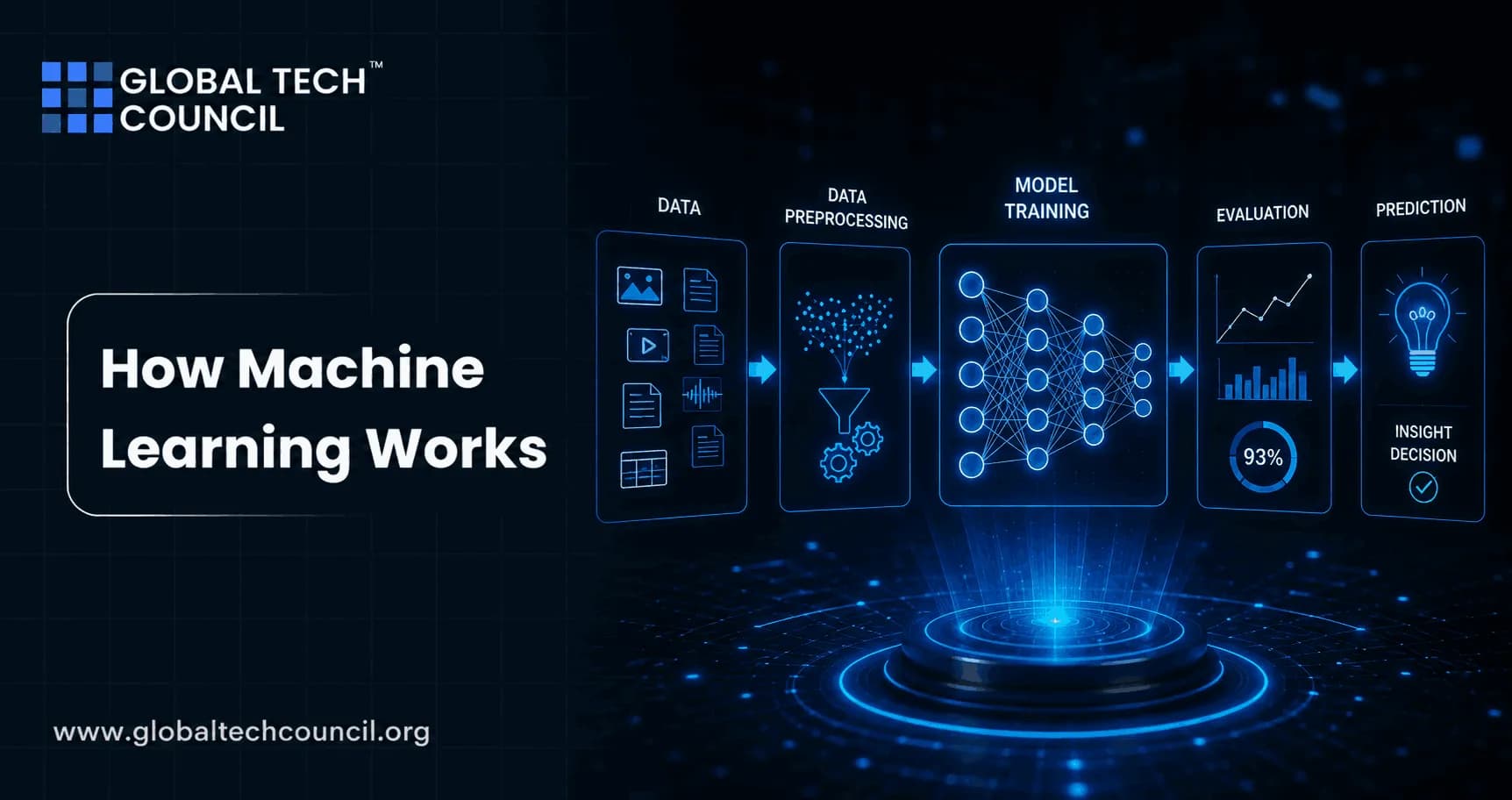
How machine learning works is simpler than the hype suggests: you define a prediction problem, train a statistical model on examples, test whether it generalizes, then put it into a real workflow where it keeps being monitored. The slogan is easy. The hard part is getting the data, metrics, deployment, and governance right.
Machine learning is no longer a lab-only skill. Recent market studies place the global machine learning market in the tens of billions of US dollars in 2025, with many forecasts expecting annual growth rates above 25 percent through 2030. Exact numbers vary because analysts count cloud AI, software platforms, and services differently. The direction is not in doubt. ML is becoming core infrastructure for finance, healthcare, retail, manufacturing, cybersecurity, and software development.

As machine learning becomes a core capability across industries, professionals need more than theoretical knowledge to build reliable solutions. They must understand data preparation, feature engineering, model evaluation, deployment, and continuous monitoring. A Certified Machine Learning Expert credential provides a structured pathway for developing these practical skills and applying them confidently to real-world machine learning projects.
What Machine Learning Actually Does
Machine learning uses data to estimate patterns that can be applied to new cases. A spam filter learns from past emails. A credit risk model learns from repayment history. A predictive maintenance model learns from vibration, temperature, and fault logs. Once trained, the model produces an output: a class, a score, a forecast, a ranking, or a recommended action.
That output is not magic. It is the result of a model minimizing error on historical examples. Sometimes the model is a simple logistic regression with a few dozen features. Sometimes it is a transformer with billions of parameters. The workflow is still recognizable: data goes in, patterns are learned, predictions come out.
The Machine Learning Lifecycle: Data to Predictions
1. Define the problem before choosing the model
Start with the task. Are you predicting a number, assigning a category, ranking items, finding clusters, or detecting anomalies? This choice shapes everything that follows.
Classification: Predict a label, such as fraud or not fraud.
Regression: Predict a value, such as monthly demand.
Ranking: Order search results, products, or recommendations.
Clustering: Group similar customers or documents.
Anomaly detection: Flag unusual behavior in logs, payments, or sensor streams.
Pick the success metric early. Accuracy is fine for balanced classification, but it can mislead badly in rare-event problems. In fraud detection, a model that predicts no fraud for every transaction may show 99 percent accuracy if fraud is rare. Useless. You usually need precision, recall, F1-score, ROC-AUC, or cost-based metrics.
This is a common certification exam trap too: candidates mix up precision and recall. If your security team cannot afford to miss real attacks, recall matters. If analysts are drowning in false alerts, precision becomes the pain point.
2. Collect and integrate data
ML teams gather data from transaction systems, CRM platforms, IoT sensors, electronic health records, clickstreams, partner APIs, logs, and public datasets. Then comes the less glamorous work: joining tables, fixing timestamps, mapping IDs, and building a consistent schema.
Small mismatch, big damage. I have seen time-series models look excellent in notebooks because the feature table accidentally included a value recorded after the prediction time. That is target leakage. In production, the model collapses because the future is no longer available.
3. Clean data and engineer features
Data preparation often decides whether machine learning works. You handle missing values, remove duplicate records, standardize units, encode categories, and process text or images. Feature engineering turns raw fields into useful signals: ratios, rolling averages, counts over time windows, recency values, or domain-specific indicators.
A practical example: for churn prediction, last login date is weaker than days since last login. The model does not know today unless you tell it. For payments fraud, number of failed attempts in the last 10 minutes may carry more signal than the total lifetime failed attempts.
Also watch library defaults. In scikit-learn, recent versions renamed the OneHotEncoder argument to sparse_output. Old code with sparse=False can fail with TypeError: OneHotEncoder.__init__() got an unexpected keyword argument 'sparse'. That error is not a theory problem. It blocks real training pipelines on upgrade day.
4. Choose a learning approach
Different model families fit different jobs.
Supervised learning: Uses labeled examples. Common algorithms include linear regression, logistic regression, decision trees, random forests, gradient boosting, support vector machines, and neural networks.
Unsupervised learning: Finds structure without labels. Examples include k-means clustering, hierarchical clustering, PCA, t-SNE, autoencoders, and anomaly detection methods.
Semi-supervised and self-supervised learning: Use large unlabeled datasets with limited labels. This pattern is central to modern language and vision models.
Reinforcement learning: Trains an agent through rewards and penalties. It is useful in games, robotics, resource allocation, and some recommendation systems, but it is the wrong first choice for most business prediction problems.
To be blunt, start simple unless you have a reason not to. Gradient boosting with XGBoost, LightGBM, or CatBoost still beats deep learning on many structured business datasets. Transformers are powerful, but they are not automatically better for a 50-column tabular dataset.
5. Train the model
Training is where the model adjusts its parameters to reduce a loss function. A loss function measures how wrong the predictions are. Gradient descent and related optimizers update parameters step by step.
You usually split data into training, validation, and test sets. The training set teaches the model. The validation set guides tuning. The test set gives a final estimate of performance on unseen data. For time-series problems, do not randomly shuffle rows. Use a time-based split so the past predicts the future.
Hyperparameters matter. Learning rate, tree depth, regularization strength, batch size, and dropout can quietly change results. In deep learning, an AdamW learning rate of 0.001 may train cleanly, while 0.01 can turn loss into NaN on the same dataset. Fast failure. Check gradients, normalize inputs, and try a smaller learning rate before blaming the architecture.
6. Evaluate beyond one score
Evaluation should match the use case. For classification, use precision, recall, F1-score, ROC-AUC, and confusion matrices. For regression, use mean absolute error, mean squared error, or root mean squared error. For recommenders, ranking metrics such as NDCG are often more useful than plain accuracy.
Do not skip qualitative review. Look at false positives and false negatives. Check performance across regions, user groups, device types, and time periods. A model can perform well overall while failing a subgroup that matters legally or ethically.
Governance is now part of engineering. The NIST AI Risk Management Framework 1.0, published in January 2023, gives organizations a practical structure for mapping, measuring, managing, and governing AI risk. The EU AI Act entered into force on 1 August 2024 and introduced risk-based obligations for AI systems. If you build high-impact ML systems, documentation is not optional paperwork. It is evidence.
7. Deploy and monitor
Deployment turns a trained model into a service, batch job, embedded application, or workflow component. You may expose predictions through an API, run scoring nightly in a data warehouse, or ship a compact model to an edge device.
Production changes the job. You monitor latency, error rates, input distributions, prediction distributions, drift, fairness indicators, and business outcomes. If customer behavior changes, a once-accurate model can decay. If a sensor is replaced and starts reporting in a different unit, the model may fail silently.
MLOps brings order to this process. It covers dataset versioning, model registries, CI/CD, approval workflows, monitoring, rollback plans, and audit trails. Tools such as MLflow, Kubeflow, Airflow, Docker, Kubernetes, and cloud ML platforms are common in enterprise stacks.
Modern AI initiatives often combine predictive machine learning models with deep learning, automation, and intelligent decision-making systems. A Certified AI & Machine Learning Expert credential helps professionals understand how these technologies work together, enabling them to design scalable AI solutions while maintaining strong technical and operational foundations.
Modern Machine Learning: Deep Learning, Transformers, and AutoML
Deep learning changed machine learning by letting models learn representations directly from raw data. Convolutional neural networks improved image recognition and inspection systems. Sequence models and transformers changed natural language processing, speech, code assistance, and multimodal applications.
Transformers use attention mechanisms to focus on relevant parts of the input. Foundation models are trained on broad datasets and adapted through fine tuning, prompt design, or retrieval augmented generation. For many teams, the job is no longer training a huge model from scratch. You work on data quality, domain adaptation, evaluation, access control, and safe integration.
AutoML can speed up model search and hyperparameter tuning. Use it. Just do not use it blindly. AutoML will not fix a leaked feature, biased labels, a poor metric, or a missing approval process.
Successfully deploying advanced AI systems also requires knowledge of cloud infrastructure, MLOps, distributed computing, automation pipelines, and modern AI architectures. A Deep Tech Certification helps professionals strengthen these technical capabilities, making it easier to build, deploy, and manage machine learning solutions in complex production environments.
Where Machine Learning Is Used
Finance and insurance: Credit scoring, fraud detection, risk models, claims automation, underwriting, and portfolio analytics.
Healthcare: Medical imaging, readmission risk, patient deterioration models, clinical note processing, and drug discovery support.
Retail and e-commerce: Recommendations, churn prediction, inventory forecasting, dynamic pricing, and marketing attribution.
Manufacturing and IoT: Predictive maintenance, visual quality inspection, energy optimization, and supply chain planning.
Cybersecurity: Phishing detection, endpoint anomaly detection, user behavior analytics, and alert prioritization.
Software development: Code completion, test generation, documentation, summarization, and knowledge retrieval.
Skills You Need to Learn Machine Learning Properly
If you want to understand how machine learning works in practice, build skills in four areas:
Python and data handling: pandas, NumPy, SQL, and clean data pipelines.
Modeling: scikit-learn, gradient boosting libraries, PyTorch or TensorFlow, and model evaluation.
MLOps: versioning, deployment, monitoring, containers, APIs, and cloud services.
Responsible AI: bias testing, documentation, privacy, security, and regulatory awareness.
For structured learning, use Global Tech Council resources as your next step: explore the machine learning certification path, data science training, AI certification options, and cybersecurity courses if your ML work touches risk detection or secure deployment. Pick the path based on your role. Developers should prioritize Python, APIs, and MLOps. Analysts should strengthen statistics and feature engineering. Enterprise leaders should focus on governance, evaluation, and operating models.
Next Step: Build a Small ML System End to End
Do not stop at theory. Choose a dataset, define one prediction target, train a baseline model, evaluate it honestly, and deploy it as a small API or batch scoring job. Keep the model simple at first. Add monitoring. Write a one-page model card explaining the data, metric, limits, and retraining plan.
That exercise teaches the real answer to how machine learning works: the model is only one part of the system. The prediction depends on data quality, task design, evaluation discipline, deployment engineering, and governance. If you want a guided route, start with Global Tech Council's machine learning or data science certification pages, then build one project that proves you can move from data to predictions without losing control of the process.
While technical expertise is essential, successful machine learning projects also depend on aligning technology with business strategy, customer needs, and measurable outcomes. A Marketing & Business Certification helps professionals develop this broader perspective, enabling them to connect machine learning initiatives with organizational objectives, operational efficiency, and long-term business growth.
FAQs
1. How does machine learning work?
Machine learning works by training algorithms to recognize patterns in data and use those patterns to make predictions or decisions. Instead of relying solely on manually programmed rules, the model learns from examples and improves its performance through training and evaluation.
2. What role does data play in machine learning?
Data is the foundation of every machine learning system. High-quality, relevant, and representative data allows models to identify meaningful relationships, while incomplete, biased, or inaccurate data can reduce prediction accuracy and reliability.
3. What is the machine learning process?
The typical machine learning workflow includes collecting data, cleaning and preparing it, selecting features, choosing an algorithm, training the model, validating its performance, testing with unseen data, deploying the model, and continuously monitoring and updating it as new data becomes available.
4. What is data preprocessing?
Data preprocessing is the process of preparing raw data before model training. Common preprocessing tasks include removing duplicates, handling missing values, correcting inconsistencies, encoding categorical variables, scaling numerical values, and eliminating obvious errors that could affect model performance.
5. What are features in machine learning?
Features are the measurable characteristics or variables used by a machine learning model to make predictions. For example, when predicting house prices, features might include location, square footage, number of bedrooms, property age, and nearby amenities.
6. What is feature engineering?
Feature engineering involves selecting, transforming, or creating features that help improve model performance. Well-designed features can make patterns easier for algorithms to learn, often resulting in better predictions and improved model efficiency.
7. What is model training?
Model training is the stage where an algorithm analyzes training data to learn patterns and relationships between inputs and outputs. During this process, the model adjusts its internal parameters to minimize prediction errors according to its learning objective.
8. What are training, validation, and test datasets?
Training data is used to teach the model, validation data helps tune model settings and compare alternatives, and test data evaluates final performance using previously unseen examples. Separating these datasets helps measure how well the model generalizes beyond its training data.
9. What is a machine learning algorithm?
A machine learning algorithm is the mathematical procedure that enables a model to learn from data. Different algorithms are designed for different tasks, including classification, regression, clustering, recommendation systems, and anomaly detection.
10. How does a model make predictions?
After training, the model receives new input data and applies the patterns it has learned to generate predictions, classifications, recommendations, or probability estimates. The quality of these predictions depends on the training process, available data, and the suitability of the chosen algorithm.
11. What is model evaluation?
Model evaluation measures how accurately a machine learning model performs on unseen data. Depending on the problem, common evaluation metrics include accuracy, precision, recall, F1 score, mean absolute error (MAE), root mean squared error (RMSE), and area under the ROC curve (AUC).
12. What is overfitting and underfitting?
Overfitting occurs when a model memorizes training data instead of learning general patterns, causing poor performance on new data. Underfitting happens when a model is too simple to capture meaningful relationships, resulting in weak performance on both training and unseen datasets.
13. What is model deployment?
Model deployment is the process of integrating a trained machine learning model into a production environment where it can generate predictions for real users or business applications. Deployment often includes monitoring, logging, version management, and performance tracking.
14. Why do machine learning models need monitoring?
Real-world data changes over time, which can reduce model accuracy through a phenomenon known as model drift. Continuous monitoring helps detect declining performance, identify unexpected behavior, and determine when retraining or updates are needed.
15. What are common challenges in machine learning?
Common challenges include poor data quality, limited training data, biased datasets, privacy concerns, computational costs, model interpretability, feature selection, changing business requirements, and maintaining reliable performance after deployment.
16. How does artificial intelligence relate to machine learning predictions?
Machine learning is one of the primary technologies used to build AI systems that make predictions and support decision-making. AI applications often combine machine learning with other techniques such as natural language processing, computer vision, reasoning systems, and optimization algorithms.
17. What trends are shaping machine learning in 2025-2026?
Key trends include generative AI, multimodal machine learning, automated machine learning (AutoML), explainable AI, federated learning, synthetic data generation, edge AI, privacy-enhancing technologies, energy-efficient model design, and increased enterprise adoption of AI-powered workflows.
18. What are best practices for building accurate machine learning models?
Best practices include collecting high-quality data, defining clear objectives, selecting appropriate algorithms, performing careful feature engineering, validating models thoroughly, monitoring production performance, documenting experiments, reducing bias, and retraining models when data or business conditions change.
19. What should beginners understand about machine learning predictions?
Beginners should recognize that machine learning predictions are statistical estimates rather than guarantees. Even well-trained models can make incorrect predictions when presented with unfamiliar, incomplete, or rapidly changing data, making regular evaluation and human oversight important in many applications.
20. What is the future of machine learning prediction systems?
Machine learning prediction systems are expected to become more accurate, efficient, and widely integrated across industries such as healthcare, finance, manufacturing, retail, transportation, and scientific research. Advances in computing power, responsible AI practices, and improved model architectures will likely support better real-time decision-making while increasing emphasis on transparency, fairness, and security. Computers are becoming remarkably skilled at finding patterns, but they still depend on humans to ask sensible questions instead of simply throwing more data at the problem.
Related Articles
View All
Machine Learning
Machine Learning for Predictive Analytics: Turning Data into Forecasts
Learn how machine learning for predictive analytics turns historical and real-time data into forecasts for finance, healthcare, retail, IoT, and operations.

Machine Learning
Data Preprocessing for Machine Learning: Cleaning, Scaling, and Transforming Data
Learn how data preprocessing for machine learning improves model accuracy, reliability, and governance through cleaning, scaling, encoding, and transformation.

Machine Learning
Machine Learning vs Data Science: Roles, Skills, and Career Paths
Compare machine learning vs data science across responsibilities, skills, tools, career paths, and certifications so you can choose the right AI career track.
Trending Articles
The Role of Blockchain in Ethical AI Development
How blockchain technology is being used to promote transparency and accountability in artificial intelligence systems.
AWS Career Roadmap
A step-by-step guide to building a successful career in Amazon Web Services cloud computing.
Top 5 DeFi Platforms
Explore the leading decentralized finance platforms and what makes each one unique in the evolving DeFi landscape.