

Hyperparameter Tuning in Machine Learning: Methods, Tools, and Best Practices
 Suyash Raizada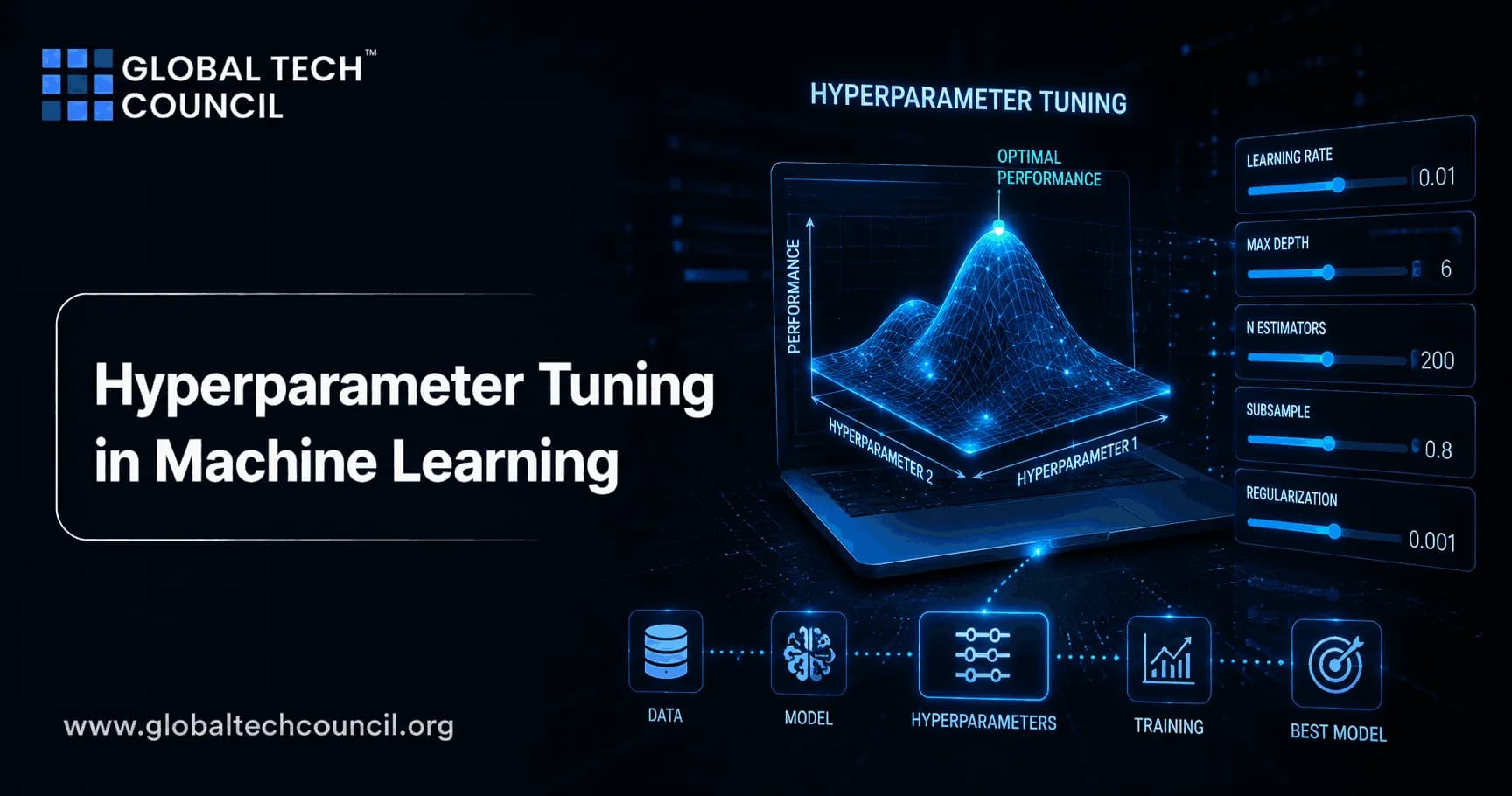
Hyperparameter tuning in machine learning is the work of choosing the settings a model does not learn by itself: learning rate, tree depth, regularization strength, batch size, kernel parameters, architecture choices, and more. Get these wrong and a good model can look broken. Get them right and you often gain better validation scores, steadier training, and fewer unpleasant surprises after deployment.
To be blunt, default settings are starting points, not strategy. Scikit-learn, XGBoost, PyTorch, TensorFlow, Optuna, Hyperopt, and Ray Tune all make tuning easier, but they do not replace judgment. You still need clean data splits, the right metric, sensible search ranges, and disciplined experiment tracking.

Building reliable machine learning models requires more than selecting an algorithm. Understanding evaluation, optimization, validation, and model improvement techniques is equally important. A Certified Machine Learning Expert credential helps professionals develop these practical skills, providing a strong foundation for applying hyperparameter tuning effectively in real-world machine learning projects.
What Hyperparameters Actually Control
Hyperparameters shape the learning process before training begins. They can control model capacity, regularization, optimization behavior, feature sampling, and architecture. Parameters, by contrast, are learned from data, such as coefficients in logistic regression or weights in a neural network.
Common examples include:
Learning rate: Often the most sensitive value in neural networks and gradient boosting.
Regularization strength: Controls overfitting in models such as logistic regression, support vector machines, and neural networks.
Tree depth and number of estimators: Central to random forests, XGBoost, LightGBM, and similar models.
Batch size: Changes training speed, memory use, and sometimes final accuracy.
Kernel and gamma: Critical in support vector machines with RBF kernels.
A small practitioner detail: in PyTorch training, a learning rate that is just 10 times too high can move you from steady convergence to RuntimeError: Function 'LogSoftmaxBackward0' returned nan values in its 0th output when anomaly detection is enabled. The model architecture may be fine. The learning rate is not.
As machine learning models move into production, tuning becomes part of a broader lifecycle that includes experiment tracking, reproducibility, deployment, and continuous monitoring. A Certified MLOps Expert credential helps professionals develop these operational skills, enabling them to manage optimized models efficiently across enterprise environments.
Main Methods for Hyperparameter Tuning
Manual Search
Manual search still has a place. If you know the model family well, you can test a few meaningful values quickly. For example, when tuning logistic regression, trying C values such as 0.01, 0.1, 1, and 10 is often enough to see whether regularization matters.
The downside is obvious. Manual tuning depends on your experience, and it is easy to miss interactions between parameters. Use it for first passes, not final evidence.
Grid Search
Grid search tests every combination in a predefined grid. In scikit-learn, GridSearchCV remains common because it is transparent and easy to explain to a team.
Grid search works well when the search space is small. It becomes wasteful fast. Five hyperparameters with six possible values each means 7,776 model fits before cross validation. If only one or two values matter, much of that compute is burned on weak combinations.
Random Search
Random search samples from distributions instead of testing every grid point. Bergstra and Bengio's 2012 work showed why random search is often more efficient than grid search when only a subset of hyperparameters strongly affects performance.
Use random search when you do not yet know which parameters matter. It is simple, parallel-friendly, and surprisingly hard to beat for early experimentation.
Bayesian Optimization
Bayesian optimization treats validation performance as an expensive black-box function. It builds a surrogate model from previous trials, then chooses the next configuration using an acquisition function that balances exploration with likely improvement.
Gaussian processes, random forests, and tree-based estimators can serve as surrogates. In practice, tools such as Optuna, Hyperopt, and scikit-optimize often use variants that work well with mixed search spaces.
Choose Bayesian optimization when each model run is expensive. If one training job takes three hours on an NVIDIA A100 GPU, you do not want to waste 200 trials guessing blindly.
Tree-structured Parzen Estimator
The Tree-structured Parzen Estimator, usually called TPE, models good and poor configurations separately, then samples values expected to improve results. Hyperopt popularized TPE, and Optuna uses it as a default sampler for many workflows.
TPE is practical when search spaces are conditional. For example, if optimizer = Adam, you may tune beta values. If optimizer = SGD, momentum becomes relevant instead.
Hyperband and Successive Halving
Hyperband, introduced by Li and colleagues in 2017, is a resource-aware method. It evaluates many configurations with small budgets, then stops poor performers early and gives more epochs, data, or iterations to stronger candidates.
This is useful for deep learning and boosting workloads where bad settings reveal themselves early. Scikit-learn includes HalvingGridSearchCV and HalvingRandomSearchCV as experimental search options, while Ray Tune and Optuna support pruning strategies for early stopping.
Evolutionary and Genetic Methods
Evolutionary algorithms keep a population of candidate configurations and update them through mutation, crossover, and selection. They work well when the search space is irregular or highly parallel compute is available.
They are not my first pick for small tabular projects. Random search or Bayesian optimization will usually get you there with less complexity. But for architecture search, simulation-heavy workloads, or high performance computing clusters, population methods can be a good fit.
Popular Tools for Hyperparameter Optimization
Scikit-learn
For classical machine learning, start with scikit-learn. GridSearchCV and RandomizedSearchCV integrate cleanly with pipelines and cross validation.
from scipy.stats import loguniform
from sklearn.datasets import load_breast_cancer
from sklearn.model_selection import RandomizedSearchCV, StratifiedKFold
from sklearn.svm import SVC

X, y = load_breast_cancer(return_X_y=True)

search = RandomizedSearchCV(
    estimator=SVC(kernel="rbf"),
    param_distributions={
        "C": loguniform(1e-2, 1e3),
        "gamma": loguniform(1e-4, 1e0)
    },
    n_iter=30,
    scoring="roc_auc",
    cv=StratifiedKFold(n_splits=5, shuffle=True, random_state=42),
    random_state=42,
    n_jobs=-1
)

search.fit(X, y)
print(search.best_params_)
print(search.best_score_)
Notice the log-uniform distributions. That matters. Hyperparameters such as C, gamma, learning rate, and regularization strength should often be searched on a logarithmic scale, not a linear one.
Optuna
Optuna is a strong default for Python teams. It supports TPE, pruning, relational storage, study resumes, and clean integration with PyTorch, TensorFlow, XGBoost, LightGBM, and scikit-learn. Its trial API is simple enough for production code reviews.
Hyperopt
Hyperopt is older but still useful, especially for TPE-based search. Some teams keep it because existing tuning jobs and ML pipelines already depend on it.
Ray Tune
Ray Tune fits distributed workloads. If you need parallel trials across multiple nodes, schedulers such as ASHA, and integrations with training frameworks, Ray Tune is worth considering. It is heavier than Optuna for a laptop experiment, but better suited to cluster-scale tuning.
AutoML Platforms
AutoML systems combine model selection, feature preprocessing, and hyperparameter tuning. They are useful for baseline generation and enterprise workflows such as churn prediction, demand forecasting, and fraud detection. Do not treat them as autopilot. Inspect the selected features, validation setup, runtime cost, and failure modes.
Optimizing machine learning models at scale also depends on expertise in cloud computing, distributed systems, software engineering, and infrastructure automation. A Deep Tech Certification helps professionals strengthen these advanced technical capabilities, making it easier to implement scalable model training, optimization, and deployment workflows.
Best Practices for Hyperparameter Tuning
1. Choose the Right Metric First
Do not optimize accuracy if your business problem needs recall, F1, ROC AUC, precision at k, or log loss. For fraud detection, a 99 percent accuracy score can be meaningless if fraud is rare. Your metric should match the decision the model supports.
2. Keep a True Test Set Untouched
Tuning repeatedly on the same validation set can overfit the validation data. Use cross validation inside the tuning loop where appropriate, then evaluate the final selected model once on a separate test set.
3. Start Wide, Then Narrow
Begin with random search over broad plausible ranges. After you identify useful regions, narrow the ranges and run Bayesian optimization or a focused random search. Dense grid search too early is usually a poor use of compute.
4. Search Log Scales for Scale-sensitive Values
Learning rates, weight decay, SVM C, gamma, and regularization constants often differ by orders of magnitude. Try values such as 1e-4, 1e-3, 1e-2, and 1e-1 before arguing about 0.031 versus 0.033.
5. Fix Seeds, but Do Not Worship Them
Set random seeds for repeatability. Then test the final configuration across several seeds if the model is stochastic. A single lucky seed is not a reliable model selection process.
6. Track Every Trial
Record hyperparameters, dataset version, code version, random seed, metric, runtime, hardware, and failures. MLflow, Weights & Biases, Neptune, Optuna dashboards, and even a clean database table can work. The tool matters less than consistency.
7. Watch for Library Defaults
Defaults change. In scikit-learn 1.1, for example, RandomForestClassifier moved away from the old max_features="auto" behavior toward "sqrt" as the default. Pin versions in production and record them with your experiments.
Which Method Should You Use?
Small search space: Use grid search if you need a simple, explainable sweep.
Unknown parameter importance: Use random search first.
Expensive model runs: Use Bayesian optimization or TPE.
Deep learning with early signals: Use Hyperband, ASHA, or pruning.
Large parallel compute: Consider evolutionary or population-based methods.
Fast baseline needed: Try AutoML, then review the pipeline manually.
Hyperparameter Tuning Skills for Professional ML Teams
For developers and data professionals, hyperparameter tuning is no longer an optional add-on. It sits beside feature engineering, model evaluation, experiment tracking, and deployment monitoring. If you are building this skill path, connect it with structured learning in machine learning, data science, Python, and MLOps.
On Global Tech Council, this article pairs well with training such as the Certified Machine Learning Expert™ and Certified Artificial Intelligence (AI) Expert™, along with data science and Python programming courses. If your goal is applied ML work, prioritize hands-on tuning with scikit-learn and Optuna before moving into distributed systems.
Next Step
Pick one model you already use and run a 30-trial random search with clean cross validation, log-scaled ranges, and full experiment tracking. Then repeat the same task with Optuna TPE. Compare validation score, test score, runtime, and parameter importance. That exercise will teach you more about hyperparameter tuning in machine learning than another theoretical checklist.
While technical optimization improves model performance, understanding business priorities ensures those improvements translate into measurable outcomes. A Marketing & Business Certification helps professionals develop business-focused skills that support better communication with stakeholders and stronger alignment between machine learning initiatives and organizational goals.
FAQs
1. What is hyperparameter tuning in machine learning?
Hyperparameter tuning is the process of selecting the optimal configuration values that control how a machine learning algorithm learns from data. Unlike model parameters, which are learned during training, hyperparameters are defined before training begins and can significantly influence model performance, training time, and generalization.
2. Why is hyperparameter tuning important?
Proper hyperparameter tuning can improve prediction accuracy, reduce overfitting or underfitting, enhance model stability, and optimize computational efficiency. Well-tuned models are more likely to generalize effectively to unseen data than models using default settings.
3. What is the difference between parameters and hyperparameters?
Parameters are values that a machine learning model learns automatically during training, such as the weights in a neural network or the coefficients in linear regression. Hyperparameters are configuration settings chosen by developers before training, such as learning rate, tree depth, batch size, or the number of estimators.
4. Which machine learning algorithms require hyperparameter tuning?
Many supervised and unsupervised learning algorithms benefit from hyperparameter tuning, including decision trees, random forests, gradient boosting models, support vector machines (SVMs), k-nearest neighbors (KNN), XGBoost, LightGBM, CatBoost, neural networks, and clustering algorithms.
5. What are common hyperparameters in machine learning?
Common hyperparameters include learning rate, maximum tree depth, number of trees, batch size, number of epochs, regularization strength, dropout rate, kernel type, hidden layer size, optimizer selection, and the number of nearest neighbors, depending on the algorithm being used.
6. What is Grid Search?
Grid Search is a systematic tuning method that evaluates every possible combination of predefined hyperparameter values. While it is simple to understand and implement, it can become computationally expensive when the search space is large.
7. What is Random Search?
Random Search selects random combinations of hyperparameters from a defined search space instead of evaluating every possibility. It often finds strong-performing configurations more efficiently than Grid Search, especially when only a few hyperparameters have a major impact on performance.
8. What is Bayesian Optimization?
Bayesian Optimization uses the results of previous evaluations to intelligently select promising hyperparameter combinations. This approach can reduce the number of required training runs while efficiently exploring complex search spaces, making it suitable for computationally expensive models.
9. What is Hyperband?
Hyperband is a resource-efficient hyperparameter optimization algorithm that evaluates many candidate models while allocating computational resources dynamically. Poor-performing configurations are stopped early, allowing more resources to be devoted to stronger candidates.
10. What is Optuna?
Optuna is an open-source hyperparameter optimization framework that automates the search for effective model configurations. It supports efficient optimization techniques, pruning of unpromising trials, and integration with popular machine learning and deep learning libraries.
11. What is cross-validation in hyperparameter tuning?
Cross-validation evaluates model performance across multiple training and validation splits instead of relying on a single dataset partition. Combining cross-validation with hyperparameter tuning provides a more reliable estimate of how well a model is likely to perform on unseen data.
12. Which tools support hyperparameter tuning?
Popular tools include Scikit-learn's GridSearchCV and RandomizedSearchCV, Optuna, Ray Tune, Hyperopt, Keras Tuner, TensorFlow Tuner, Weights & Biases Sweeps, MLflow integrations, and cloud-based machine learning platforms that provide automated optimization capabilities.
13. How do you define a hyperparameter search space?
A search space specifies the hyperparameters to optimize along with their possible values or ranges. Well-designed search spaces are based on algorithm characteristics, domain knowledge, computational resources, and practical constraints rather than testing arbitrary combinations.
14. What challenges are associated with hyperparameter tuning?
Challenges include long training times, high computational costs, selecting appropriate evaluation metrics, avoiding overfitting to validation data, designing effective search spaces, balancing exploration and exploitation, and managing experiments across multiple models.
15. How does hyperparameter tuning help prevent overfitting?
Hyperparameter tuning can identify model configurations that balance learning capacity and generalization. Parameters controlling regularization, tree complexity, dropout, early stopping, and learning rate can reduce the risk of fitting noise rather than meaningful patterns in the training data.
16. What role does automation play in hyperparameter tuning?
Automation reduces manual experimentation by systematically exploring candidate configurations and recording results. Automated workflows improve reproducibility, accelerate experimentation, and allow practitioners to compare models more efficiently while minimizing human error.
17. What are best practices for hyperparameter tuning?
Best practices include starting with baseline models, using cross-validation, selecting meaningful evaluation metrics, narrowing the search space with domain knowledge, tracking experiments, applying early stopping where appropriate, documenting results, and validating final models on independent test datasets.
18. How does hyperparameter tuning fit into MLOps?
Within MLOps, hyperparameter tuning is integrated into automated training pipelines, experiment tracking, model versioning, and continuous evaluation workflows. This helps ensure that optimized models can be reproduced, monitored, governed, and redeployed consistently across development and production environments.
19. What trends are shaping hyperparameter tuning in 2025-2026?
Emerging trends include AI-assisted optimization, AutoML platforms, distributed hyperparameter searches, multi-objective optimization, hardware-aware tuning, efficient optimization for foundation models, cloud-native experiment management, and tighter integration with LLMOps and enterprise AI platforms.
20. What is the future of hyperparameter tuning in machine learning?
Hyperparameter tuning is expected to become increasingly automated and intelligent as machine learning platforms evolve. Future systems will likely combine adaptive optimization algorithms, automated experiment tracking, scalable cloud infrastructure, and governance capabilities to improve both model quality and operational efficiency. Even so, experienced practitioners will still need to define sensible objectives and constraints because no optimization algorithm can rescue a search space that resembles a random shopping list.
Related Articles
View All
Machine Learning
Machine Learning Tools and Technologies
Machine Learning (ML) has emerged as one of the most transformative technologies in recent years, enabling automation, data-driven decision-making, and predictive analytics across various industries. From finance to healthcare, businesses leverage ML tools to gain insights, optimize…

Machine Learning
Top 10 Machine Learning Model Monitoring Tools of 2021
Machine learning is becoming more critical and necessary technology day by day. It helps the machines to learn things and grow their intelligence capability. Many fields like artificial intelligence, data science, automation use the technology of ML. The scope and spread of machine learning are…

Machine Learning
The Future of Machine Learning: Trends, Opportunities, and Challenges
Explore the future of machine learning, including foundation models, edge ML, AutoML, MLOps, governance, market growth, and career opportunities.
Trending Articles
The Role of Blockchain in Ethical AI Development
How blockchain technology is being used to promote transparency and accountability in artificial intelligence systems.
AWS Career Roadmap
A step-by-step guide to building a successful career in Amazon Web Services cloud computing.
Top 5 DeFi Platforms
Explore the leading decentralized finance platforms and what makes each one unique in the evolving DeFi landscape.