

Machine Learning Career Roadmap: Skills, Roles, and Learning Path for 2026
 Suyash Raizada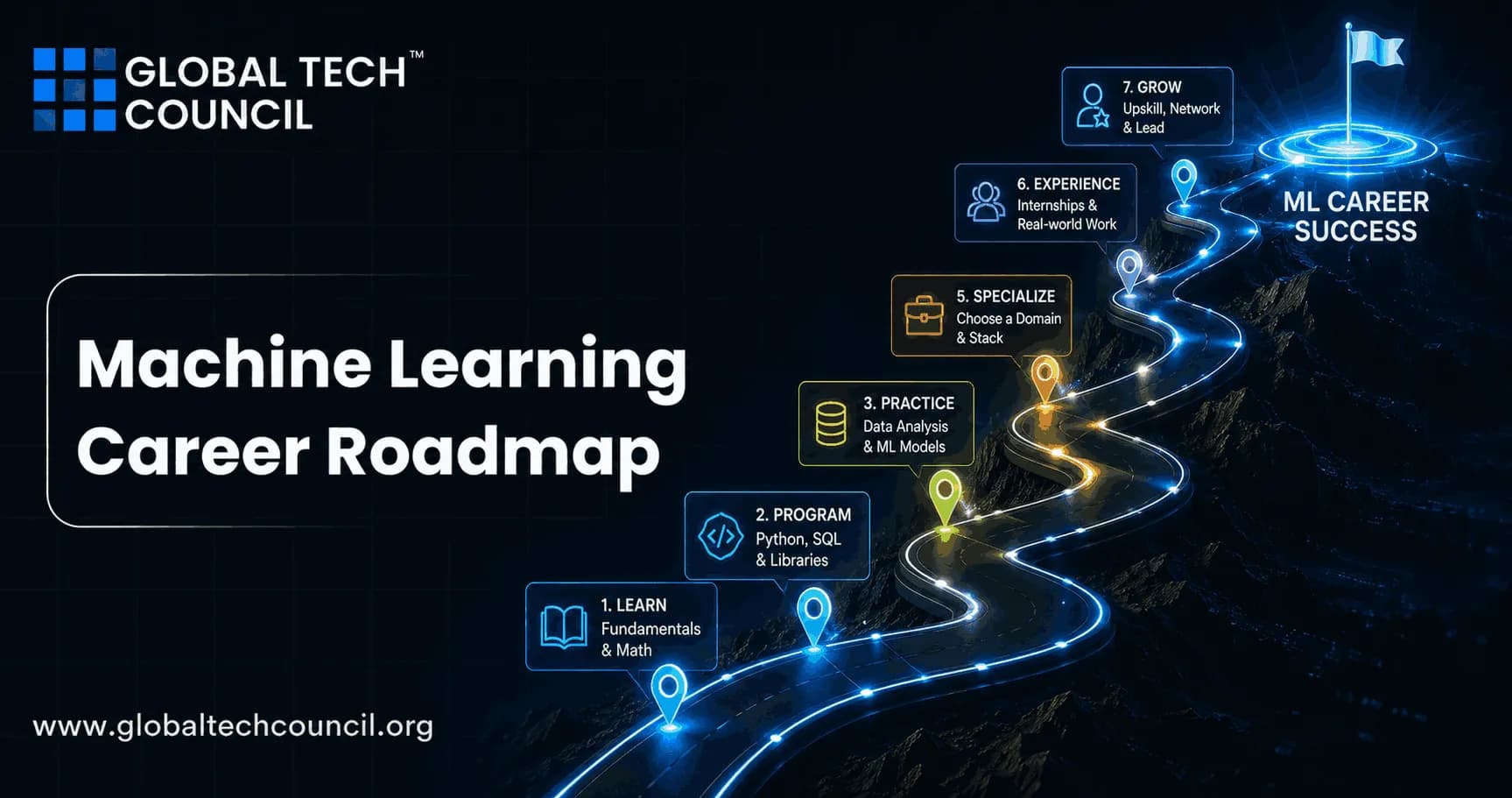
Machine learning career roadmap planning should start with a blunt fact: machine learning engineer is usually not a true entry-level job. Most hiring teams expect you to bring software engineering, data analysis, or data engineering experience before you take ownership of models in production. That does not mean you need a PhD. It does mean your path needs structure, projects, and proof that your models work outside a notebook.
The U.S. Bureau of Labor Statistics projects 26 percent employment growth for computer and information research scientists from 2023 to 2033, much faster than the average for all occupations. AI hiring is not limited to research labs either. Banks, hospitals, manufacturers, SaaS teams, retailers, and public-sector organizations now need people who can build, evaluate, deploy, and monitor ML systems.

As organizations expand their AI initiatives, professionals need a strong foundation in machine learning concepts, model evaluation, feature engineering, and deployment practices. A Certified Machine Learning Expert credential helps build these practical skills, making it easier to progress from learning algorithms to delivering production-ready machine learning solutions.
What a Machine Learning Career Looks Like in 2024-2026
Machine learning careers now sit at the intersection of data, code, infrastructure, and applied AI. In 2018, a strong Kaggle profile and a few scikit-learn projects could get serious attention. Today, that is rarely enough. You need to show that you can ship.
A realistic machine learning career roadmap usually takes one to three years for someone with a technical background. If you already code daily, know SQL, and can study full time, an 8-12 month intensive path is possible. For most working professionals, plan for a staged transition.
Hiring teams increasingly test for end-to-end ability:
Clean and prepare messy data
Train classical ML and deep learning models
Choose the right metric for the business problem
Deploy a model through an API, often with FastAPI or Flask
Use Docker, CI/CD, and cloud services
Work with large language models, retrieval-augmented generation, and model evaluation
Monitor drift, latency, cost, and failure modes after release
That last part matters. A model with 94 percent accuracy in a notebook can still be useless if inference takes 4 seconds per request or if a small schema change breaks the pipeline on Monday morning.
Core Machine Learning Roles
Machine Learning Engineer
A machine learning engineer builds models and turns them into working software. You will train models, write production code, create data pipelines, expose predictions through APIs, test behavior, and work with DevOps or platform teams.
This role fits you if you like both modeling and engineering. You should be comfortable with Python, Git, testing, SQL, REST APIs, and at least one cloud platform. Many roles ask for 2-5 years of prior software, data, or applied ML experience.
Data Scientist or Applied ML Practitioner
Data scientists focus more on analysis, experimentation, statistics, and communication. You might build churn models, forecast demand, test pricing changes, or explain customer behavior to product teams.
This is a practical entry point for many people. If you are moving from analytics to machine learning, strengthen your statistics, model evaluation, feature engineering, and storytelling. Then add deployment skills.
AI Engineer and LLM Application Developer
AI engineers build applications using foundation models such as GPT-family models, Claude, Gemini, Llama, or Mistral. The work often includes prompt design, tool calling, RAG pipelines, vector databases, fine-tuning, and evaluation.
Do not treat LLM work as just prompting. A good AI engineer understands retrieval quality, hallucination risk, chunking strategy, embeddings, latency, token cost, and security. In RAG systems, chunk size can quietly change answer quality. I have seen a 1,000-token chunk work well for legal policy search and fail badly for short FAQ retrieval, where 250-400 tokens gave cleaner matches.
MLOps Engineer or ML Platform Engineer
MLOps engineers keep the ML lifecycle under control. They manage experiment tracking, model registries, deployment pipelines, feature stores, monitoring, and infrastructure.
This path is right for you if Kubernetes, Docker, Terraform, MLflow, DVC, Airflow, and cloud services sound more interesting than tuning neural network layers. It is also one of the most practical specializations for enterprises, because failed ML projects usually fail at integration, not at algorithm selection.
As enterprises move more AI models into production, operational expertise has become a critical differentiator. A Certified MLOps Expert credential helps professionals develop skills in experiment tracking, model versioning, deployment automation, monitoring, CI/CD pipelines, and lifecycle management, enabling them to build reliable and scalable machine learning systems.
Research Scientist and ML Architect
Research scientists design new methods or improve existing model architectures. ML architects design large-scale AI systems, choose platforms, set governance patterns, and guide engineering teams.
These roles often require advanced degrees or a strong publication and systems record. If your goal is original research in deep learning, a master's degree or PhD is still the cleaner route.
Technical Skills You Need
Python and Software Engineering
Python remains the default language for machine learning because of NumPy, Pandas, scikit-learn, PyTorch, TensorFlow, XGBoost, Matplotlib, and the Hugging Face ecosystem. Learn Python properly, not just notebook snippets.
Focus on:
Functions, classes, modules, packaging, and virtual environments
Git workflows, pull requests, and code review
Unit tests with pytest
API development with FastAPI
Basic system design and logging
Data validation with tools such as Pydantic
A small practitioner detail: if you train a PyTorch classifier with nn.CrossEntropyLoss and pass float labels, you will hit RuntimeError: expected scalar type Long but found Float. Beginners often waste an hour changing the model when the fix is simply making the target tensor class indices of type torch.long. These small mistakes teach more than another passive video lesson.
Math, Statistics, and ML Foundations
You do not need to become a pure mathematician, but you do need working knowledge of linear algebra, calculus, probability, and statistics. You should understand gradients, distributions, variance, regularization, confidence intervals, and the bias-variance tradeoff.
Then study core algorithms:
Linear and logistic regression
Decision trees and random forests
Gradient boosting with XGBoost or LightGBM
Support vector machines
K-means and clustering methods
Principal component analysis
Recommendation and ranking basics
Learn metrics early. Accuracy is the wrong metric for many imbalanced problems. For fraud detection, precision, recall, F1, ROC-AUC, PR-AUC, and business cost often matter more.
Data Handling and SQL
Most ML work starts with imperfect data. You need Pandas, NumPy, SQL, missing value handling, categorical encoding, joins, date features, and data quality checks.
Watch library versions. In scikit-learn 1.2, OneHotEncoder introduced sparse_output and deprecated the older sparse parameter. That kind of change can break old tutorials and older production code. Read release notes. Seriously.
Deep Learning and Generative AI
Move into deep learning after you can build strong classical ML baselines. PyTorch is the better first deep learning framework for most engineers because its debugging style feels closer to normal Python. TensorFlow is still widely used in enterprise and mobile pipelines.
Cover CNNs for images, transformers for text, embeddings, transfer learning, fine-tuning, and model evaluation. For LLM work, build at least one RAG application using a vector database such as FAISS, Milvus, Pinecone, Weaviate, or PostgreSQL with pgvector. Add evaluation. A chatbot demo without evaluation is not a portfolio project.
MLOps, Cloud, and Deployment
Production ML needs repeatability. Learn Docker, FastAPI, MLflow, DVC, GitHub Actions, Kubernetes basics, and one cloud provider such as AWS, Google Cloud, or Microsoft Azure.
At minimum, you should be able to:
Train a model from a clean script, not only a notebook
Track experiments and parameters
Save and version model artifacts
Serve predictions through an API
Containerize the service
Log predictions and monitor model drift
If you are planning enterprise AI work, add security and governance. NIST released the AI Risk Management Framework 1.0 in 2023, and the EU AI Act entered into force in 2024. Responsible AI is now part of real ML delivery, not a side topic.
Beyond machine learning, many enterprise projects require knowledge of cloud platforms, distributed systems, cybersecurity, automation, and modern software infrastructure. A Deep Tech Certification helps professionals strengthen these advanced technical capabilities, preparing them to design and manage scalable technology solutions across multiple domains.
A Practical Machine Learning Learning Path
Stage 1: Build Foundations, Months 0-3
Learn Python, Git, SQL, statistics, and basic linear algebra. Do small exercises daily. Avoid jumping into transformers before you can explain train-test leakage.
Stage 2: Build Classical ML Projects, Months 3-6
Use scikit-learn and XGBoost on tabular datasets. Build projects such as churn prediction, loan default risk, price prediction, or customer segmentation. Write a short technical report for each project. Include metric choice, feature decisions, and failure cases.
Stage 3: Add Deep Learning, Months 6-10
Build an image classifier with transfer learning, a text classification model with Hugging Face Transformers, and a time-series forecasting project. Compare deep learning with simpler baselines. Sometimes logistic regression wins. Accept that.
Stage 4: Deploy and Monitor, Months 10-14
Turn one model into a service. Use FastAPI, Docker, MLflow, and a cloud deployment target. Add basic tests and logging. This is where your portfolio starts to look job-ready.
Stage 5: Specialize, Months 14-24
Pick one lane:
ML engineering: production systems, APIs, pipelines, model monitoring
MLOps: infrastructure, CI/CD, Kubernetes, MLflow, cloud automation
AI engineering: LLM apps, RAG, agents, evaluation, inference cost control
Data science: experimentation, statistics, business modeling, stakeholder communication
Research: papers, math depth, novel architectures, advanced optimization
Portfolio Projects That Hiring Managers Actually Read
Three complete projects beat ten shallow notebooks. Make each project easy to inspect.
Tabular ML: fraud, churn, credit scoring, or demand forecasting with proper validation
NLP or LLM: document question answering with RAG, citations, and evaluation
Computer vision: defect detection, medical image classification, or object detection
MLOps project: model API with Docker, MLflow tracking, CI tests, and deployment notes
Use a clean README. Show the architecture, dataset source, metrics, trade-offs, and how to run the project. If it takes 40 minutes to understand your repository, the reviewer will leave.
Education and Certification Strategy
A bachelor's degree in computer science, statistics, mathematics, engineering, or data science remains common in job descriptions. A master's degree or PhD helps for research scientist and advanced ML roles. Still, practical proof can carry serious weight for engineering-focused roles.
Use certification to structure your learning and validate skills, not as a substitute for projects. For professionals and enterprises, Global Tech Council certification programs can support a staged path across machine learning, AI, data science, Python programming, cloud, and cybersecurity. Pair each certification module with a project that proves the skill in code.
Next Step: Choose Your First 90 Days
If you are new to the field, spend the next 90 days on Python, SQL, statistics, and one classical ML project. If you already code professionally, build a deployed ML API and add MLflow tracking. If you work with enterprise data, learn MLOps and governance early.
Do not chase every new model release. Pick a role, build evidence, and follow a focused machine learning career roadmap. Start with one production-minded project this week, then use a structured Global Tech Council learning path to close the gaps you find while building it.
Building a successful machine learning career also involves understanding how technical solutions support organizational goals and customer outcomes. A Marketing & Business Certification helps professionals develop business and strategic thinking, enabling them to communicate AI initiatives effectively and align machine learning projects with measurable business value.
FAQs
1. What is a machine learning career roadmap?
A machine learning career roadmap is a structured learning and professional development plan that outlines the knowledge, technical skills, tools, projects, and career milestones needed to become a machine learning professional. It helps learners progress from foundational concepts to advanced AI development and production deployment.
2. Why pursue a career in machine learning in 2026?
Machine learning continues to be a key technology supporting automation, predictive analytics, intelligent applications, and generative AI across many industries. As organizations expand AI initiatives, professionals with practical machine learning skills are expected to remain in demand, although hiring needs vary by market and specialization.
3. What educational background is helpful for machine learning?
Many machine learning professionals have backgrounds in computer science, mathematics, statistics, engineering, physics, or related quantitative disciplines. However, practical experience, technical portfolios, certifications, and demonstrated problem-solving skills can also play an important role in career development.
4. What programming languages should you learn first?
Python is the primary programming language for machine learning because of its extensive ecosystem of libraries and frameworks. SQL is also highly valuable for working with data, while familiarity with languages such as R, Java, Scala, or C++ can be beneficial for specialized projects or enterprise environments.
5. Which mathematical concepts are important?
Core mathematical topics include linear algebra, probability, statistics, calculus, optimization, and basic discrete mathematics. Understanding these concepts helps professionals evaluate algorithms, interpret model performance, and troubleshoot machine learning systems more effectively.
6. What machine learning concepts should beginners master?
Beginners should understand supervised learning, unsupervised learning, reinforcement learning, feature engineering, model evaluation, overfitting, underfitting, cross-validation, bias-variance trade-offs, and common algorithms before progressing to more advanced AI topics.
7. Which tools and frameworks should you learn?
Popular tools include NumPy, Pandas, scikit-learn, TensorFlow, PyTorch, Jupyter Notebook, Git, Docker, MLflow, Apache Spark, Kubernetes, and cloud platforms such as AWS, Microsoft Azure, and Google Cloud for scalable machine learning development.
8. How important is data preprocessing?
Data preprocessing is one of the most important stages of a machine learning workflow. Cleaning data, handling missing values, feature selection, feature engineering, normalization, and encoding categorical variables often have a significant impact on overall model performance.
9. What projects should beginners build?
Useful beginner projects include spam detection, house price prediction, customer churn prediction, recommendation systems, sentiment analysis, image classification, sales forecasting, fraud detection, and predictive maintenance. Well-documented projects demonstrate practical skills to employers and collaborators.
10. What are common machine learning job roles?
Common roles include Machine Learning Engineer, Data Scientist, AI Engineer, MLOps Engineer, Data Engineer, Applied Scientist, Research Engineer, Computer Vision Engineer, NLP Engineer, AI Product Manager, and Machine Learning Research Scientist.
11. What technical skills are most valuable?
Important technical skills include Python programming, SQL, statistics, machine learning algorithms, deep learning, cloud computing, software engineering, APIs, MLOps, version control, model deployment, and data pipeline development.
12. What soft skills are important for machine learning professionals?
Strong communication, analytical thinking, collaboration, problem-solving, project management, business understanding, documentation, adaptability, and ethical decision-making are essential for translating technical solutions into real-world business value.
13. How important is MLOps in 2026?
MLOps has become a critical skill for deploying, monitoring, updating, and governing machine learning models in production. Knowledge of CI/CD pipelines, model versioning, monitoring, automation, and cloud infrastructure is increasingly valuable in enterprise AI environments.
14. Should you learn deep learning?
Learning deep learning is beneficial for professionals interested in computer vision, natural language processing, speech recognition, robotics, and generative AI. A strong foundation in traditional machine learning should generally come first before specializing in advanced neural network architectures.
15. How can you build a strong machine learning portfolio?
A competitive portfolio should include diverse projects, well-organized GitHub repositories, clear documentation, reproducible code, data analysis reports, deployed applications where appropriate, and explanations of the business problems solved and the evaluation methods used.
16. What certifications can support a machine learning career?
Professional certifications from universities, cloud providers, and technology organizations can help validate technical knowledge. Certifications are most effective when combined with practical projects, continuous learning, relevant work experience, and contributions to open-source or research initiatives.
17. What trends are shaping machine learning careers in 2026?
Key trends include generative AI, multimodal foundation models, agentic AI, explainable AI, edge AI, AI governance, synthetic data, privacy-preserving machine learning, efficient model architectures, and growing demand for professionals with expertise in responsible AI and MLOps.
18. What mistakes should beginners avoid?
Common mistakes include skipping mathematical fundamentals, relying only on tutorials, neglecting software engineering practices, ignoring data quality, avoiding deployment experience, building repetitive portfolio projects, overlooking AI ethics, and expecting certifications alone to secure employment.
19. What is a recommended learning path for becoming a machine learning professional?
A practical roadmap begins with learning Python, SQL, mathematics, and statistics, followed by data analysis, machine learning fundamentals, model evaluation, and real-world projects. From there, learners can explore deep learning, cloud platforms, MLOps, model deployment, and specialized fields such as computer vision or natural language processing while continuously expanding their portfolio and industry knowledge.
20. What does the future hold for machine learning careers?
Machine learning careers are expected to continue evolving as AI technologies become more integrated into business operations, scientific research, healthcare, finance, manufacturing, and public services. Success will increasingly depend on combining technical expertise with domain knowledge, responsible AI practices, communication skills, and the ability to adapt to rapidly changing tools and frameworks. The roadmap may never truly end, but fortunately, continuous learning is considerably cheaper than continuously replacing your career every few years.
Related Articles
View All
Machine Learning
Machine Learning vs Data Science: Roles, Skills, and Career Paths
Compare machine learning vs data science across responsibilities, skills, tools, career paths, and certifications so you can choose the right AI career track.

Machine Learning
Machine Learning Certifications and Career Paths in 2026: Skills, Roles, and Salary Trends
Explore machine learning certifications and career paths in 2026, including in-demand skills, generative AI roles, and salary trends. Learn how to select certifications that map to real deployment work.
Machine Learning
Top Machine Learning Use Cases Across Industries in 2026
Explore the top machine learning use cases across industries in 2026, from predictive maintenance and fraud detection to healthcare AI and CRM automation.
Trending Articles
The Role of Blockchain in Ethical AI Development
How blockchain technology is being used to promote transparency and accountability in artificial intelligence systems.
AWS Career Roadmap
A step-by-step guide to building a successful career in Amazon Web Services cloud computing.
Top 5 DeFi Platforms
Explore the leading decentralized finance platforms and what makes each one unique in the evolving DeFi landscape.