

Machine Learning Certification Guide: Choose the Right Program
 Suyash Raizada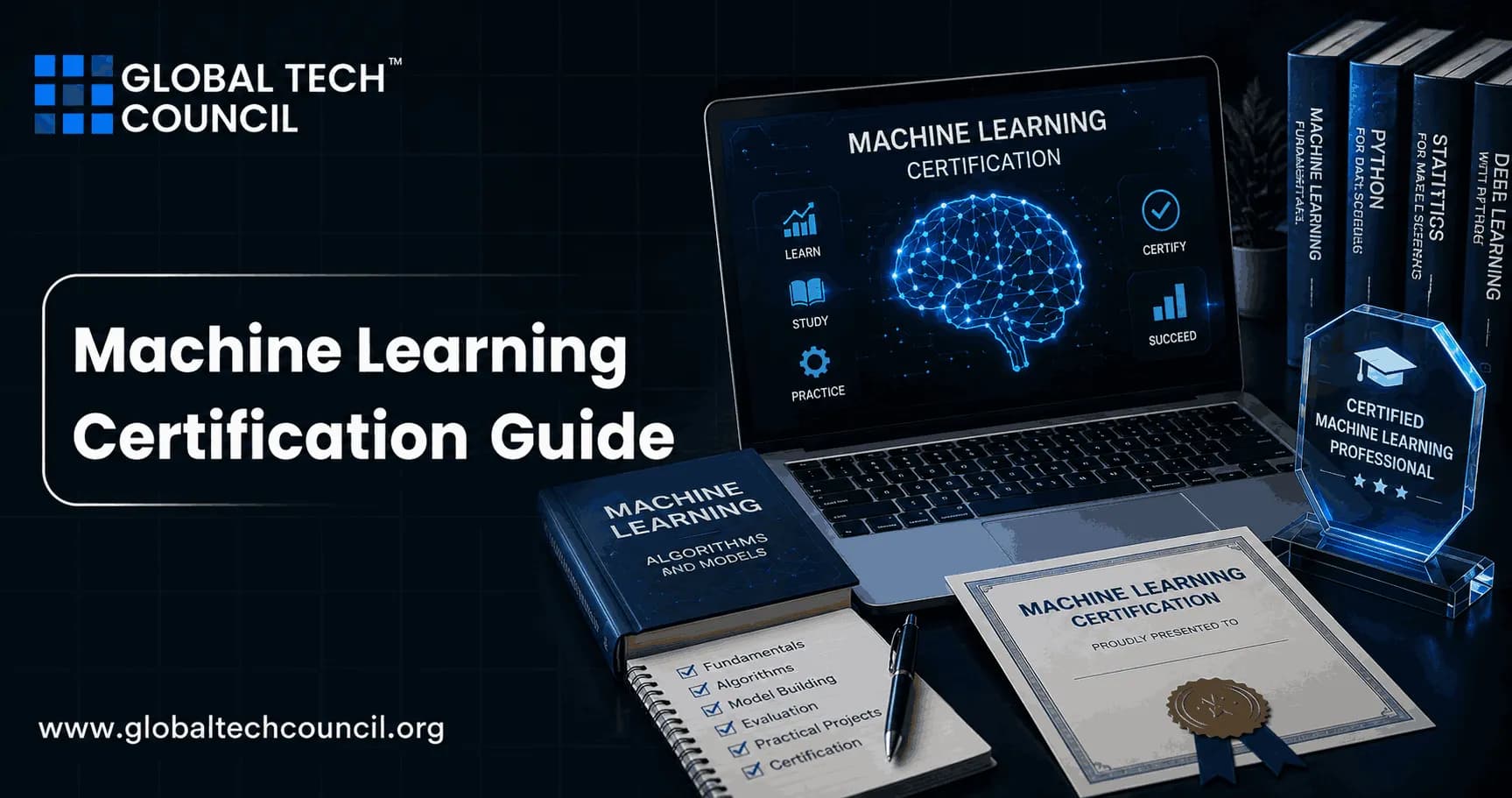
Short answer: use this machine learning certification guide to match the program to the work you want to do, not to the loudest provider name. A good certification should build core ML judgment, give you real projects, and help you prove that you can move a model from notebook to production without breaking the business process around it.
That last part matters. In interviews, people rarely fail because they cannot define gradient descent. They fail when asked how they handled data leakage, model drift, a bad validation split, or a deployment that behaved differently from the training notebook. Choose a program that prepares you for those questions.

Building a successful career in machine learning requires more than understanding algorithms. A Certified Machine Learning Expert credential helps professionals develop practical expertise in model development, evaluation, feature engineering, and deployment, ensuring they are prepared for real-world machine learning projects rather than just theoretical concepts.
What machine learning certifications look like in 2026
The certification market now falls into four practical groups:
Foundational ML programs: best for beginners and analysts moving into data science. They cover regression, classification, clustering, model evaluation, and Python workflows.
Cloud and platform credentials: AWS, Microsoft Azure, Google Cloud, and Databricks certifications validate work on a specific stack.
Advanced specialist tracks: useful for deep learning, MLOps, computer vision, NLP, and large-scale training.
AI strategy certifications: suited to product managers, consultants, and leaders who need to govern AI projects rather than train models daily.
The best path is usually stacked. Start with Python and ML foundations. Add one serious project-heavy program. Then pick a cloud ML or MLOps credential that matches your employer's infrastructure. If your company runs Azure Machine Learning, an AWS credential may still teach useful ideas, but it will not help you as directly on Monday morning.
Start with the role you want
Do not ask, Which certification is best? Ask, Which certification proves the skills for my target role?
If you want to become a machine learning engineer
Choose a machine learning certification program that includes Python, scikit-learn, model evaluation, feature pipelines, APIs, containers, and basic MLOps. You need more than clean notebooks. You need to show that you can version data, reproduce training, and serve predictions safely.
A practical portfolio should include at least three end-to-end projects. For example: a churn model with calibration, a document classifier with error analysis, and a deployed inference API with monitoring. Small is fine. Finished is better than fancy.
As organizations increasingly deploy machine learning models into production, operational skills have become just as important as model-building expertise. A Certified MLOps Expert credential helps professionals develop capabilities in model deployment, CI/CD pipelines, experiment tracking, monitoring, versioning, and lifecycle management, making it easier to maintain reliable machine learning systems at scale.
If you are a software developer adding ML skills
You can move faster than a total beginner because you already understand testing, Git, APIs, and deployment. Spend less time on introductory programming and more time on statistics, model selection, data preprocessing, and cloud ML services.
For this profile, a foundation course plus a cloud ML certification is often the shortest credible route. Treat Microsoft Azure AI-900 as an entry point only. For deeper work, compare role-based options such as Azure Data Scientist Associate DP-100, Google Cloud Professional Machine Learning Engineer, AWS Certified Machine Learning Engineer - Associate, and Databricks Machine Learning credentials.
If you are a data analyst moving into data science
Pick a program with strong feature engineering, SQL, statistics, supervised learning, and business problem framing. Analysts often know the data better than engineers, which is a real advantage. Your gap is usually production practice and model validation.
Pay close attention to how the program teaches metrics. Accuracy is not enough. You should be comfortable with precision, recall, F1 score, ROC AUC, calibration curves, and cost-sensitive evaluation.
If you lead AI projects
You do not need to become the person tuning learning rates at midnight. You do need to understand feasibility, risk, governance, data quality, and vendor claims. Look for AI strategy or AI project management training that covers model risk, responsible AI, security, and the NIST AI Risk Management Framework 1.0.
Global Tech Council readers comparing leadership and technical paths can use the AI, machine learning, data science, cloud, and cybersecurity certification categories as internal comparison points before choosing a single track.
Check your current skill level honestly
Here is the blunt test. If you cannot write a Python function, read a pandas DataFrame, and explain the difference between training and test data, do not jump into an advanced ML engineer exam. You will memorize terms and still struggle when the dataset is messy.
Beginners should build this base first:
Python 3.12 fundamentals, including functions, files, exceptions, and virtual environments.
NumPy, pandas, matplotlib or seaborn, and scikit-learn.
Basic linear algebra, probability, and statistics.
Supervised and unsupervised learning concepts.
Evaluation, cross-validation, and leakage prevention.
One real detail from practice: many learners hit this error when running older notebooks on newer scikit-learn versions: TypeError: OneHotEncoder.__init__() got an unexpected keyword argument 'sparse'. The sparse parameter was deprecated in scikit-learn 1.2 in favor of sparse_output, and it was removed in 1.4, so older course material often breaks. A good certification course updates labs for library changes like this. A weak one leaves you debugging stale notebooks instead of learning ML.
Evaluate the curriculum, not the brochure
A credible machine learning certification should publish clear outcomes. Look for these topics:
Regression, classification, clustering, dimensionality reduction, and anomaly detection.
Train-test splits, cross-validation, bias-variance trade-off, and model selection.
Feature engineering for numerical, categorical, time-based, and text data.
Deep learning basics if the program targets modern AI roles.
Deployment through APIs, batch scoring, or cloud endpoints.
MLOps topics such as experiment tracking, model registry, CI or CD, drift monitoring, and rollback planning.
Ethics, privacy, security, and responsible AI governance.
Reject programs that are mostly video lectures and multiple-choice quizzes. You may get a certificate, but you will not get the judgment needed for real projects. Be wary too of programs promising job-ready ML competency in under 40 hours. That can work for awareness training. It is not enough for engineering work.
Modern AI careers often extend beyond machine learning into cloud computing, distributed systems, automation, cybersecurity, and enterprise infrastructure. A Deep Tech Certification helps professionals strengthen these advanced technical capabilities, enabling them to build scalable, production-ready solutions across a wide range of emerging technologies.
Compare duration, workload, and cost
Serious reskilling takes time. A 4 to 6 week survey course can be useful if you already code well and need orientation. For a career shift, expect 4 to 12 months of steady work at 10 or more hours per week.
Before paying, ask these questions:
Does the fee include training, labs, projects, mentor support, practice tests, and the exam?
Are cloud credits included, or will you pay separately?
Do projects require deployment, or only notebook submission?
Is there code review by a practitioner?
Are prerequisites stated clearly?
Does the certificate expire or require renewal?
Exam-only certifications can be valuable when you already have experience. They are a poor substitute for structured learning if you are new.
Give employer recognition the right weight
Recognition matters, but it is not magic. University-backed programs, major cloud credentials, and well-known industry programs tend to be easier for recruiters to understand. Job descriptions often mention AWS, Azure, Google Cloud, Databricks, PyTorch, TensorFlow, Kubernetes, MLflow, and SQL because those tools appear in production environments.
Still, a certificate logo will not rescue a thin portfolio. Hiring managers want proof. Put your GitHub projects, model cards, evaluation notes, and deployment screenshots next to the credential on your resume. If you cannot explain why your model failed on a subgroup of users, you are not ready.
Portfolio quality beats certificate collecting
Three strong projects beat eight shallow certificates. Build projects that show the whole ML lifecycle:
Problem framing: define the business question and success metric.
Data work: ingest, clean, document, and split data correctly.
Modeling: compare baselines before complex models.
Evaluation: report metrics that match the cost of mistakes.
Deployment: serve predictions through an API or batch job.
Monitoring: track drift, latency, and prediction quality.
Use simple tools first. A scikit-learn pipeline with FastAPI, Docker, GitHub Actions, and MLflow teaches more production thinking than a large neural network that nobody can run twice.
A practical decision framework
Use this machine learning certification guide as a checklist before you enroll:
Write your 2 to 3 year target role in one sentence.
Scan 20 job postings for that role and list repeated skills.
Map your gaps in Python, math, data handling, cloud, and deployment.
Choose the certification type: foundational, cloud-specific, specialist, or leadership.
Check whether the curriculum includes projects, MLOps, and current tools.
Verify workload, cost, prerequisites, renewal rules, and included resources.
Pick the program that helps you build evidence, not just pass an exam.
Where Global Tech Council fits into your learning plan
If you are comparing certification routes, use Global Tech Council's machine learning category as a starting point, then branch into related AI, data science, programming, cloud, IoT, and cybersecurity certifications where your target role requires them. For example, an ML engineer working on connected devices may need IoT security awareness. A data scientist moving into generative AI may need stronger Python and responsible AI foundations.
The right order matters. Do not add a specialist credential before your foundation is stable. Do not pick a cloud certification for a platform you never use unless your target employers use it heavily.
What to do next
Open three job postings for the role you want. Highlight the repeated tools and responsibilities. Then choose one machine learning certification that closes the largest skill gap and requires you to ship at least one end-to-end project. If you need a structured starting point, review Global Tech Council's machine learning and AI certification categories, then build a 90-day study plan around Python, model evaluation, and one deployable project.
While technical skills are essential for machine learning professionals, understanding business objectives is equally important for delivering successful AI initiatives. A Marketing & Business Certification helps professionals develop strategic and commercial awareness, enabling them to align technical solutions with organizational goals, customer value, and long-term business growth.
FAQs
1. What is a machine learning certification?
A machine learning certification is a credential that demonstrates knowledge of machine learning concepts, algorithms, tools, and practical applications. Certifications may be offered by universities, technology companies, cloud providers, or professional education platforms and often assess both theoretical understanding and hands-on skills.
2. Why should you earn a machine learning certification?
A certification can help validate technical skills, demonstrate commitment to professional development, and strengthen a resume or professional profile. While certifications alone do not guarantee employment, they can complement practical experience, projects, and formal education.
3. Who should pursue a machine learning certification?
Machine learning certifications are suitable for aspiring machine learning engineers, data scientists, software developers, AI engineers, data analysts, researchers, IT professionals, and business professionals seeking a better understanding of AI technologies for their organizations.
4. What prerequisites are helpful before starting?
Basic knowledge of Python programming, mathematics, statistics, linear algebra, probability, SQL, and data analysis is beneficial. Familiarity with programming concepts and introductory machine learning principles makes it easier to understand more advanced topics.
5. What topics are typically covered in machine learning certification programs?
Most programs cover supervised learning, unsupervised learning, model evaluation, feature engineering, data preprocessing, deep learning fundamentals, neural networks, model deployment, MLOps basics, responsible AI, and practical projects using popular machine learning frameworks.
6. Which programming languages should you learn?
Python is the primary programming language for most machine learning certifications due to its extensive ecosystem of libraries. Some programs also introduce SQL, R, Java, or Scala depending on their focus and intended audience.
7. Which tools and frameworks are commonly included?
Popular tools include TensorFlow, PyTorch, scikit-learn, Pandas, NumPy, Jupyter Notebook, MLflow, Git, Docker, Kubernetes, Apache Spark, and cloud machine learning services offered by AWS, Microsoft Azure, and Google Cloud.
8. Are cloud provider certifications valuable?
Cloud certifications that include machine learning and AI services can be valuable for professionals working with enterprise cloud environments. They often demonstrate familiarity with deploying, managing, and scaling machine learning solutions using cloud-native tools and infrastructure.
9. Are university certificates different from industry certifications?
University certificates often emphasize academic foundations, mathematics, and research-oriented concepts, while industry certifications generally focus on practical implementation, cloud platforms, production workflows, and real-world business applications. Both can be valuable depending on individual career goals.
10. How long does it take to complete a machine learning certification?
Completion times vary depending on the program, prior experience, and study schedule. Introductory certifications may take several weeks, while comprehensive professional programs or university certificates can require several months of consistent learning and project work.
11. How much do machine learning certification programs cost?
Costs vary widely depending on the provider, curriculum, instructor support, and examination requirements. Some introductory courses are available at low cost or free, while professional certifications, university programs, and specialized boot camps may require a more substantial financial investment.
12. What should you look for when choosing a certification?
Evaluate the curriculum, instructor expertise, practical project opportunities, industry recognition, assessment methods, technology coverage, update frequency, learner support, and whether the program aligns with your career objectives and current skill level.
13. Which certification is best for beginners?
Beginners often benefit from programs that introduce Python, statistics, data analysis, and foundational machine learning concepts before progressing to advanced topics. A structured curriculum with practical exercises and guided projects can provide a solid starting point.
14. Which certification is best for experienced professionals?
Experienced professionals may benefit from advanced certifications covering deep learning, MLOps, cloud AI platforms, distributed machine learning, model deployment, AI governance, or specialized domains such as computer vision or natural language processing.
15. Do employers value machine learning certifications?
Many employers consider certifications as one indicator of technical knowledge, particularly when combined with relevant work experience, strong portfolios, open-source contributions, internships, research, or demonstrated problem-solving ability. Hiring decisions typically consider multiple qualifications rather than certifications alone.
16. How can you prepare for a machine learning certification exam?
Preparation typically includes reviewing core concepts, practicing Python programming, completing hands-on projects, studying mathematical foundations, solving sample questions, using official learning resources where available, and gaining practical experience with common machine learning frameworks.
17. What trends are shaping machine learning certifications in 2025-2026?
Certification programs are increasingly incorporating generative AI, multimodal models, MLOps, responsible AI, AI governance, foundation models, edge AI, cloud-native deployment, model monitoring, prompt engineering, and AI security to reflect evolving industry needs.
18. What are common mistakes when selecting a certification?
Common mistakes include choosing a program based solely on popularity, ignoring prerequisites, overlooking hands-on learning opportunities, selecting outdated content, focusing only on theoretical material, and assuming a certification alone will secure a specific job or salary.
19. How can a certification improve your machine learning career?
A certification can help organize your learning, demonstrate foundational knowledge, and increase confidence when applying for internships or professional roles. Pairing certification with practical projects, GitHub repositories, real-world problem solving, and continuous learning often provides greater long-term career value than relying on credentials alone.
20. What is the best way to choose the right machine learning certification?
The best certification depends on your current experience, career objectives, preferred technologies, and desired industry specialization. Look for programs with current content, practical exercises, recognized instructors or providers, and a curriculum that aligns with evolving AI technologies and responsible development practices. A certificate can open a door, but your portfolio, curiosity, and ability to solve real problems are usually what persuade someone to hand you the keys.
Related Articles
View All
Machine Learning
How to Choose the Right Machine Learning Algorithm: A Practical Decision Guide
A practical, step-by-step guide to choosing the right machine learning algorithm based on task type, data structure, metrics, constraints, and systematic testing.

Machine Learning
Machine Learning Algorithms Explained: A Practical Beginner Guide
A practical beginner guide to Machine Learning Algorithms, covering supervised, unsupervised, ensemble, neural network, and reinforcement learning methods.
Machine Learning
The Machine Learning Lifecycle: A Step-by-Step Guide
A practical guide to the machine learning lifecycle, covering problem framing, data quality, MLOps, deployment, monitoring, drift, and retraining.
Trending Articles
The Role of Blockchain in Ethical AI Development
How blockchain technology is being used to promote transparency and accountability in artificial intelligence systems.
AWS Career Roadmap
A step-by-step guide to building a successful career in Amazon Web Services cloud computing.
Top 5 DeFi Platforms
Explore the leading decentralized finance platforms and what makes each one unique in the evolving DeFi landscape.