

LLMs vs Machine Learning: What's the Difference?
 Suyash Raizada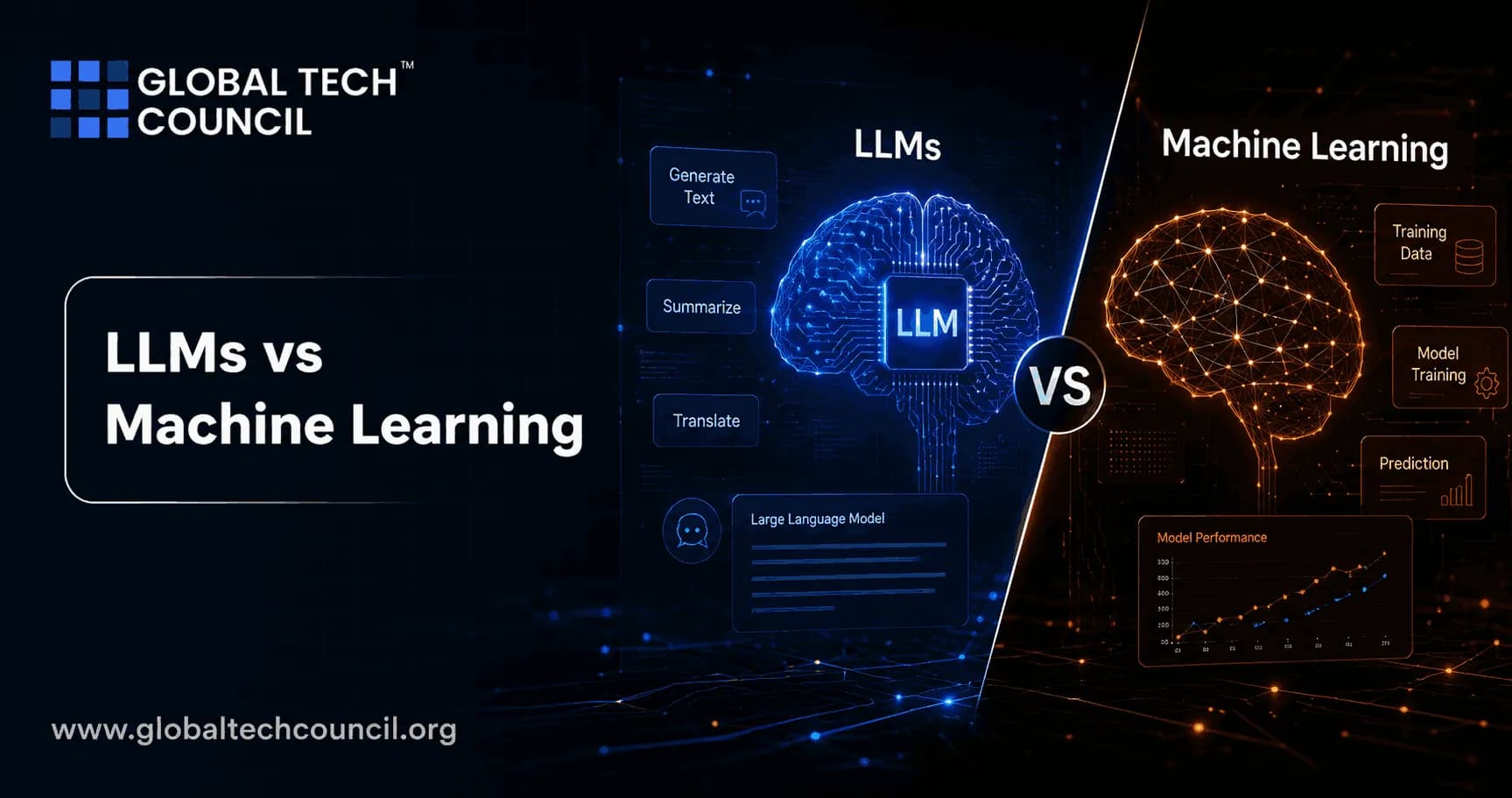
LLMs vs Machine Learning is not a contest between two equal categories. Machine learning is the wider discipline of systems that learn patterns from data. Large language models, or LLMs, are a specialized type of deep learning model built mainly for understanding and generating language at very large scale.
That distinction matters when you choose a model, design an AI system, or plan your next certification path. A random forest may beat an LLM on a credit-risk table. An LLM may crush that same random forest when the task is summarizing 300 pages of policy documents. Use the right tool. Not the fashionable one.

Choosing the right AI approach starts with understanding the fundamentals of machine learning before moving into more specialized technologies. A Certified Machine Learning Expert credential helps professionals build practical expertise in model development, evaluation, deployment, and decision-making, making it easier to identify the most appropriate solution for different business problems.
What Is Machine Learning?
Machine learning, or ML, is a core area of artificial intelligence where algorithms learn from data instead of relying on manually written rules for every case. You train a model on examples, evaluate how well it generalizes, then use it to make predictions or decisions on new data.
Common ML tasks include:
Classification: Predicting categories, such as fraud or not fraud.
Regression: Predicting numeric values, such as next month's revenue.
Clustering: Grouping similar customers, documents, or devices.
Forecasting: Estimating demand, traffic, energy usage, or inventory needs.
Anomaly detection: Finding unusual patterns in logs, transactions, or sensor readings.
Traditional ML often works best with structured data: rows, columns, labels, timestamps, transaction fields, sensor values. Think scikit-learn models, XGBoost, LightGBM, logistic regression, support vector machines, and time-series models.
Here is a detail candidates often miss in training labs. A simple logistic regression in scikit-learn can silently underperform if it does not converge. You may see the warning ConvergenceWarning: lbfgs failed to converge (status=1): STOP: TOTAL NO. of ITERATIONS REACHED LIMIT. The fix is often boring but real: scale your features and increase max_iter. That kind of practical ML knowledge still matters, even if your team is also using LLMs.
What Is a Large Language Model?
A large language model is a deep learning model trained on huge volumes of text and code to predict and generate sequences of tokens. Modern LLMs are usually based on the transformer architecture, introduced in the 2017 paper Attention Is All You Need. Transformers use self-attention to track relationships between words, code symbols, and longer passages of context.
LLMs can perform many language-heavy tasks through prompts:
Question answering
Summarization
Translation
Code generation and explanation
Chatbot responses
Document search and knowledge-base assistance
Drafting reports, emails, and technical notes
Models such as GPT-style systems, Google Gemini, and open-source transformer models sit in this category. Global Tech Council has also covered transformer-based LLMs and their use in reasoning, coding assistance, multilingual work, and enterprise AI workflows.
As organizations increasingly integrate generative AI into their products and operations, there is growing demand for professionals who can build reliable language-based applications. A Certified LLM Developer credential helps develop practical skills in transformer architectures, prompt engineering, retrieval-augmented generation, fine-tuning, and deploying enterprise-ready LLM solutions.
LLMs vs Machine Learning: The Core Difference
The simplest way to remember it is this:
Machine learning is the broad field.
Deep learning is a subset of machine learning.
LLMs are a subset of deep learning focused on language and general-purpose text tasks.
So LLMs do not replace machine learning. They extend it. In most serious systems, you will use both.
Data Type
Traditional ML is usually strongest on structured or semi-structured data. A fraud model may use transaction amount, merchant category, card age, country mismatch, velocity counts, and device fingerprint signals.
LLMs are trained mainly on unstructured language: books, web pages, documentation, source code, articles, and other text sources. They are built to understand context, wording, and intent, then generate responses.
Architecture
Traditional ML may use decision trees, random forests, gradient boosting, regression models, naive Bayes, k-nearest neighbors, or smaller neural networks. These models can be trained and deployed with modest compute.
LLMs use large transformer networks with billions of parameters in many modern systems. They need substantial GPU infrastructure for training and careful engineering for inference, latency, memory use, safety controls, and monitoring.
Task Design
Classical ML is usually task-specific. If you build a churn prediction model, it predicts churn. If you need a demand forecast, you build or train a different model.
LLMs are more general. You can ask the same model to summarize a contract, classify a support ticket, draft SQL, explain a Python error, or compare two policies. This ability comes from pre-training on broad data and adapting behavior through prompting, retrieval, fine-tuning, or tool use.
Compute and Cost
A gradient boosting model may train on a laptop or a small cloud instance. Many production ML models have thousands to millions of parameters.
Large LLMs can have billions or hundreds of billions of parameters, and training them from scratch can require large GPU clusters and major budget. For most enterprises, training a frontier LLM from zero is the wrong move. Use an existing model, add retrieval-augmented generation, fine-tune only when needed, and measure the result.
Where Traditional Machine Learning Still Wins
To be blunt, many business problems do not need an LLM. If your data is tabular and your output is a score, a smaller ML model is often cheaper, faster, and easier to explain.
Traditional ML is usually the better choice for:
Credit scoring: Regulators and auditors need explainable features and clear decision logic.
Fraud detection: Low latency matters. A tree-based model may respond in milliseconds.
Demand forecasting: Sales history, seasonality, and promotions fit time-series and gradient boosting approaches well.
Predictive maintenance: Sensor streams are often numeric, noisy, and time-dependent.
Medical risk scoring: Interpretability and validation are critical.
If you are preparing for applied AI work, do not skip statistics, evaluation metrics, feature engineering, data leakage, and model monitoring. These topics appear again when you work with LLMs, only with more moving parts.
Where LLMs Are the Better Fit
LLMs shine when language is the interface or the data itself. They are useful when users ask open-ended questions, documents are long, or the answer requires synthesis across many text sources.
Good LLM use cases include:
Internal knowledge assistants for policies, tickets, and documentation
Customer support chatbots with retrieval from approved sources
Contract and compliance document summarization
Code review assistance and test generation
Multilingual support and translation workflows
Agentic workflows where the model calls tools, APIs, and databases
One warning. Do not put a plain chatbot on top of sensitive enterprise data and call it done. Use access control, retrieval filters, logging, prompt injection testing, and human review for high-risk actions. OWASP has published a Top 10 for LLM applications covering risks such as prompt injection and insecure output handling, and those issues show up quickly in real deployments.
Hybrid AI: The Pattern Enterprises Actually Use
The strongest architecture is often a hybrid one. A classical ML model predicts churn. An LLM explains the main risk factors in plain language for an account manager. A retrieval system pulls the customer history. A rules engine blocks actions that violate policy.
This pattern is practical because each component does what it is good at:
ML model: Scores structured data.
LLM: Interprets, summarizes, or generates language.
Retriever: Grounds answers in approved documents.
Workflow engine: Controls actions and approvals.
Monitoring layer: Tracks drift, hallucination risk, latency, and user feedback.
If you work in enterprise AI, this is the stack you should expect. Not one giant model doing everything.
Implementing hybrid AI systems successfully also requires expertise beyond machine learning models, including cloud infrastructure, software engineering, MLOps, cybersecurity, and scalable deployment practices. A Deep Tech Certification helps professionals strengthen these advanced technical capabilities, enabling them to design and manage robust AI systems that perform reliably in production environments.
Regulation and Risk: Why LLMs Get More Scrutiny
LLMs and foundation models receive heavier regulatory attention because they are general-purpose, trained on broad datasets, and can affect many downstream applications.
The EU AI Act, which entered into force in 2024, creates obligations for general-purpose AI models, including transparency, technical documentation, copyright policies, and additional duties for models with systemic risk. Obligations for general-purpose AI model providers began applying from August 2, 2025, according to the EU implementation timeline.
In the United States, the National Institute of Standards and Technology has published the AI Risk Management Framework and launched NIST GenAI to support evaluation of generative AI systems. NIST describes dual-use foundation models as broadly trained, generally self-supervised models with at least tens of billions of parameters that can be used across many contexts.
For developers, the message is clear. Evaluation is not optional. Test for bias, data exposure, hallucination, jailbreak behavior, unsafe tool calls, and security flaws before deployment.
Which Skills Should You Learn First?
If you are new to AI, start with machine learning fundamentals. Learn Python 3.12, pandas, NumPy, scikit-learn, model validation, feature engineering, and metrics such as precision, recall, F1 score, ROC-AUC, and mean absolute error.
Then move into deep learning and LLMs. Study transformers, embeddings, tokenization, attention, fine-tuning, retrieval-augmented generation, vector databases, prompt evaluation, and agentic design.
For internal learning paths, Global Tech Council's Certified LLM Developer is a relevant next step if you want to build and deploy language-model applications. The Agentic AI Expert program fits professionals who want to design LLM-based agents that coordinate tools and workflows. Pair either path with strong machine learning training if your role includes production AI, analytics, or decision systems.
LLMs vs Machine Learning: Practical Decision Guide
Use this quick rule set:
Use traditional ML when your data is structured, your target is narrow, cost matters, and explanations are required.
Use LLMs when the main input or output is language, code, documents, or conversation.
Use hybrid AI when you need prediction plus explanation, retrieval, workflow automation, or natural language access to structured systems.
Avoid LLMs when a simple model is accurate, auditable, and cheaper to operate.
Avoid classical ML alone when users need flexible language interaction or document reasoning.
The next step is concrete. Take one tabular dataset and one document-heavy problem. Build a scikit-learn baseline for the first. Build a retrieval-augmented LLM prototype for the second. Compare cost, latency, accuracy, and failure modes. That exercise will teach you the real difference faster than any definition.
Technical expertise helps build effective AI systems, but long-term success also depends on understanding business priorities, customer needs, and organizational strategy. A Marketing & Business Certification helps professionals develop these business-focused skills, enabling them to align AI initiatives with measurable business outcomes and communicate their value to stakeholders.
FAQs
1. What is the difference between LLMs and machine learning?
Machine learning (ML) is a broad field of artificial intelligence that enables computers to learn patterns from data to make predictions or decisions. Large Language Models (LLMs) are a specific type of machine learning model, typically built using deep learning and transformer architectures, that are designed to understand and generate human language.
2. What is machine learning?
Machine learning is a branch of AI that uses algorithms to learn from data without being explicitly programmed for every scenario. Common machine learning tasks include classification, regression, clustering, recommendation systems, anomaly detection, and forecasting across many industries.
3. What is a Large Language Model (LLM)?
A Large Language Model is an advanced deep learning model trained on large collections of text to perform language-related tasks. Depending on its design and deployment, an LLM can generate text, summarize information, answer questions, assist with coding, translate languages, and support conversational AI applications.
4. Are LLMs a type of machine learning?
Yes. LLMs are a specialized category of machine learning models. More specifically, they are built using deep learning techniques and transformer neural networks, making them one subset within the broader machine learning landscape.
5. How do traditional machine learning models work?
Traditional machine learning models learn relationships between input features and target outcomes using structured datasets. Algorithms such as linear regression, decision trees, random forests, support vector machines, and gradient boosting are commonly used for prediction and pattern recognition.
6. How do LLMs work?
LLMs learn statistical relationships between words, phrases, and larger language patterns during training. Most modern LLMs use transformer architectures with attention mechanisms that enable them to understand context and generate coherent responses based on the input they receive.
7. What types of data do machine learning models use?
Machine learning models can work with structured, semi-structured, and unstructured data. Examples include spreadsheets, sensor readings, financial records, images, audio, customer transactions, medical data, and text, depending on the algorithm and application.
8. What types of data are LLMs trained on?
LLMs are primarily trained on large text-based datasets that may include books, articles, websites, technical documentation, publicly available content, licensed data, and other language resources. Training datasets and methods vary by model developer and intended use.
9. What are the main use cases for machine learning?
Machine learning is widely used for fraud detection, demand forecasting, predictive maintenance, medical diagnosis support, recommendation systems, quality control, customer segmentation, cybersecurity, supply chain optimization, and financial risk analysis.
10. What are the main use cases for LLMs?
LLMs are commonly used for chatbots, content generation, document summarization, translation, programming assistance, search augmentation, question answering, knowledge management, customer support, and workflow automation involving natural language.
11. What algorithms are commonly used in machine learning?
Machine learning includes algorithms such as linear regression, logistic regression, decision trees, random forests, support vector machines, k-nearest neighbors, Naive Bayes, XGBoost, LightGBM, clustering algorithms, and neural networks, depending on the problem being solved.
12. What technologies are commonly used to build LLMs?
Modern LLMs are typically built using transformer architectures and deep learning frameworks such as PyTorch or TensorFlow. Training often requires specialized hardware, distributed computing, large datasets, and optimization techniques to efficiently process billions of parameters.
13. Which requires more computing resources?
In general, LLM training requires substantially more computational resources than many traditional machine learning models. While inference costs vary depending on model size and deployment method, classical ML models are often more efficient for narrowly defined prediction tasks.
14. When should you use machine learning instead of an LLM?
Traditional machine learning is often appropriate when working with structured datasets, well-defined prediction problems, limited computational resources, or applications requiring high interpretability and efficient inference. The most suitable approach depends on the business objective, available data, and technical constraints.
15. When should you use an LLM instead of traditional machine learning?
LLMs are often well suited for applications involving natural language understanding, text generation, conversational interfaces, document analysis, coding assistance, and multilingual communication. Organizations should also evaluate factors such as privacy, latency, cost, and regulatory requirements before deployment.
16. Can LLMs and machine learning be used together?
Yes. Many AI systems combine LLMs with traditional machine learning models to leverage the strengths of both approaches. For example, an application may use classical ML for fraud scoring while using an LLM to summarize findings or explain results in natural language.
17. What challenges do LLMs and machine learning share?
Both approaches require high-quality data, careful model evaluation, ongoing monitoring, bias mitigation, security controls, and responsible governance. Models may also require periodic retraining or updates as data distributions, business requirements, or regulatory expectations change.
18. What are best practices for choosing between LLMs and machine learning?
Clearly define the business problem, understand the available data, compare performance, assess computational costs, consider explainability, evaluate privacy and compliance requirements, and measure success using appropriate performance metrics. Selecting the simplest approach that effectively solves the problem is often the most practical strategy.
19. How are LLMs and machine learning evolving in 2025-2026?
Current trends include multimodal AI, smaller domain-specific language models, retrieval-augmented generation (RAG), agentic AI, explainable AI, federated learning, edge AI, synthetic data, and increased emphasis on AI governance, transparency, and responsible deployment across industries.
20. What is the future relationship between LLMs and machine learning?
LLMs are expected to complement rather than replace traditional machine learning. Classical ML will likely remain the preferred choice for many structured prediction tasks, while LLMs will continue expanding capabilities in language understanding and intelligent assistance. Many future AI systems will combine both techniques to deliver efficient, reliable, and context-aware solutions. After all, using an LLM to predict tomorrow's inventory levels can be a bit like hiring a novelist to organize your warehouse. Sometimes you need poetry, and sometimes you just need a spreadsheet.
Related Articles
View All
Machine Learning
The Future of Machine Learning: Trends, Opportunities, and Challenges
Explore the future of machine learning, including foundation models, edge ML, AutoML, MLOps, governance, market growth, and career opportunities.

Machine Learning
Machine Learning Certification Guide: Choose the Right Program
A practical 2026 guide to choosing the right machine learning certification based on role, skill level, curriculum, projects, cloud stack, and career goals.

Machine Learning
Machine Learning Career Roadmap: Skills, Roles, and Learning Path for 2026
A practical machine learning career roadmap covering skills, roles, timelines, projects, MLOps, LLMs, and certification options for job-ready growth.
Trending Articles
The Role of Blockchain in Ethical AI Development
How blockchain technology is being used to promote transparency and accountability in artificial intelligence systems.
AWS Career Roadmap
A step-by-step guide to building a successful career in Amazon Web Services cloud computing.
Top 5 DeFi Platforms
Explore the leading decentralized finance platforms and what makes each one unique in the evolving DeFi landscape.