

Machine learning for kids: How can you make your kid future-ready?
 Aman Singh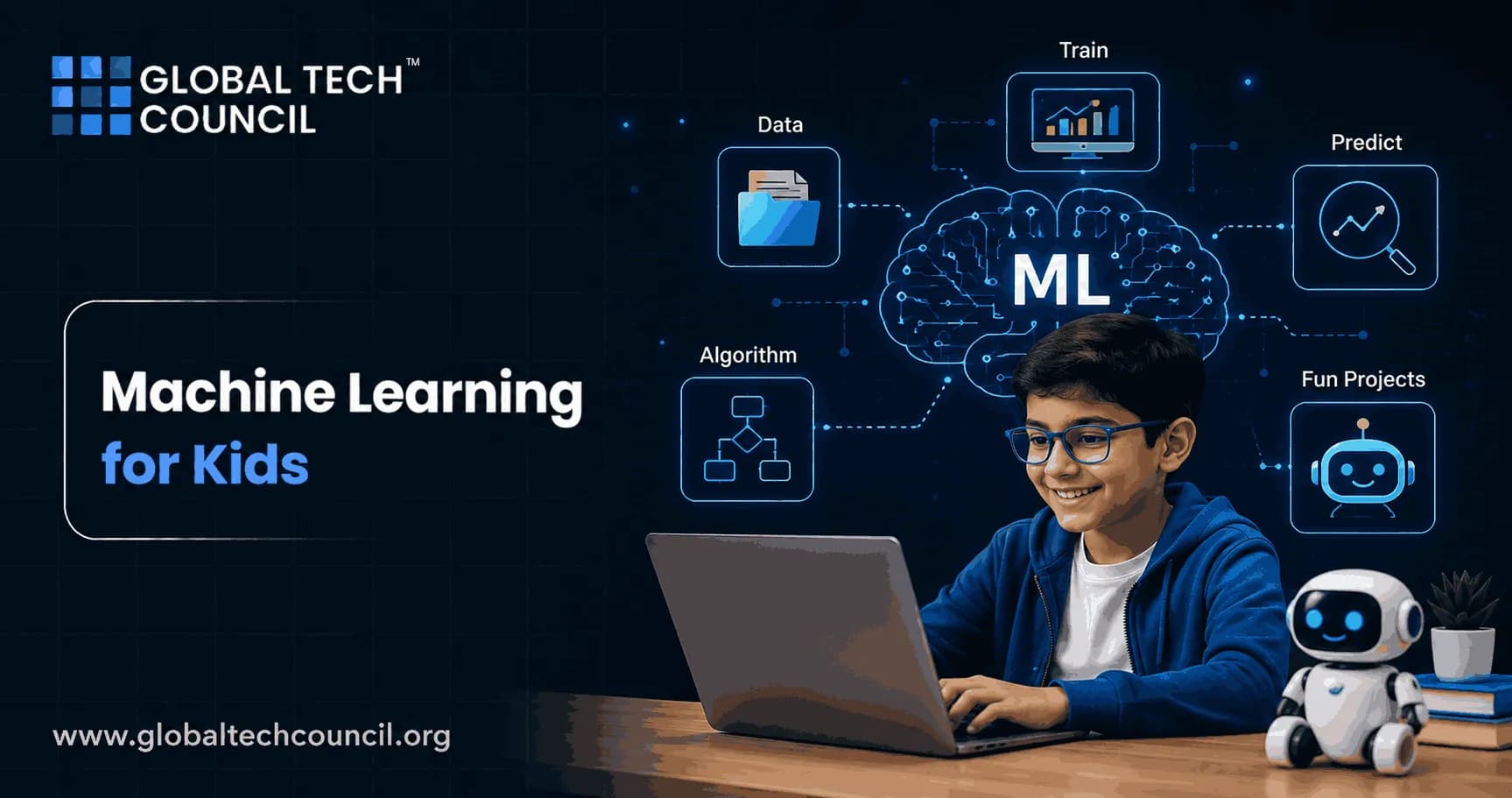
Machine learning for kids means introducing children to the ideas behind how computers learn from data, so they build comfort with AI tools years before those tools shape their careers. The short answer to "how can you make your kid future-ready" is this: start early, keep it hands-on, and treat machine learning as a life skill rather than a coding elective. Children who grow up understanding how AI systems make decisions will be better equipped to work alongside those systems, question their outputs, and build with them, whatever field they eventually choose. Parents exploring this path sometimes deepen their own understanding first through a program like the Certified Machine Learning Expert course, so they can guide their child's learning with real context instead of guesswork.
This shift is not hype. Schools, employers, and even toy makers are already rebuilding around AI literacy. A child who learns to think in terms of patterns, data, and predictions today will not be starting from zero when machine learning becomes as ordinary as spreadsheets or search engines. The rest of this guide breaks down what machine learning actually means for kids, why it matters for their future, and how to introduce it at the right pace for their age.

What Is Machine Learning, and Why Should Kids Learn It Early?
Machine learning is a branch of artificial intelligence where computers improve at a task by learning from examples instead of following fixed instructions. A child does not need to understand neural networks to grasp the core idea. Show them how a music app learns their taste from what they skip and what they replay, and they already understand the basic loop: data goes in, patterns get found, predictions come out.
Learning this early matters for three reasons. First, AI tools are already part of daily life, from voice assistants to recommendation feeds, so kids are using machine learning systems long before they study them formally. Second, early exposure builds comfort rather than intimidation, the same way early exposure to reading builds comfort with books. Third, the workforce your child enters will expect baseline AI fluency the way today's workforce expects baseline computer literacy. Families who want a more structured starting point often look at a broader Certified AI & Machine Learning Expert track for themselves, since a parent who understands the fundamentals can translate them into simpler language for a child far more effectively than any app alone.
How Machine Learning Skills Prepare Kids for Future Careers
Career forecasts consistently point in one direction. Roles that involve working with AI systems, whether that means building them, applying them, or managing the people who do, are growing across nearly every industry, not just software companies. Hospitals use machine learning for diagnostics support. Farms use it for crop monitoring. Retailers use it for inventory and pricing. Film studios use it for editing and effects. A child who understands the basics of how these systems work will have an advantage no matter which of these fields they eventually enter.
This is not only about future coding jobs. Machine learning literacy also supports skills that transfer everywhere: breaking a big problem into smaller steps, testing an idea and adjusting based on results, and reading data critically instead of accepting it at face value. These habits matter for a future doctor, marketer, or small business owner just as much as they matter for a future engineer. Raising a future-ready child means raising a child who can adapt when the tools around them keep changing, and machine learning is currently the clearest example of that kind of change.
Best Ways to Introduce Machine Learning to Kids by Age Group
Machine learning does not need to look like machine learning at first. The right entry point depends heavily on age.
Ages 5 to 8
At this stage, keep everything visual and playful. Simple pattern games, sorting activities, and apps that let a child "teach" a character to recognize shapes or sounds work well. The goal is not technical accuracy. It is building the intuition that a computer can get better at something by seeing many examples, the same way a child gets better at recognizing dog breeds by seeing many dogs.
Ages 9 to 12
Children in this range can handle simple, guided projects. Block-based tools that let kids train a model to recognize their own voice, a specific object through a webcam, or a handwriting sample are effective because the child sees cause and effect directly. This is also a good age to introduce basic vocabulary such as data, training, and prediction, since kids at this stage enjoy having the "grown-up words" for things they already understand intuitively.
Ages 13 to 17
Teenagers can move into more structured learning: basic Python, working with real datasets, and building small projects such as a spam filter or a simple recommendation tool. This is also the age to start conversations about how these systems can be biased or wrong, since teenagers are old enough to handle nuance and are already forming opinions about the tech they use daily.
Across every age group, the pattern that works best is short, project-based sessions rather than long lecture-style lessons. Kids retain far more from building something small and finishing it than from watching a long explanation of theory.
Skills Beyond Coding: Critical Thinking, Ethics, and Creativity
It is tempting to treat machine learning for kids as purely a coding topic, but the strongest programs go further. Teaching a child to question where a dataset came from, whether it represents everyone fairly, and what happens when a prediction is wrong builds a kind of critical thinking that will matter for the rest of their life, regardless of career path. A child who asks "why did the app suggest that" is practicing the same reasoning an adult data scientist uses daily.
Creativity matters just as much. Some of the most engaging kids' machine learning projects involve art, music, or storytelling, such as training a model to generate silly poems or to sort a child's own drawings by style. These projects keep the subject fun while quietly building technical comfort. For families who want to build a genuine, well-rounded foundation rather than a narrow coding-only track, a broader Deep Tech Certification path can help a parent understand how machine learning connects to the wider technology landscape their child will grow up in, including robotics, data systems, and emerging computing tools.
Where Kids Can Put These Skills to the Test: World Tech Olympiad
Learning machine learning concepts at home is a strong start, but kids also benefit from a structured, competitive environment where they can apply what they have learned alongside peers. Designed to encourage technology learning among school students, the World Tech Olympiad (WTO) brings together participants from Class 2 to Class 12 through different technology-focused challenges. Its areas include robotics, AI, programming, computational thinking, and cybersecurity, with competition levels structured to suit different age groups and abilities. The Olympiad supports participation through separate routes for families and educational institutions. Parents can enroll their children directly, while schools can register as institutions and facilitate participation for students who meet the eligibility requirements.
For a child already exploring machine learning at home, a program like this offers a natural next step: a real deadline, real feedback, and real peers working on similar problems.
Signs Your Child Is Ready for Advanced Machine Learning Learning
Not every child needs to jump into Python at nine years old, and pushing too fast can backfire. A few signs suggest a child is ready to go beyond the basics: they start asking how an app or game "knows" things about them, they enjoy pattern-based puzzles more than average, they get frustrated when a simple explanation feels incomplete, or they start tinkering with settings in apps just to see what changes. None of these signs are required, and plenty of kids develop strong machine learning skills without showing any of them early. Readiness is about curiosity and persistence, not raw talent.
How Parents Can Support Machine Learning Learning at Home
You do not need a technical background to support this kind of learning. A few practical habits go a long way.
Talk about the AI your family already uses. When a streaming app makes a recommendation or a phone autocorrects a word, ask your child how they think the app "knew" that. These small conversations build the same reasoning skills as a formal lesson, with none of the pressure.
Let your child see you learning too. If you are working through a certification or an online course yourself, mentioning it casually shows your child that learning new technology is a normal, ongoing part of adult life, not something that stops after school.
Choose tools built for kids, not scaled-down adult tools. Kid-focused platforms are designed around attention spans, reading levels, and motivation in ways that adult software rarely is, and that difference shows up quickly in how long a child stays engaged.
Protect the fun. The fastest way to lose a child's interest in machine learning is to turn it into homework. Competitions, games, and creative projects keep the subject feeling like play even as the underlying skills get more advanced.
Final Thoughts
Making a child future-ready does not require predicting exactly which jobs will exist in fifteen years. It requires giving them comfort with the tools that are already reshaping every industry, along with the judgment to use those tools well. Machine learning for kids, done right, builds exactly that combination: technical familiarity, critical thinking, and creative confidence. Parents who want to guide this journey well often find it helps to build their own literacy first, and a structured option such as a Marketing Certification can be just as valuable as a technical one, since knowing how to explain and present ideas clearly is a skill your child will need regardless of which technology path they eventually choose.
Start small, stay consistent, and let curiosity lead. The families who make the biggest difference are rarely the ones with the most advanced tools at home. They are the ones who keep the conversation about technology open, honest, and ongoing.
FAQs
1. What Is Machine Learning for Kids?
Machine learning for kids is an age-appropriate introduction to how computers learn patterns from data and use those patterns to make predictions or decisions. Instead of beginning with advanced mathematics, children can explore concepts through games, visual programming, simple datasets, image recognition, or beginner coding projects. The goal is not to turn an eight-year-old into a machine learning engineer before lunch. It is to develop curiosity, computational thinking, problem-solving skills, and a basic understanding of how AI-powered technology works.
2. Why Should Kids Learn Machine Learning?
Kids are growing up in a world where AI influences search, entertainment, education, communication, transportation, healthcare, and many future careers. Learning machine learning can help children understand technology rather than simply consume it. They can develop skills in logical reasoning, experimentation, data literacy, creativity, and critical thinking. More importantly, children can learn that AI systems have limitations and that their outputs should be questioned rather than automatically trusted.
3. At What Age Can Kids Start Learning Machine Learning?
Children can begin exploring basic AI and machine learning concepts in primary school when activities are appropriately designed for their age. Younger children can learn ideas such as patterns, classification, instructions, and cause and effect without writing code. Older children can gradually progress into visual programming, Python, datasets, algorithms, and model training. Readiness depends more on the child's interests, mathematical foundations, and learning style than on reaching one supposedly magical birthday.
4. How Can Parents Make Their Kids Future-Ready for AI?
Parents can focus on developing a combination of Digital Literacy + Mathematics + Coding + Data Literacy + AI Understanding + Creativity + Communication + Critical Thinking. Children should learn how technology works while also developing distinctly human capabilities such as judgment, collaboration, curiosity, and problem solving. Future readiness should not mean predicting one particular career. Technology changes far too quickly for that. It means giving children adaptable skills that remain useful as tools and occupations evolve.
5. Does a Child Need to Learn Coding Before Machine Learning?
Not necessarily. Children can understand many fundamental machine learning concepts without programming. Visual tools can demonstrate how examples are collected, labeled, trained, tested, and used for predictions. Coding becomes more useful as children progress toward building customized projects. A sensible learning path is Computational Thinking → Visual Programming → AI Concepts → Basic Coding → Python → Data → Machine Learning Projects, rather than throwing a Python textbook at a child and wondering why enthusiasm has mysteriously disappeared.
6. What Programming Language Should Kids Learn for Machine Learning?
Python is commonly used for machine learning because it has relatively readable syntax and a large ecosystem of data and AI libraries. However, younger learners may benefit from starting with visual programming environments before moving to text-based programming. The important objective is understanding concepts such as variables, conditions, loops, functions, data, and algorithms. Programming languages will change throughout a child's lifetime, while computational thinking is considerably less likely to become obsolete.
7. What Machine Learning Concepts Can Kids Learn?
Kids can learn concepts such as data, features, labels, classification, prediction, training, testing, accuracy, bias, and pattern recognition. Older learners can explore supervised and unsupervised learning, regression, neural networks, computer vision, and natural language processing. These ideas should be introduced through practical examples. A child classifying pictures of animals can learn surprisingly important concepts about training data and prediction without needing to begin with linear algebra.
8. How Can Kids Learn Machine Learning Through Projects?
Project-based learning allows children to understand machine learning by building something they can test. They might create an image classifier, recognize hand gestures, categorize objects, analyze simple datasets, or build a basic recommendation system. A useful project cycle is Choose a Problem → Collect Data → Label Examples → Train Model → Test Model → Find Errors → Improve Model. This also teaches an important lesson adults occasionally struggle with: the first model working does not mean the project is finished.
9. Can Kids Learn AI Without Advanced Mathematics?
Yes. Beginners can understand many AI concepts using examples, visualization, experimentation, and simple programming. As learners progress, mathematics becomes increasingly important. Statistics, probability, algebra, vectors, and eventually calculus and linear algebra help explain why machine learning algorithms behave as they do. Parents should therefore encourage strong mathematical foundations without making advanced mathematics a prerequisite for every early AI experiment.
10. What Is the Difference Between AI, Machine Learning, and Coding for Kids?
Coding means writing instructions that computers execute. Machine learning involves systems learning patterns from examples rather than having every rule explicitly programmed. Artificial intelligence is a broader category covering technologies designed to perform tasks associated with intelligent behavior. Children can understand the relationship as Coding → Tell Computer the Rules and Machine Learning → Give Computer Examples to Learn Patterns. AI can include machine learning as well as other computational approaches.
11. How Can Machine Learning Improve a Child's Problem-Solving Skills?
Machine learning projects encourage children to break large problems into smaller questions. They must decide what information is needed, collect examples, test assumptions, analyze mistakes, and improve their solution. This creates a cycle of Problem → Hypothesis → Experiment → Evidence → Improvement. These skills extend beyond technology into science, mathematics, research, and everyday decision-making. The model being wrong can actually be educational, provided nobody responds by simply asking a chatbot to declare it correct.
12. How Can Kids Learn About Data Through Machine Learning?
Machine learning provides a practical way to teach data literacy. Children can learn where data comes from, how it is collected, why data quality matters, and how incomplete or unbalanced datasets affect results. They can also learn to distinguish correlation from causation and recognize misleading conclusions. Data literacy will be valuable across many future professions because increasingly sophisticated tools still depend on humans understanding whether the information going into them makes sense.
13. How Can Kids Learn About AI Bias and Fairness?
Parents and teachers can demonstrate bias using simple datasets. For example, children can train an image classifier using many examples from one category but very few from another and observe how performance changes. This helps explain the relationship Training Data → Learned Patterns → Predictions → Potential Bias. Discussions can then expand into fairness, representation, and responsible technology. Teaching children that algorithms can make mistakes is arguably more useful than presenting AI as an infallible electronic oracle.
14. Should Kids Use Generative AI Tools for Learning?
Generative AI can support learning when used thoughtfully. Children can use AI to explain concepts, brainstorm project ideas, practice coding, generate quizzes, or explore alternative solutions. However, they should also learn to verify information, protect personal data, recognize fabricated outputs, and complete important thinking independently. Parents and educators should establish age-appropriate supervision and rules. The objective should be AI as Learning Support, not AI as a Machine That Quietly Completes Childhood.
15. How Can Parents Teach Responsible AI Use?
Parents can teach children never to share sensitive personal information unnecessarily, to question AI-generated answers, to verify important claims, and to understand that generated content may contain errors or bias. Children should also learn about copyright, academic integrity, privacy, respectful behavior, and responsible creation. A simple framework is Ask → Evaluate → Verify → Improve → Use Responsibly. Responsible AI literacy should develop alongside technical skills rather than being introduced after questionable habits have already become normal.
16. What Skills Will Children Need in an AI-Driven Future?
Future-ready children will benefit from technical and human skills. Technical foundations include digital literacy, mathematics, data literacy, programming, cybersecurity awareness, and AI understanding. Human capabilities include critical thinking, creativity, communication, collaboration, adaptability, curiosity, and ethical judgment. As AI becomes better at performing routine cognitive tasks, the ability to define problems, evaluate information, make judgments, and combine knowledge across disciplines may become increasingly valuable.
17. Will Learning Machine Learning Help Kids Get Future Jobs?
Machine learning knowledge can prepare children for careers in AI, software, robotics, data science, cybersecurity, engineering, research, finance, healthcare, and many other fields. However, parents should avoid treating childhood AI education as training for one specific future job. Many roles children eventually enter may not yet exist in their current form. A stronger approach develops transferable foundations that allow them to learn new technologies throughout their careers.
18. How Much Time Should Kids Spend Learning AI and Coding?
The appropriate amount depends on age, interest, school commitments, and overall screen time. Short, engaging sessions can be more effective than long compulsory lessons, especially for younger children. Projects should coexist with reading, mathematics, science, arts, sports, social interaction, and unstructured play. Becoming “future-ready” by spending childhood permanently attached to a computer would be a rather spectacular misunderstanding of the objective.
19. What Mistakes Should Parents Avoid When Teaching Kids Machine Learning?
Parents should avoid starting with material that is too advanced, focusing exclusively on coding syntax, comparing children with others, turning every activity into career preparation, or allowing AI tools to replace independent thinking. Another mistake is emphasizing certificates over projects and understanding. Children generally learn technology more effectively when they are encouraged to explore, make mistakes, build things, and explain what they discovered. Curiosity is a more useful long-term asset than racing through an adult curriculum.
20. What Is the Best Machine Learning Roadmap for Kids?
A future-ready learning journey should begin with foundations rather than advanced machine learning.
For younger children, the pathway can begin with:
Patterns → Logic → Puzzles → Digital Literacy → Visual Programming → Simple AI Experiments
The next stage can introduce computational thinking:
Variables → Conditions → Loops → Functions → Algorithms → Small Projects
Children can then progress into basic programming:
Python → Data Structures → Problem Solving → Simple Applications
Once those foundations are comfortable, machine learning can be introduced through:
Data → Features → Labels → Training → Prediction → Testing → Accuracy
Practical projects can then become progressively more sophisticated:
Image Classification
↓
Text Classification
↓
Recommendation Systems
↓
Simple Predictive Models
↓
Computer Vision
↓
Natural Language Processing
Older learners can eventually explore:
Statistics + Probability + Linear Algebra + Python + Data Analysis + Machine Learning Algorithms + Neural Networks
But technical skills are only half of future readiness.
Children should simultaneously develop:
Critical Thinking
Creativity
Communication
Research Skills
Collaboration
Data Literacy
Privacy Awareness
AI Ethics
Independent Problem Solving
A particularly useful habit is teaching children a five-stage relationship with AI:
Think First → Ask AI → Examine the Answer → Verify It → Improve It
That prevents AI from becoming a substitute for reasoning.
Parents can also encourage children to become creators rather than passive consumers:
Play a Game → Understand How Games Work → Build a Game
Use an AI Tool → Understand How AI Learns → Build a Simple AI Project
Watch Recommendations → Explore How Recommendation Systems Work
This shift from consumption to creation is one of the strongest ways to develop technological confidence.
The central principle is:
Do not prepare children for one future technology. Prepare them to keep learning as technology changes.
Machine learning is useful because it teaches children about data, patterns, experimentation, algorithms, uncertainty, and problem solving. Those capabilities can remain valuable even as today's AI tools are replaced by technologies nobody has named yet.
The future-ready child is therefore not necessarily the child who knows the most AI tools.
It is the child who can learn new tools, question their outputs, solve unfamiliar problems, create with technology, and know when not to use it.
Related Articles
View All
Machine Learning
How to make money with Machine Learning 2021
Did you ever notice that thousands of entrepreneurs enter the industry each year to pitch their unique ideas in the present era? Machine learning has now become a general term in the business nowadays, thanks to past incredible breakthroughs. AI and machine learning are increasing in popularity…

Machine Learning
How does Spotify use machine learning to analyze data and make decisions?
Spotify, the largest on-demand music agency within the entire world, embraced documents of compelling bounds from the scientific state using the latest technologies to market victory. Spotify today has millions of online subscribers. The reason for its success lies in Spotify’s innovative use…

Machine Learning
The Future of Machine Learning: Trends, Opportunities, and Challenges
Explore the future of machine learning, including foundation models, edge ML, AutoML, MLOps, governance, market growth, and career opportunities.
Trending Articles
The Role of Blockchain in Ethical AI Development
How blockchain technology is being used to promote transparency and accountability in artificial intelligence systems.
AWS Career Roadmap
A step-by-step guide to building a successful career in Amazon Web Services cloud computing.
Top 5 DeFi Platforms
Explore the leading decentralized finance platforms and what makes each one unique in the evolving DeFi landscape.