

Semi-Supervised Learning Explained: Training Models with Limited Labeled Data
 Suyash Raizada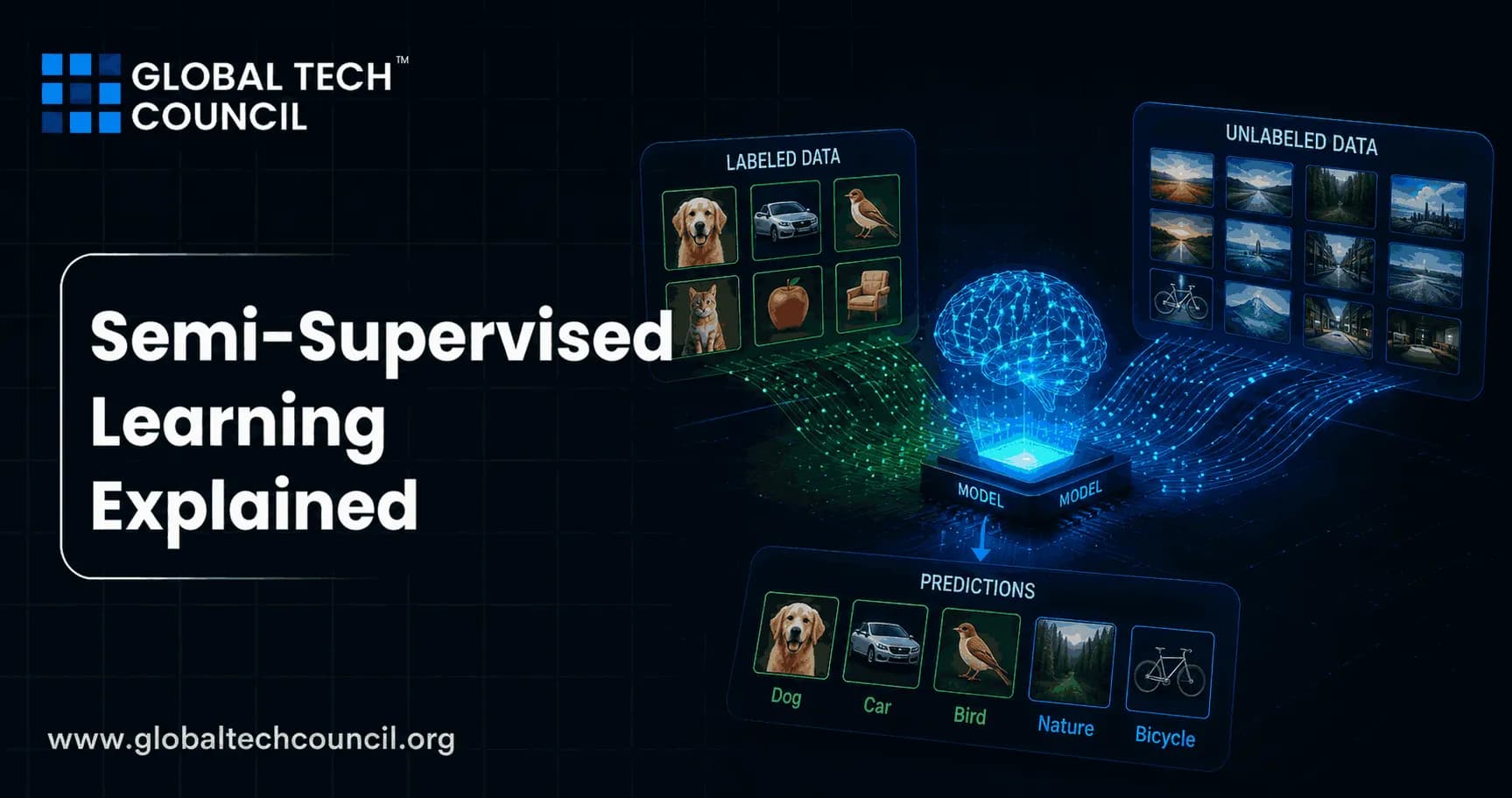
Semi-supervised learning trains a model with a small labeled dataset and a much larger pool of unlabeled data. You use the labeled examples for ground truth, then use the unlabeled examples to teach the model what the broader data distribution looks like. Done well, this can cut annotation work by 30 percent to 50 percent in some vision and medical imaging tasks while keeping accuracy close to fully supervised training.
That last phrase matters: done well. Semi-supervised learning, often shortened to SSL, is not a magic fix for missing labels. If your unlabeled data comes from the wrong population, or if it contains unknown classes your model is not prepared to handle, SSL can make results worse. I have seen this in image classifiers where a high confidence pseudo-label threshold looked safe on paper, then quietly reinforced a rare-class error for 20 epochs.

As organizations increasingly work with limited labeled data, understanding semi-supervised learning has become an important skill for AI practitioners. A Certified Machine Learning Expert credential helps professionals build practical expertise in model development, evaluation, data preparation, and deployment, providing the foundation needed to apply advanced machine learning techniques effectively.
What Is Semi-Supervised Learning?
Semi-supervised learning sits between supervised learning and unsupervised learning. In supervised learning, every training sample has a label. In unsupervised learning, none of the samples have labels. SSL uses both.
A typical setup looks like this:
Labeled data: A small set of examples with trusted labels, such as 2,000 labeled chest X-rays.
Unlabeled data: A much larger set without labels, such as 100,000 additional X-rays from the same hospital network.
Training objective: Learn from the labeled data while using the unlabeled data to improve generalization.
The core assumption is simple but strict: the input distribution p(x) must tell you something useful about the label distribution p(y|x). In plain English, similar samples should usually have similar labels, or classes should form meaningful clusters. If that assumption breaks, unlabeled data may add noise instead of signal.
Why Semi-Supervised Learning Matters
Labels are expensive. Sometimes painfully expensive.
A cat-versus-dog image label is cheap. A pixel-level brain tumor segmentation label requires a trained clinician or radiology specialist. Legal document tagging may require domain experts. Fraud labels often arrive late, after investigations close. In these cases, you may have millions of raw records and only a small labeled subset.
Semi-supervised learning helps when:
You have far more unlabeled data than labeled data.
Manual labeling is costly, slow, or inconsistent.
The unlabeled data comes from the same or a closely related distribution.
You can validate the model carefully before deployment.
Research in medical image segmentation has shown SSL pipelines matching or beating fully supervised baselines while using about 50 percent fewer labels. A 2024 Scientific Reports study on the S4MI pipeline reported strong segmentation results across multiple datasets with reduced annotation load. Object detection surveys from 2024 also show semi-supervised object detection narrowing the gap between limited-label and fully labeled training, especially with teacher-student models and transformer-based detectors such as Semi-DETR variants.
As semi-supervised learning becomes a key component of modern AI applications, professionals benefit from understanding how it integrates with deep learning, computer vision, natural language processing, and enterprise AI systems. A Certified AI & Machine Learning Expert credential helps develop this broader perspective, enabling practitioners to design intelligent solutions that effectively combine multiple machine learning approaches.
How Semi-Supervised Learning Works
1. Self-Training and Pseudo-Labeling
Self-training is the most intuitive SSL method. Train a model on labeled data. Use it to predict labels for unlabeled data. Keep the predictions that are confident enough. Retrain using both real labels and pseudo-labels.
For example, FixMatch uses weak augmentation to create a pseudo-label, then asks the model to predict the same label under strong augmentation. A common confidence threshold is 0.95. That threshold is not a small detail. Set it too low and noisy pseudo-labels spread fast. Set it too high and the model may ignore useful samples for minority classes.
Practical note: in PyTorch, pseudo-labels passed to torch.nn.CrossEntropyLoss must be integer class indices with dtype torch.long. If you accidentally pass float labels, you will often hit RuntimeError: expected scalar type Long but found Float. It is a small bug, but it wastes real training time.
2. Consistency Regularization
Consistency regularization says that a model should make stable predictions when the same input is changed slightly. For images, that might mean cropping, flipping, color jitter, CutOut, Mixup, RandAugment, or GridMask. For text, it could mean dropout, token masking, or paraphrase-style perturbations.
The idea is sensible: if a model calls a mildly cropped image a melanoma case, it should not call the strongly augmented version benign unless the augmentation destroyed key evidence.
Methods such as Mean Teacher, FixMatch, Interpolation Consistency Training, and uncertainty-aware consistency have become common in deep SSL research. In practice, consistency loss is often the part that makes modern SSL outperform plain pseudo-labeling.
3. Graph-Based Semi-Supervised Learning
Graph-based methods build a graph where each node is a data point and each edge represents similarity. Labels then propagate from labeled nodes to nearby unlabeled nodes. This works well when local similarity is meaningful.
Medical imaging, remote sensing, and document clustering can benefit from this approach. The trade-off is scale. Building and storing large similarity graphs can be expensive unless you use approximate nearest neighbor search, sparse graphs, or mini-batch graph methods.
4. Generative Models and EM
Classical SSL often used generative models, such as mixture models, with Expectation Maximization. These methods model how data is generated, then use unlabeled samples to estimate the structure of the input space.
They can work when the assumptions fit the data. If your classes do not match the mixture structure, results can be poor. To be blunt, I would not start here for a modern image or NLP project unless you have a specific reason.
5. Co-Training and Multi-View Learning
Co-training uses multiple views of the same data. One model teaches another. In healthcare, one view could be an MRI sequence and another could be clinical metadata. In web classification, one view might be page text while another is anchor text.
Deep variants use CNN and transformer models together, especially in medical image segmentation. This can work well, but only when the views provide complementary information. Two weak copies of the same model usually just repeat the same mistakes.
Where Semi-Supervised Learning Performs Best
Medical Imaging
This is one of SSL's strongest use cases. Pixel-level annotation for organ segmentation, lesion detection, pathology slides, and tumor boundaries is expensive. Semi-supervised segmentation lets teams train with a smaller labeled set and a larger archive of unlabeled scans.
Surveys in clinical imaging report that semi-supervised segmentation can approach fully supervised upper bounds on benchmark datasets. Some studies also report Lin's concordance correlation coefficient above 0.8 in evaluation settings, with performance near expert agreement for selected tasks.
Computer Vision and Object Detection
Image classification, object detection, autonomous driving perception, surveillance, and remote sensing all generate more raw data than humans can label. Semi-supervised object detection uses pseudo-boxes, teacher-student models, and cross-view consistency to learn from unlabeled images.
Transformer-based detectors are gaining attention because global attention can help with object context, but they are not automatically better. For smaller datasets or constrained hardware, a well-tuned CNN detector may still be the practical choice.
Natural Language Processing
NLP has used SSL-style ideas for years. Text classification, sentiment analysis, intent detection, and open-set classification all benefit from unlabeled corpora. The challenge is label ambiguity. If human annotators disagree, pseudo-labeling can amplify that uncertainty.
For many NLP teams, self-supervised pretraining followed by semi-supervised fine-tuning is the better path. Start with a pretrained encoder, then use SSL when your task-specific labels are limited.
Federated and Streaming Data
Federated semi-supervised learning is useful when data cannot be centralized, such as in hospitals, banks, or mobile devices. Streaming SSL handles delayed labels, where ground truth arrives days or weeks later. Fraud detection is a good example. You train while labels are still incomplete, then correct course as confirmed cases arrive.
Common Risks in Semi-Supervised Learning
SSL fails in predictable ways. Watch for these:
Bad pseudo-labels: Early model errors become training data, then grow stronger.
Class imbalance: The model labels common classes confidently and ignores rare ones.
Open-set data: Unlabeled samples may include classes not present in your labeled set.
Distribution shift: Your labeled data may come from one scanner, region, app version, or time period while unlabeled data comes from another.
Overconfident models: Neural networks can be confidently wrong, especially under shift.
Use confidence thresholds, calibration checks, out-of-distribution detection, class-balanced sampling, and a validation set that reflects deployment data. Do not tune only on a clean academic split if production data is messy.
Deploying semi-supervised learning models in production also requires expertise in cloud infrastructure, MLOps, distributed computing, automation pipelines, and scalable AI platforms. A Deep Tech Certification helps professionals strengthen these advanced technical capabilities, making it easier to build, deploy, monitor, and optimize enterprise-grade AI systems.
A Practical SSL Workflow
Start with a supervised baseline. Train on labeled data only. You need a reference point.
Audit unlabeled data. Remove duplicates, corrupt files, obvious outliers, and known wrong-domain samples.
Choose a method. For image tasks, start with FixMatch or Mean Teacher. For NLP, consider pretrained embeddings plus pseudo-labeling.
Set conservative thresholds. A pseudo-label threshold around 0.95 is common in FixMatch-style training, but validate it for your class balance.
Track per-class metrics. Accuracy alone hides rare-class collapse. Use F1, recall, calibration error, and confusion matrices.
Test under shift. Hold out data from a different time period, device, site, or user group if possible.
Skills to Build Next
If you want to apply semi-supervised learning at work, learn three things together: supervised model evaluation, representation learning, and deployment monitoring. SSL is not just a training trick. It changes how you select data, measure risk, and maintain models after release.
For structured learning, use Global Tech Council's AI, data science, and machine learning certification paths as internal learning routes. Pair the theory with one hands-on project: take a small labeled subset of CIFAR-10, add unlabeled images, train a FixMatch-style model, then compare it with a supervised baseline. Keep the per-class confusion matrix. That is where the real lesson shows up.
Technical expertise enables organizations to build effective AI solutions, but long-term success also depends on aligning those solutions with business goals and customer needs. A Marketing & Business Certification helps professionals develop this broader business perspective, enabling them to connect machine learning initiatives with organizational strategy, measurable outcomes, and sustainable growth.
FAQs
1. What is semi-supervised learning?
Semi-supervised learning is a machine learning approach that combines a relatively small amount of labeled data with a much larger amount of unlabeled data during model training. This method helps improve model performance when obtaining labeled data is expensive, time-consuming, or impractical.
2. How does semi-supervised learning work?
Semi-supervised learning begins by training a model on labeled data and then leveraging patterns in unlabeled data to improve learning. Depending on the technique used, the model may generate pseudo-labels, enforce prediction consistency, or learn shared data representations that enhance overall performance.
3. How is semi-supervised learning different from supervised learning?
Supervised learning relies entirely on labeled datasets with known outputs. Semi-supervised learning supplements a limited labeled dataset with abundant unlabeled data, reducing the need for extensive manual annotation while often achieving better results than using the labeled data alone.
4. How is semi-supervised learning different from unsupervised learning?
Unsupervised learning analyzes unlabeled data to identify hidden patterns or group similar observations without predicting known outcomes. Semi-supervised learning still performs predictive tasks but improves accuracy by combining labeled examples with additional unlabeled information.
5. Why is semi-supervised learning important?
Many organizations possess large volumes of unlabeled data but only a limited amount of labeled data. Semi-supervised learning allows businesses and researchers to make better use of these datasets, reducing annotation costs while improving model performance in suitable applications.
6. What are common semi-supervised learning techniques?
Common techniques include pseudo-labeling, self-training, co-training, consistency regularization, graph-based learning, label propagation, teacher-student models, entropy minimization, and semi-supervised deep learning methods. The appropriate approach depends on the dataset and problem being addressed.
7. What is pseudo-labeling?
Pseudo-labeling is a technique in which a model predicts labels for unlabeled data and then uses the most confident predictions as additional training examples. Careful validation is important because incorrect pseudo-labels can introduce errors into the learning process.
8. What is consistency regularization?
Consistency regularization encourages a model to produce similar predictions when the same input is modified slightly through data augmentation or other transformations. This helps improve model robustness and generalization when working with limited labeled data.
9. What is label propagation?
Label propagation is a graph-based method that spreads labels from labeled data points to nearby unlabeled examples based on similarity. It is particularly useful when similar observations are expected to belong to the same category.
10. Which industries use semi-supervised learning?
Semi-supervised learning is used in healthcare, finance, cybersecurity, retail, manufacturing, telecommunications, autonomous vehicles, scientific research, education, agriculture, and digital marketing, particularly when labeled data is scarce but large unlabeled datasets are available.
11. What are common real-world applications?
Applications include medical image analysis, fraud detection, speech recognition, document classification, customer segmentation, image recognition, recommendation systems, anomaly detection, natural language processing, quality inspection, and predictive maintenance.
12. What are the advantages of semi-supervised learning?
Semi-supervised learning reduces labeling costs, improves the use of available data, often increases prediction accuracy compared with purely supervised models using limited labels, and can improve model generalization when appropriate assumptions about the data are satisfied.
13. What are the limitations of semi-supervised learning?
Performance depends on the quality of the labeled data, the similarity between labeled and unlabeled datasets, and the learning technique used. Incorrect pseudo-labels, biased datasets, or poor-quality unlabeled data can reduce model effectiveness and introduce errors.
14. How does semi-supervised learning relate to deep learning?
Semi-supervised learning is frequently combined with deep learning models, particularly in computer vision, speech recognition, and natural language processing. Deep neural networks can benefit from large unlabeled datasets while requiring fewer manually labeled examples for downstream tasks.
15. How is semi-supervised learning evaluated?
Models are typically evaluated using separate labeled validation and test datasets. Common metrics include accuracy, precision, recall, F1 score, ROC-AUC, mean absolute error (MAE), or other task-specific measures, depending on whether the problem involves classification or regression.
16. What challenges do semi-supervised learning projects face?
Common challenges include selecting representative labeled samples, preventing confirmation bias from incorrect pseudo-labels, managing data imbalance, handling noisy datasets, ensuring computational efficiency, protecting privacy, and maintaining performance as data distributions change over time.
17. What trends are shaping semi-supervised learning in 2025-2026?
Key trends include multimodal AI, foundation models, self-supervised pretraining, synthetic data generation, active learning, explainable AI, federated learning, edge AI, responsible AI governance, and more efficient algorithms that reduce dependence on large labeled datasets.
18. What are best practices for implementing semi-supervised learning?
Best practices include collecting representative labeled data, validating pseudo-label quality, preprocessing datasets carefully, monitoring model confidence, comparing multiple learning techniques, evaluating models on independent test data, documenting experiments, and continuously monitoring deployed models for performance and fairness.
19. What should beginners know before learning semi-supervised learning?
Beginners should first understand supervised learning, unsupervised learning, data preprocessing, model evaluation, and basic deep learning concepts. A solid foundation in Python, statistics, and machine learning frameworks such as TensorFlow or PyTorch will make it easier to understand how semi-supervised techniques improve model performance with limited labeled data.
20. What is the future of semi-supervised learning?
Semi-supervised learning is expected to play an increasingly important role as organizations continue generating vast amounts of unlabeled data while seeking to reduce annotation costs. Advances in foundation models, self-supervised learning, active learning, and responsible AI are likely to make semi-supervised techniques more accurate, scalable, and accessible across industries. Teaching an AI with only a handful of labeled examples and a mountain of unlabeled data is a bit like giving someone a few puzzle pieces and expecting them to admire the finished picture, except modern algorithms are getting surprisingly good at it.
Related Articles
View All
Machine Learning
Model Training Explained: How Machine Learning Models Learn
Model training explained with the learning loop, loss functions, backpropagation, gradient descent, mini-batches, validation, and practical debugging tips.

Machine Learning
Self-Supervised Learning Explained: The Foundation of Modern AI Models
Self-supervised learning powers modern AI models by turning raw unlabeled data into training signals for language, vision, speech, and multimodal systems.

Machine Learning
Machine Learning for Predictive Analytics: Turning Data into Forecasts
Learn how machine learning for predictive analytics turns historical and real-time data into forecasts for finance, healthcare, retail, IoT, and operations.
Trending Articles
The Role of Blockchain in Ethical AI Development
How blockchain technology is being used to promote transparency and accountability in artificial intelligence systems.
AWS Career Roadmap
A step-by-step guide to building a successful career in Amazon Web Services cloud computing.
Top 5 DeFi Platforms
Explore the leading decentralized finance platforms and what makes each one unique in the evolving DeFi landscape.