

Supervised vs Unsupervised vs Reinforcement Learning: Key Differences with Real-World Examples
 Suyash Raizada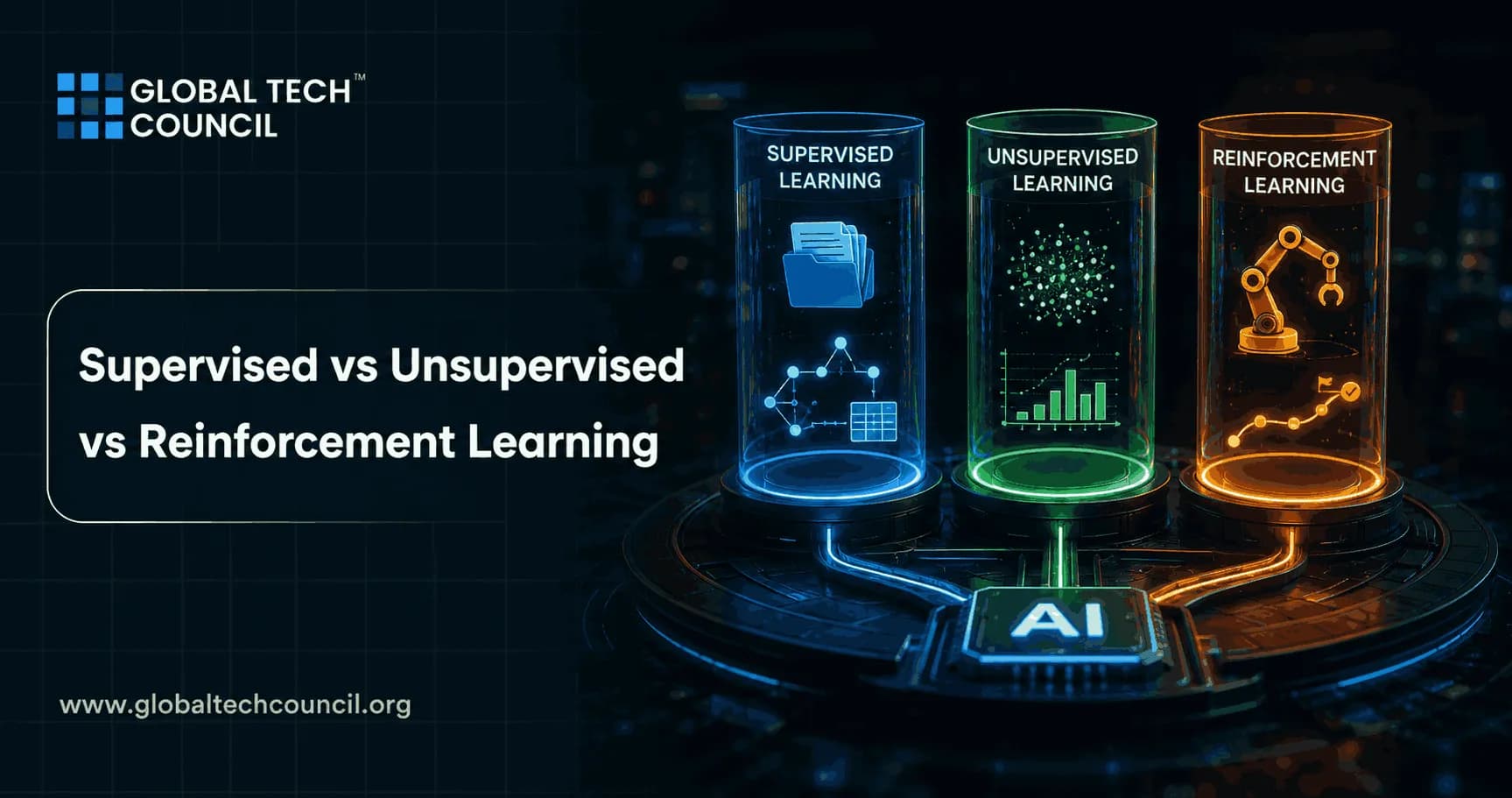
Supervised vs unsupervised vs reinforcement learning is one of the most practical comparisons in machine learning because each paradigm learns from a different type of feedback: labeled targets, unlabeled structure, or rewards from interaction. Understanding these differences helps professionals choose the right approach for prediction, pattern discovery, or sequential decision-making in real systems.
As machine learning adoption expands across industries, organizations increasingly need professionals who can identify the right learning paradigm, evaluate model performance, and align technical approaches with business objectives. Becoming a Machine Learning Expert helps practitioners build the expertise required to design, deploy, and optimize supervised, unsupervised, and reinforcement learning solutions across real-world environments.

What Is the Difference Between Supervised, Unsupervised, and Reinforcement Learning?
The three paradigms differ primarily by the data and feedback they rely on:
Supervised learning learns from labeled data to predict known outcomes.
Unsupervised learning learns from unlabeled data to discover patterns, groupings, or representations.
Reinforcement learning learns through rewards and penalties by taking actions in an environment over time.
Supervised learning dominates many production deployments because businesses frequently have historical records with clear targets. Unsupervised learning becomes critical when labels are costly or unavailable, and reinforcement learning is best suited to interactive control problems where decisions unfold sequentially.
Supervised Learning: Mapping Inputs to Outputs
Supervised learning trains a model on examples where each input has a correct output label. The model learns a mapping from features to targets and then generalizes to new data. This paradigm is especially effective when you can define a clear success metric and have reliable training labels.
Common Supervised Learning Tasks
Classification: predict a discrete class, such as spam vs not spam.
Regression: predict a continuous value, such as sales volume or house price.
Typical Supervised Learning Algorithms
Linear regression and logistic regression
Support vector machines (SVM)
k-nearest neighbors (k-NN)
Decision trees, random forests, gradient boosting
Deep neural networks (including CNNs and transformer-based models in modern workflows)
Real-World Examples of Supervised Learning
Credit risk evaluation: predicting probability of default using labeled historical loan outcomes (defaulted vs repaid).
Fraud detection: predicting whether a transaction is fraudulent using past fraud labels.
Demand forecasting: predicting future sales or inventory requirements using historical data and known outcomes.
Medical image classification: classifying images as benign vs malignant when expert labels are available.
Email spam filtering: learning from labeled spam and non-spam examples.
Strengths and Limitations
Strength: typically achieves high predictive performance when labels are accurate and representative.
Limitation: requires large, well-labeled datasets. Label bias can translate directly into model bias, which raises the importance of fairness, robustness, and explainability in sensitive domains like lending and healthcare.
Unsupervised Learning: Discovering Structure in Unlabeled Data
Unsupervised learning works with datasets that have no ground-truth labels. Rather than predicting a known target, the model identifies hidden structure such as clusters, associations, or lower-dimensional representations. This is often the starting point when organizations have large volumes of behavioral, sensor, or log data with limited labeling capacity.
Common Unsupervised Learning Tasks
Clustering: group similar records, such as customer segments based on behavior.
Association rule mining: identify co-occurrence patterns, such as products frequently bought together.
Dimensionality reduction: compress high-dimensional data into fewer informative features.
Typical Unsupervised Learning Algorithms
K-means and fuzzy C-means
Hierarchical clustering
Apriori for association rules
Principal component analysis (PCA)
Autoencoders for representation learning
Real-World Examples of Unsupervised Learning
Customer segmentation: clustering customers by spend patterns, product preferences, or engagement to inform marketing and personalization strategies.
Anomaly detection: identifying unusual network traffic patterns or abnormal sensor readings that deviate from typical clusters and distributions.
Recommendation systems: learning user-item similarity or latent factors from co-occurrence and interaction patterns.
Market basket analysis: discovering that certain products are often purchased together using association rules.
Preprocessing for downstream modeling: applying dimensionality reduction to create compact features before supervised training.
Strengths and Limitations
Strength: does not require labels, making it valuable for data exploration and feature learning when labeling is expensive or impractical.
Limitation: evaluation is inherently harder. Cluster quality can be subjective and results may vary with algorithm choices and hyperparameters. Unsupervised outputs generally require domain validation before driving business decisions.
Reinforcement Learning: Learning by Acting to Maximize Reward
Reinforcement learning (RL) is designed for problems where an agent must take actions in an environment to maximize cumulative reward. Unlike supervised learning, there is no fixed labeled dataset. The agent learns from experience, often formalized as a Markov decision process (MDP), where actions influence future states and rewards can be delayed.
Typical Reinforcement Learning Algorithms
Q-learning
SARSA
Policy gradient methods
Actor-critic approaches
In many modern applications, deep reinforcement learning combines deep neural networks with RL to handle high-dimensional inputs such as images. Practical RL implementations frequently rely on simulation-based training before transferring policies into controlled real-world systems.
Real-World Examples of Reinforcement Learning
Games and simulations: training agents to win games or achieve higher scores through reward feedback.
Robotics and control: learning grasping or locomotion policies through trial and error, typically first in simulation for safety and speed.
Self-driving and driver-assist systems: optimizing sequential decisions such as braking and steering under safety and comfort constraints.
Healthcare decision support: exploring sequential treatment strategies where rewards correspond to patient outcomes, subject to strict safety and ethical requirements.
Strengths and Limitations
Strength: the most direct fit for sequential decision-making where actions affect future outcomes and short-term versus long-term utility must be balanced.
Limitation: often computationally intensive and data-inefficient. It requires carefully designed reward functions and safe training environments, particularly in high-stakes domains.
Supervised vs Unsupervised vs Reinforcement Learning: Side-by-Side Comparison
1) Type of Feedback
Supervised: direct labels (targets).
Unsupervised: no labels, only patterns in the data.
Reinforcement: rewards or penalties after actions.
2) Primary Objective
Supervised: predict y from x.
Unsupervised: learn structure or representations of x.
Reinforcement: learn a policy for choosing actions that maximize long-term reward.
3) Evaluation Approach
Supervised: clear metrics such as accuracy, AUC, precision-recall, and RMSE on held-out labeled data.
Unsupervised: indirect evaluation, for example cluster coherence, stability, or downstream usefulness.
Reinforcement: average reward, success rate, or performance in simulation and controlled tests.
4) Complexity and Data Requirements
Supervised: often simpler to operationalize once labels exist, though labeling can be expensive and time-consuming.
Unsupervised: can be more complex because the system must infer structure without ground truth.
Reinforcement: frequently the most complex due to exploration requirements, delayed rewards, and large state-action spaces.
How to Choose the Right Approach in Practice
A practical decision framework used across engineering teams begins with three questions:
Do you have labeled data and a clear target? If yes, start with supervised learning.
Do you need to understand the data or find segments and anomalies? If yes, use unsupervised learning.
Does the system need to make sequential decisions over time with delayed outcomes? If yes, consider reinforcement learning, typically with simulation and safety constraints in place.
Many machine learning initiatives ultimately support business goals such as customer acquisition, retention, personalization, demand forecasting, and revenue growth. A Marketing Certification helps professionals understand how customer behavior, analytics, segmentation, and business strategy can be combined with machine learning insights to drive measurable commercial outcomes.
Hybrid Workflows Are Common in Practice
Real deployments frequently combine paradigms:
Unsupervised clustering to define customer segments.
Supervised models to predict churn or conversion within each segment.
Reinforcement learning to optimize a sequence of actions, such as selecting the best next offer over time under business rules.
Current practice also shows increasing use of self-supervised pretraining and other label-efficient methods to reduce labeling effort while still delivering strong supervised performance for core prediction tasks.
Beyond understanding individual learning paradigms, professionals increasingly need a broader perspective on AI governance, responsible AI practices, model risk management, explainability, and deployment oversight. An AI Certification provides foundational knowledge across these areas, helping practitioners evaluate, implement, and manage AI systems with greater technical confidence and strategic awareness throughout their lifecycle.
Conclusion
Supervised vs unsupervised vs reinforcement learning is fundamentally a comparison of what signal the model learns from: labels, structure, or rewards. Supervised learning is typically the best fit for prediction tasks when labeled outcomes exist. Unsupervised learning is essential for exploring and organizing large unlabeled datasets. Reinforcement learning addresses interactive problems where decisions unfold over time and success depends on long-term reward accumulation.
For professionals building real-world machine learning systems, the most reliable approach is to define the business objective clearly, audit available data and feedback signals, and choose the simplest paradigm that fits the problem. When needed, combine paradigms to progress from understanding data, to predicting outcomes, to optimizing decisions in production.
FAQs
What are the main types of machine learning?
The three primary types of machine learning are Supervised Learning, Unsupervised Learning, and Reinforcement Learning. Each uses a different approach to learning from data and solving problems.
What is supervised learning?
Supervised learning is a machine learning approach where models are trained using labeled data, meaning the correct answers are already known during training.
How does supervised learning work?
The model learns the relationship between input data and known outputs, then uses that knowledge to make predictions on new data.
What are common examples of supervised learning?
Examples include spam detection, sentiment analysis, fraud detection, customer churn prediction, image classification, and house price prediction.
What is unsupervised learning?
Unsupervised learning is a machine learning approach where models analyze unlabeled data to discover hidden patterns, structures, or relationships without predefined outcomes.
How does unsupervised learning work?
The algorithm examines data independently and groups, organizes, or identifies patterns based on similarities and differences.
What are common examples of unsupervised learning?
Examples include customer segmentation, recommendation systems, anomaly detection, market basket analysis, and topic modeling.
What is reinforcement learning?
Reinforcement learning is a machine learning method where an agent learns by interacting with an environment and receiving rewards or penalties based on its actions.
How does reinforcement learning work?
The agent performs actions, observes outcomes, receives feedback, and continuously adjusts its strategy to maximize long-term rewards.
What are common examples of reinforcement learning?
Examples include robotics, autonomous vehicles, game-playing AI, recommendation optimization, supply chain management, and dynamic pricing systems.
What type of data is used in supervised learning?
Supervised learning requires labeled datasets where both the input data and the correct output values are available.
What type of data is used in unsupervised learning?
Unsupervised learning uses unlabeled data where the algorithm must identify patterns without predefined categories or target values.
Does reinforcement learning require labeled data?
No. Reinforcement learning learns through trial and error using rewards and penalties rather than labeled datasets.
Which machine learning type is best for prediction tasks?
Supervised learning is typically the best choice for prediction tasks because it learns from known outcomes and can forecast future results.
Which machine learning type is best for discovering hidden patterns?
Unsupervised learning is designed to uncover hidden structures, relationships, and groupings within data.
What are the advantages of supervised learning?
Supervised learning often provides high accuracy, clear evaluation metrics, and strong performance when quality labeled data is available.
What are the advantages of unsupervised learning?
Unsupervised learning can analyze large amounts of unlabeled data, identify hidden insights, and support exploratory data analysis.
What are the advantages of reinforcement learning?
Reinforcement learning excels in dynamic environments where decisions must be optimized continuously based on changing conditions.
What are the challenges of each learning type?
Supervised learning requires large labeled datasets, unsupervised learning can produce difficult-to-interpret results, and reinforcement learning often demands significant computational resources and training time.
How do you choose between supervised, unsupervised, and reinforcement learning?
Choose supervised learning when you have labeled data and clear prediction goals, unsupervised learning when you need to discover patterns in unlabeled data, and reinforcement learning when an agent must learn optimal actions through interaction and feedback.
Related Articles
View All
Machine Learning
Machine Learning vs Artificial Intelligence: Key Differences and Examples
Understand Machine Learning vs Artificial Intelligence with clear definitions, examples, use cases, differences, and practical learning paths.

Machine Learning
Types of Machine Learning: Supervised, Unsupervised, Reinforcement, and More
A practical guide to the main types of machine learning, how they work, where they fit, and how professionals should choose the right approach.

Machine Learning
Unsupervised Learning Explained: Clustering, Patterns, and Real-World Applications
Learn how unsupervised learning finds clusters, anomalies, and hidden patterns in unlabeled data, with practical use cases across security, healthcare, supply chain, and marketing.
Trending Articles
The Role of Blockchain in Ethical AI Development
How blockchain technology is being used to promote transparency and accountability in artificial intelligence systems.
AWS Career Roadmap
A step-by-step guide to building a successful career in Amazon Web Services cloud computing.
Top 5 DeFi Platforms
Explore the leading decentralized finance platforms and what makes each one unique in the evolving DeFi landscape.