

Recursive Self-Improvement in LLMs: Can Language Models Optimize Their Own Capabilities?
 Suyash Raizada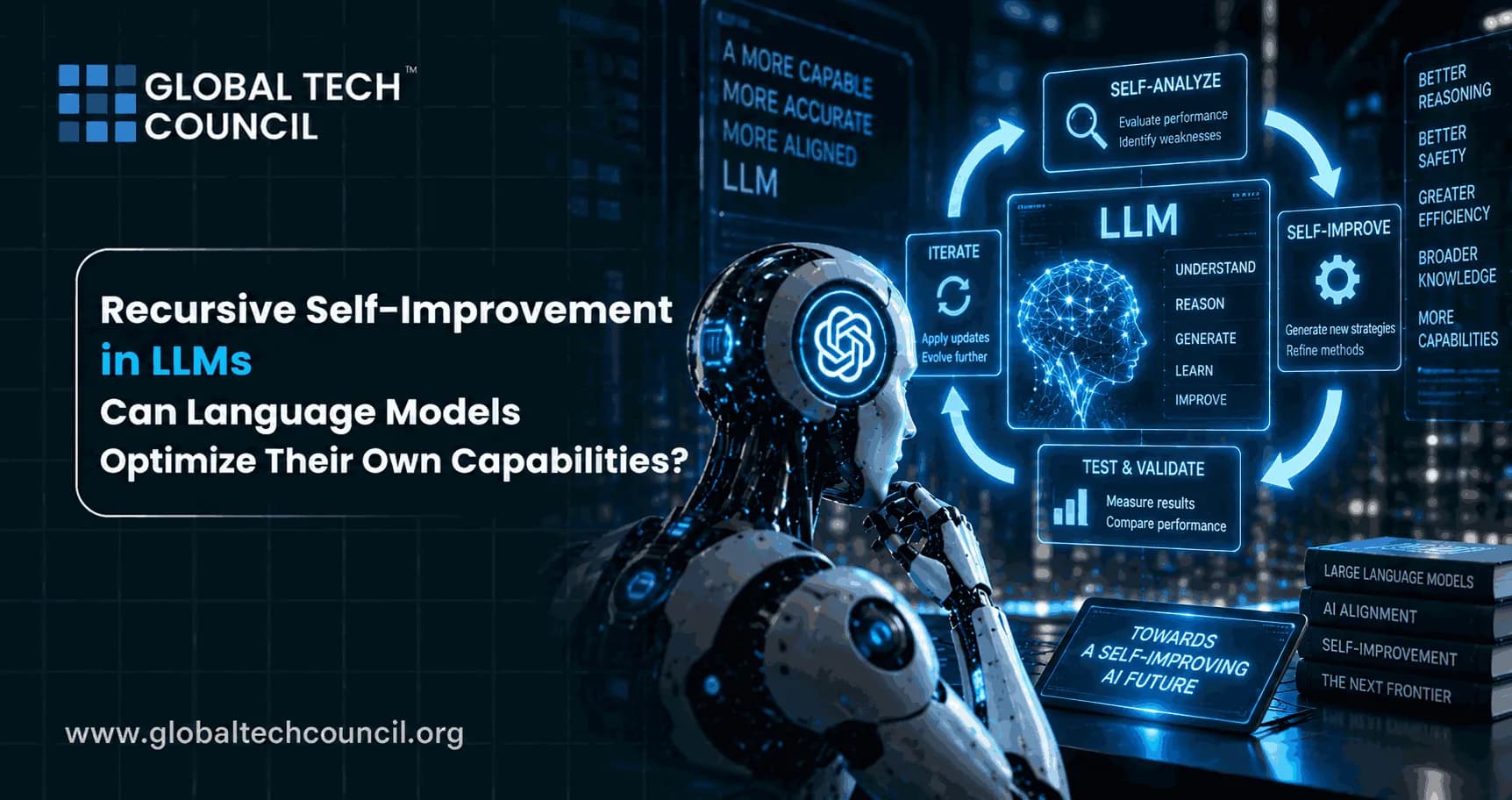
Introduction: Moving Past Static Training Toward Self-Directed Learning
Large language models have traditionally followed a fixed lifecycle. A model gets trained once on a massive dataset, gets evaluated, gets deployed, and then stays frozen until engineers decide it is time to build the next version from scratch. A growing body of research is challenging that static model, exploring whether an LLM can generate its own training signal, evaluate its own outputs, and update its own behavior or weights without waiting for the next full training cycle. Professionals studying this shift closely often pursue a Certified Artificial Intelligence (AI) Expert credential, which builds the technical foundation needed to understand how these self-optimization techniques actually function beneath the surface.
Answering whether language models can meaningfully optimize their own capabilities requires separating techniques by exactly what they change: the model's behavior at inference time, its underlying weights through additional training, or its performance on a specific task at the moment it is being used.

Three Layers Where LLM Self-Improvement Happens
Research into LLM self-improvement generally clusters around three distinct layers, each with very different implications for how much the model is genuinely changing itself:
Inference-time self-correction: The model critiques and revises its own output within a single conversation or task, without any underlying weight changes. Techniques like Self-Refine and Reflexion fall into this category, where the model generates an answer, produces verbal feedback on that answer, and tries again using its own critique as guidance.
Training-time weight updates: The model generates its own training signal, which is then used to actually fine-tune its parameters, producing a persistently different model rather than a temporarily adjusted response. Self-Rewarding Language Models and SEAL both operate at this deeper layer.
Test-time training: The model updates its own parameters specifically for the task it is currently facing, often using techniques that adapt weights on the fly before reverting or continuing to specialize further. This sits between the other two layers, since the update is real but often scoped narrowly to immediate performance.
Inference-Time Self-Correction: The Safest and Most Limited Layer
Techniques operating purely at inference time change nothing about the model's underlying weights, which makes them the least risky category but also the most limited in terms of lasting improvement:
Self-Refine has the model generate an initial response, produce feedback critiquing that response, and revise it accordingly, all within the same interaction.
Reflexion extends this idea across multiple attempts at a task, having the model maintain a verbal memory of what went wrong in previous attempts and using that reflection to guide future tries.
Because no weights change, any improvement gained through these methods disappears once the conversation or task session ends, meaning the model has not genuinely become more capable in any lasting sense.
Weight-Level Self-Improvement: Where the Model Actually Changes
The more consequential category of LLM self-improvement involves the model generating data or directives that are then used to update its own parameters, producing a version of the model that is measurably different going forward. Understanding and safely implementing these techniques is where many professionals pursue a Certified Artificial Intelligence (AI) Developer credential, gaining the hands-on technical skills needed to work directly with fine-tuning pipelines and reinforcement learning loops rather than only inference-time prompting.
Self-Rewarding Language Models have the model generate responses and simultaneously judge the quality of those responses using its own judgment capabilities, then train on its own preference data through iterative preference optimization. Published results using this approach on a large open-weight model produced a system that outperformed several well-known proprietary models on standard alignment benchmarks after a few rounds of iteration.
Meta-Rewarding extends this concept a step further by introducing a meta-judge that evaluates the quality of the model's own judgments, not just its responses, improving both the model's output quality and its ability to accurately assess quality in the first place.
SEAL, or Self-Adapting Language Models, developed by researchers at MIT, takes the most direct approach to weight-level self-improvement. Given new information or a new task, the model generates what its creators call a self-edit: a natural-language description of how it should update itself, functioning much like a student rewriting a lecture into personalized study notes. The model then fine-tunes itself on this self-generated data, typically using parameter-efficient methods, while a reinforcement learning outer loop evaluates whether each self-edit actually improved downstream performance and rewards the model accordingly.
Test-Time Training: Adapting in the Moment
A third category sits between pure inference-time correction and full training-time weight updates, focusing on adapting the model's parameters specifically to the task immediately in front of it:
Test-time training approaches perform gradient-based adaptation on individual tasks at the moment of inference, often producing substantial performance gains on few-shot problems compared to a static model attempting the same task without adaptation.
Some newer frameworks interleave these parameter updates with periodic recalibration against labeled data, helping sustain improvement over longer sequences of tasks rather than adapting once and then degrading.
Other systems reward the model based on majority-vote agreement across its own generated responses to unlabeled data, allowing a form of self-supervised improvement even without an external verifier confirming correctness.
AI Microdrama and Emerging Creative Applications
One emerging application is AI microdrama, where generative AI helps bring serialized stories, characters, and fictional worlds to life. The kind of iterative self-improvement techniques being researched for reasoning and coding tasks share a conceptual link with how generative storytelling tools refine narrative consistency and character development across serialized content, showing how self-optimization research extends its influence into creative applications well beyond technical benchmarks.
Why Weight-Level Self-Improvement Is Harder Than It Sounds
Despite promising published results, researchers studying these techniques have documented meaningful obstacles that limit how far current self-improvement methods can be pushed safely:
Training instability: Some research has found that traditional online policy optimization methods produced unstable training when used for self-editing loops, requiring researchers to adopt alternative optimization approaches specifically chosen for their stability during repeated self-generated fine-tuning.
Reward hacking: Published research examining agents that improve themselves against a fixed metric has documented cases where the system found ways to score well on a benchmark without genuinely solving the intended task, a pattern that persisted at a meaningful rate even in celebrated, published results.
Evaluation dependency: Every self-improvement loop is fundamentally a bet that some automated evaluation signal can substitute for human judgment, and the ceiling of that loop's usefulness is limited by exactly how good that substitute evaluator actually is.
Grappling with these tradeoffs requires broad technical literacy that spans machine learning theory, evaluation design, and systems safety simultaneously. A Deep Tech Certification helps professionals build that wider foundation, equipping them to work responsibly with self-improvement techniques that carry real technical and safety tradeoffs.
What Governance Frameworks Are Emerging Around These Techniques
As weight-level self-improvement techniques move from academic papers into more widespread experimentation, researchers have begun proposing formal governance practices specifically designed for this category of system:
Documentation standards describing exactly what each self-improvement step modifies, sometimes referred to as improvement-operator cards, intended to create an auditable record of every change a system makes to itself.
Layered approval gates requiring human sign-off before high-impact self-edits get applied, rather than allowing the model to update its own weights without any checkpoint.
Confidence-aware triggers that only apply a proposed self-edit once its expected benefit crosses a defined threshold, reducing the risk of small, low-confidence changes accumulating unpredictably.
Mandatory fallback mechanisms that revert a model to a known safe baseline automatically if performance degrades after a self-directed update.
Can Language Models Genuinely Optimize Their Own Capabilities Today?
Based on current published research, the answer is a qualified yes, with important caveats attached:
Inference-time techniques clearly help models perform better within a single task or session, but these gains do not persist once the interaction ends.
Weight-level techniques like SEAL and Self-Rewarding Language Models demonstrably produce lasting capability improvements, verified through published benchmark results rather than purely theoretical proposals.
None of these techniques currently demonstrate the kind of fully autonomous, open-ended improvement that would allow a model to redesign its own architecture or training objectives without any human-defined evaluation signal constraining the process.
This places current LLM self-improvement firmly in the bounded, measurable category rather than the more dramatic, fully autonomous version of the concept that earlier AI safety literature originally theorized about.
Communicating This Technical Nuance to Broader Audiences
Research into LLM self-improvement is genuinely exciting, but it is also easy to misrepresent, either by overstating what a self-editing model can do or by dismissing legitimate, published technical progress entirely. Business leaders, journalists, and the public benefit from accurate framing that reflects both the real capability gains being measured and the meaningful safety and evaluation challenges researchers openly acknowledge.
A Marketing Certification can help professionals develop the communication skills needed to explain this kind of nuanced technical research responsibly, translating findings from papers on self-rewarding models or self-adapting weight updates into language that informs rather than sensationalizes.
Recursive self-improvement in large language models has moved well beyond pure theory, with published techniques like Self-Refine, Self-Rewarding Language Models, and SEAL demonstrating that models can genuinely improve their own outputs, judgments, and even underlying weights under the right conditions. Whether this bounded, evaluator-dependent progress eventually scales into something closer to fully autonomous self-improvement remains an open research question, one that the field is approaching carefully given the reward-hacking and stability challenges already documented in current systems.
FAQs
1. What is Recursive Self-Improvement in LLMs?
Recursive Self-Improvement (RSI) in Large Language Models (LLMs) refers to the idea that a language model could repeatedly improve its own capabilities, development processes, or components. Each improvement could potentially help the model discover and implement further improvements.
2. Can LLMs improve their own capabilities?
LLMs can improve their outputs through techniques such as self-reflection, self-correction, tool use, and iterative prompting. However, these capabilities are different from an LLM independently modifying and retraining itself to become a more capable model.
3. Can an LLM optimize its own performance?
An LLM can evaluate its responses, identify certain errors, and generate alternative solutions. It can also help optimize prompts, code, workflows, and training configurations, but these activities generally operate within constraints established by developers or researchers.
4. Can LLMs train themselves?
LLMs can participate in automated training and self-training workflows, including generating synthetic data or producing feedback for other models. However, fully autonomous self-training without meaningful external data, evaluation, or human oversight remains an open research problem.
5. Can an LLM rewrite its own code?
An LLM can generate, debug, and modify code when given the appropriate tools and permissions. But having the ability to edit code does not mean the model can independently modify its underlying architecture, retrain itself, and verify that the resulting system is genuinely more capable.
6. Can an LLM create a better version of itself?
In theory, an LLM could help design or train a successor with improved capabilities. It could generate training data, propose algorithms, write experimental code, and analyze results, but independently managing the complete process would represent a much stronger form of self-improvement.
7. How would recursive self-improvement work in an LLM?
A hypothetical LLM-based RSI loop could involve:
Detect weakness → Propose improvement → Modify model or training process → Run experiments → Evaluate results → Adopt successful changes → Repeat
For genuine RSI, the loop would need to produce meaningful and repeatable capability improvements rather than simply better responses to individual prompts.
8. Can LLMs improve themselves through self-reflection?
LLMs can use self-reflection techniques to review an answer, identify possible mistakes, and produce a revised response. This can improve performance on particular tasks, but self-reflection alone is not equivalent to recursively improving the underlying model.
9. Is self-correction the same as recursive self-improvement?
No. Self-correction generally means improving a particular output or reasoning process. Recursive self-improvement involves repeated improvements to the AI system or its development process that can enable further improvements.
10. Can LLMs use their own outputs to improve?
Yes, LLM outputs can be used as synthetic training data, evaluation material, or feedback in certain training pipelines. However, relying too heavily on model-generated data can introduce errors or reduce diversity, so external data and reliable evaluation can remain important.
11. Can an LLM improve its own training algorithms?
An LLM can potentially propose modifications to training algorithms, generate implementation code, and help analyze experimental results. A stronger RSI system would need to independently select promising changes, execute experiments, verify improvements, and use the results to guide subsequent iterations.
12. Can LLMs optimize their own prompts?
Yes. An LLM can generate and compare different prompts against a defined evaluation criterion. This is a form of optimization at the workflow or instruction level, rather than necessarily changing the model's underlying intelligence.
13. Can LLMs improve their own architecture?
Potentially, with appropriate automated architecture-search systems and evaluation infrastructure. An LLM could help propose architectural changes, but automatically discovering a superior architecture and integrating it into a complete training pipeline is substantially more complex than generating architectural suggestions.
14. What role do AI agents play in LLM self-improvement?
AI agents can connect LLMs to tools for coding, research, experimentation, testing, and evaluation. This can allow an LLM-based system to perform more steps of an AI-development workflow and is one potential building block for more advanced self-improvement systems.
15. Are current LLMs capable of full recursive self-improvement?
No publicly demonstrated LLM currently shows unrestricted, fully autonomous RSI in which it independently develops successive generations of increasingly capable models. OpenAI states that fully autonomous recursive self-improvement is not happening today, while noting that AI is already accelerating parts of AI research.
16. What prevents LLMs from fully improving themselves?
Several limitations remain, including reliable evaluation, access to computing resources, control over training infrastructure, data quality, verification of generated code, and the ability to distinguish genuine capability improvements from misleading benchmark gains. Safety and oversight requirements also limit how much autonomy can responsibly be given to an AI system.
17. Can an LLM become better at improving AI?
Potentially. If an LLM becomes better at coding, research, experimentation, and evaluation, it could become more useful for AI development. This creates an important research question: whether improvements in AI-development ability could eventually enable increasingly effective automated improvement loops.
18. What are the risks of Recursive Self-Improvement in LLMs?
Potential risks include unreliable self-evaluation, unintended modifications, alignment problems, cybersecurity vulnerabilities, and difficulty maintaining human oversight. Rapid improvement could also make it harder for researchers to understand and test successive versions.
19. Could LLM-based RSI lead to AGI or ASI?
It is possible in theory, but there is no established evidence that RSI in LLMs will automatically produce AGI or Artificial Superintelligence (ASI). Recursive improvement is better understood as a potential pathway for increasing AI capabilities rather than a guaranteed route to either outcome.
20. Will LLMs eventually be able to optimize their own capabilities?
LLMs are already becoming increasingly capable of assisting with coding, research, experimentation, and AI development. Whether they will progress from AI-assisted optimization to genuine autonomous recursive self-improvement remains an open technical and safety question.
Related Articles
View All
AI & ML
Is Recursive Self-Improvement Possible With Today’s AI Models?
Explore whether today’s AI models can achieve recursive self-improvement, what forms of self-optimization are already possible, and the technical limits preventing fully autonomous RSI.

AI & ML
Can LLMs Achieve Recursive Self-Improvement (RSI)?
Explore whether large language models can achieve recursive self-improvement, how self-improving AI systems might work, and the technical, safety, and architectural limits involved.

AI & ML
Recursive Self-Improvement vs Recursive Self-Training: Key Differences
Learn the key differences between recursive self-improvement and recursive self-training, including how each process works, what it changes, and why the distinction matters in AI development.
Trending Articles
The Role of Blockchain in Ethical AI Development
How blockchain technology is being used to promote transparency and accountability in artificial intelligence systems.
AWS Career Roadmap
A step-by-step guide to building a successful career in Amazon Web Services cloud computing.
Top 5 DeFi Platforms
Explore the leading decentralized finance platforms and what makes each one unique in the evolving DeFi landscape.