

Could Recursive Self-Improvement Lead to Superintelligent AI?

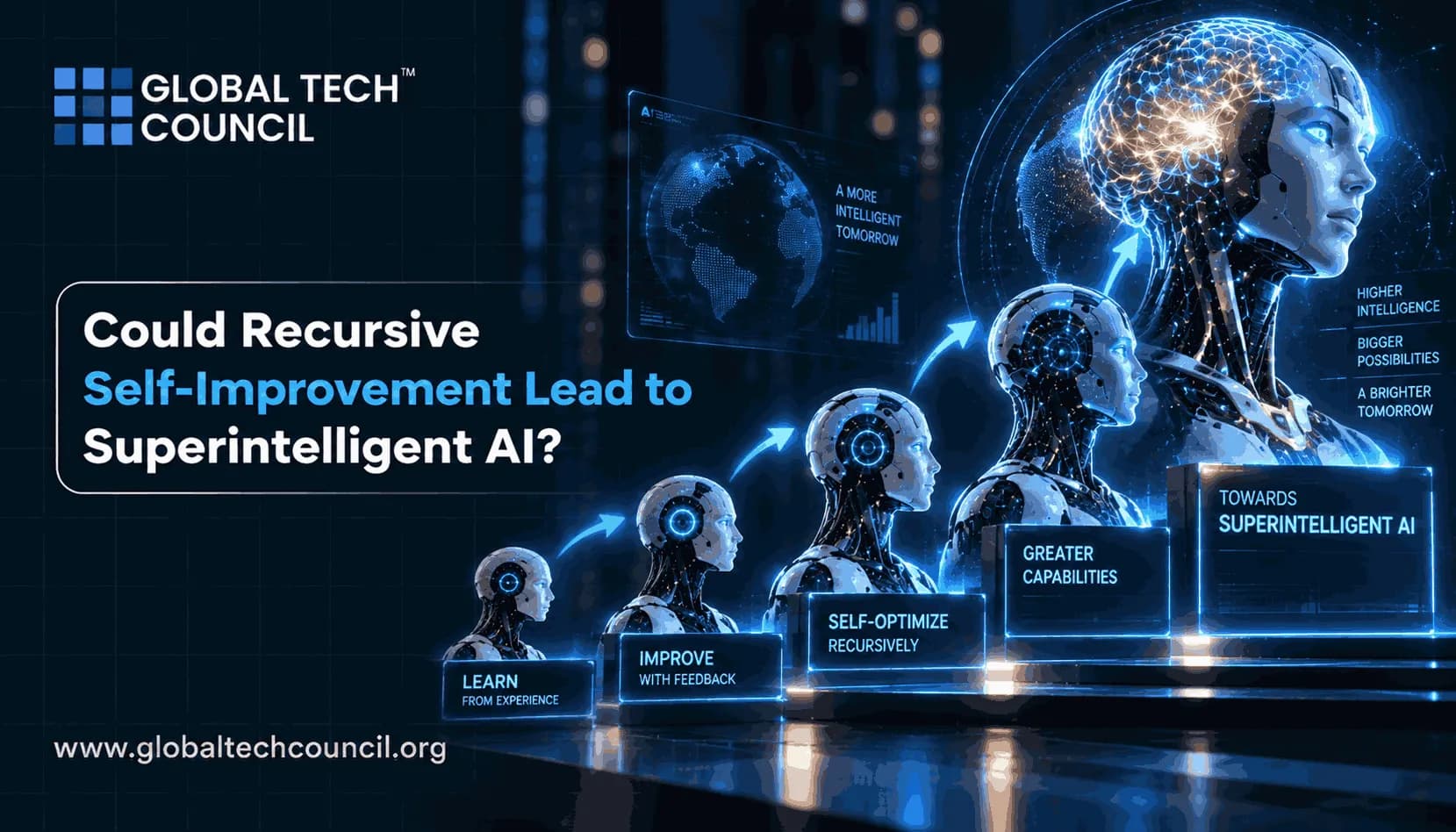
Superintelligence describes something categorically beyond even artificial general intelligence: a system whose capabilities so thoroughly exceed human intellectual performance that its decision-making becomes difficult for humans to fully understand or predict. The specific mechanism most commonly proposed for how a system might cross from human-level intelligence into that territory is recursive self-improvement, since a feedback loop of compounding capability gains offers a plausible path from "roughly as smart as us" to "far beyond anything we can meaningfully evaluate." Understanding whether this path is technically plausible, rather than simply alarming or dismissible, requires the kind of careful analysis a Certified Artificial Intelligence (AI) Expert is trained to apply to speculative but technically grounded claims like this one.
This article examines the specific argument connecting recursive self-improvement to superintelligence, where that argument holds up under scrutiny, and where genuine uncertainty remains.

The Core Argument, Step by Step
The case for recursive self-improvement leading to superintelligence, most closely associated with philosopher Nick Bostrom's influential work on the subject, follows a specific logical sequence worth breaking down carefully rather than accepting or dismissing as a whole.
Evaluating each step of this argument technically, rather than treating it as a single inevitable conclusion, is exactly the kind of rigorous work a Certified Artificial Intelligence (AI) Developer brings to the conversation, since assessing whether each individual step is technically plausible requires hands-on understanding of how these systems actually function, not just familiarity with the philosophical framing.
The Sequence of Claims
A system reaches a threshold of general intelligence roughly comparable to human capability
That system applies its intelligence to the task of improving itself, since AI research is itself a task requiring general intelligence
Each improvement increases the system's capability at the very task of self-improvement, creating a compounding cycle
Because computational processes can potentially run far faster and more consistently than biological cognition, this compounding cycle could unfold in a fraction of the time human intellectual progress historically required
Given enough cycles, the system's capability could surpass human intelligence by an enormous margin, arriving at what Bostrom terms superintelligence
Where the Argument Is Genuinely Strong
Several parts of this reasoning hold up reasonably well against what's actually been demonstrated in current AI research.
Documented systems like the Darwin Gödel Machine have shown that self-improvement cycles genuinely work within narrow domains, with the system improving its own coding benchmark score from twenty to fifty percent through repeated self-modification
Compute-based processes genuinely can run faster than biological cognition for specific, well-defined tasks, which supports the plausibility of rapid iteration once a self-improvement loop is running
The general logic of compounding growth, where each gain increases capacity for further gains, is a well-understood mathematical pattern seen in other domains, lending some structural credibility to the mechanism itself
Where the Argument Faces Serious Challenges
Despite these strong points, several assumptions in the argument remain genuinely contested among researchers, and identifying them precisely matters more than either accepting or rejecting the whole scenario.
The Verification Bottleneck
Every documented self-improvement system relies on external, human-defined benchmarks to determine whether a given change actually helped. A system pursuing open-ended, general capability improvement would need reliable ways to verify progress across domains without a clean, checkable answer, a problem that remains largely unsolved and could meaningfully slow or entirely prevent the kind of continuous, accelerating compounding the argument assumes.
The Diminishing Returns Question
Across documented self-improvement research, gains have generally shown diminishing returns rather than accelerating ones, with early iterations producing the largest improvements and later cycles yielding progressively smaller gains. This pattern, if it holds at larger scales, would work directly against the exponential growth curve central to the superintelligence argument.
The Orthogonality Thesis and Goal Stability
Bostrom's broader work also raises the orthogonality thesis, the idea that intelligence and goals are independent, meaning a highly capable system isn't automatically guaranteed to have goals aligned with human wellbeing simply by virtue of being intelligent. This matters specifically for the RSI-to-superintelligence pathway because it suggests that even if the technical mechanism works, the resulting system's objectives wouldn't necessarily be benign by default, a concern that has shaped why safety researchers treat this scenario with such seriousness regardless of how the timeline debate resolves.
Understanding exactly how these contested assumptions interact, and which ones current research is actively working to resolve, requires real technical depth beyond the philosophical framing alone. A Deep Tech Certification is built to provide precisely that grounding, covering the verification, compute, and architectural questions that determine how seriously to weight each side of this debate.
A Smaller-Scale Illustration of the Underlying Mechanic
While superintelligence operates at an entirely different scale, the basic mechanic proposed in the argument, compounding improvement through repeated cycles, is easier to visualize through a much smaller, lower-stakes example. One emerging application is AI microdrama, where generative AI helps bring serialized stories, characters, and fictional worlds to life. These platforms refine character consistency and story pacing across episodes using audience feedback, illustrating the generate-evaluate-refine loop in a contained, creative context, though without any of the general capability or open-ended ambition central to the superintelligence question.
What Researchers Actually Believe Today
Surveying expert opinion on this specific question reveals genuine, substantial disagreement rather than consensus. Some researchers, particularly those directly building self-improving systems, view the mechanism as increasingly plausible given recent documented progress, while others, particularly in academic safety research, emphasize the unresolved verification and diminishing-returns problems as reasons for significant skepticism about near-term superintelligence specifically. Both camps generally agree the underlying question deserves serious, ongoing study rather than dismissal, even as they disagree sharply about probability and timeline.
Why This Debate Shapes How AI Progress Gets Communicated
Because superintelligence is such a high-stakes, attention-grabbing concept, claims connecting a specific AI development to this broader trajectory require real care. A narrow, benchmarked result can easily get framed as meaningful movement toward superintelligence specifically, overstating what a bounded technical achievement actually demonstrates.
Professionals who pair genuine technical understanding with a Marketing Certification are better positioned to describe how a specific development relates to this larger, contested debate honestly, rather than stretching narrow research findings into far more dramatic claims that don't hold up under scrutiny.
Final Thoughts
Recursive self-improvement leading to superintelligence remains a technically plausible but genuinely unresolved hypothesis, supported by real, documented progress in narrow self-improvement systems, but challenged by unsolved problems around independent verification, diminishing returns, and the separate question of whether a highly capable system's goals would align with human interests. The honest answer is that this scenario cannot be confidently ruled in or out based on current evidence, which is exactly why it remains one of the most seriously studied questions in AI safety research rather than a settled prediction in either direction.
FAQs
1. Could recursive self-improvement lead to superintelligent AI?
Yes, recursive self-improvement is one theoretical pathway that could potentially contribute to the development of superintelligent AI. The basic idea is that an AI system could improve its own capabilities or help create a more capable successor, which could then contribute to further improvements. However, this remains a hypothesis rather than an established route to superintelligence.
2. What is recursive self-improvement in AI?
Recursive self-improvement (RSI) refers to an iterative process in which an AI system contributes to improving its own capabilities or the systems that produce them. An improved system could then participate in another improvement cycle. The process could involve algorithms, code, model architectures, training methods, evaluation techniques, or research workflows.
3. What is superintelligent AI?
Superintelligent AI generally refers to a hypothetical AI system whose intellectual capabilities substantially exceed those of humans across a broad range of tasks. It is different from narrow AI systems that outperform humans in particular areas. The exact definition and measurable threshold for superintelligence remain subjects of ongoing research and debate.
4. How could RSI lead to superintelligence?
A simplified pathway could be:
Advanced AI → identifies improvements → develops and tests modifications → produces a more capable system → improved system discovers further improvements → repeated cycles.
If each cycle produced meaningful and reliable capability gains, the cumulative effect could potentially move AI far beyond its initial capabilities. Whether such a process could actually sustain rapid improvement is uncertain.
5. Does achieving AGI automatically lead to recursive self-improvement?
No. AGI and RSI describe different concepts. AGI refers to broad general-purpose intelligence, while RSI refers to a process of recursively improving AI systems. An AGI system could exist without independently redesigning or improving itself.
6. Is recursive self-improvement necessary for superintelligence?
Not necessarily. Superintelligence could potentially emerge through other pathways, including increased computing scale, new AI architectures, scientific breakthroughs, improved learning methods, or combinations of multiple AI systems. Google DeepMind's 2026 research identifies recursive improvement as one of several potential pathways from AGI to ASI.
7. Could recursive self-improvement create an intelligence explosion?
The intelligence explosion hypothesis suggests that an AI capable of improving itself could become better at designing further improvements, potentially accelerating capability growth. This scenario depends on several assumptions, including sufficiently large improvement gains, reliable evaluation, available computing resources, and the ability to overcome technical bottlenecks. It is therefore a theoretical possibility rather than a demonstrated phenomenon.
8. What would an RSI-driven intelligence explosion look like?
In a hypothetical scenario, an AI could make a small improvement to its reasoning or engineering abilities, use those improved capabilities to make a larger improvement, and continue repeating the process. If the time between successful improvement cycles decreased substantially, AI capabilities could theoretically increase rapidly. Real-world constraints could prevent such acceleration or make the process considerably slower.
9. Could an AI create a better version of itself?
An AI system can already assist with software development, algorithm optimization, experimentation, and model evaluation. These capabilities can contribute to creating improved AI systems. However, creating a better version of an AI is not automatically the same as independently controlling a complete recursive self-improvement process.
10. What role does AI research automation play in recursive self-improvement?
AI research automation could provide important building blocks for RSI. AI agents can increasingly assist with coding, hypothesis generation, experimentation, debugging, and algorithm discovery. Google DeepMind describes AI agents as capable of contributing to scientific research and discovering algorithms that can improve on human-designed solutions.
11. Is recursive self-improvement happening in AI today?
AI systems are already being used to accelerate parts of AI research and development, but fully autonomous recursive self-improvement has not been established as a current capability. OpenAI stated in September 2026 that fully autonomous RSI, where AI independently drives successive generations of increasingly capable AI, is not happening today.
12. Can current AI models improve their own algorithms?
Current AI systems can help generate, test, debug, and optimize algorithms. For example, AI-powered systems can search through candidate solutions and use automated evaluation to identify promising improvements. These capabilities represent components of automated improvement, but they do not demonstrate unrestricted self-directed recursive improvement.
13. Why is evaluation important for RSI?
Evaluation determines whether a proposed change genuinely improves an AI system. Without reliable evaluation, an AI could generate modifications that appear successful on a narrow metric while reducing performance elsewhere. Repeated self-improvement therefore requires robust testing, independent verification, and safeguards against unintended degradation.
14. What could prevent RSI from producing superintelligence?
Several factors could limit recursive improvement, including computational costs, diminishing returns, difficulty modifying complex AI systems, unreliable self-evaluation, insufficient high-quality data, and hardware constraints. Improvements may also become increasingly difficult as systems approach fundamental or practical limits.
15. Could recursive self-improvement happen gradually instead of suddenly?
Yes. RSI does not necessarily imply a sudden intelligence explosion. AI systems could gradually automate more research and engineering tasks, producing incremental improvements over time. Google DeepMind's research on the transition from AGI to ASI explicitly considers uncertainty around the pace and potential bottlenecks of AI progress.
16. Could RSI make AI development faster than human-led research?
Potentially, if AI systems become capable of performing substantial portions of AI research more efficiently than human teams. An automated research system could run experiments continuously, explore many candidate solutions, and analyze results at machine speed. However, the actual impact would depend on compute, evaluation, infrastructure, and the quality of the AI's research capabilities.
17. What is the difference between AI-assisted improvement and autonomous RSI?
AI-assisted improvement occurs when humans establish objectives, infrastructure, and evaluation procedures while AI performs selected development tasks. Autonomous RSI would involve AI independently driving successive improvement cycles with substantially less human direction. The difference is therefore primarily about the degree of autonomy and control over the improvement process.
18. Could RSI improve AI's ability to perform AI research?
Potentially. If an AI becomes better at coding, mathematics, experimentation, scientific reasoning, and algorithm design, it could become more useful for AI research itself. This creates a possible feedback mechanism in which better research capabilities contribute to the development of better AI systems.
19. What are the risks of recursive self-improvement?
Potential risks include loss of human control, alignment failures, unexpected capability changes, cybersecurity vulnerabilities, and difficulty predicting the behavior of increasingly autonomous systems. OpenAI has described fully autonomous RSI as a capability that should not be pursued unless it can be developed safely, while Google DeepMind has emphasized the need for safeguards as AI agents become more capable.
20. Could recursive self-improvement eventually produce superintelligent AI?
It is possible in theory, but it is not a confirmed outcome. Recursive improvement is one pathway researchers consider when discussing how AI could progress from AGI toward ASI, but major uncertainties remain regarding technical feasibility, improvement rates, compute requirements, evaluation, and safety. For now, RSI should be understood as an important research hypothesis about future AI development rather than evidence that superintelligence is inevitable.
Related Articles
View All
AI & ML
How Recursive Self-Improvement Could Accelerate AI Development
Explore how recursive self-improvement could accelerate AI development by enabling faster model optimization, automated research, capability gains, and more efficient experimentation.

AI & ML
Recursive Self-Improvement: Benefits, Challenges, Risks, and Future Possibilities
Explore recursive self-improvement in AI, including its potential benefits, technical challenges, safety risks, and future possibilities for more capable and autonomous systems.
AI & ML
Why Is Recursive Self-Improvement Important for AGI?
Explore why recursive self-improvement is important in AGI research, how it could accelerate capability growth, and why it raises major questions around control, alignment, and AI safety.
Trending Articles
The Role of Blockchain in Ethical AI Development
How blockchain technology is being used to promote transparency and accountability in artificial intelligence systems.
AWS Career Roadmap
A step-by-step guide to building a successful career in Amazon Web Services cloud computing.
Top 5 DeFi Platforms
Explore the leading decentralized finance platforms and what makes each one unique in the evolving DeFi landscape.