

How Recursive Self-Improvement Could Accelerate AI Development


Building a new AI model traditionally involves a long chain of human-driven steps: researchers design experiments, write and debug code, run training jobs, evaluate results, and repeat the cycle over weeks or months. Recursive self-improvement techniques are starting to compress specific parts of that chain, not by replacing human researchers entirely, but by automating the more repetitive, time-consuming pieces of the process. Understanding exactly which parts of AI development are speeding up, and by how much, requires precise technical analysis rather than vague claims about acceleration, and that precision is exactly what a Certified Artificial Intelligence (AI) Expert is trained to bring to conversations about AI development speed.
This article focuses specifically on the concrete mechanisms through which recursive self-improvement techniques are compressing AI development timelines today, and what that acceleration looks like in practical terms.

Automating Routine Research Engineering
A significant share of AI research involves engineering work that doesn't require novel scientific insight, tuning hyperparameters, writing supporting code, debugging training pipelines, and running repetitive experiments to test small variations. This is precisely the category of work that self-improving and AI-assisted tools have started automating most effectively.
Implementing these automated pipelines correctly requires detailed engineering judgment, and this is exactly the kind of practical work a Certified Artificial Intelligence (AI) Developer handles directly, since building a system that reliably automates research engineering tasks without introducing subtle errors requires careful, hands-on technical design.
What This Looks Like in Practice
Major AI labs report that a meaningful share of their internal code, in some cases between ten and twenty percent, is now generated by AI systems rather than written manually by engineers
Systems like AlphaEvolve can generate and test thousands of candidate code variations for a specific technical problem, a volume of experimentation no human engineering team could realistically match manually
Automated debugging and code review tools catch a growing share of errors before they reach human reviewers, reducing the time spent on manual quality checks
Compressing the Experimentation and Evaluation Cycle
Beyond writing code faster, self-improvement techniques are also shortening how long it takes to test whether a given change actually works, a step that has historically been one of the slowest parts of AI development.
Parallel Experimentation at Scale
Systems like the Darwin Gödel Machine and AlphaEvolve don't test one modification at a time the way a human research team typically would. They run many candidate modifications in parallel, evaluating each against a defined benchmark automatically, which allows a single system to explore far more of the possible solution space within a given timeframe than sequential, human-paced experimentation would allow.
Faster Feedback Loops
Because these systems can automatically test and score their own proposed changes, the feedback loop between "try something" and "know whether it worked" shrinks dramatically compared to a process that depends on human researchers manually reviewing each result. The Darwin Gödel Machine's improvement from twenty to fifty percent on a real coding benchmark happened through exactly this kind of rapid, automated iteration cycle.
Self-Optimizing Infrastructure
One of the more significant, if less visible, ways recursive self-improvement accelerates AI development involves the infrastructure used to train models in the first place, rather than the models themselves.
AlphaEvolve has been used to optimize data center scheduling, recovering a meaningful share of Google's global compute capacity that would otherwise go underused
The same system has been credited with speeding up the training pipeline for the Gemini models it's built on top of, meaning improvements to infrastructure compound directly into faster future model development
Even modest efficiency gains at this infrastructure level can meaningfully shorten how long it takes to train each new model generation, since training runs for large models can otherwise take weeks
Understanding exactly how these infrastructure-level gains compound across successive model generations requires genuine technical depth, and a Deep Tech Certification provides precisely that grounding, covering the systems-level factors that determine how efficiently a given acceleration technique actually translates into faster real-world development.
Why Acceleration Compounds Rather Than Stays Flat
A key reason this acceleration matters more than a simple one-time speedup is that each improvement can feed into the next round of development. A faster training pipeline means faster iteration on the next model. A more efficient code-generation tool means engineers spend less time on routine tasks and more time on genuinely novel research questions. This compounding effect is part of why data tracking AI task-completion length has shown the duration of tasks AI systems can reliably handle roughly doubling every seven months in recent measurements, a trend directly connected to these accelerating development practices.
A Smaller-Scale Example of Faster Iteration
The same underlying principle, using automated feedback to speed up how quickly a project improves, shows up in creative industries adopting similar iterative techniques. One emerging application is AI microdrama, where generative AI helps bring serialized stories, characters, and fictional worlds to life. These platforms can iterate on episode content and adjust based on audience response far more quickly than traditional production timelines would allow, a smaller-scale, creative-industry reflection of the same acceleration principle driving faster AI research cycles more broadly.
Why Accurate Framing of This Acceleration Matters
As AI development genuinely speeds up through these mechanisms, there's a real risk of overstating what that acceleration actually means, conflating a faster development pipeline with runaway, uncontrolled progress. The mechanisms described here, automated code generation, parallel experimentation, and infrastructure optimization, represent genuine, measurable efficiency gains within processes that remain guided by human-defined research priorities and safety review, not evidence of AI systems operating independently of human direction.
Communicating this distinction accurately matters as more companies discuss their development speed publicly, and professionals who pair real technical understanding with a Marketing Certification are better positioned to describe genuine acceleration honestly, without either understating real progress or overstating it into something closer to autonomous, uncontrolled development.
Final Thoughts
Recursive self-improvement techniques are genuinely accelerating AI development today, through automated research engineering, parallel experimentation at a scale human teams alone couldn't match, and infrastructure-level optimizations that compound across successive model generations. This acceleration is real and measurable, reflected in trends like AI task-completion length doubling roughly every seven months, but it remains a process of increasingly efficient, human-guided development rather than autonomous AI research proceeding without oversight. Understanding the specific mechanisms behind this speedup provides a far more accurate picture than treating "AI development is accelerating" as a single, undifferentiated claim.
FAQs
1. How could recursive self-improvement accelerate AI development?
Recursive self-improvement (RSI) could accelerate AI development by allowing increasingly capable AI systems to contribute to the creation of improved algorithms, models, training methods, and research tools. Instead of relying entirely on human researchers for every iteration, AI could automate parts of the development cycle and potentially shorten the time between improvements.
2. What is recursive self-improvement in AI?
Recursive self-improvement is the theoretical process in which an AI system improves its own capabilities or helps create an improved successor. The improved system can then contribute to another round of improvements. This creates a feedback loop in which AI development could potentially become increasingly automated.
3. How could RSI speed up AI research?
An AI capable of performing research tasks could generate hypotheses, write code, run experiments, analyze results, and propose new approaches. Automating these activities could allow more experiments to be performed in less time. The resulting feedback could then guide subsequent development cycles.
4. Could RSI automate AI model development?
Potentially, RSI could automate a larger portion of the model-development lifecycle, including architecture design, data preparation, training optimization, testing, and evaluation. Automated systems can already handle some of these tasks individually. A more advanced recursive system would connect them into a continuous improvement process.
5. Could recursive self-improvement make AI training faster?
It could potentially improve the efficiency of AI training by discovering better algorithms, optimizing code, reducing unnecessary computation, or improving training strategies. Google DeepMind's AlphaEvolve, for example, has been used to optimize algorithms associated with AI training and infrastructure. However, these demonstrated improvements are bounded rather than proof of fully autonomous RSI.
6. How can AI improve the algorithms used in AI development?
AI systems can generate candidate algorithms, test them against predefined objectives, and select promising solutions for additional experimentation. This can be combined with evolutionary search or automated evaluation. Such systems can explore large numbers of possible solutions that would be difficult to test manually.
7. What role does AI-assisted coding play in recursive self-improvement?
AI-assisted coding can allow models to generate, debug, optimize, and test software used in AI development. If the resulting code is automatically evaluated and incorporated into subsequent experiments, coding becomes part of an iterative improvement loop. However, generating code alone does not constitute recursive self-improvement.
8. Could RSI reduce the time needed to develop new AI models?
Potentially, if AI systems become capable of automating significant portions of research and engineering. A system that can rapidly generate candidates, run experiments, analyze results, and refine successful approaches could reduce development time. The actual reduction would depend on the quality of the AI's contributions and the availability of computing resources.
9. How could recursive self-improvement optimize AI model architectures?
An automated improvement system could generate different model architectures, train or test them, compare their performance, and retain promising configurations. Repeating this process could potentially identify architectures that improve accuracy, efficiency, or other target capabilities. Neural architecture search provides a related example of automated architecture optimization.
10. Could RSI improve AI data generation?
Yes. An advanced AI development system could potentially generate synthetic training examples, create specialized datasets, identify gaps in existing data, and develop evaluation tasks. However, generated data needs careful validation because low-quality or repetitive synthetic data can reduce model performance rather than improve it.
11. Why is automated evaluation important for faster AI development?
Faster experimentation is useful only if the system can reliably identify which experiments actually worked. Automated evaluation allows candidate algorithms, models, or training procedures to be tested against predefined criteria. Reliable evaluation can therefore turn large-scale experimentation into a practical improvement loop.
12. Could recursive self-improvement accelerate AGI development?
Potentially. If an advanced AI becomes capable of performing substantial AI research and engineering, it could help improve the systems used to pursue AGI. This could create a feedback loop in which better AI research capabilities contribute to further AI improvements. However, RSI is not a guaranteed requirement or pathway to AGI.
13. Could RSI accelerate the transition from AGI to ASI?
Recursive improvement is one possible pathway discussed in research on the transition from AGI to Artificial Superintelligence (ASI). If an AGI could reliably improve its own algorithms, training processes, or research capabilities, those improvements could potentially contribute to increasingly capable successors. The pace and feasibility of such a transition remain uncertain.
14. What is the difference between AI automation and recursive self-improvement?
AI automation means using AI to perform specific tasks with limited human intervention. Recursive self-improvement implies a broader iterative process in which AI contributes to improving the systems responsible for its own capabilities or those of its successors. Automation can therefore be a component of RSI without being RSI itself.
15. Could RSI allow AI systems to run experiments continuously?
A sufficiently automated AI research system could potentially generate experiments, execute them using available infrastructure, analyze the results, and propose additional experiments. Continuous experimentation could increase the number of development cycles completed over a given period. Human oversight, resource limits, and safety controls could still determine which experiments are permitted.
16. What factors could limit the speed of recursive self-improvement?
Important constraints include computing capacity, energy, hardware availability, data quality, algorithmic bottlenecks, evaluation reliability, and the difficulty of making meaningful improvements. Improvements may also become progressively harder as systems approach technical limits. As a result, recursive improvement does not necessarily imply unlimited or exponential progress.
17. Could recursive self-improvement produce diminishing returns?
Yes. Early improvements may provide substantial gains, while later improvements can become increasingly difficult to discover. An AI system may also encounter fundamental limitations in algorithms, hardware, data, or available compute. Therefore, repeated improvement cycles do not guarantee that every generation will be significantly better.
18. What are the risks of accelerating AI development through RSI?
Rapidly automated AI development could create challenges involving safety, alignment, cybersecurity, evaluation, and human oversight. If an automated system makes changes faster than researchers can thoroughly evaluate them, identifying unexpected behavior could become more difficult. Strong testing and controlled deployment would therefore remain important.
19. Is recursive self-improvement already accelerating AI development?
AI is already accelerating parts of AI research and development, including coding, algorithm discovery, experimentation, and optimization. However, current evidence does not establish that fully autonomous RSI is driving successive generations of increasingly capable AI. OpenAI stated in September 2026 that fully autonomous recursive self-improvement is not happening today.
20. Could recursive self-improvement fundamentally change AI development?
If highly reliable autonomous RSI were achieved, it could change AI development by shifting a larger share of research and engineering from human-led iteration toward AI-driven iteration. This could potentially increase the speed and scale of experimentation. However, whether RSI can achieve sustained, broad, and reliable capability gains remains an open research question rather than an established prediction.
Related Articles
View All
AI & ML
Could Recursive Self-Improvement Lead to Superintelligent AI?
Explore whether recursive self-improvement could lead to superintelligent AI, how rapid capability growth might occur, and the major technical, safety, and governance questions involved.

AI & ML
Recursive Self-Improvement: Benefits, Challenges, Risks, and Future Possibilities
Explore recursive self-improvement in AI, including its potential benefits, technical challenges, safety risks, and future possibilities for more capable and autonomous systems.
AI & ML
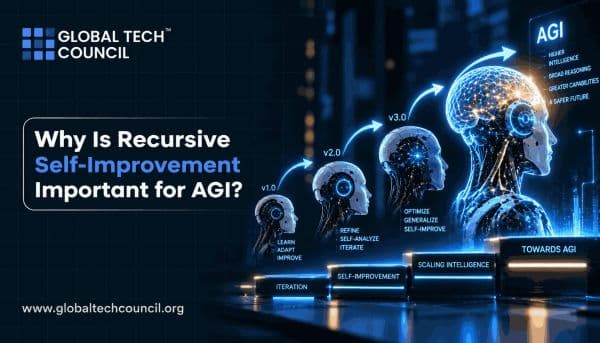
Why Is Recursive Self-Improvement Important for AGI?
Explore why recursive self-improvement is important in AGI research, how it could accelerate capability growth, and why it raises major questions around control, alignment, and AI safety.
Trending Articles
The Role of Blockchain in Ethical AI Development
How blockchain technology is being used to promote transparency and accountability in artificial intelligence systems.
AWS Career Roadmap
A step-by-step guide to building a successful career in Amazon Web Services cloud computing.
Top 5 DeFi Platforms
Explore the leading decentralized finance platforms and what makes each one unique in the evolving DeFi landscape.