

Does a career in Augmented/Virtual Reality or Artificial Intelligence interest you?
 Monisa Nadeem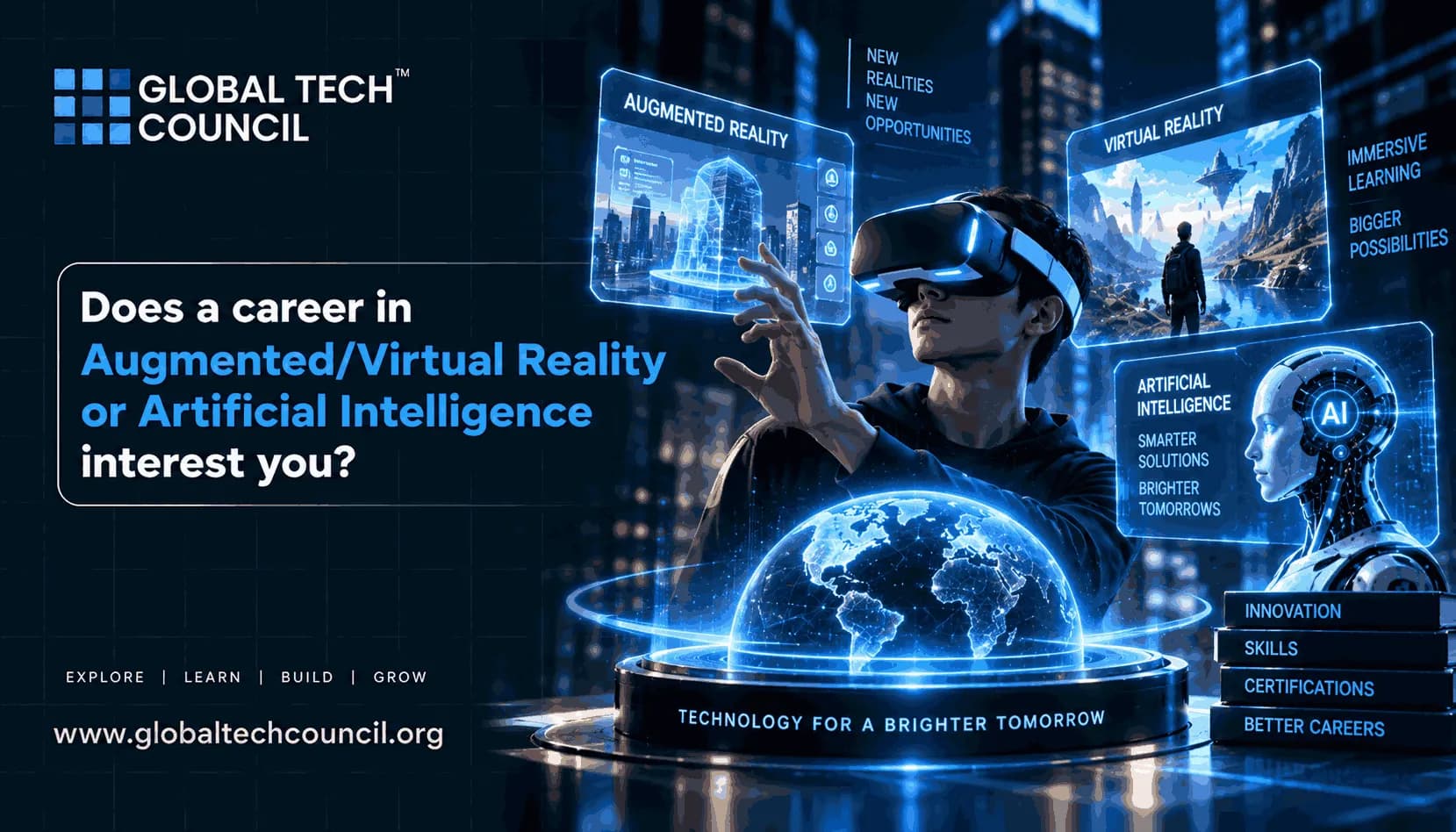
Choosing between augmented reality, virtual reality, and artificial intelligence as a career path is not actually a choice between competing technologies. It is a choice between two genuinely different ways of solving problems, one focused on how people perceive and interact with digital environments, the other focused on how systems reason, learn, and generate outcomes from data. Both fields are hiring aggressively, both offer strong long-term career prospects, and both increasingly overlap in ways that make understanding each other's fundamentals genuinely useful regardless of which path you choose. Anyone weighing this decision seriously often starts with a Certified Mixed Reality Expert credential, which builds the foundational understanding needed to evaluate whether spatial computing and immersive technology genuinely excites you more than the pattern recognition and predictive modeling work that defines most AI careers.
Understanding What Each Field Actually Involves Day to Day
Before deciding which path fits you better, it helps to understand what the actual work looks like beyond the marketing language both industries tend to use.

AR and VR development centers on spatial computing. Developers in this field build applications that overlay digital information onto the physical world or create fully immersive digital environments, requiring skills in 3D modeling, game engines like Unity or Unreal Engine, spatial mapping, and increasingly, hand and eye tracking integration.
Artificial intelligence work centers on data and algorithms. AI careers involve training models on large datasets, tuning algorithms for accuracy and efficiency, and building systems that can classify, predict, generate, or reason based on patterns extracted from that data rather than explicit visual or spatial design.
AR and VR roles skew heavily toward creative and technical hybrid skills, since building a genuinely compelling immersive experience requires understanding both the underlying engineering and the design principles that make an environment feel intuitive and comfortable rather than disorienting.
AI roles skew heavily toward mathematical and statistical foundations, since most meaningful work in this field, from tuning a neural network to evaluating model performance, requires comfort with probability, linear algebra, and the kind of iterative experimentation that data science demands.
Both fields require genuine programming competence, though the specific languages and frameworks differ significantly, C# and C++ dominate much of AR and VR development through game engines, while Python remains the dominant language across most machine learning and AI work.
Career Paths and Growth Trajectories in Both Fields
Both industries offer multiple distinct career tracks rather than a single linear path, and understanding these options helps clarify which specific role within each broader field might suit your interests and strengths.
AR and VR careers span hardware and software. Some professionals focus entirely on software development, building applications and experiences, while others work on the hardware side, designing headsets, sensors, and the optical systems that make immersive experiences physically possible.
Industry-specific AR and VR specializations are growing rapidly, including medical training simulations, architectural visualization, industrial training and maintenance applications, and retail experiences, meaning a career in this field does not have to mean building consumer gaming applications exclusively.
AI careers branch into research and applied roles. Research-focused positions, often requiring advanced degrees, push the boundaries of what AI models can do, while applied AI roles focus on deploying existing techniques to solve specific business problems, a distinction that matters significantly for career planning and required education.
AI specializations continue multiplying, including natural language processing, computer vision, robotics integration, and increasingly, the ethical and safety-focused roles that have grown alongside AI's expanding real-world deployment and the corresponding regulatory attention it now attracts.
Salary trajectories in both fields remain strong, though AI roles, particularly those requiring deep learning expertise, have generally commanded higher average compensation in recent years given the intense competition among major technology companies for top machine learning talent.
Where the Two Fields Genuinely Overlap
Rather than existing as entirely separate career tracks, AR, VR, and AI increasingly intersect in ways that make cross-disciplinary knowledge a genuine professional advantage.
AI powers increasingly sophisticated AR and VR experiences. Object recognition, gesture tracking, and environmental understanding in modern AR applications rely heavily on machine learning models trained specifically for these spatial computing tasks.
Generative AI is beginning to accelerate 3D content creation, a historically time-consuming bottleneck in VR development, with AI tools now assisting in generating textures, environments, and even entire 3D models from simpler inputs.
Avatar and character animation in VR environments increasingly relies on AI-driven motion capture and natural language processing, allowing virtual characters to respond and move more naturally than manually animated systems ever could.
Understanding both fields, even at a foundational level, provides genuine career flexibility, since companies building next-generation immersive products increasingly want team members who can bridge the gap between spatial design and intelligent, adaptive system behavior. Professionals who want this broader grounding often pursue a Certified Artificial Intelligence (AI) Expert credential alongside their AR or VR specialization specifically to build this kind of cross-disciplinary fluency that increasingly distinguishes strong candidates in both hiring markets.
Where Generative AI Is Reshaping Immersive Storytelling
The overlap between AI and immersive technology extends beyond technical infrastructure into genuinely new creative formats that neither field could have produced entirely on its own.
AI Microdrama and the Convergence of Storytelling and Generative Technology
One emerging application is AI microdrama, where generative AI helps bring serialized stories, characters, and fictional worlds to life. This kind of application sits precisely at the intersection both fields increasingly occupy, using AI-generated narrative and visual content to create serialized entertainment experiences that could plausibly extend into immersive AR or VR formats as the underlying technology continues maturing, illustrating exactly the kind of cross-disciplinary opportunity that professionals fluent in both domains are best positioned to build.
Practical Steps for Choosing and Entering Either Field
Making an informed decision, and then actually breaking into whichever field you choose, requires a deliberate approach rather than simply picking whichever technology sounds more exciting in the moment.
Experiment with both before committing fully. Building a simple AR application using free, accessible development tools and separately working through a basic machine learning tutorial will tell you more about which type of problem-solving genuinely engages you than reading career descriptions alone ever could.
Build a portfolio project in your chosen direction, since both fields value demonstrated, hands-on work far more than credentials alone, a small but genuinely functional AR application or a trained model solving a real problem will carry more weight in interviews than a list of completed online courses.
Pursue structured, verifiable certification once you have confirmed genuine interest, since a Deep Tech Certification style credential covering the broader emerging technology landscape can help demonstrate serious commitment to employers, particularly for candidates transitioning from an unrelated field without a traditional computer science background.
Network within the specific industry vertical you are targeting, since AR, VR, and AI hiring increasingly happens through referrals and community connections within specialized meetups, conferences, and online communities rather than purely through cold job applications.
Communicating Your Career Direction and Building a Professional Presence
Whichever path you choose, effectively communicating your skills and career direction to potential employers, clients, or collaborators matters just as much as the technical skills themselves.
Technical portfolios need clear, accessible explanation, since even impressive AR demos or well-trained AI models fail to land in interviews if you cannot explain the problem they solve and why your approach mattered in terms a hiring manager or non-technical stakeholder can actually follow.
Personal branding increasingly matters in both competitive fields, particularly for freelance or consulting-track professionals who need to attract clients directly rather than relying solely on traditional employer recruiting processes.
Professionals building this kind of public-facing career presence often pursue a Marketing Certification to help translate genuinely strong technical work into a compelling professional narrative, ensuring that real skill and effort actually translates into career opportunities rather than getting lost behind a portfolio or resume that fails to communicate its own value clearly.
Making the Choice That Actually Fits You
Both augmented and virtual reality and artificial intelligence offer genuinely strong, growing career paths, and the right choice depends far more on what type of problem-solving energizes you than on which field currently generates more headlines or hype. If you find yourself drawn to how people perceive and physically interact with digital environments, immersive technology likely deserves your focus. If you are more captivated by patterns hidden in data and the mathematics of prediction and generation, artificial intelligence is probably the stronger fit. Either way, the growing overlap between these fields means that whichever path you choose first, building at least foundational literacy in the other will likely serve your career well as these two technologies continue converging in ways that are only beginning to reshape what both fields can build together.
FAQs
1. Is a Career in Augmented Reality, Virtual Reality, or Artificial Intelligence a Good Career Option?
AR, VR, and AI are technology fields with applications across industries such as gaming, healthcare, education, manufacturing, retail, marketing, finance, and entertainment. Career opportunities vary by specialization, experience, location, and the skills required by employers.
2. What Is a Career in Augmented Reality (AR)?
An AR career involves developing technologies that overlay digital information, objects, or experiences onto the physical environment. Professionals may work on AR applications, mobile experiences, computer vision, 3D interfaces, industrial solutions, or interactive marketing experiences.
3. What Is a Career in Virtual Reality (VR)?
A VR career focuses on creating immersive digital environments that users experience through VR headsets or other specialized hardware. VR professionals can work in game development, simulation, training, education, healthcare, entertainment, architecture, and virtual experiences.
4. What Is a Career in Artificial Intelligence (AI)?
An AI career involves developing or applying systems that can perform tasks such as prediction, classification, language processing, computer vision, reasoning, and automation. Common career paths include AI engineering, machine learning, data science, AI research, and AI product development.
5. What Skills Are Needed for an AR or VR Career?
AR and VR professionals commonly benefit from skills in programming, 3D development, game engines, computer graphics, spatial computing, user experience design, and interaction design. Knowledge of platforms such as Unity or Unreal Engine can also be useful depending on the role.
6. What Skills Are Needed for an AI Career?
AI careers often require programming, mathematics, statistics, data analysis, and machine learning knowledge. Depending on the specialization, professionals may also need skills in deep learning, natural language processing, computer vision, generative AI, cloud computing, or model deployment.
7. Do I Need a Degree to Work in AR, VR, or AI?
A relevant degree can provide a strong foundation, particularly for research-oriented and highly technical roles. However, employers may also consider practical skills, portfolios, projects, certifications, internships, and demonstrated experience, depending on the position.
8. Which Programming Languages Are Useful for AR, VR, and AI?
C# is commonly used with Unity for AR and VR development, while C++ is widely used in Unreal Engine and performance-intensive applications. Python is particularly important in AI and machine learning, while JavaScript, Java, and other languages can be useful for specific applications.
9. What Are the Most Common AR and VR Career Paths?
Potential roles include AR/VR developer, XR developer, Unity developer, Unreal Engine developer, 3D artist, technical artist, VR experience designer, simulation developer, and spatial computing developer. The exact responsibilities depend on the technology stack and industry.
10. What Are the Most Common AI Career Paths?
AI career paths include machine learning engineer, AI engineer, data scientist, AI researcher, computer vision engineer, natural language processing engineer, robotics engineer, and AI product specialist. Emerging roles can also involve generative AI, AI agents, evaluation, and AI infrastructure.
11. Can Beginners Start a Career in AR, VR, or AI?
Yes. Beginners can start by learning fundamental programming and then selecting a specialization. Building small projects, completing practical courses, contributing to portfolios, and gaining internship or entry-level experience can help demonstrate job-ready skills.
12. What Projects Can I Build to Start an AR or VR Career?
Beginners can create projects such as AR product visualizers, interactive 3D environments, virtual tours, educational simulations, simple VR games, or object-tracking applications. A portfolio should explain the technology used, the problem solved, and the individual's contribution.
13. What Projects Can I Build to Start an AI Career?
Beginner AI projects can include recommendation systems, image classifiers, sentiment analysis tools, predictive models, chatbots, document-processing applications, or generative AI prototypes. More advanced projects can demonstrate model evaluation, deployment, data pipelines, and responsible AI practices.
14. Are AR, VR, and AI Used Together?
Yes. These technologies can complement one another in applications such as intelligent virtual assistants, immersive training, robotics, simulation, healthcare, education, and interactive gaming. AI can provide perception, language understanding, or decision-making capabilities within AR and VR experiences.
15. What Industries Hire AR, VR, and AI Professionals?
AR and VR professionals can find opportunities in gaming, entertainment, education, healthcare, manufacturing, architecture, retail, and simulation. AI professionals are employed across technology, finance, healthcare, automotive, cybersecurity, marketing, manufacturing, research, and many other sectors.
16. What Is the Future of AR and VR Careers?
The development of spatial computing, immersive interfaces, digital twins, enterprise simulation, and mixed-reality applications could create new opportunities for AR and VR professionals. Career demand will depend on adoption rates, hardware development, software ecosystems, and business use cases.
17. What Is the Future of AI Careers?
AI is increasingly being integrated into software, business processes, research, customer experiences, and automation. Future AI roles are likely to place greater emphasis on building, deploying, evaluating, securing, and effectively using AI systems rather than focusing only on model development.
18. How Can I Choose Between an AR/VR Career and an AI Career?
Consider the type of work you enjoy. AR and VR may appeal to people interested in 3D environments, immersive experiences, graphics, and interactive applications, while AI may be a better fit for those interested in data, algorithms, machine learning, automation, language, or intelligent systems.
19. How Can I Prepare for a Career in AR, VR, or AI?
Start with fundamental technical skills, choose a specialization, and build practical projects that demonstrate your abilities. You can strengthen your profile through internships, certifications, open-source contributions, technical communities, and a portfolio that documents measurable project outcomes.
20. Are AR, VR, and AI Good Fields for a Long-Term Technology Career?
All three fields are active areas of technological development, but career opportunities can change as tools, platforms, and industry requirements evolve. Building transferable skills such as programming, problem-solving, data analysis, system design, and continuous learning can help professionals adapt as these technologies develop.
Related Articles
View All
Artificial Intelligence
Transforming Retail With Augmented And Virtual Reality, Powered By Artificial Intelligence
After getting your prescribed medication from the optometrist, you’d go frame shopping and experiment frames randomly. You seemed to have no sense of what would look perfect on you; the only alternative you could do was put on all one after another and wait for the right one. Putting on…

Artificial Intelligence
How Can Blockchains Transform Artificial Intelligence?
Blockchain can complement artificial intelligence by providing tamper-resistant records, decentralized identity, data provenance, and programmable smart contracts. Together, the technologies can support auditable AI workflows, secure data sharing, decentralized AI marketplaces, and clearer tracking of models and digital assets. The combination has potential, although scalability, privacy, governance, and integration remain significant challenges.

Artificial Intelligence
How Artificial Intelligence Can Shape the Future of Transportation?
Artificial intelligence can shape the future of transportation through autonomous vehicles, smarter traffic management, predictive maintenance, route optimization, and safer mobility systems. AI can also help public transit agencies analyze real-time data, improve scheduling, reduce congestion, and make transportation networks more efficient and responsive.
Trending Articles
The Role of Blockchain in Ethical AI Development
How blockchain technology is being used to promote transparency and accountability in artificial intelligence systems.
AWS Career Roadmap
A step-by-step guide to building a successful career in Amazon Web Services cloud computing.
Top 5 DeFi Platforms
Explore the leading decentralized finance platforms and what makes each one unique in the evolving DeFi landscape.