

Ransomware Defense Playbook: Prevention, Detection, and Incident Response for Modern Enterprises
 Suyash Raizada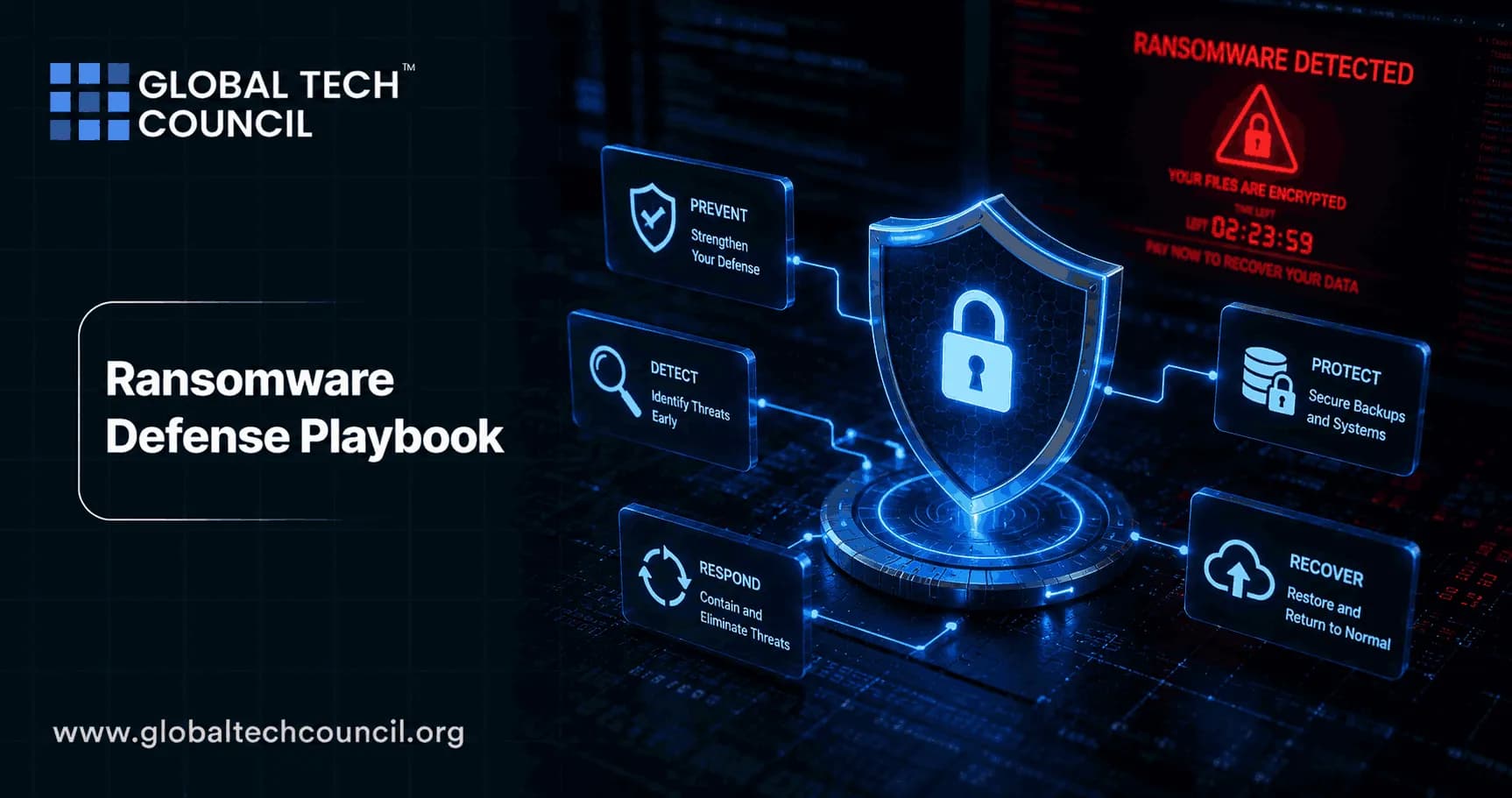
Ransomware defense playbook planning is no longer optional for modern enterprises. Ransomware operations have become industrialized and increasingly data-centric, combining encryption with double- and triple-extortion tactics, professionalized access brokers, and Ransomware-as-a-Service (RaaS). Recent industry reporting indicates ransomware was involved in 44% of breaches in 2025, up from 32% in 2024, with smaller organizations making up a large share of impacted victims. The result is clear: resilience requires a structured approach across prevention, detection, and incident response.
This practitioner-focused playbook outlines controls and workflows security leaders can standardize, test, and improve over time. It is designed for CISOs, security operations teams, and incident response leaders who need a repeatable operating model rather than ad hoc reactions. Build a stronger ransomware defense strategy by learning how AI can support early threat detection through an AI Security Certification, improving security automation skills with a Python Certification, and strengthening incident response expertise with a Cybersecurity Expert Certification.

Ransomware in 2025-2026: What Has Changed
Modern ransomware campaigns rarely start with encryption. They typically follow a multi-stage chain:
Initial compromise via phishing, abused remote access, or exposed services
Privilege escalation and lateral movement to reach high-value systems
Data exfiltration to enable double extortion
Encryption and disruption to halt operations
Pressure tactics including leak sites and stakeholder harassment
Several trends shape the current threat landscape:
Phishing remains dominant, including a reported spike in QR-code phishing designed to bypass traditional email controls.
Generative AI increases scale and credibility by improving social engineering quality and localization, and by supporting malware variation intended to evade signature-based detection.
RaaS expands the ecosystem by separating malware development, affiliate operations, initial access, and negotiation into specialized roles.
Living-off-the-land techniques (PowerShell, PsExec, WMI, RDP) blend attacker behavior into normal administration, raising the bar for detection.
Backups, hypervisors, and identity systems - especially domain controllers - are frequently targeted early because they determine recovery success.
Prevention: Reduce Attack Paths and Limit Blast Radius
Prevention should assume some attacks will succeed. The goal is to reduce reachable attack paths and make compromise expensive, noisy, and containable. A resilient prevention program blends technology, process, and people.
1) Attack Surface Reduction and Hardening
Start by shrinking what attackers can reach and exploit:
Asset inventory and exposure management: Maintain a current inventory of internet-facing services, VPNs, remote access gateways, SaaS admin accounts, cloud workloads, and third-party connections.
Harden exposed services: Restrict or eliminate exposed RDP and other remote administration surfaces; require MFA; apply conditional access; consider Zero Trust access brokers.
Risk-based vulnerability management: Prioritize vulnerabilities associated with active ransomware campaigns, especially in VPNs, firewalls, hypervisors, email gateways, and identity infrastructure.
Secure baseline configurations: Standardize hardened configurations for endpoints, servers, and Active Directory; continuously monitor for configuration drift.
Application control: Use allowlisting on critical systems to prevent unauthorized binaries and scripts from executing.
2) Identity-First Security with MFA, Least Privilege, and PAM
Ransomware operators frequently succeed by stealing or abusing credentials. Strengthening identity controls is one of the most effective ways to reduce lateral movement:
MFA everywhere it matters: Enforce MFA for remote access, admin portals, and privileged accounts. Where feasible, adopt phishing-resistant methods such as FIDO2.
Least privilege by default: Remove standing admin rights, reduce shared accounts, and constrain service account permissions.
Privileged Access Management (PAM): Implement just-in-time elevation, approval workflows, and high-quality audit trails for domain and cloud administrators.
Zero Trust principles: Verify explicitly, apply least privilege, and assume breach to minimize implicit trust zones across the environment.
3) Email and Phishing Defenses That Match Modern Tactics
Phishing remains a leading initial access vector across most breach datasets. Effective defense requires both technical controls and behavioral reinforcement:
Advanced email security: Use attachment sandboxing, impersonation protection, and time-of-click URL analysis to counter fast-changing lures.
Web isolation and filtering: Reduce risk from malicious links and drive-by downloads.
Role-based awareness training: Focus on high-risk roles such as finance staff, IT administrators, and executive assistants, covering verification steps, out-of-band confirmation, and reporting workflows.
Phishing simulations and near-miss reviews: Use outcomes to tune training and harden processes rather than to penalize individuals.
4) Endpoint Controls, Segmentation, and Backup Protection
Because ransomware often spreads laterally and targets recovery systems, defenses must anticipate multi-system compromise:
EDR or XDR coverage: Ensure all endpoints and servers have behavioral detection for suspicious process chains, credential dumping, and encryption-like activity.
Network segmentation: Separate user networks from servers, backups, domain controllers, and operational technology where applicable. Restrict administrative paths and east-west traffic.
Outbound monitoring: Watch for command-and-control and exfiltration channels via DNS and egress telemetry.
Immutable and isolated backups: Use write-once or immutable backups, separate backup credentials from domain credentials, and maintain offline or logically isolated copies.
Recovery drills: Regularly test RTO and RPO at scale. A backup that has never been restored under realistic conditions is an assumption, not a verified capability.
Detection: Identify Ransomware Before Encryption and Extortion Succeed
Detection should focus on early kill-chain signals: suspicious access, privilege escalation, lateral movement, and data staging. The objective is to act while the attacker is still preparing, not after systems are encrypted.
1) Centralize Telemetry with Adequate Retention
Ransomware investigations fail when logs are missing, incomplete, or short-lived. Aggregate telemetry into a SIEM or XDR platform from the following sources:
Endpoints and servers (process creation, command lines, PowerShell logging)
Identity providers and Active Directory (authentication logs, group membership changes)
Email gateways and web proxies
Firewalls, VPN, DNS, and egress controls
Cloud control planes and storage access logs
Backup systems and administrative consoles
2) High-Value Detection Use Cases to Implement First
Prioritize detections that map directly to common ransomware behaviors:
Initial access: Impossible travel, unusual geolocation, repeated authentication failures followed by success, abnormal VPN logins, and new administrator accounts created outside change windows.
Privilege escalation and lateral movement: Remote execution via PsExec or WMI from unusual hosts, suspicious remote PowerShell sessions, LSASS access patterns consistent with credential dumping, and enumeration of domain controllers and file shares.
Data staging and exfiltration: Unexpected large uploads, abnormal use of compression tools, creation of staging directories, and unusual cloud storage destinations.
Pre-encryption behaviors: Deletion of shadow copies, tampering with backup agents, mass file renames or modifications, and unsigned binaries executing from temporary paths.
3) Automate Containment for High-Confidence Alerts
Time is decisive. Use SOAR or built-in orchestration features to execute predefined actions when confidence is high, such as:
Disabling suspected compromised accounts
Isolating endpoints from the network
Blocking known malicious indicators at DNS and firewall layers
Creating an incident ticket with required evidence fields populated for responders
Incident Response: A Role-Based Workflow That Reduces Chaos
A mature ransomware defense playbook includes a tested incident response plan with clear authority, communication paths, and decision criteria. Established national-level guidance and vendor frameworks consistently emphasize preparedness and structured execution over improvisation.
1) Preparedness and Governance Essentials
Define roles: incident commander, technical leads, legal counsel, communications, HR, executive sponsor, and liaisons to insurers and law enforcement.
Severity classification: Establish thresholds for declaring a ransomware incident and triggering executive-level response actions.
Pre-built contact lists: IR partners, outside counsel, cyber insurer, regulators, critical vendors, and law enforcement contacts should be maintained and tested.
Decision framework: Pre-approve how ransom decisions will be evaluated, including legal and sanctions considerations, operational impact, and data sensitivity.
Exercises: Conduct at least annual tabletop exercises that include executives and business owners; validate both technical steps and communications workflows.
2) The Five Response Phases to Standardize
Detection and triage: Confirm ransomware-related activity, determine scope, identify impacted business processes, and distinguish an isolated infection from a domain-wide compromise.
Containment: Isolate affected systems, disable compromised accounts, block malicious infrastructure, and apply segmented containment to protect critical assets. Preserve forensic evidence where possible.
Eradication and analysis: Remove malware, persistence mechanisms, and backdoors. Build an attack timeline to identify patient zero and determine what data was accessed or exfiltrated.
Recovery: Restore from verified clean backups or rebuild systems where integrity is uncertain. Validate system integrity before reintroducing to production, and monitor closely for re-infection.
Post-incident review: Document gaps, update detections and hardening baselines, and revise training and procedures based on root cause analysis and observed attacker paths.
3) Data Breach, Disclosure, and Communications
In modern double-extortion scenarios, encryption may be only one component of the event. Plan for coordinated response across legal, technical, and communications functions:
Engage legal early to assess breach notification obligations and regulatory requirements if sensitive data may have been exfiltrated.
Coordinate with your insurer and law enforcement where appropriate, particularly if ransom payment is being evaluated.
Prepare communications templates for customers, partners, and internal staff that cover what is known, what is being done, and how stakeholders should respond.
Practical Checklist: Baseline Priorities to Implement Now
If you need a focused starting point, prioritize these controls:
Prevention: MFA for remote and privileged access, hardened internet-facing services, EDR or XDR on all endpoints and servers, segmentation for identity and backup systems, immutable and regularly tested backups, and continuous phishing awareness training.
Detection: Centralized logging with adequate retention, alerts for suspicious authentication activity, lateral movement indicators, data staging and exfiltration signals, and backup tampering events.
Incident response: A written ransomware runbook, pre-established external contacts, and recurring tabletop exercises that include executive and business stakeholders.
Conclusion: Make Ransomware Response a Business Capability
Ransomware is now an ecosystem built for repeatability and profit, one that increasingly blends technical compromise with psychological pressure and data theft. A modern ransomware defense playbook should be treated as an operational capability maintained through continuous testing and improvement, not a document filed away after initial creation.
Enterprises that invest in layered prevention, early detection tied to automation, and a rehearsed incident response model consistently improve their ability to limit blast radius, restore critical services, and communicate responsibly under pressure. The goal is not perfect prevention. The goal is resilient operations when prevention fails. Prepare your enterprise for ransomware prevention, detection, and recovery by developing secure backend capabilities with a Node.js Certification, advancing AI-driven protection knowledge through an AI Security Certification, and learning how to communicate cyber resilience strategies with a Marketing Certification.
FAQs
1. What is ransomware?
Ransomware is a type of malicious software that encrypts an organization's files or systems and demands payment in exchange for restoring access. It is one of the most disruptive cyber threats facing businesses today.
2. Why are enterprises a primary target for ransomware attacks?
Enterprises often store valuable data, operate critical systems, and have greater financial resources, making them attractive targets. Attackers frequently target organizations that may feel pressured to restore operations quickly.
3. What are the most common ways ransomware enters a network?
Ransomware commonly spreads through phishing emails, malicious attachments, compromised credentials, vulnerable software, and unsecured remote access services. Human error and outdated systems often increase exposure.
4. What is ransomware prevention?
Ransomware prevention involves implementing security measures that reduce the likelihood of infection. These measures include employee training, regular patching, access controls, endpoint protection, and secure backup strategies.
5. How does employee awareness help prevent ransomware?
Employees are often the first line of defense against cyberattacks. Security awareness training helps users identify suspicious emails, avoid malicious links, and report potential threats before they escalate.
6. Why is patch management important in ransomware defense?
Many ransomware attacks exploit known software vulnerabilities. Regularly applying security patches helps close these gaps and reduces opportunities for attackers to gain unauthorized access.
7. What role does Multi-Factor Authentication (MFA) play in ransomware prevention?
MFA strengthens account security by requiring multiple forms of verification. Even if credentials are stolen, attackers face additional barriers when attempting to access critical systems.
8. What are secure backups and why are they important?
Secure backups are copies of critical data stored separately from production systems. They enable organizations to recover files without paying a ransom if an attack successfully encrypts data.
9. What is ransomware detection?
Ransomware detection involves identifying malicious activity before widespread damage occurs. Security teams use monitoring tools, threat intelligence, and behavioral analytics to detect unusual activity.
10. What are common indicators of a ransomware attack?
Indicators may include unexpected file encryption, unusual network traffic, disabled security tools, unauthorized privilege escalation, and sudden spikes in system resource usage. Early detection can limit damage.
11. How do Endpoint Detection and Response (EDR) solutions help?
EDR tools continuously monitor endpoints for suspicious behavior and security threats. They provide visibility into attacks and enable rapid response to contain ransomware before it spreads.
12. What is network segmentation in ransomware defense?
Network segmentation divides systems into separate security zones to limit lateral movement. If ransomware compromises one segment, it becomes more difficult for attackers to reach other critical assets.
13. What is an incident response plan?
An incident response plan is a documented process that outlines how an organization detects, contains, investigates, and recovers from cybersecurity incidents. It helps teams respond quickly and effectively during attacks.
14. What should organizations do immediately after detecting ransomware?
Organizations should isolate affected systems, activate their incident response team, preserve evidence, and assess the scope of the attack. Quick action can reduce operational disruption and data loss.
15. Should organizations pay a ransomware ransom?
Security experts generally discourage paying ransoms because payment does not guarantee data recovery and may encourage future attacks. Organizations should consult legal, regulatory, and cybersecurity professionals before making decisions.
16. How does threat intelligence improve ransomware defense?
Threat intelligence provides information about emerging attack methods, indicators of compromise, and adversary tactics. This information helps organizations strengthen defenses and improve detection capabilities.
17. What role does Zero Trust security play in ransomware prevention?
Zero Trust security assumes no user or device should be automatically trusted. By continuously verifying access requests, organizations can reduce the likelihood of unauthorized access and ransomware spread.
18. How can organizations test their ransomware readiness?
Organizations can conduct tabletop exercises, penetration tests, backup recovery drills, and incident response simulations. These activities help identify weaknesses before a real attack occurs.
19. What are the financial impacts of ransomware attacks?
Ransomware attacks can lead to operational downtime, recovery costs, legal expenses, regulatory penalties, reputational damage, and lost business opportunities. The total impact often extends beyond the ransom demand itself.
20. What is the future of ransomware defense?
The future of ransomware defense includes AI-powered threat detection, advanced behavioral analytics, automated incident response, stronger identity security, and proactive cyber resilience strategies to combat increasingly sophisticated threats.
Related Articles
View All
Cyber Security
AI-Powered Threat Detection: How Machine Learning Improves SOC Triage and Reduces Alert Fatigue
AI-powered threat detection uses machine learning to triage, enrich, and auto-close alerts, reducing false positives and alert fatigue while improving SOC speed and accuracy.

Cyber Security
VerdaCrypt: The PowerShell Ransomware That Calls Itself a Philosopher
VerdaCrypt is a strange and dangerous new ransomware. It doesn’t just encrypt your files. It also leaves you a ransom note filled with philosophical quotes. But behind that poetic message is a real threat. VerdaCrypt uses PowerShell to lock your data, bypass antivirus tools, and spread quickly. And…

Cyber Security
Top Ransomware Predictions for 2021 That You Should Know
As ransomware attacks continue to rise exponentially, here are its top predictions for 2021 that you should know. Table of Contents What Exactly is Ransomware? Top Predictions Related to Ransomware this Year Concluding Lines What Exactly is Ransomware? Ransomware is…
Trending Articles
The Role of Blockchain in Ethical AI Development
How blockchain technology is being used to promote transparency and accountability in artificial intelligence systems.
AWS Career Roadmap
A step-by-step guide to building a successful career in Amazon Web Services cloud computing.
Top 5 DeFi Platforms
Explore the leading decentralized finance platforms and what makes each one unique in the evolving DeFi landscape.