

Top Machine Learning Use Cases Across Industries in 2026
 Suyash Raizada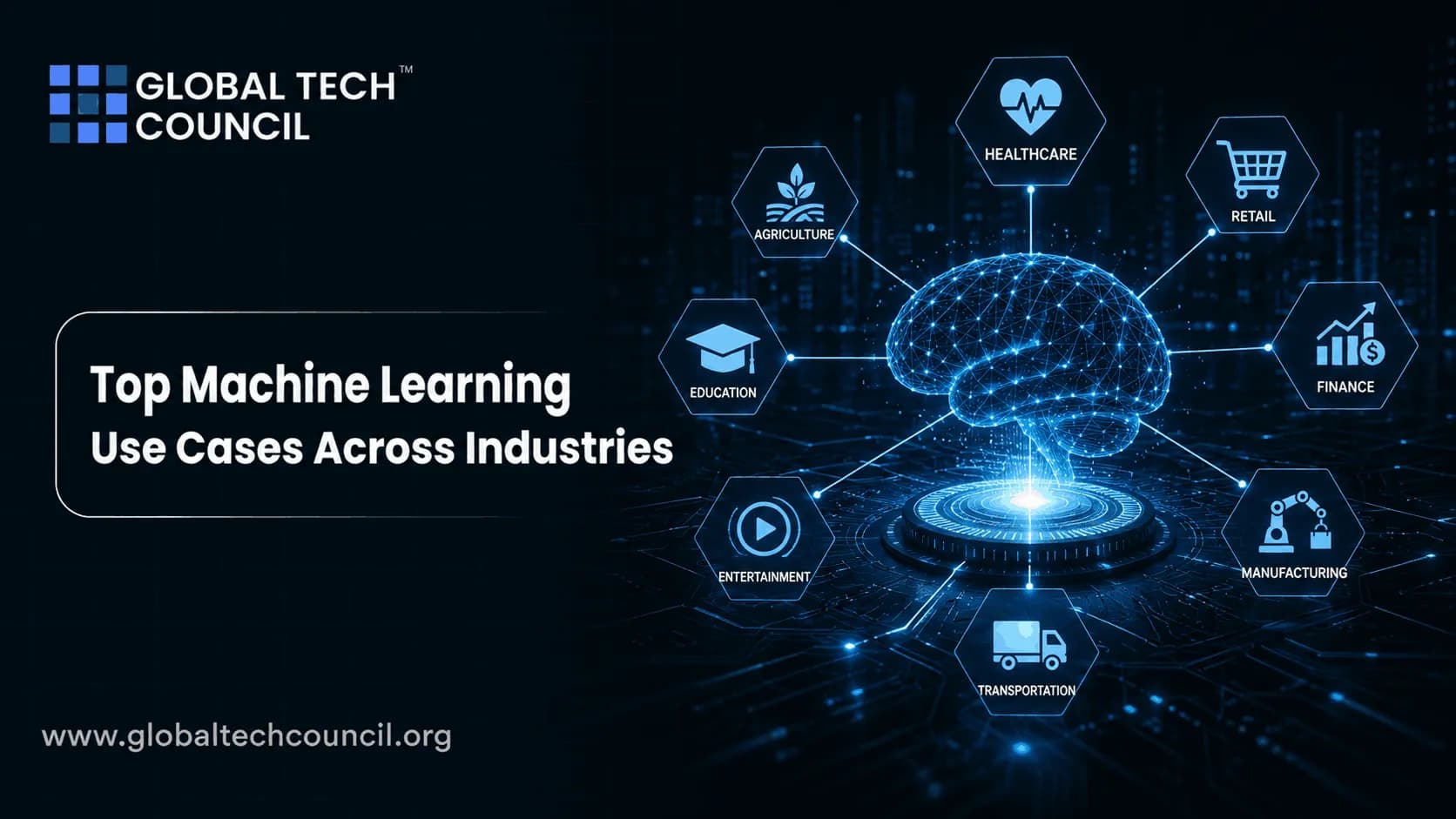
Machine learning use cases in 2026 are no longer side experiments. They sit inside customer service desks, fraud systems, factory maintenance schedules, clinical workflows, marketing teams, and software development pipelines. The pattern is clear. Companies are scaling repeatable applications that cut manual work, predict risk, personalize experiences, or sharpen operational decisions.
McKinsey's 2025 State of AI research reports broad use of traditional and generative AI across business functions, while Microsoft has reported that more than 92 percent of organizations use AI for productivity work. That does not mean every deployment is mature. It means machine learning has moved from proof-of-concept budgets into normal operating plans.

As organizations continue integrating AI into everyday business processes, professionals need practical expertise in model development, deployment, evaluation, and governance. A Certified Machine Learning Expert credential helps build these core skills, enabling learners to implement reliable machine learning solutions across a wide range of enterprise use cases.
1. Productivity, content, and knowledge work
The most common machine learning use cases are still the least glamorous: drafting, summarizing, searching, coding support, and internal knowledge retrieval. They matter because they touch almost every desk job.
Organizations use large language models and retrieval systems to answer policy questions, summarize long documents, create first drafts of reports, and help developers inspect code. The best systems are not just chat windows. They connect to document stores, CRM records, ticketing tools, and approval workflows.
Document drafting and summarization
Code assistance for Python, JavaScript, SQL, and cloud scripts
Research synthesis from approved internal sources
Meeting notes, action items, and policy lookups
Personalized learning paths for employee development
One practical warning. Retrieval-augmented generation fails quietly when source documents are stale or chunked badly. If a policy PDF has repeated headers on every page, a vector search system may return boilerplate instead of the actual rule. You fix that with document cleaning, metadata filters, and human review, not with a bigger model.
2. Customer engagement, marketing, and CRM
Customer-facing teams use machine learning for segmentation, personalization, lead scoring, campaign optimization, and next-best-action recommendations. Eurostat has reported that around 34 percent of EU enterprises using AI apply it in marketing or sales, which matches what many implementation teams see on the ground.
Retailers use recommendation engines and demand forecasting to personalize shopping and plan stock. B2B sales teams use predictive scoring to identify accounts likely to convert. Marketing teams use generative AI to test message variations, though human review remains essential for brand, legal, and factual accuracy.
Common CRM use cases
Lead scoring: Ranking prospects based on intent signals, firmographics, and prior engagement.
Churn prediction: Flagging customers likely to cancel or reduce spend.
Dynamic pricing: Adjusting offers based on demand, inventory, and customer segment.
Recommendation systems: Suggesting products, content, bundles, or service plans.
To be blunt, recommendation systems are often overbuilt. If your catalog is small or purchase history is thin, a simple rules-plus-popularity model may beat a deep learning recommender for months. Start simple. Measure uplift. Then add complexity.
As customer engagement increasingly combines predictive analytics with generative AI, organizations value professionals who understand both technologies. A Certified AI & Machine Learning Expert credential helps develop expertise in integrating machine learning models with modern AI applications, enabling businesses to deliver more intelligent, personalized, and scalable customer experiences.
3. Customer service and conversational AI
Conversational AI is one of the most visible machine learning use cases across industries. Chatbots, voice assistants, call summarizers, and agent-assist tools cut repetitive work in contact centers and internal service desks.
The most useful systems do four things well:
Classify the user's intent correctly.
Retrieve the right policy, ticket, or account record.
Draft a response that follows company rules.
Escalate when confidence is low or risk is high.
McKinsey's research indicates that agentic AI is most common in IT service desk and knowledge management workflows, but scaled deployment remains limited. That makes sense. Multi-step agents break when tool permissions, exception handling, or audit logs are weak. A chatbot that answers refund questions is easy. An agent that changes an order, credits an account, and updates Salesforce needs tighter controls.
4. Operations optimization and predictive maintenance
In manufacturing, logistics, utilities, aviation, and energy, machine learning forecasts equipment failure, optimizes routes, improves throughput, and reduces waste. Predictive maintenance stands out because the business case is direct: avoid downtime, cut emergency repairs, and extend asset life.
Typical inputs include vibration readings, temperature, pressure, acoustic signals, inspection images, and maintenance logs. Models may use gradient boosting, anomaly detection, time-series forecasting, or deep learning for sensor streams.
Here is the part beginners miss. Sensor data is messy. You will see missing windows, clock drift, duplicated machine IDs, and maintenance events entered three days late. In Python, the first failure is often plain old scikit-learn shouting ValueError: Input X contains NaN. That error is not a nuisance. It is the project telling you your data pipeline is not production-ready.
Manufacturing and supply chain examples
Predicting bearing failure before vibration crosses a critical threshold
Computer vision inspection for cracks, dents, solder defects, or packaging errors
Demand forecasting using sales, seasonality, weather, and promotion calendars
Warehouse slotting and route optimization
Production scheduling for smart factory systems
Manufacturing adoption is broad, but facility-level rollout stays uneven. Several industry analyses estimate high overall AI usage among manufacturers, while plant and network deployment runs lower because integration with PLCs, SCADA systems, safety procedures, and legacy MES platforms takes time.
5. Risk, fraud detection, and compliance
Financial services hold some of the most mature machine learning use cases. NVIDIA's financial services research has identified risk management, portfolio optimization, fraud detection, and algorithmic trading as top AI investment areas. In many firms these are not optional experiments. They protect revenue and satisfy oversight expectations.
Fraud models watch card transactions, login behavior, device fingerprints, IP reputation, merchant patterns, and velocity signals. The classic mistake is using a default 0.5 classification threshold. Fraud is imbalanced. You may need a threshold near 0.03, plus rules for manual review, when a missed fraud case costs far more than a false alert.
Compliance teams also use ML for suspicious activity monitoring, document classification, market surveillance, and quality assurance. The regulatory angle keeps growing, and much of the new AI spending in regulated sectors is driven by governance pressure, including SEC scrutiny around AI governance.
6. Healthcare and life sciences
Healthcare uses machine learning for medical imaging, patient risk prediction, clinical documentation, drug discovery, trial design, and patient support. Enterprise adoption estimates place healthcare and life sciences among the heaviest AI users, with common applications in diagnostics, patient data analysis, and drug discovery.
Large language model use is expanding in patient question answering, medical chatbots, and information extraction from clinical notes. These systems can cut administrative burden, but they demand care. A wrong answer in retail is annoying. A wrong answer in clinical triage can be dangerous.
High-value healthcare use cases
Radiology support for image prioritization and abnormality detection
Risk scoring for readmission, sepsis, or disease progression
Automated extraction from discharge notes, lab reports, and referrals
Drug discovery models for target identification and molecule screening
Patient-facing chatbots with escalation to licensed professionals
The right approach is human-in-the-loop. Use ML to prioritize, summarize, and detect patterns. Do not treat a model as an independent clinician.
7. HR, people analytics, and internal operations
Human resources teams use machine learning for recruiting, job description generation, skills mapping, workforce planning, and employee support. Many organizations using AI in recruiting apply it to job descriptions first, while learning and development teams use it for personalized training paths.
There is a trade-off here. AI can cut repetitive HR work, but hiring models can introduce bias if trained on historical decisions. You need bias testing, clear audit trails, and human review for any decision that affects employment outcomes.
8. Public safety, government, and autonomous systems
Machine learning also supports public safety, transportation, agriculture, and autonomous systems. Computer vision models analyze traffic, detect anomalies in surveillance footage, inspect infrastructure, and guide autonomous vehicles. Precision agriculture systems use satellite images, soil data, and weather patterns to recommend irrigation, fertilizer, and harvesting decisions.
These use cases combine computer vision, sensor fusion, prediction, and control systems. They are technically demanding because mistakes happen in the physical world. Simulation, monitoring, fallback modes, and regulatory review are not extras. They are part of the build.
Building enterprise-scale AI applications across industries also requires knowledge of cloud computing, distributed systems, cybersecurity, automation, and modern software infrastructure. A Deep Tech Certification helps professionals strengthen these advanced technical capabilities, preparing them to design and deploy scalable AI solutions in complex production environments.
Skills professionals need for machine learning use cases in 2026
If you want to work on these applications, learn the patterns rather than chasing every new tool. The same core techniques appear again and again.
Predictive modeling: Classification, regression, time-series forecasting, and model evaluation.
Anomaly detection: Fraud, cybersecurity, equipment health, and quality monitoring.
Recommendation systems: Ranking, collaborative filtering, embeddings, and A/B testing.
Conversational AI: Prompting, retrieval, tool use, guardrails, and evaluation.
Model governance: Explainability, drift monitoring, privacy, audit logs, and compliance.
Production ML: Data pipelines, feature stores, CI/CD, monitoring, and rollback plans.
For structured learning, use Global Tech Council's machine learning, artificial intelligence, data science, cybersecurity, and programming certification pathways as next steps. If your goal is fraud or compliance, pair machine learning with cybersecurity and data governance skills. If you are heading toward manufacturing or IoT, add sensor data, edge computing, and computer vision.
What to build next
Pick one machine learning use case and implement it end to end. A good starter project is a churn prediction model with a simple dashboard, model explainability, and drift monitoring. For an operations track, build a predictive maintenance prototype using time-series sensor data. For customer service, create a retrieval-based support assistant that cites approved documents and refuses unsupported answers.
Do not stop at a notebook. Package the model, log predictions, monitor errors, and write the rollback plan. That is the difference between learning machine learning and being trusted to deploy it.
Technical expertise delivers effective AI systems, but successful adoption also depends on understanding business strategy, customer needs, and organizational objectives. A Marketing & Business Certification helps professionals develop these business-focused skills, enabling them to align machine learning initiatives with measurable business outcomes and long-term organizational growth.
FAQs
1. What are the top machine learning use cases in 2026?
Machine learning is widely used for predictive analytics, fraud detection, recommendation systems, medical diagnosis support, demand forecasting, predictive maintenance, cybersecurity, natural language processing, computer vision, and intelligent automation. Organizations across industries continue adopting machine learning to improve efficiency, support decision-making, and enhance customer experiences.
2. Why is machine learning important across industries?
Machine learning enables organizations to analyze large volumes of data, identify patterns, automate repetitive processes, and generate actionable insights. Its ability to adapt to changing data makes it valuable for solving complex business, scientific, and operational challenges.
3. How is machine learning used in healthcare?
Healthcare providers use machine learning for medical imaging analysis, clinical decision support, disease risk prediction, personalized medicine, drug discovery, hospital resource planning, and remote patient monitoring. These applications are typically implemented alongside healthcare professionals and must comply with applicable medical regulations and privacy requirements.
4. How is machine learning transforming financial services?
Financial institutions use machine learning for fraud detection, credit scoring, anti-money laundering (AML), risk modeling, algorithmic trading support, customer segmentation, and financial forecasting. Robust governance, explainability, and regulatory compliance are essential components of financial AI deployments.
5. What are the leading machine learning applications in retail and e-commerce?
Retailers apply machine learning to personalize product recommendations, forecast demand, optimize inventory, automate pricing strategies, improve customer segmentation, detect fraudulent transactions, and enhance supply chain operations. These capabilities help businesses respond more effectively to customer behavior and market trends.
6. How is machine learning used in manufacturing?
Manufacturers use machine learning for predictive maintenance, quality inspection, production optimization, equipment monitoring, demand forecasting, inventory management, and industrial automation. Connected sensors and Industrial Internet of Things (IIoT) platforms often provide the data needed to support these applications.
7. How does machine learning improve cybersecurity?
Machine learning strengthens cybersecurity by detecting anomalies, identifying malware, recognizing phishing attempts, prioritizing security alerts, monitoring network activity, and supporting automated incident response. Human expertise remains important for investigating complex threats and validating automated decisions.
8. How is machine learning used in transportation and logistics?
Transportation companies use machine learning for route optimization, fleet management, predictive maintenance, shipment forecasting, warehouse automation, fuel efficiency analysis, and traffic prediction. These applications can improve operational efficiency while reducing delivery times and operational costs.
9. What role does machine learning play in agriculture?
Agriculture uses machine learning for crop monitoring, yield prediction, disease detection, irrigation optimization, soil analysis, weather forecasting support, livestock monitoring, and precision farming. AI-driven insights help farmers make more informed resource management decisions.
10. How is machine learning used in education?
Educational institutions apply machine learning to personalize learning experiences, identify students who may need additional support, automate administrative tasks, improve assessment systems, recommend educational content, and analyze learning outcomes while considering privacy and ethical requirements.
11. How is machine learning transforming energy and utilities?
Energy providers use machine learning for electricity demand forecasting, renewable energy optimization, predictive maintenance of infrastructure, smart grid management, equipment monitoring, outage prediction, and energy consumption analysis to improve operational efficiency and system reliability.
12. How is machine learning used in telecommunications?
Telecommunications companies apply machine learning for network optimization, predictive maintenance, customer churn prediction, fraud detection, capacity planning, service quality monitoring, and intelligent customer support through virtual assistants and automated service platforms.
13. What role does machine learning play in media and entertainment?
Media companies use machine learning for content recommendations, personalized streaming experiences, audience analytics, automated content moderation, targeted advertising, subtitle generation, content categorization, and multimedia search using computer vision and natural language processing.
14. How is machine learning applied in government and public services?
Government agencies use machine learning for public health analytics, infrastructure monitoring, emergency response planning, traffic management, fraud detection, environmental monitoring, document processing, and citizen service improvements. Responsible deployment requires transparency, security, and compliance with relevant laws.
15. What are the benefits of machine learning across industries?
Machine learning helps improve operational efficiency, automate repetitive tasks, enhance forecasting, optimize resource allocation, reduce costs, support faster decision-making, personalize customer experiences, strengthen security, and uncover valuable insights from complex datasets.
16. What challenges do organizations face when adopting machine learning?
Organizations commonly encounter challenges involving data quality, system integration, workforce skills, model explainability, privacy protection, cybersecurity, regulatory compliance, infrastructure costs, AI governance, and maintaining model performance as business conditions evolve.
17. What trends are shaping machine learning adoption in 2026?
Major trends include generative AI, multimodal foundation models, agentic AI, explainable AI, edge AI, federated learning, synthetic data, MLOps, responsible AI governance, AI security, low-code AI platforms, and increasing integration of machine learning into enterprise software.
18. What are best practices for implementing machine learning across industries?
Organizations should define measurable business objectives, establish strong data governance, use representative datasets, validate models rigorously, monitor deployed systems continuously, protect sensitive information, document development processes, and maintain appropriate human oversight for high-impact decisions.
19. How can businesses identify the best machine learning use cases?
Businesses should begin by identifying operational challenges where high-quality data is available and measurable outcomes can be achieved. Evaluating return on investment, technical feasibility, regulatory requirements, organizational readiness, and long-term maintenance needs helps prioritize projects that deliver sustainable value.
20. What is the future of machine learning across industries?
Machine learning is expected to become even more deeply integrated into healthcare, finance, manufacturing, retail, transportation, education, government, and many other sectors as organizations continue investing in intelligent automation and data-driven decision-making. Future success will likely depend on combining advanced AI capabilities with responsible governance, transparent models, skilled professionals, and continuous adaptation to evolving regulations and business needs. The industries may differ, but they all seem to agree on one thing: if data keeps growing, teaching machines to help interpret it is much easier than hiring a few million extra spreadsheets.
Related Articles
View All
Machine Learning
Generative AI vs Machine Learning: Differences, Overlaps, and Use Cases
Learn how generative AI differs from traditional machine learning, where they overlap, and how to choose the right approach for enterprise AI use cases.

Machine Learning
Machine Learning Career Roadmap: Skills, Roles, and Learning Path for 2026
A practical machine learning career roadmap covering skills, roles, timelines, projects, MLOps, LLMs, and certification options for job-ready growth.

Machine Learning
Decision Trees in Machine Learning: How They Work and When to Use Them
Learn how decision trees work in machine learning, when to use them, their strengths, limits, pruning methods, and role in modern tabular modeling.
Trending Articles
The Role of Blockchain in Ethical AI Development
How blockchain technology is being used to promote transparency and accountability in artificial intelligence systems.
AWS Career Roadmap
A step-by-step guide to building a successful career in Amazon Web Services cloud computing.
Top 5 DeFi Platforms
Explore the leading decentralized finance platforms and what makes each one unique in the evolving DeFi landscape.