

AI Agents Calling Other Agents

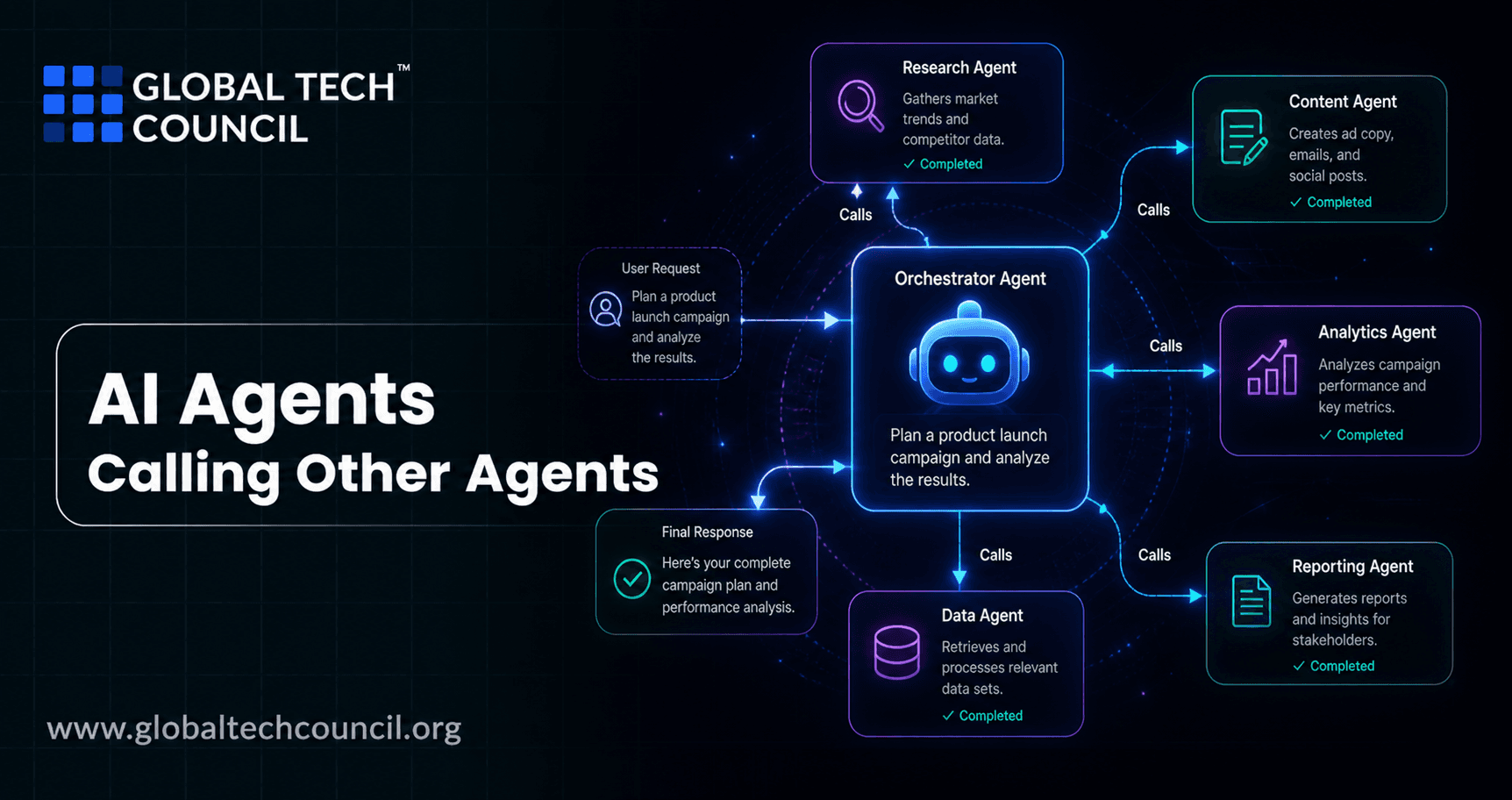
Artificial intelligence is no longer limited to isolated tools performing individual tasks. The latest evolution in AI is the emergence of interconnected systems where AI agents can communicate, collaborate, and even delegate work to one another. This concept, often described as “AI agents calling other agents,” is redefining how automation and intelligent systems operate.
Instead of relying on a single system to handle everything, modern AI architectures use multiple specialized agents that interact dynamically. This creates a more flexible, scalable, and efficient approach to solving complex problems.

To fully understand this shift, professionals are increasingly exploring advanced domains like the Agentic AI expert certification, which focuses on autonomous and collaborative AI systems.
Understanding AI Agents in Modern Systems
AI agents are autonomous software entities designed to perceive inputs, process information, and take actions to achieve specific goals. Unlike traditional software, these agents can adapt, learn, and make decisions based on changing conditions.
Common examples include:
Virtual assistants handling user queries
Recommendation engines suggesting products or content
Automated systems managing workflows
To build a strong foundation in these technologies, many professionals pursue programs like the AI expert certification, which explains core AI concepts and practical applications.
What Does It Mean for AI Agents to Call Other Agents?
The phrase refers to a system where one AI agent interacts with another to complete a task. Instead of operating in isolation, agents collaborate by:
Delegating subtasks
Requesting information
Triggering actions across systems
For example, a travel booking AI might call a pricing agent to compare costs, a scheduling agent to check availability, and a payment agent to process transactions. This creates a seamless and intelligent workflow.
How Multi-Agent Systems Function
Task Breakdown and Delegation
When a complex request is received, the primary agent divides it into smaller tasks. Each task is then assigned to a specialized agent.
Communication Mechanisms
Agents communicate through structured protocols, APIs, or messaging systems. These interactions allow them to exchange data and coordinate effectively.
Aggregation of Results
Once individual agents complete their tasks, the results are returned and combined into a final output. This ensures that complex processes are handled efficiently.
Practical Applications of Agent-to-Agent Communication
Customer Experience Automation
In customer support systems, AI agents collaborate to resolve queries quickly. One agent may handle user interaction while others manage billing, shipping, or technical issues.
E-Commerce Ecosystems
Online platforms use multiple agents to manage inventory, pricing, recommendations, and logistics. These agents work together to deliver a seamless shopping experience.
Marketing and Campaign Management
AI agents are widely used in digital marketing to manage campaigns, analyze performance, and optimize targeting. Professionals can enhance their expertise in this area through the AI powered digital marketing course.
Software Development and Automation
In development environments, AI agents assist with coding, testing, and debugging. Developers can strengthen their skills with the AI Powered coding expert Course, which focuses on building intelligent applications.
Benefits of AI Agents Collaborating
Improved Efficiency
Multiple agents working together can complete tasks faster than a single system. This reduces processing time and enhances productivity.
Scalability
Multi-agent systems can handle large workloads by distributing tasks. This makes them suitable for enterprise-level applications.
Specialized Performance
Each agent is designed for a specific function, resulting in higher accuracy and better outcomes.
Reduced Human Effort
Automation minimizes the need for manual intervention, allowing humans to focus on strategic tasks.
Challenges in Multi-Agent Systems
Coordination Complexity
Managing communication between multiple agents requires robust systems. Poor coordination can lead to inefficiencies.
Security and Privacy Risks
Data exchange between agents must be secured to prevent breaches. Strong security measures are essential.
System Reliability
Failures in one agent can impact the entire workflow. Systems must include fail-safe mechanisms.
Ethical Considerations
Autonomous decision-making raises questions about accountability and transparency. These issues must be addressed carefully.
The Rise of Agentic AI
Agentic AI represents a new class of systems capable of independent action and decision-making. These systems not only perform tasks but also plan, adapt, and collaborate with other agents.
This approach is transforming industries by enabling more intelligent and autonomous workflows. As adoption grows, understanding agentic systems will become increasingly important for professionals.
Future Trends in AI Agent Collaboration
The future of AI is moving toward highly interconnected ecosystems. Key trends include:
Advanced multi-agent architectures
Real-time collaboration between systems
Increased autonomy and decision-making capabilities
Integration across industries and platforms
As these systems evolve, they will handle increasingly complex tasks with minimal human input.
Conclusion
AI agents calling other agents represent a fundamental shift in how artificial intelligence systems operate. By enabling collaboration between specialized agents, these systems can solve complex problems more efficiently and effectively.
While the benefits are significant, challenges such as coordination, security, and ethics must be carefully managed. As technology continues to advance, multi-agent systems will play a central role in shaping the future of automation.
Professionals who understand and adapt to this shift will be better positioned to thrive in an increasingly AI-driven world.
FAQs
1. What are AI agents and how do they work?
AI agents are autonomous systems that can perform tasks without constant human input. They analyze data, make decisions, and execute actions based on predefined goals. These systems can adapt and improve over time. They are widely used in automation and intelligent applications.
2. What does it mean for AI agents to call other agents?
It means that one AI system can communicate with another to complete a task. Instead of handling everything alone, it delegates specific tasks to specialized agents. This creates a collaborative workflow. It improves efficiency and accuracy.
3. Why are multi-agent systems important?
Multi-agent systems allow complex tasks to be divided among specialized agents. This improves speed and performance. It also enables scalability. These systems are essential for modern automation.
4. How do AI agents communicate with each other?
AI agents communicate through APIs, messaging protocols, or structured data exchanges. These methods enable seamless interaction. Communication is usually automated. This ensures efficiency.
5. What industries use AI agent collaboration?
Industries such as e-commerce, finance, healthcare, and marketing use AI agent collaboration. These systems improve operations and customer experiences. They also reduce costs. Adoption is increasing rapidly.
6. Can AI agents replace human workers?
AI agents can automate repetitive tasks but cannot fully replace humans. Human creativity and judgment remain essential. Agents act as assistants. They enhance productivity.
7. What are the risks of multi-agent systems?
Risks include security issues, system failures, and ethical concerns. Poor coordination can lead to errors. Proper safeguards are necessary. Responsible use is important.
8. How do AI agents improve efficiency?
AI agents work continuously and can handle multiple tasks simultaneously. This reduces delays and increases productivity. They optimize workflows. Efficiency improves significantly.
9. What is agentic AI?
Agentic AI refers to systems that can act independently and make decisions. These systems can collaborate with other agents. They are more advanced than traditional AI tools. They represent the future of automation.
10. Are AI agents expensive to implement?
Costs vary depending on complexity. Simple systems are affordable. Advanced systems require more investment. However, they offer long-term benefits.
11. Can small businesses use AI agents?
Yes, small businesses can use AI agents for tasks like marketing and customer support. These tools are becoming more accessible. They improve efficiency. They reduce costs.
12. How do AI agents handle errors?
AI agents use feedback loops to detect and correct errors. They learn from past performance. Human oversight is still important. This ensures reliability.
13. What skills are needed to work with AI agents?
Skills in programming, data analysis, and AI concepts are essential. Understanding automation is also helpful. Continuous learning is important. These skills improve effectiveness.
14. Can AI agents learn over time?
Yes, many AI agents use machine learning to improve performance. They adapt based on data. This makes them more effective. Learning is a key feature.
15. How secure are AI agent systems?
Security depends on system design. Proper encryption and safeguards are necessary. Data protection is critical. Organizations must follow best practices.
16. What tools are used to build AI agents?
Developers use programming languages, AI frameworks, and cloud platforms. These tools support development and deployment. They provide scalability. They are widely used.
17. Can AI agents collaborate in real time?
Yes, AI agents can interact in real time. This allows quick responses. It improves efficiency. Real-time collaboration is a major advantage.
18. What is the future of AI agents?
The future includes more autonomous and intelligent systems. Agents will handle complex workflows. Integration will increase. This will transform industries.
19. How do AI agents impact businesses?
AI agents improve efficiency and reduce costs. They enhance customer experiences. Businesses can scale operations more easily. They gain a competitive edge.
20. Should professionals learn about AI agents?
Yes, understanding AI agents is important for future careers. It improves job opportunities. Professionals can stay competitive. Learning these skills is valuable.
Related Articles
View All
AI & ML
AI Agents Explained: Architecture, Tool Use, Memory, and Real-World Applications
AI agents combine LLMs with tools, memory, and orchestration to complete multi-step workflows. Learn agent architecture, memory types, tool use patterns, and real applications.
AI & ML
Introducing Workspace Agents in ChatGPT
Introduction Artificial Intelligence is no longer just a personal productivity tool. Furthermore, on April 22, 2026, OpenAI announced a shift that changes how entire teams work together. The launch of Workspace Agents in ChatGPT marks the most significant update to the platform since custom GPTs…
AI & ML
GPT 6 Astra: What OpenAI's New Frontier Model Means for AI, Security, and Work
GPT 6 Astra is OpenAI's newest frontier model, with phased access, stronger safety controls, and major implications for cybersecurity, coding, and enterprise AI.
Trending Articles
The Role of Blockchain in Ethical AI Development
How blockchain technology is being used to promote transparency and accountability in artificial intelligence systems.
AWS Career Roadmap
A step-by-step guide to building a successful career in Amazon Web Services cloud computing.
Top 5 DeFi Platforms
Explore the leading decentralized finance platforms and what makes each one unique in the evolving DeFi landscape.