

Recursive Self-Improvement vs Recursive Self-Training: Key Differences

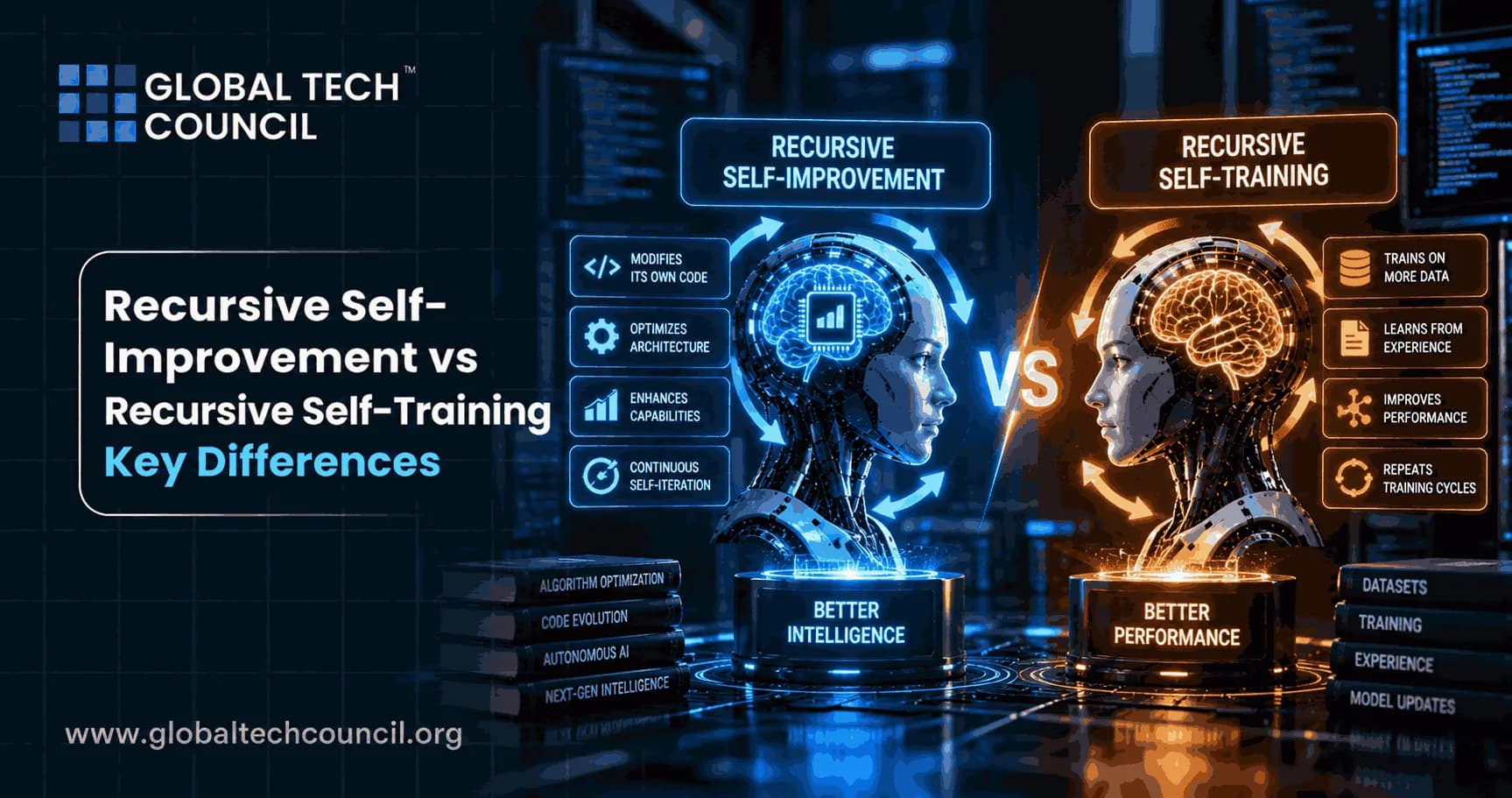
These two terms get used interchangeably in AI discussions far more often than they should be, and the confusion causes real problems in how people interpret AI progress. Recursive self-training describes something already happening in production AI systems today, while recursive self-improvement describes a much broader, largely theoretical capability that no deployed system has convincingly demonstrated. Knowing where that line sits is fundamental to reading AI news accurately, and it's exactly the kind of distinction a Certified Artificial Intelligence (AI) Expert learns to make when evaluating capability claims rather than taking headlines at face value.
This article breaks down what each term actually means, where they overlap, and why conflating them leads to consistently inflated expectations about how fast AI systems are advancing.

Defining Recursive Self-Training
Recursive self-training refers to a specific, concrete process: using a model's own generated outputs as training data for subsequent versions of that model. The "recursive" element comes from the loop, where each generation of the model produces data that helps train the next.
This is a hands-on engineering process rather than an abstract concept, and it's something a Certified Artificial Intelligence (AI) Developer would work with directly, since implementing self-training pipelines involves practical decisions about synthetic data generation, quality filtering, and evaluation benchmarks rather than theoretical speculation about future AI trajectories.
What Recursive Self-Training Looks Like in Practice
The typical process involves a model generating synthetic examples, those examples being filtered for quality, and the surviving data being used to fine-tune a newer version of the model. Techniques like reinforcement learning from AI feedback and model distillation fall under this broader umbrella. Crucially, humans still define the training objectives, select the filtering criteria, and decide when a new version is good enough to deploy.
The Known Limitation: Model Collapse
Recursive self-training carries a well-documented failure mode. When models are trained too heavily on their own outputs across successive generations, quality and diversity can degrade rather than improve, a phenomenon researchers call model collapse. Errors and biases compound, rare patterns disappear from the data distribution, and the model gradually becomes worse at handling edge cases. This is why self-training in practice almost always mixes synthetic data with fresh human-generated data rather than relying on model outputs alone.
Defining Recursive Self-Improvement
Recursive self-improvement describes something far more expansive: a system that enhances its own overall capability, then uses that enhanced capability to drive further enhancements, with each cycle theoretically enabling faster or more substantial gains than the last.
The key difference is scope. Self-training improves a model's performance within a fixed architecture using a specific mechanism. Self-improvement, as the term is used in AI research, implies the system could modify its own architecture, redefine its own objectives, or discover entirely new improvement methods that its designers never anticipated.
Why the Distinction Matters Technically
A system that generates better training data is optimizing within boundaries someone else established. A system capable of genuine recursive self-improvement would be able to identify and redraw those boundaries itself. That gap is not a matter of degree. It involves capabilities like self-modeling and open-ended goal revision that remain unsolved research problems rather than engineering challenges with known solutions.
The Core Differences at a Glance
The clearest way to separate the two concepts is by looking at what each one actually changes.
Scope of change: Self-training adjusts model weights and performance. Self-improvement would alter architecture, methods, and potentially objectives.
Human involvement: Self-training requires humans to define objectives, filter data, and approve deployment. Self-improvement implies substantially reduced human involvement across the entire loop.
Current status: Self-training is deployed and widely used across the industry today. Self-improvement remains theoretical, with no publicly demonstrated example meeting the full definition.
Failure modes: Self-training fails through gradual quality degradation, which is measurable and correctable. Self-improvement carries harder-to-predict risks, which is why it features prominently in AI safety research.
Rate of change: Self-training produces incremental gains that typically plateau. Self-improvement implies compounding gains that could accelerate rather than level off.
Where These Concepts Show Up in Real Applications
Understanding the practical version of this distinction is easier with a concrete example from outside pure research. One emerging application is AI microdrama, where generative AI helps bring serialized stories, characters, and fictional worlds to life. Systems in this space often refine their outputs iteratively, adjusting character consistency, pacing, and plot direction based on what audiences engage with most. This is recursive self-training in a creative context: the system improves its outputs using feedback loops, but it isn't redesigning how it fundamentally works, and a human still defines what "engaging" means as the target.
Why the Confusion Persists
Part of the problem is that "self-improving AI" makes for a far more compelling headline than "AI system using synthetic training data with human-defined quality filters." Media coverage frequently describes genuine self-training results using self-improvement language, which inflates public perception of how autonomous these systems actually are. Professionals who want to evaluate such claims rigorously often pursue a Deep Tech Certification, which provides the technical grounding needed to read past marketing language and assess what a given system has actually demonstrated.
Why This Distinction Matters Beyond Research Circles
Getting these terms right affects decisions well outside AI labs. Businesses planning technology investments, policymakers drafting oversight frameworks, and teams building products on top of AI models all make better decisions when they understand whether a capability is currently available or still speculative.
This applies directly to how AI progress gets communicated. Teams responsible for positioning AI-powered products need to describe capabilities accurately rather than borrowing language from research speculation, and professionals who pair technical understanding with a Marketing Certification are often better positioned to communicate what a system genuinely does without overstating it, which builds far more durable credibility than hype that later gets corrected.
Final Thoughts
Recursive self-training is a real, active engineering practice with known benefits and a documented failure mode in model collapse. Recursive self-improvement is a broader theoretical concept describing autonomous, compounding capability gains that no current system has achieved. Treating the first as evidence of the second is the most common mistake in this conversation, and keeping the two clearly separated is the difference between understanding AI progress accurately and consistently overestimating it.
FAQs
1. What is the difference between Recursive Self-Improvement and Recursive Self-Training?
Recursive Self-Improvement (RSI) is a broader concept where an AI repeatedly improves its capabilities, algorithms, architecture, or development process. Recursive Self-Training (RST) specifically focuses on an AI using generated data, outputs, or feedback to train or refine future versions of itself.
2. What is Recursive Self-Improvement in AI?
Recursive Self-Improvement is a process in which an AI system identifies ways to improve itself, implements or enables those improvements, evaluates the results, and uses the improved system to pursue further improvements.
3. What is Recursive Self-Training in AI?
Recursive Self-Training involves repeatedly training a model using information generated by the model itself or by earlier versions of the model. The process can involve synthetic data, pseudo-labels, generated examples, or model-generated feedback.
4. Are Recursive Self-Improvement and Recursive Self-Training the same?
No. They overlap but are not interchangeable. Self-training is one possible mechanism for improving a model, while RSI describes a broader iterative improvement process.
5. Which is broader, RSI or Recursive Self-Training?
RSI is broader. It can include changes to model architecture, algorithms, training methods, code, tools, research strategies, and other components, while recursive self-training primarily concerns the training process.
6. How does Recursive Self-Training work?
A simplified RST loop can look like:
Model generates data → Data is filtered or evaluated → Model trains on the data → New model generates more data → Process repeats
The quality of filtering and evaluation is critical because mistakes can potentially propagate from one generation to the next.
7. How does Recursive Self-Improvement work?
A simplified RSI loop is:
Identify limitation → Design improvement → Implement change → Test and evaluate → Adopt successful change → Repeat
Unlike self-training, this process does not have to involve retraining the model after every iteration.
8. Can Recursive Self-Training lead to Recursive Self-Improvement?
Potentially. If self-training produces a genuinely more capable model and that model becomes better at discovering additional improvements, self-training could become one component of an RSI loop. However, self-training alone does not guarantee recursive self-improvement.
9. Can RSI happen without self-training?
Yes. An AI could potentially improve through better algorithms, architecture changes, software optimization, tool improvements, automated research, or improved inference methods without directly training on its own generated data.
10. Can an AI train itself using its own outputs?
Yes. AI-generated outputs can be used as synthetic training data or feedback in certain training pipelines. However, researchers need quality controls because generated data can contain errors or reinforce existing weaknesses.
11. What are the main benefits of Recursive Self-Training?
Recursive self-training can potentially generate large amounts of task-specific training data and reduce dependence on manually labeled examples. It can also allow models to practice specific capabilities repeatedly under controlled objectives.
12. What are the main benefits of Recursive Self-Improvement?
RSI could potentially improve multiple aspects of an AI system rather than only its training data. These might include reasoning, algorithms, software, architecture, research methods, efficiency, and evaluation processes.
13. What are the limitations of Recursive Self-Training?
A major concern is error accumulation. If a model repeatedly learns from low-quality outputs produced by itself or similar models, errors, biases, or undesirable patterns can potentially be reinforced. Recent research has also examined degradation and collapse risks associated with recursive self-training of language models.
14. What are the limitations of Recursive Self-Improvement?
RSI faces broader challenges, including computing requirements, reliable evaluation, data limitations, alignment, cybersecurity, and the difficulty of determining which changes genuinely improve the overall system. Current AI can automate parts of AI development, but fully autonomous RSI has not been publicly demonstrated.
15. Does Recursive Self-Training require changing the AI model?
Usually, yes, because training is intended to update the model's parameters or produce a new version. By contrast, RSI can potentially improve an AI system without changing its underlying model, such as by improving its tools, algorithms, prompts, or surrounding infrastructure.
16. Does RSI always involve retraining?
No. RSI could involve software modifications, improved algorithms, better tools, architectural changes, or other improvements that do not necessarily require traditional retraining. Retraining can be one part of the larger improvement process.
17. Which approach is closer to autonomous AI development?
Recursive Self-Improvement is generally closer to the broader idea of autonomous AI development because it can include research, coding, experimentation, evaluation, and model development. Recursive self-training is more narrowly focused on using generated information to train future model versions.
18. Can LLMs perform Recursive Self-Training today?
LLMs can participate in self-training workflows involving synthetic data, generated feedback, and iterative fine-tuning. However, this does not mean that LLMs independently control the entire process or have achieved unrestricted recursive self-improvement.
19. Is Recursive Self-Training a form of Recursive Self-Improvement?
It can be, but not automatically. If recursive self-training produces meaningful improvements that enable the system to perform further improvement cycles, it could form part of an RSI process. If it simply generates and consumes training data without expanding the system's ability to improve itself, it is better described as recursive self-training.
20. Which is more important for the future of AI: RSI or Recursive Self-Training?
They serve different purposes. Recursive self-training focuses on how models can learn from generated information, while RSI focuses on how AI systems could repeatedly improve themselves more broadly. Future AI development could potentially combine self-training with automated coding, research, architecture search, experimentation, and evaluation to create increasingly sophisticated improvement loops.
Related Articles
View All
AI & ML
Recursive Self-Improvement and AI Safety: What Are the Risks?
Recursive self-improvement could allow AI systems to enhance their capabilities repeatedly, raising concerns around alignment, control, oversight, rapid capability growth, and unpredictable behavior.
AI & ML
What Are the Limitations of Recursive Self-Improvement in AI?
Explore the main limitations of recursive self-improvement in AI, including model reliability, evaluation challenges, resource constraints, alignment risks, diminishing returns, and technical bottlenecks.
AI & ML
Is Recursive Self-Improvement Possible With Today’s AI Models?
Explore whether today’s AI models can achieve recursive self-improvement, what forms of self-optimization are already possible, and the technical limits preventing fully autonomous RSI.
Trending Articles
The Role of Blockchain in Ethical AI Development
How blockchain technology is being used to promote transparency and accountability in artificial intelligence systems.
AWS Career Roadmap
A step-by-step guide to building a successful career in Amazon Web Services cloud computing.
Top 5 DeFi Platforms
Explore the leading decentralized finance platforms and what makes each one unique in the evolving DeFi landscape.