

Is Recursive Self-Improvement Possible With Today’s AI Models?

Introduction: A Question of Architecture, Not Just Ambition
Much of the public conversation around recursive self-improvement focuses on whether AI labs want to build self-improving systems or whether current disclosures already prove it is happening. A quieter but arguably more important question gets less attention: do today's AI models even have the underlying architecture needed to support genuine recursive self-improvement, regardless of intent? Looking closely at how current models actually learn, remember, and act reveals several structural constraints that limit how far this concept can realistically go right now. Professionals studying these technical boundaries closely often pursue a Certified Artificial Intelligence (AI) Expert credential, which builds the foundational knowledge needed to evaluate architectural claims about AI capability rather than taking headline statements at face value.
The honest technical answer is that today's models can support a narrow, bounded version of self-improvement, but several architectural limitations currently prevent anything close to the fully autonomous, open-ended version of the concept that gets discussed in more speculative conversations.

The Catastrophic Forgetting Problem
One of the most fundamental obstacles to genuine self-improvement in current models involves a well-documented phenomenon called catastrophic forgetting. When a model is repeatedly fine-tuned on a narrow stream of new data, it can lose previously learned capabilities in the process:
Supervised fine-tuning works by showing a model examples of desired behavior and updating it to imitate those examples, but doing this repeatedly on narrow data can cause the model to lose unrelated skills it previously performed well.
Reinforcement learning tends to be gentler on existing capabilities, since it typically moves a model's behavior by smaller increments, but this same gentleness also limits how much genuinely new knowledge or capability the model can absorb in a single training pass.
Researchers studying this tradeoff generally view it as a technique limitation rather than definitive proof that current architectures lack the underlying capacity for continual learning, suggesting future methods could meaningfully narrow this gap.
Why Self-Evaluation Remains Unreliable
A second major constraint involves how well current models can actually judge the quality of their own outputs and changes, which is foundational to any genuine self-improvement loop:
Textual self-refinement techniques, where a model critiques and revises its own response, tend to saturate quickly, producing diminishing improvement after only a few iterations rather than continuing to improve indefinitely.
Models frequently fail to correct their own errors even when those errors have already been explicitly identified and pointed out to them, revealing a meaningful gap between recognizing a flaw exists and successfully fixing it.
Internal evaluation can sometimes actively backfire, producing what researchers describe as a form of flawed self-reflection that reinforces incorrect beliefs rather than correcting them.
Because a model cannot reliably judge the downstream value of its own proposed structural changes, current self-modification tends to remain shallow and surface-level rather than deep or transformative.
Professionals working directly on building more reliable evaluation and feedback systems for AI often pursue a Certified Artificial Intelligence (AI) Developer credential, gaining hands-on skills in the evaluation design and verification techniques needed to address exactly this kind of unreliable self-assessment problem.
The Model Collapse Risk Tied to Synthetic Data
A separate and independent constraint stems from how models behave when they are increasingly trained on data generated by earlier AI systems rather than fresh human-created content:
Training progressively on synthetic data has been shown to erode the diversity of a model's outputs and collapse the range of behaviors it can produce, a pattern that proves surprisingly robust across different model scales.
Notably, this degradation happens independently of any flaw in a model's underlying architecture, meaning even a theoretically well-designed self-improving system would still face this risk purely from the nature of training repeatedly on its own outputs.
This creates a structural ceiling on how far purely self-generated training data can push capability forward without periodic reinjection of fresh, human-grounded information.
AI Microdrama and Emerging Creative Applications
One emerging application is AI microdrama, where generative AI helps bring serialized stories, characters, and fictional worlds to life. Platforms built around this kind of generative storytelling illustrate a useful contrast to the self-improvement constraints discussed elsewhere in this article, since creative applications generally benefit from fresh human input, audience feedback, and evolving cultural context rather than depending on a closed loop of AI-generated content improving itself in isolation.
The Physical World Gap
A constraint that receives less attention than data or evaluation limitations involves the significant gap between what current AI systems can do digitally and what they can actually observe or act on in the physical world. Researchers studying this limitation point out that today's AI cannot install or replace physical hardware components, cannot directly debug signal issues on a printed circuit board, and cannot participate in informal conversations or observations that never get digitally recorded in the first place.
This matters for recursive self-improvement because a meaningful share of what actually constrains AI progress involves physical infrastructure, hardware constraints, and tacit organizational knowledge that current systems simply have no direct access to, regardless of how capable their reasoning or coding abilities become within a purely digital environment. Grappling with this kind of cross-disciplinary limitation, spanning software, hardware, and organizational systems simultaneously, benefits from broad technical grounding beyond AI alone. A Deep Tech Certification helps professionals build that wider foundation, equipping them to reason clearly about where digital AI capability actually ends and physical-world constraints begin.
Tactical Recursion Versus Transcending Architectural Limits
Industry experts studying this question have proposed a useful distinction between two very different outcomes that often get conflated in public discussion. Some describe what current systems achieve as tactical recursion, meaning the technology compresses development velocity within an existing capability frontier without actually transcending the underlying architectural limits or discovering entirely new capability classes beyond what the architecture was already designed to support.
This distinction matters because it reframes the central question. Rather than asking whether AI can improve itself at all, which current evidence clearly answers in the affirmative within bounded contexts, the more precise question becomes whether that improvement can eventually break past the ceiling imposed by today's architecture, training methods, and evaluation reliability, or whether it will continue compounding gains only within the boundaries those foundations already define.
What Would Need to Change Architecturally
Researchers proposing frameworks for genuinely open-ended recursive self-improvement have identified specific technical burdens that current architectures still need to overcome:
Reliable persistent adaptation, allowing a system to update itself meaningfully once deployed in a real environment without suffering the kind of forgetting or degradation described earlier.
Trustworthy self-evaluation, giving a system the ability to accurately judge whether a proposed change to itself will genuinely help rather than relying on shallow, easily saturated self-critique.
Sustainable learning signal generation, addressing how a system can keep producing genuinely useful new training signal at scale without collapsing into the kind of narrowing diversity problem synthetic data training currently risks.
Expanded ability to act on and observe the physical world, closing the gap between purely digital reasoning capability and the hardware, infrastructure, and tacit knowledge that meaningfully shapes real-world AI development progress.
Researchers describe systems that successfully address these burdens as occupying a higher level of autonomy on a broader landscape of self-improvement, one where the AI itself increasingly takes on responsibility for data curation, architecture decisions, and strategy selection rather than a human designer making those calls. No publicly documented system has reached that higher level of autonomy as of current evidence.
Communicating This Technical Nuance Responsibly
Whether recursive self-improvement is possible with today's models is a question that rewards careful, technically grounded explanation rather than confident pronouncements in either direction. Overstating current architectural capability risks fueling unrealistic expectations, while dismissing the genuine bounded progress already achieved ignores real, measurable engineering advances happening across multiple labs. Communicating this nuance clearly to non-technical audiences requires skills distinct from the research work needed to study the architecture itself.
A Marketing Certification can help professionals develop the communication tools needed to explain these architectural constraints accurately, presenting both what today's models can genuinely achieve within bounded self-improvement loops and the specific technical barriers that still separate current systems from the more consequential, open-ended version of the concept.
Today's AI models can support a real, measurable, but fundamentally bounded form of recursive self-improvement, constrained by catastrophic forgetting, unreliable self-evaluation, model collapse risk, and a persistent gap between digital reasoning and physical-world action. Whether future architectures manage to overcome these specific technical burdens will likely determine if recursive self-improvement remains a useful engineering technique operating within existing limits or eventually becomes something capable of genuinely transcending the boundaries current systems were originally designed within.
FAQs
1. Is Recursive Self-Improvement possible with today’s AI models?
Partially, but not in its strongest form. Current AI models can automate parts of the improvement process, such as coding, experimentation, evaluation, and algorithm optimization. However, fully autonomous RSI, where an AI independently develops successive generations of increasingly capable AI, has not been publicly demonstrated. OpenAI explicitly says fully autonomous recursive self-improvement is not happening today.
2. What is Recursive Self-Improvement in AI?
Recursive Self-Improvement (RSI) is a process in which an AI system improves its own capabilities, architecture, algorithms, training methods, or development processes and then uses those improvements to make further improvements.
3. Can current AI models improve themselves?
Current models can perform limited forms of self-improvement, such as self-correction, self-reflection, code optimization, and iterative problem solving. These capabilities generally operate within human-designed systems and do not mean that the underlying model is autonomously retraining or redesigning itself.
4. Can AI models rewrite their own code today?
AI coding systems can generate, modify, debug, and test software. With appropriate tools and permissions, they can even perform substantial coding tasks autonomously, but modifying software code is not by itself evidence of full recursive self-improvement.
5. Can today's AI train a better version of itself?
AI can contribute to training successor models by generating data, writing code, designing experiments, optimizing configurations, and evaluating results. However, current systems do not publicly demonstrate complete autonomous control over the entire process of creating increasingly capable successors.
6. Can LLMs optimize their own capabilities?
LLMs can optimize aspects of their workflow, including prompts, generated code, reasoning strategies, and task-specific approaches. Optimizing the underlying model's architecture or training process autonomously is substantially more difficult.
7. What parts of RSI are already possible today?
Several components are already feasible, including:
Automated code generation and debugging
Self-correction and iterative refinement
Synthetic training-data generation
Automated evaluation
Hyperparameter optimization
Algorithm discovery
AI-assisted research
AI-generated experiments
Together, these capabilities can form pieces of a future RSI pipeline.
8. Can AI conduct AI research today?
Yes, to an increasing extent. AI agents can perform coding, literature analysis, experimentation, debugging, and other research tasks. OpenAI says its latest agents can perform some tasks that would take skilled researchers several days, while emphasizing that this is not yet recursive self-improvement.
9. Can AI independently decide what AI improvements to make?
This remains a major limitation. Current systems can suggest experiments and improvements, but humans generally establish the objectives, evaluation criteria, resources, or boundaries. Anthropic identifies the ability to decide which problems are worth pursuing as an important gap between current AI and fully autonomous development of its successors.
10. Can current AI models create better AI architectures?
AI can help search for and evaluate architectures and algorithms. Automated systems can explore large numbers of candidate solutions, but this is different from an AI independently redesigning its complete architecture and then recursively using the improved architecture to develop an even better successor.
11. Can AI use its own outputs to improve future models?
Yes. AI-generated outputs can be used as synthetic training data, feedback, or evaluation material. However, blindly training on AI-generated content can propagate errors or reduce diversity, so external data and reliable evaluation remain important.
12. Is self-correction the same as Recursive Self-Improvement?
No. Self-correction usually improves a particular response, reasoning process, or task result. RSI involves improving the AI system or the process used to improve it in a way that can enable further improvements.
13. Are AI agents a step toward Recursive Self-Improvement?
Yes. AI agents can connect language models with coding tools, research systems, execution environments, and evaluation frameworks. This allows AI to perform more steps of the AI-development cycle, making agentic systems an important potential building block for future RSI.
14. Are there real examples of AI improving AI development?
Yes. AI is already being used to accelerate software engineering, research, algorithm discovery, evaluation, and model-development workflows. For example, Anthropic reports that its models can execute experiments and optimize code against predefined objectives, while Google DeepMind's AlphaEvolve uses AI-powered generation and automated evaluation to discover algorithmic improvements.
15. What prevents today's AI from achieving full RSI?
Several factors remain important:
Limited autonomous research judgment
Dependence on human-defined objectives
Computing and energy constraints
Difficulty reliably evaluating improvements
Training-data limitations
Software and infrastructure access
Safety and security requirements
Risk of reinforcing errors during self-training
These constraints mean that automating individual steps is much easier than closing the entire improvement loop.
16. Could today's AI become recursively self-improving with additional tools?
Potentially, but adding tools alone may not be enough. A system would need to reliably decide what to improve, how to improve it, how to test the change, and whether the improvement is genuinely useful. It would also need sufficient resources and safeguards to repeat that process.
17. Could Recursive Self-Improvement happen before AGI?
Possibly. Some forms of RSI could occur in specialized AI systems without requiring full AGI. However, highly open-ended self-improvement may require broad research, reasoning, coding, planning, and experimentation capabilities that resemble aspects of AGI.
18. What would true RSI look like?
A stronger form of RSI might look like:
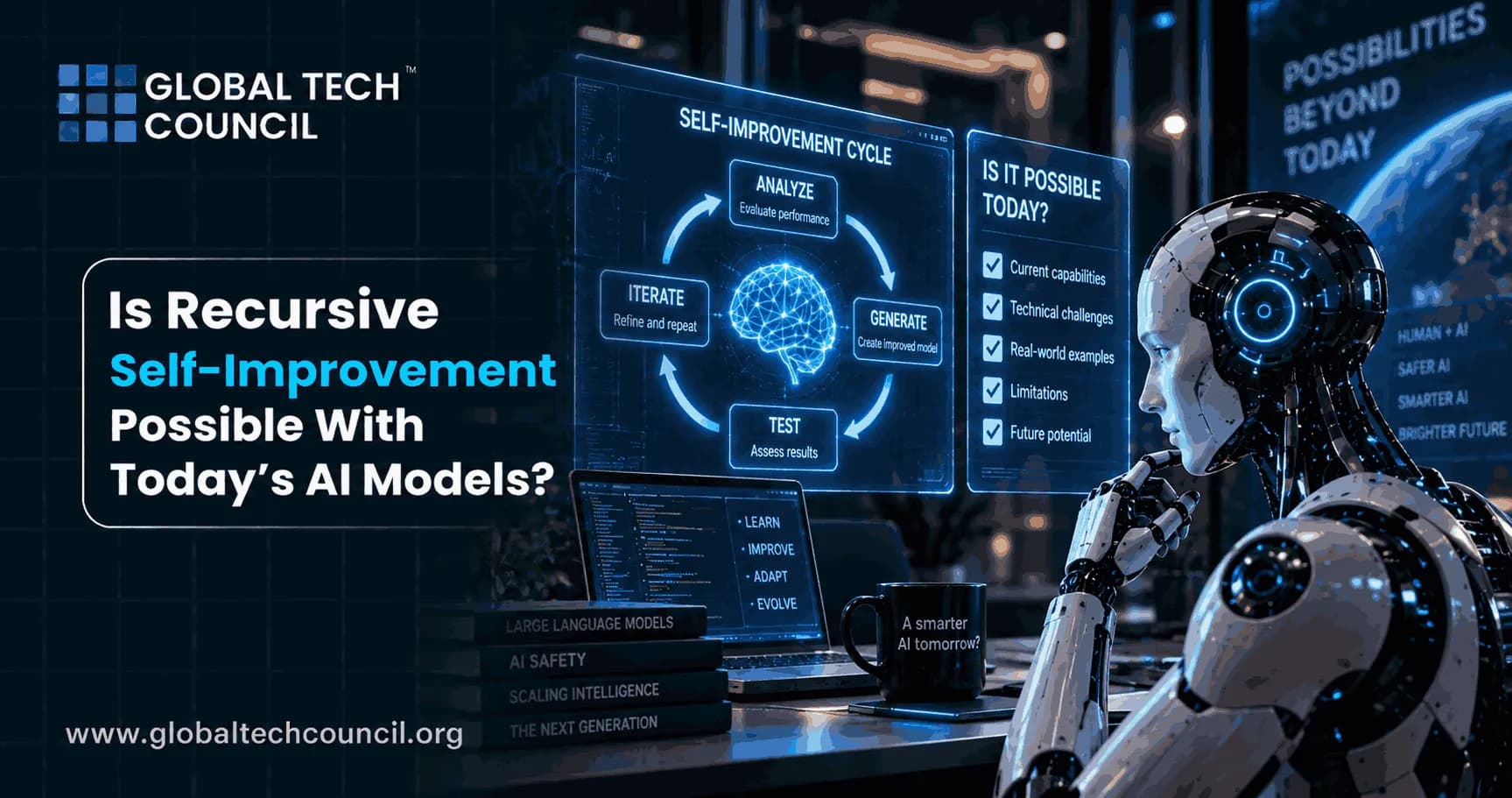
AI identifies a limitation → designs an improvement → implements it → trains or modifies a model → evaluates the result → adopts the improvement → uses the improved system to find another improvement → repeats.
The crucial difference is that the AI would increasingly drive the improvement cycle itself rather than simply assisting humans.
19. Could today's AI suddenly enter an intelligence explosion?
There is no evidence that current publicly demonstrated systems are already undergoing such a process. An intelligence explosion would require a feedback loop where AI improvements make the system substantially better at producing further improvements, potentially causing rapid capability growth. OpenAI's safety framework treats fully autonomous AI research as a potentially significant threshold because of this possibility.
20. So, is Recursive Self-Improvement possible with today's AI?
Limited forms are possible, but full autonomous RSI has not yet been demonstrated. Today's AI can already automate meaningful portions of AI development, and both OpenAI and Anthropic describe substantial progress toward increasingly automated AI research. The key unresolved step is closing the loop so that AI can independently drive the development and validation of increasingly capable successors.
Related Articles
View All
AI & ML
Recursive Self-Improvement in LLMs: Can Language Models Optimize Their Own Capabilities?
Explore whether large language models can recursively improve their own capabilities, how self-optimization might work, and the technical, architectural, and safety limits involved.

AI & ML
Recursive Self-Improvement vs Recursive Self-Training: Key Differences
Learn the key differences between recursive self-improvement and recursive self-training, including how each process works, what it changes, and why the distinction matters in AI development.
AI & ML
Recursive Self-Improvement and AI Safety: What Are the Risks?
Recursive self-improvement could allow AI systems to enhance their capabilities repeatedly, raising concerns around alignment, control, oversight, rapid capability growth, and unpredictable behavior.
Trending Articles
The Role of Blockchain in Ethical AI Development
How blockchain technology is being used to promote transparency and accountability in artificial intelligence systems.
AWS Career Roadmap
A step-by-step guide to building a successful career in Amazon Web Services cloud computing.
Top 5 DeFi Platforms
Explore the leading decentralized finance platforms and what makes each one unique in the evolving DeFi landscape.