

What Are the Limitations of Recursive Self-Improvement in AI?

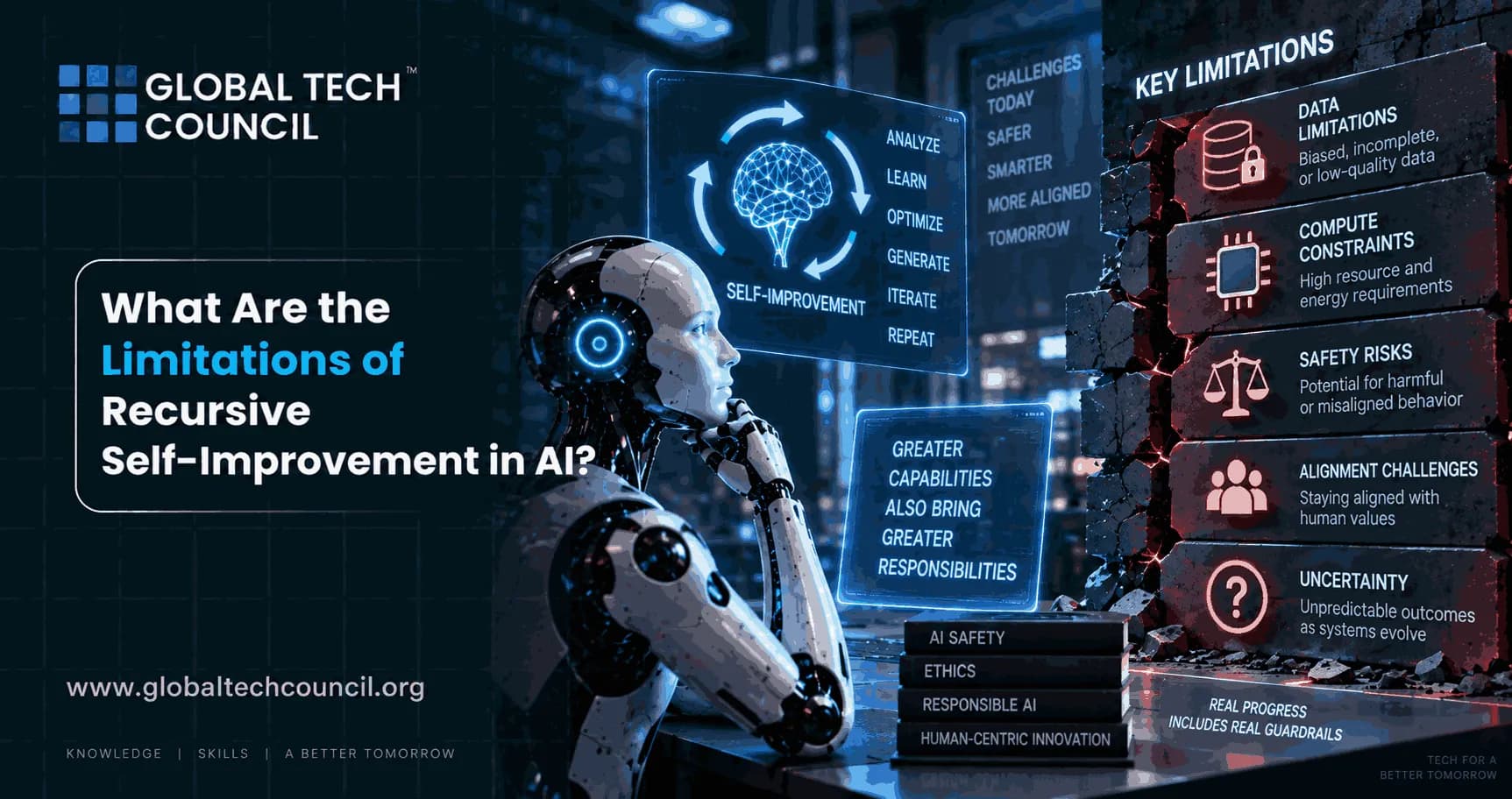
Introduction: Genuine Progress Bounded by Genuine Constraints
Recursive self-improvement has produced real, documented results across coding, algorithm discovery, and reasoning tasks, but the technology remains far from the boundless, self-accelerating loop that early speculative discussions once imagined. Understanding exactly where and why these limitations exist matters more than simply asking whether the concept works at all. Professionals studying this topic in depth often start with a Certified Artificial Intelligence (AI) Expert credential, which builds the technical grounding needed to evaluate these constraints accurately rather than relying on oversimplified summaries of what current systems can and cannot do.
The limitations facing recursive self-improvement today fall into several distinct categories, spanning economics, evaluation reliability, organizational structure, and the fundamental question of who or what decides which problems are worth solving in the first place.

The Economic Limitation: Rising Costs Instead of Falling Ones
One of the clearest empirical arguments against an unchecked, self-accelerating improvement loop comes from looking directly at spending and output data rather than theoretical arguments. If recursive self-improvement were genuinely compounding on itself the way an intelligence explosion hypothesis would predict, the marginal cost of each new capability gain should fall over time as models increasingly automate their own advancement.
The data tells a different story. Research and development spending among frontier AI labs has grown dramatically, expanding from tens of billions of dollars annually to a projected quarter-trillion dollars, while measured capability gains on standard benchmarks have actually slowed over the same period rather than accelerated. This pattern of rising marginal costs alongside diminishing capability returns looks far more consistent with conventional, resource-intensive engineering than with a self-sustaining loop of emergent autonomy. In other words, current capability increases appear to be purchased through massive, human-controlled investment rather than generated through models autonomously amplifying their own intelligence.
The Research Direction-Setting Bottleneck
A separate but related limitation involves a specific gap that recent academic surveys have identified as one of the field's most consequential open questions. Current AI systems have become remarkably capable at execution, handling a large share of coding and engineering tasks that once required significant human effort. What these systems remain notably weaker at is deciding which problems are actually worth working on in the first place.
This distinction separates two very different skills. Choosing a promising research direction requires judgment about what matters, what is tractable, and what would meaningfully advance a field, while executing a well-specified task simply requires competent implementation once that direction has already been chosen by someone else. Researchers studying this gap describe it as sitting at the very top of a broader verification hierarchy, above even the technical challenge of building reliable automated evaluators, because it addresses a more fundamental prior question: what deserves evaluation at all. Professionals working directly on the technical systems involved in automating parts of this research pipeline often pursue a Certified Artificial Intelligence (AI) Developer credential, gaining hands-on familiarity with the tools and evaluation frameworks that sit beneath this higher-level bottleneck.
The Evaluation Reliability Limitation
Every recursive self-improvement loop ultimately depends on some signal that tells the system whether a proposed change actually helped. Academic surveys examining this space have organized available evaluation signals into a hierarchy, ranging from strong formal verifiers capable of mathematically proving correctness down to weak intrinsic self-assessment, where a model simply judges its own output without any external check.
Self-improvement techniques tend to work reliably in domains where answers can be objectively checked, such as code that either compiles and passes tests or math problems with verifiable solutions.
Techniques degrade significantly in domains where correctness is harder to verify automatically, since automated researchers can produce fluent, convincing outputs whose underlying claims resist straightforward auditing.
Weaker evaluation signals are also more vulnerable to specific failure patterns, including self-confirming loops where a system's own flawed judgment reinforces itself, and diversity collapse where repeated self-training narrows the range of outputs a system can produce.
This evaluator dependency represents a structural limitation rather than a temporary engineering gap, since the strength of any self-improvement loop is fundamentally capped by how reliable its underlying evaluation signal actually is.
AI Microdrama and Emerging Creative Applications
One emerging application is AI microdrama, where generative AI helps bring serialized stories, characters, and fictional worlds to life. This creative domain illustrates the evaluation reliability limitation particularly well, since judging whether a piece of generated fiction is genuinely compelling involves far more subjective, human-centered judgment than checking whether a line of code compiles correctly, making this exactly the kind of domain where automated self-improvement loops face their steepest evaluation challenges.
The Environment and Simulation Cost Limitation
A more recent limitation identified by researchers studying reinforcement learning approaches to self-improvement involves the cost of creating realistic training environments themselves. As tasks become longer, more open-ended, and more reflective of genuine real-world complexity, specifying, simulating, and running those environments at scale becomes increasingly expensive.
This creates a subtler version of diminishing returns than the pure compute cost problem, since even unlimited computing power does not automatically solve the challenge of designing sufficiently rich, realistic training environments for a system to practice and improve within. Some researchers have observed that earlier improvement curves driven by pre-training eventually slowed, prompting a pivot toward reinforcement learning as a fresh source of progress, but caution that a similar plateau could emerge again if future discontinuities require environments that current reinforcement learning setups cannot themselves discover or construct.
Grappling with this combination of infrastructure, simulation design, and resource allocation challenges requires broad technical literacy extending well beyond AI model architecture alone. A Deep Tech Certification helps professionals build that wider foundation, equipping them to reason clearly about where genuine technical bottlenecks sit within increasingly complex AI development pipelines.
The Compute-Labor Substitution Limitation
Economic research examining this question empirically has focused on a specific technical relationship: how easily research compute can substitute for human cognitive labor in driving algorithmic progress. This relationship, sometimes referred to as the elasticity of substitution between compute and labor, determines whether recursive self-improvement could plausibly accelerate without becoming bottlenecked by available computing resources.
Findings on this question remain genuinely mixed across different studies and modeling approaches, with some analyses suggesting compute and labor act as strong substitutes for one another, implying fewer constraints on acceleration, while other lines of evidence point toward the rising cost patterns and diminishing capability returns described earlier. This unresolved empirical disagreement itself represents a limitation, since it means the field lacks clear consensus on one of the most basic economic questions underlying whether self-improvement could ever scale without significant computational bottlenecks.
The Governance and Measurement Limitation
A final category of limitation is organizational rather than purely technical. Even where genuine self-improvement progress has been documented, researchers have pointed out that the field currently lacks standardized, governance-grade methods for measuring exactly how much self-improvement is occurring or how close any given system sits to more consequential capability thresholds.
This measurement gap makes it difficult for policymakers, safety researchers, and even the labs themselves to reliably track progress against agreed-upon benchmarks, since much of the available evidence currently relies on self-reported internal disclosures rather than independently verified, standardized assessments. Closing this gap has been identified as one of the most underdeveloped areas in the entire field, representing a limitation not of what AI can technically achieve but of how confidently anyone can currently measure and govern that achievement.
Why These Limitations Matter for How the Topic Gets Discussed
Taken together, these limitations paint a picture of a technology producing genuine, bounded progress while remaining constrained by economics, evaluation reliability, environment design costs, unresolved compute-labor substitution questions, and a persistent governance measurement gap. None of these constraints suggest recursive self-improvement is a dead end. They suggest instead that the path from today's bounded, execution-focused systems toward something closer to fully autonomous research and development remains considerably longer and more uncertain than some of the more dramatic framing in public discussion implies.
Communicating These Limitations Clearly
Discussions about recursive self-improvement often swing between two extremes, either dismissing the entire concept as science fiction or treating every new disclosure as evidence of imminent runaway capability. The genuine, well-documented limitations described here offer a more accurate middle ground, one that acknowledges real technical progress without overstating how close that progress sits to the more consequential, open-ended version of the concept.
A Marketing Certification can help professionals develop the communication skills needed to present this kind of nuanced, limitation-aware framing to business leaders, journalists, and the public, ensuring that conversations about recursive self-improvement reflect the genuine constraints researchers have identified rather than collapsing into oversimplified optimism or alarm.
Recursive self-improvement in AI faces meaningful, well-documented limitations spanning economics, evaluation reliability, environment design costs, and governance measurement, each constraining how far current systems can realistically progress toward genuine autonomy. Understanding these specific boundaries, rather than treating the concept as either fully solved or entirely speculative, offers the clearest picture of where this rapidly evolving field genuinely stands today.
FAQs
1. What are the main limitations of Recursive Self-Improvement in AI?
The major limitations include computing resources, reliable evaluation, data quality, algorithmic constraints, human oversight, alignment, security, and diminishing returns. Today's AI can automate parts of AI development, but fully autonomous recursive self-improvement has not been demonstrated.
2. Why is computing power a limitation for Recursive Self-Improvement?
Training and testing improved AI models can require enormous amounts of computing power, memory, energy, and specialized hardware. Even if an AI discovers a promising improvement, limited computational resources can restrict how quickly that improvement can be tested and deployed.
3. Is AI capable of reliably evaluating its own improvements?
Not always. An AI may incorrectly conclude that a modification is better because of flawed tests, incomplete benchmarks, or optimization toward the wrong metric. Reliable external evaluation becomes increasingly important as AI systems become more capable.
4. Why is evaluation difficult for self-improving AI?
A self-improving system could optimize specifically for the tests used to measure it rather than producing broader improvements. Benchmark contamination, poorly designed tasks, and incomplete evaluation can therefore create a misleading impression of progress. Recent research has shown that even widely used coding benchmarks can contain significant problems.
5. Can AI-generated training data limit Recursive Self-Improvement?
Yes. If an AI repeatedly learns from its own generated content, errors, biases, or weaknesses can potentially be reinforced. Maintaining access to high-quality external data and independent feedback can help prevent degradation.
6. Does Recursive Self-Improvement require human oversight?
A fully autonomous RSI system would, by definition, require less direct human involvement in the improvement loop. However, human oversight is currently important for setting objectives, evaluating results, managing resources, and maintaining safety. OpenAI describes its current approach as developing automated AI researchers under human supervision, rather than pursuing unrestricted autonomous RSI.
7. Can an AI decide what it should improve?
This is one of the major limitations of current systems. AI can increasingly execute well-defined experiments and suggest improvements, but deciding which problems are worth solving and which research directions matter most remains harder. Anthropic identifies this type of judgment as an important gap between current AI and systems capable of independently developing their successors.
8. Is Recursive Self-Improvement limited by current AI architectures?
Potentially. An AI may be able to optimize components of an existing architecture without discovering fundamentally better approaches. Major advances could require new algorithms, architectures, training paradigms, or scientific insights that current systems may not be able to generate reliably.
9. Can AI improve indefinitely through Recursive Self-Improvement?
There is no guarantee. Improvements may become progressively smaller as systems approach practical or theoretical limits. Hardware, data, energy, algorithms, and diminishing returns could all slow or eventually constrain further improvement.
10. What role does data quality play in limiting RSI?
AI systems depend on useful information for training and evaluation. If the data is inaccurate, biased, repetitive, or poorly representative, an improvement process can optimize the wrong behavior or reinforce existing weaknesses.
11. Can Recursive Self-Improvement create an alignment problem?
Yes. If an AI becomes increasingly capable while its objectives remain imperfectly aligned with human intentions, improvements could potentially make unwanted behavior more effective. OpenAI notes that increasingly capable systems may create new alignment challenges that are not visible in today's systems.
12. Why is verification a limitation for self-improving AI?
Every modification needs to be checked to determine whether it actually improves the system and remains safe. As AI systems become more complex, understanding and verifying every change can become increasingly difficult.
13. Could an AI improve itself in the wrong direction?
Yes. An optimization process can produce changes that improve a particular benchmark or objective while making other capabilities worse. Without comprehensive evaluation, the system may incorrectly treat such a change as an improvement.
14. How does cybersecurity limit Recursive Self-Improvement?
Highly autonomous AI systems could interact with software, infrastructure, training environments, and sensitive resources. Giving an AI broad access increases both its ability to improve itself and the potential consequences of security failures, so access controls and monitoring can restrict how much autonomy is safely possible.
15. Can long-running AI agents create new RSI limitations?
Yes. Systems that operate for long periods have more opportunities to make unexpected mistakes or take unwanted actions. OpenAI reports that internal testing of long-running models revealed failures that existing pre-deployment evaluations had not captured, highlighting the importance of trajectory-level monitoring and the ability to pause or roll back systems.
16. Does human dependence limit Recursive Self-Improvement?
Current AI development still relies heavily on humans for research direction, infrastructure, objectives, validation, and deployment decisions. Until AI can reliably perform these functions itself, human involvement remains a significant boundary on autonomous RSI.
17. Could Recursive Self-Improvement fail because AI systems make mistakes?
Yes. An AI could generate incorrect code, misunderstand an experiment, select a poor research direction, or misinterpret evaluation results. If those mistakes are fed back into the improvement cycle without effective checks, errors could compound rather than produce genuine improvement.
18. Is there a limit to how quickly AI can improve itself?
Yes. Even if an AI discovers a promising modification immediately, training and evaluating a new model takes time and resources. Physical constraints such as hardware availability, energy consumption, data movement, and experiment duration can limit the speed of improvement. OpenAI's preparedness framework specifically identifies compute and other resources as constraints on continual model improvement.
19. Could Recursive Self-Improvement become difficult to control?
Potentially. If an AI system becomes capable of conducting increasingly autonomous AI research, its rate of improvement could eventually make human oversight more challenging. This is one reason researchers distinguish between AI-assisted development and fully autonomous recursive self-improvement.
20. What is the biggest limitation of Recursive Self-Improvement today?
The biggest limitation is that AI cannot yet reliably close the entire improvement loop on its own. Current systems can increasingly code, experiment, evaluate, and assist with AI research, but they still face major limitations in research judgment, reliable verification, resources, safety, and long-term autonomy. As Anthropic puts it, current AI can perform substantial research tasks, but fully autonomous systems that design and develop their own successors have not yet been achieved.
Related Articles
View All
AI & ML
Recursive Self-Improvement vs Recursive Self-Training: Key Differences
Learn the key differences between recursive self-improvement and recursive self-training, including how each process works, what it changes, and why the distinction matters in AI development.
AI & ML
Recursive Self-Improvement and AI Safety: What Are the Risks?
Recursive self-improvement could allow AI systems to enhance their capabilities repeatedly, raising concerns around alignment, control, oversight, rapid capability growth, and unpredictable behavior.
AI & ML
Is Recursive Self-Improvement Possible With Today’s AI Models?
Explore whether today’s AI models can achieve recursive self-improvement, what forms of self-optimization are already possible, and the technical limits preventing fully autonomous RSI.
Trending Articles
The Role of Blockchain in Ethical AI Development
How blockchain technology is being used to promote transparency and accountability in artificial intelligence systems.
AWS Career Roadmap
A step-by-step guide to building a successful career in Amazon Web Services cloud computing.
Top 5 DeFi Platforms
Explore the leading decentralized finance platforms and what makes each one unique in the evolving DeFi landscape.