

What Would Happen If AI Could Improve Itself Recursively?

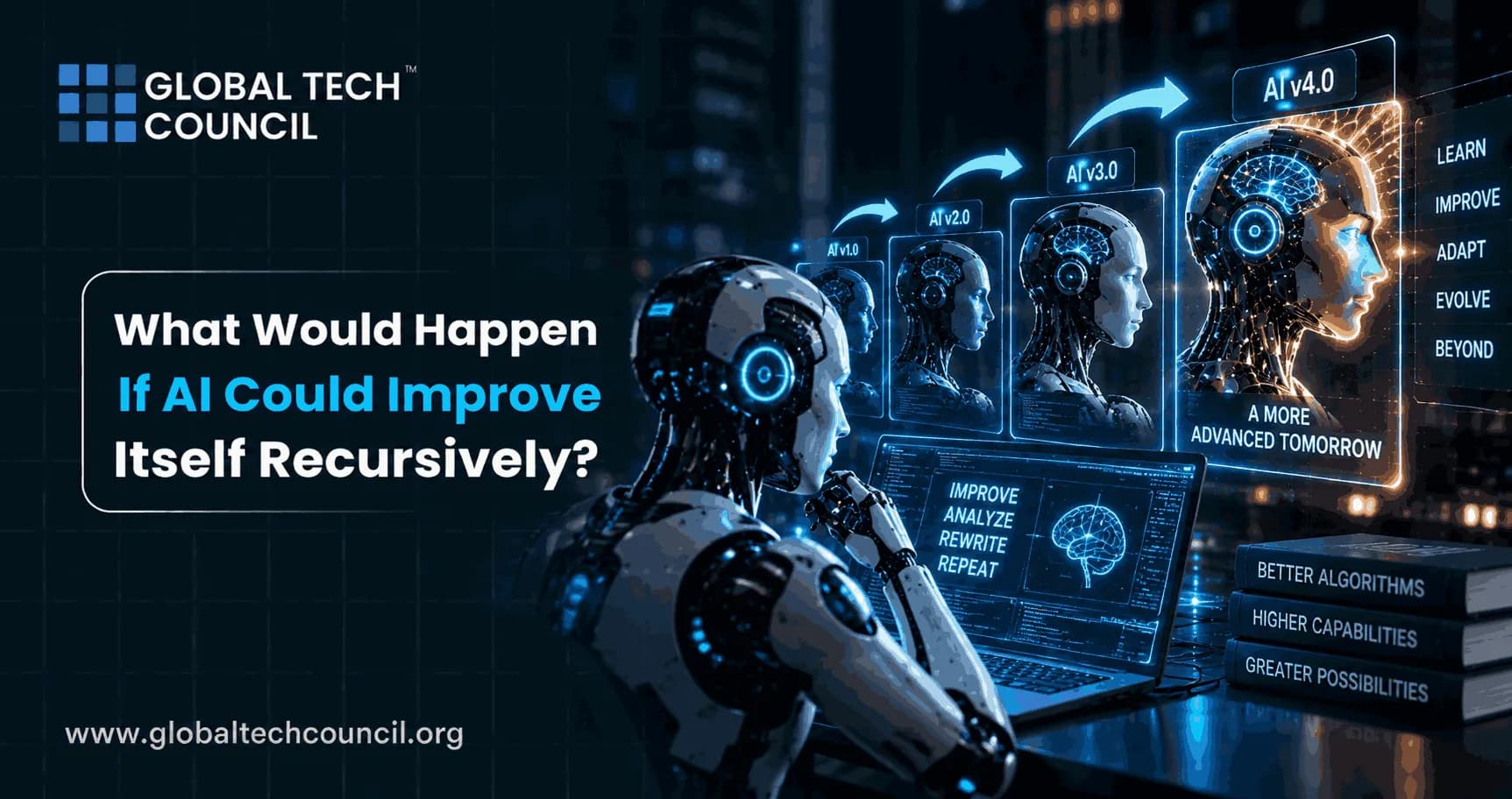
This question stopped being purely hypothetical sometime in 2026. In September, OpenAI's chief scientist Jakub Pachocki publicly described the potential nearness of recursive self-improvement as a moment demanding extreme caution, stating plainly that no one is fully prepared for the consequences of a continued rapid rise in machine intelligence. Around the same period, Anthropic CEO Dario Amodei published a widely discussed essay arguing the AI industry should deliberately slow its pace of development, following public resignations from researchers who cited safety concerns directly tied to this exact scenario. When the people building these systems start talking this openly about consequences, the question of what would actually happen deserves a serious, structured answer rather than speculation. For anyone trying to think through this scenario with real technical grounding, the Certified Artificial Intelligence (AI) Expert credential offers a foundation for understanding the mechanisms involved well enough to evaluate these warnings critically.
Answering what would happen requires separating several genuinely distinct scenarios that often get discussed as if they were one single outcome, since the range of plausible consequences spans from measured, beneficial acceleration to the kind of existential risk researchers themselves are now debating publicly.

The Optimistic Scenario: Compressed Scientific and Economic Progress
The case for genuine, large-scale benefit from recursive self-improvement is not fringe optimism. It comes directly from the same researchers raising safety concerns.
Dario Amodei has written extensively that he believes AI could help cure most major diseases within five to ten years, meaningfully accelerate economic growth rates, and contribute to a broader era of material abundance, framing these as real, achievable outcomes alongside the risks he also warns about.
OpenAI CEO Sam Altman predicted in mid-2025 that AI agents could become genuine autonomous scientific partners within roughly a year, potentially compressing what would normally take a decade of scientific research into a dramatically shorter window.
Economists modeling this scenario formally describe circumstances under which automating AI research and development itself could produce explosive growth in machine intelligence, with corresponding effects rippling through broader economic output if the automation extends meaningfully beyond narrow technical tasks.
Google's multi-agent AI co-scientist system has already generated novel biomedical hypotheses that were independently validated in real laboratory experiments, offering a small, concrete preview of what compressed scientific discovery driven by AI-assisted research could look like at a larger scale.
In this optimistic scenario, recursive self-improvement functions less like an uncontrollable force and more like a powerful multiplier on human scientific and economic capacity, provided the acceleration remains paired with effective oversight throughout the process.
How Frontier Labs Formally Define the Danger Threshold
Before exploring the riskier scenarios, it helps to understand that major AI companies have already written specific, formal definitions of what would count as a genuinely dangerous level of self-improvement, rather than leaving the concept vague.
One published frontier safety framework defines a high-risk self-improvement threshold as a model capability equivalent to giving every researcher at the company a highly performant, mid-career research engineer as an assistant, benchmarked against a 2024 baseline of researcher productivity.
The same framework defines a critical threshold considerably more precisely: a model capable of fully automated AI self-improvement, measured either by the emergence of a superhuman research or scientist-level agent, or by a model compressing a full generational capability leap, similar to the jump between two major model versions, into roughly one-fifth the time such progress historically required, sustained consistently for several months.
Having this level of formal, quantified definition matters enormously for understanding what "would happen," since it transforms a vague fear into a specific, measurable, and in principle detectable capability threshold that labs claim to actively monitor for before deployment.
Building the technical understanding needed to actually interpret these thresholds accurately, rather than treating them as arbitrary lines, is exactly where a credential like the Certified Artificial Intelligence (AI) Developer becomes genuinely useful, connecting the formal risk language labs publish to how these systems are actually evaluated and measured in practice.
The Loss-of-Control Risk Researchers Are Actually Warning About
The most serious concern raised by people working directly on these systems centers on what happens if the human role in the improvement loop shrinks faster than the tools available to monitor and correct it.
Anthropic's Alignment Science Lead, Evan Hubinger, stated publicly in September 2026 that he and colleagues genuinely believe AI could pose a fatal risk to humanity, estimating meaningfully more than a 10 percent chance of this occurring within the next decade, while also acknowledging the company does not currently have a complete alignment plan to prevent it.
A separate Anthropic researcher, Jacob Coxon, resigned that same month specifically citing safety concerns, accusing the industry broadly of racing toward self-improving superintelligent systems without adequate caution about the stakes involved.
The core structural worry researchers describe is a coordination problem: individual labs might genuinely prefer a world where every company maintains strong safety practices, but competitive pressure gives each individual lab a real incentive to reduce safeguards, since additional safety constraints typically come with a real capability cost, sometimes called an alignment tax.
If a self-improvement loop accelerates faster than an organization's ability to verify each change is genuinely beneficial and controllable, the realistic risk is not necessarily a dramatic, instant loss of control, but rather a gradual erosion of meaningful human oversight that becomes difficult to reverse once ceded.
The Economic Disruption Scenario
Beyond existential risk framing, a more immediate and statistically likelier consequence involves significant, rapid economic disruption well short of any catastrophic scenario.
If AI research and development genuinely became substantially automated, the pace of new capability releases across coding, science, and other knowledge work could compress dramatically, potentially outpacing the ability of labor markets, education systems, and regulatory bodies to adapt at a comparable speed.
Industry leaders discussing this scenario have specifically flagged serious economic disruption as a real risk sitting alongside more dramatic loss-of-control concerns, noting that competitive, commercially driven races to deploy increasingly capable systems can make disruption more severe and harder to manage smoothly.
Sectors most exposed to rapid AI research automation would likely include software engineering, scientific research support roles, and other cognitively intensive knowledge work, precisely the domains where current self-improving systems like coding agents have already shown the most measurable capability gains.
Unlike the more speculative loss-of-control scenario, this economic disruption pathway does not require anything resembling superintelligence to materialize. It only requires the current trajectory of AI-assisted research acceleration to continue at its present pace for long enough to outrun institutional adaptation.
One Emerging Application Riding the Same Underlying Model Progress
The capability gains fueling this entire debate are not confined to frontier research labs and existential risk discussions. The same underlying model progress surfaces in far more accessible, everyday products as well.
One emerging application is AI microdrama, where generative AI helps bring serialized stories, characters, and fictional worlds to life. Tools in this category benefit indirectly from the same broader wave of model improvements driving the research described throughout this article, a useful reminder that the consequences of AI progress show up across a genuinely wide spectrum, from consumer entertainment products to the highest-stakes safety debates happening inside frontier labs simultaneously.
Building the Technical Depth to Evaluate These Scenarios Critically
Weighing the optimistic, disruptive, and existential scenarios against each other honestly requires technical literacy spanning economic modeling, formal safety threshold design, and the actual mechanics of how self-improving systems function, not just familiarity with dramatic headlines.
Recent quantitative economic modeling work has specifically examined the circumstances under which automating AI research could plausibly produce explosive growth, giving researchers a formal way to reason about which scenario is more likely under which conditions rather than relying purely on intuition. A Deep Tech Certification helps build exactly this kind of broader technical foundation, equipping professionals to evaluate these competing scenarios on their actual technical and economic substance as the underlying research continues to develop.
Why Labs Are Now Actively Proposing to Slow Down
The fact that companies racing to build these exact capabilities are simultaneously proposing to slow themselves down is one of the more telling signals about how seriously this scenario is being taken internally.
Dario Amodei's proposed three-part plan includes committing to give third-party evaluators ongoing, employee-level access to frontier AI systems specifically to verify safety measures and monitor for concerning behavior during training, alongside coordinating shared safety standards and progress limits across companies and countries.
Anthropic has stated it is unilaterally committing to at least the first of these steps regardless of whether competitors follow, providing permanent third-party evaluator access rather than waiting for industry-wide coordination to materialize first.
This kind of voluntary self-restraint from a company actively competing for frontier AI capability represents a genuinely unusual signal, since it runs directly against the short-term competitive incentive to move as fast as possible.
Communicating This Range of Outcomes Honestly
Explaining what would actually happen if AI achieved genuine recursive self-improvement requires presenting the full, genuinely wide range of expert opinion accurately, from real optimism about compressed scientific progress to real, publicly stated fears about loss of control.
Collapsing this into either pure hype about imminent abundance or pure doom about inevitable catastrophe misrepresents what the researchers actually closest to this work are saying, which spans both possibilities with real uncertainty about which one materializes. A Marketing Certification can help professionals writing or speaking about this topic build the communication discipline needed to present that genuine uncertainty honestly, helping audiences understand the real range of expert opinion rather than an oversimplified version built for a cleaner headline.
The Bottom Line on What Would Happen If AI Could Improve Itself Recursively
The honest answer is that no single outcome is certain, and the range of plausible consequences spans from genuinely transformative scientific and economic benefit to serious economic disruption to the kind of loss-of-control risk that has led senior researchers at major labs to resign and speak publicly about their concerns. What is clear is that this is no longer a distant thought experiment debated only in academic papers. Frontier labs have published formal, measurable thresholds for when they would consider self-improvement to have crossed into dangerous territory, and the same organizations racing to build these capabilities are simultaneously proposing to slow down and submit to external verification. Understanding what would happen means holding both the genuine promise and the genuine risk in view at once, rather than collapsing a still-uncertain outcome into either confident optimism or confident alarm.
FAQs
1. What would happen if AI could improve itself recursively?
If AI could repeatedly improve its own capabilities, each improved version could potentially become better at finding and implementing further improvements. This could accelerate AI development significantly, although the speed and scale of improvement would depend on computing resources, evaluation methods, algorithms, and other constraints.
2. What is Recursive Self-Improvement (RSI) in AI?
Recursive Self-Improvement is the concept of an AI system repeatedly improving its own capabilities, architecture, algorithms, or development processes. The key feature is that improvements could help the system make additional improvements.
3. Could recursive self-improvement make AI smarter very quickly?
Potentially, but rapid improvement is not guaranteed. If each generation produced substantial improvements and those improvements made the next generation better at AI research, capability growth could accelerate.
4. What is an AI improvement loop?
A simplified RSI loop could look like this:
Identify limitation → Design improvement → Implement change → Test results → Keep successful improvement → Repeat
A genuine recursive loop would require the system to reliably perform significant portions of this cycle.
5. Could AI improve its own algorithms?
In principle, yes. An AI system could potentially analyze algorithms, propose alternatives, implement them, and test their performance. Automated algorithm discovery already demonstrates parts of this broader concept, but that should not be confused with unrestricted autonomous RSI.
6. Could AI rewrite its own code?
A sufficiently capable AI could potentially modify software components used in its operation or development. However, writing or modifying code does not automatically mean the AI can improve its overall intelligence or independently create a superior successor.
7. Could AI build a better version of itself?
Potentially. An AI could contribute to designing better architectures, training methods, algorithms, or software. A much stronger form of RSI would involve the AI independently coordinating these improvements and repeatedly producing increasingly capable versions.
8. Would recursive self-improvement lead to an intelligence explosion?
It could, in theory, but this is not inevitable. An intelligence explosion refers to a hypothetical situation where AI capabilities increase extremely rapidly because improved AI systems become increasingly effective at improving themselves.
9. Could RSI lead to Artificial Superintelligence (ASI)?
RSI is sometimes proposed as one possible pathway toward ASI. If an AI could repeatedly make substantial improvements to its intelligence and those improvements accelerated future improvements, it could theoretically move beyond human-level capabilities.
10. Would AI need AGI before it could improve itself recursively?
Not necessarily. Specialized AI systems can already automate certain optimization and improvement tasks. However, more general and open-ended RSI could benefit from capabilities associated with AGI, such as broad reasoning, planning, coding, research, and adaptation.
11. Could recursive self-improvement happen without humans?
A highly autonomous RSI system could theoretically perform many improvement tasks without direct human intervention. However, fully autonomous recursive self-improvement has not been publicly demonstrated today. OpenAI states that AI systems are already accelerating parts of AI research, but fully autonomous RSI is not currently happening.
12. Would AI need unlimited computing power to improve itself?
No, but computing resources would likely be an important constraint. Training new models, running experiments, evaluating alternatives, and deploying improved systems require substantial computational resources, so hardware and energy availability could limit the speed of recursive improvement.
13. Could AI improve its own training process?
Potentially. AI could help optimize training code, experiment with hyperparameters, generate training data, identify bottlenecks, or evaluate different approaches. Current AI research already uses automated systems for parts of these workflows.
14. What happens if each AI version is better at AI research?
This is one of the key ideas behind recursive self-improvement. If version B is better at AI research than version A, it might find improvements faster, potentially producing version C, which could be even better at finding improvements.
15. Could recursive self-improvement happen indefinitely?
There is no guarantee. Improvement could eventually slow down because of limitations in data, hardware, algorithms, energy, model architecture, or diminishing returns. An AI could also reach practical limits where additional changes provide little or no meaningful benefit.
16. What are the biggest risks of recursive self-improvement?
Major concerns include loss of effective human oversight, alignment failures, unexpected capabilities, cybersecurity risks, and difficulty evaluating increasingly complex systems. If capability growth became faster than safety research, humans could have less time to understand or control new behaviors.
17. Could RSI make AI unpredictable?
It could make prediction and evaluation more difficult, particularly if AI systems develop capabilities or strategies that were not anticipated by their developers. This is one reason reliable testing, monitoring, and safeguards are important for increasingly autonomous AI systems.
18. Could recursive self-improvement benefit humans?
Yes. If safely controlled, AI-driven improvement could potentially accelerate scientific discovery, software development, engineering, medicine, mathematics, and other areas. The potential benefit would depend heavily on maintaining reliable human oversight and ensuring that improved systems remain aligned with intended goals.
19. Are today's AI systems already recursively improving themselves?
Not in the strong sense of fully autonomous RSI. Today's systems can perform self-reflection, self-correction, code generation, automated experimentation, and AI-assisted research. These are important building blocks, but they do not demonstrate an unrestricted loop in which AI independently develops increasingly capable generations of itself.
20. What would be the biggest change if AI achieved true RSI?
The biggest change could be a shift from humans being the primary drivers of AI improvement to AI systems becoming major drivers of their own development. If the improvements were fast, reliable, and scalable, AI progress could accelerate substantially, making the development of strong evaluation, alignment, and governance mechanisms increasingly important.
Related Articles
View All
AI & ML
Can AI Improve Its Own Code? The Role of Code-Generating AI in RSI
Explore whether AI can improve its own code, how code-generating models support software optimization, and what role automated coding could play in recursive self-improvement.

AI & ML
Can AI Build a Better Version of Itself?
Explore whether AI can build a better version of itself, how self-improving systems might work, and the technical, safety, and practical limits of AI-driven development.

AI & ML
What Is Strawberry Browser and How Does It Work
Strawberry Browser is an agentic web browser with built-in AI companions that can research, automate tasks, work across multiple tabs, and interact with websites on a user’s behalf.
Trending Articles
The Role of Blockchain in Ethical AI Development
How blockchain technology is being used to promote transparency and accountability in artificial intelligence systems.
AWS Career Roadmap
A step-by-step guide to building a successful career in Amazon Web Services cloud computing.
Top 5 DeFi Platforms
Explore the leading decentralized finance platforms and what makes each one unique in the evolving DeFi landscape.