

Top Programming Languages for Data Scientists in 2025
 Tosh Marketing
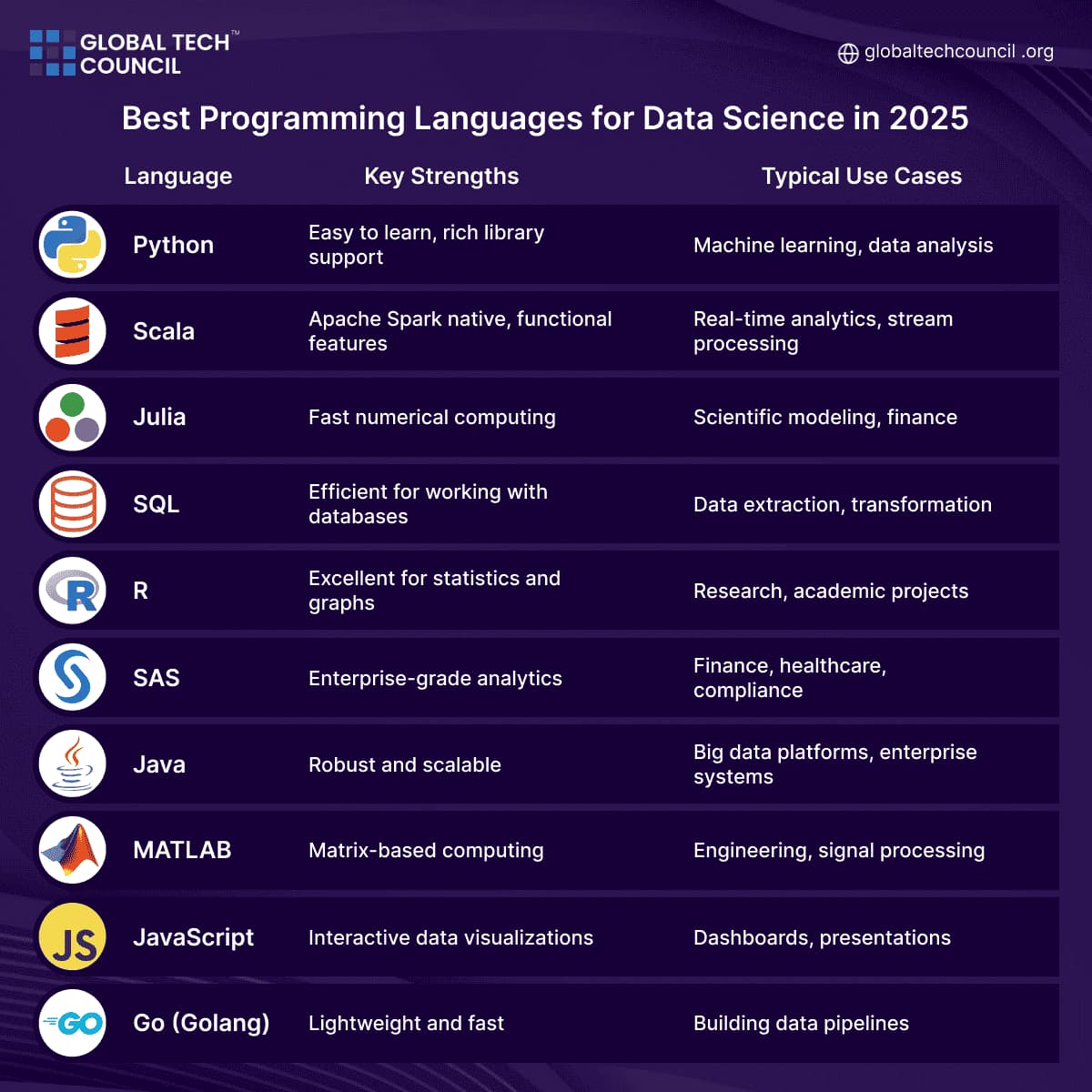
 Data scientists in 2025 need more than just analytical thinking — they need the right tools to work with data efficiently. One of the most important tools is a programming language. The best programming languages for data scientists in 2025 are Python, R, SQL, Julia, Java, Scala, JavaScript, MATLAB, Go, and SAS. Among these, Python remains the most widely used due to its simplicity and extensive library support.
R is popular for statistical analysis, SQL is essential for database queries, and Julia is rising fast for high-performance computing. Java and Scala dominate big data, while JavaScript helps with data visualization. MATLAB, Go, and SAS serve specialized roles in engineering, microservices, and regulated industries.

Whether you’re starting your data journey or looking to upskill, these languages can help you solve real-world problems, build predictive models, and handle data at scale.
Best Programming Languages for Data Science in 2025
Python
Python is the go-to language for most data scientists. Its clean syntax, extensive libraries, and huge community make it perfect for data cleaning, analysis, visualization, and building machine learning models. Tools like NumPy, Pandas, Scikit-learn, and TensorFlow power everything from beginner projects to advanced AI applications.
Python is also highly flexible — it can be used for automating tasks, developing APIs, and integrating with big data tools.
R
R is tailor-made for statistical computing and data visualization. While Python offers versatility, R offers precision in advanced analytics. It’s commonly used in academic, scientific, and medical research due to its statistical accuracy and packages like ggplot2 and caret.
R is great for data scientists who are more focused on data exploration, experimental analysis, or working in research-based environments.
SQL
Structured Query Language (SQL) isn’t used for model building, but it’s essential for working with structured databases. Data scientists use SQL every day to extract, filter, join, and summarize data from data warehouses or cloud platforms.
Knowing SQL well can significantly speed up the process of preparing data for analysis.
Julia
Julia is designed for performance. It combines the speed of C with the ease of Python, which makes it ideal for scientific computing and heavy numerical operations. It’s still emerging in mainstream data science, but in areas like finance, physics, or climate modeling, Julia is gaining traction quickly.
It’s a great choice for data scientists working with simulations or needing lightning-fast computation.
Java
Java is often used in backend systems and big data platforms like Hadoop, Spark, and Kafka. While it’s not as friendly as Python for rapid prototyping, it shines in production-grade systems where performance and scalability matter.
Many large organizations with complex infrastructure still rely on Java for their data pipelines and processing engines.
Scala
Scala runs on the Java Virtual Machine and is deeply integrated with Apache Spark. If you’re handling big data, especially at scale, Scala is a strong pick. It supports both object-oriented and functional programming and is efficient for data transformations, streaming, and distributed analytics.
Data scientists in data engineering-heavy roles often work with Scala alongside Spark.
JavaScript
JavaScript is mainly used in data science for one reason: visual storytelling. Libraries like D3.js and Chart.js make it possible to build interactive, browser-based data visualizations. If you want to create dashboards or communicate insights effectively, JavaScript is worth learning.
It’s also useful if you’re building web apps that include data-driven components.
MATLAB
MATLAB is a proprietary language widely used in engineering, robotics, and academia. It’s strong in numerical computing and matrix operations, making it useful for simulations, signal processing, and algorithm testing. Though not as popular in modern AI workflows, it’s still important in specialized areas.
Go (Golang)
Go is known for its simplicity, speed, and efficiency. While not a traditional data science tool, it’s used to build scalable data pipelines and microservices. Go’s performance makes it ideal when you’re deploying models in real-time systems or working with cloud-based data tools.
SAS
SAS has been around for decades and is still widely used in regulated industries like finance and healthcare. It offers a powerful suite of tools for statistical analysis, data reporting, and compliance. While newer tools offer more flexibility, SAS remains important for enterprise analytics teams.
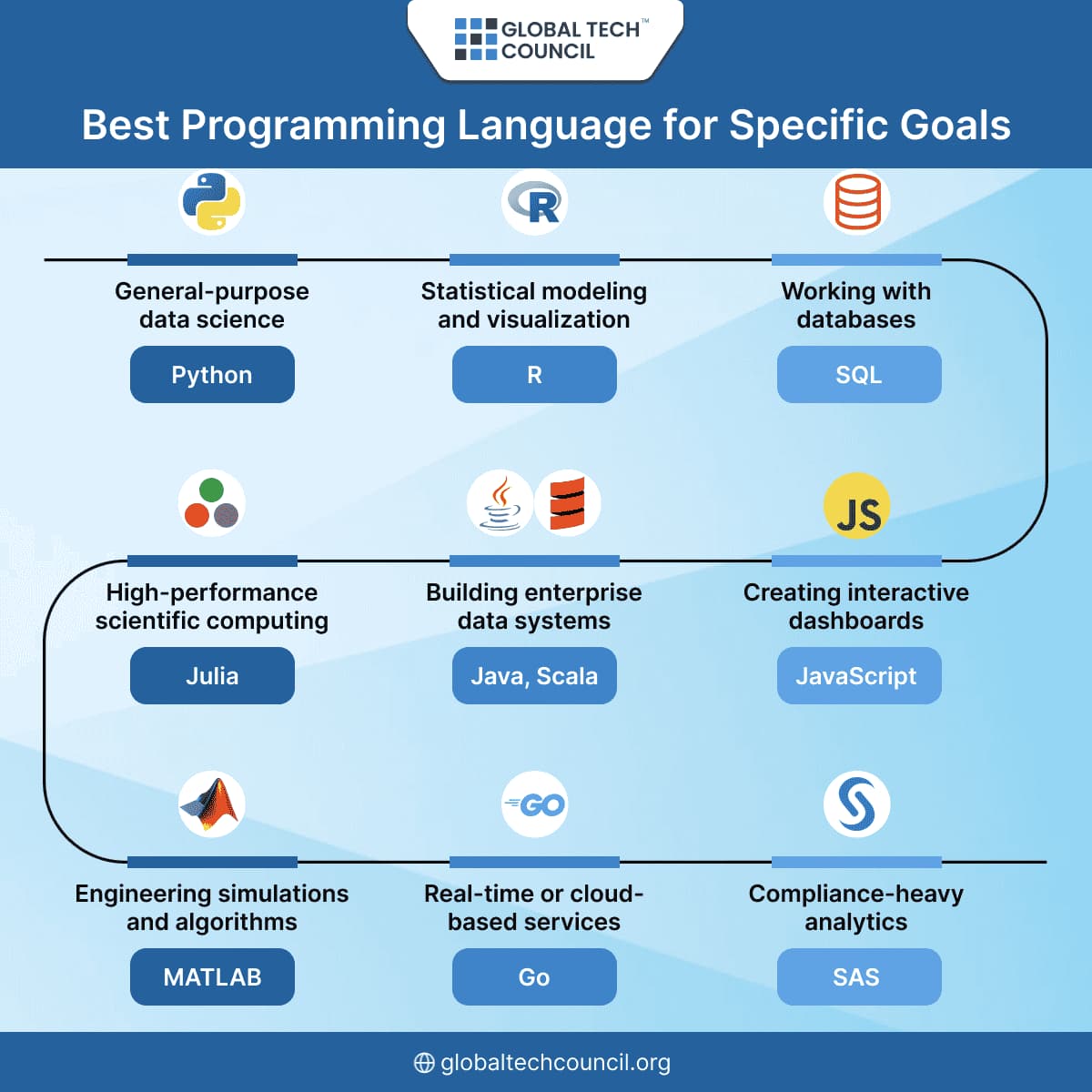
Best Programming Language Based on Your Goal
Conclusion
Data scientists in 2025 are expected to be fluent in more than one language depending on their domain. While Python remains the most accessible and popular, other languages like Julia, Go, or Scala may offer better performance or scalability depending on the project.
Start by mastering the essentials, then expand your toolkit based on what problems you’re solving. If you’re just getting started or looking to build a career-ready foundation, consider the Data Science Certification by Global Tech Council. For Deep Tech certification and broader programs in AI, blockchain, and cybersecurity, visit the Blockchain Council.
Related Articles
View All
Data Science
Top 10 Data Science Trends in 2025
The top 10 data science trends in 2025 are: Agentic AI, AutoML, Synthetic Data, Federated Learning, Augmented Analytics, Real-Time Analytics, Edge AI, Explainable AI (XAI), Data-Centric AI, and Data Democratization. These trends are reshaping how data is collected, processed, and used across…
Data Science
Top 10 Data Science Tools in 2025
The top 10 data science tools in 2025 are Python, R, Jupyter Notebook, Tableau, Power BI, Apache Spark, TensorFlow, RapidMiner, KNIME, and Google Colab. These tools help data professionals with everything from cleaning data to building predictive models and creating dashboards. If you’re…
Data Science
Top Power BI Skills Every Data Analyst Needs to Build Better BI Reports
Learn the Power BI skills data analysts need for better BI reports, including Power Query, data modeling, DAX, visualization, performance, and governance.
Trending Articles
The Role of Blockchain in Ethical AI Development
How blockchain technology is being used to promote transparency and accountability in artificial intelligence systems.
AWS Career Roadmap
A step-by-step guide to building a successful career in Amazon Web Services cloud computing.
Top 5 DeFi Platforms
Explore the leading decentralized finance platforms and what makes each one unique in the evolving DeFi landscape.