

Supervised Learning Explained: Algorithms, Examples, and Use Cases
 Suyash Raizada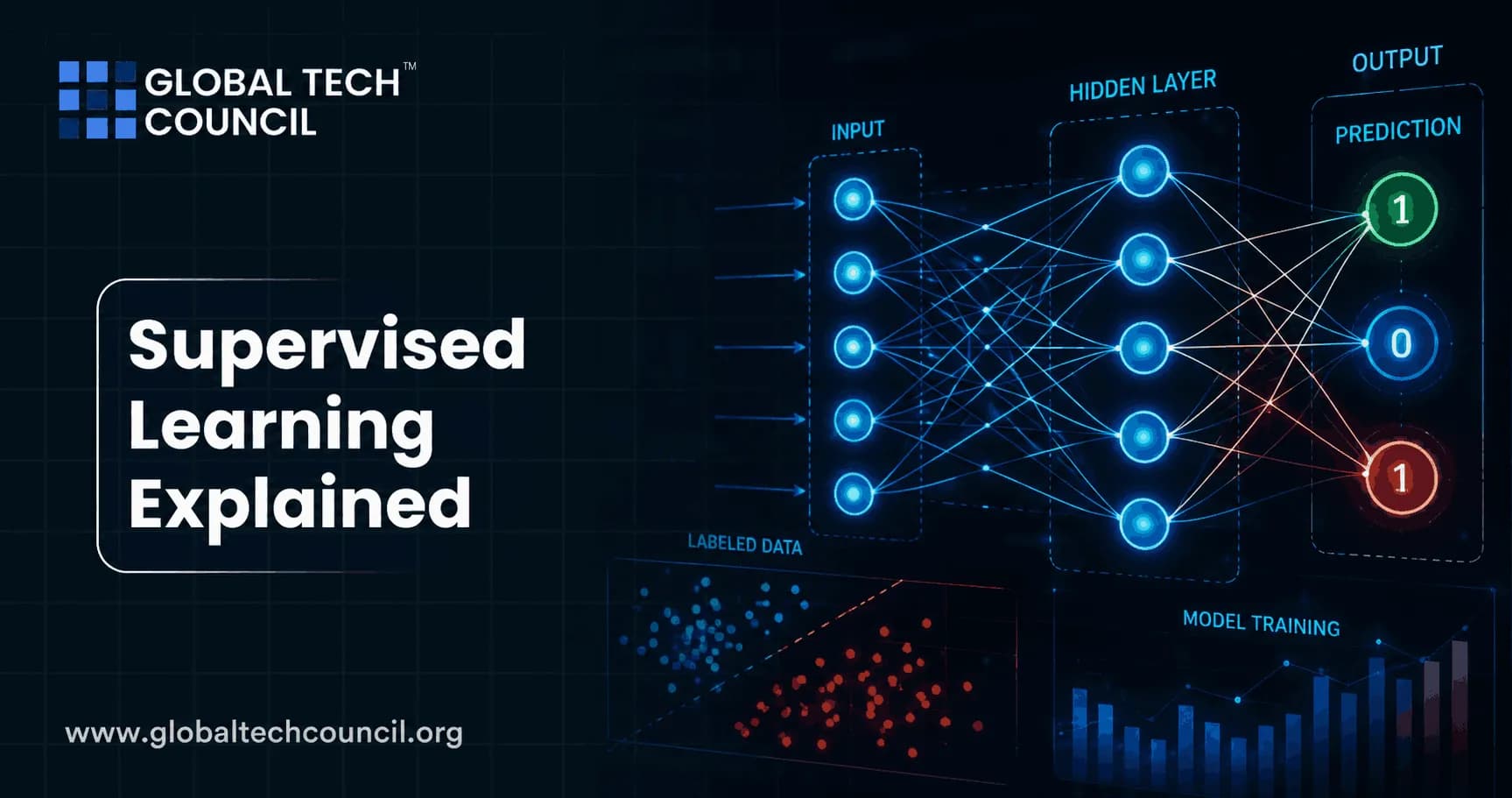
Supervised learning is the machine learning approach you use when you have labeled examples and a clear target to predict. If past loan applications are labeled as default or paid, you can train a model to estimate credit risk. If historical sales records include price, season, region, and units sold, you can forecast demand.
That simple idea powers a large share of production AI. In supervised learning, algorithms learn from labeled datasets by reducing prediction error, usually through optimization methods such as gradient descent. It remains the largest commercial segment of machine learning by a wide margin, and most of the models running in real businesses today are supervised.

Building reliable supervised learning systems requires more than selecting an algorithm. Professionals must understand data preparation, feature engineering, model evaluation, deployment, and ongoing monitoring to ensure models perform consistently in production. A Certified Machine Learning Expert credential helps develop these practical skills, providing a structured foundation for applying supervised learning to real-world business problems.
What Is Supervised Learning?
In supervised learning, every training example has two parts:
Input features: The data the model uses, such as age, transaction amount, image pixels, email text, or sensor readings.
Target label or value: The correct answer, such as spam, not spam, disease present, price, or probability of churn.
The model learns a mapping from inputs to outputs. During training, it makes predictions, compares them with the known answers, calculates a loss, then adjusts its parameters to reduce that loss. Simple models may have a handful of parameters. Deep neural networks can have millions or billions.
Here is the practical test. If you cannot define the target column, you probably do not have a supervised learning problem yet. You may need unsupervised analysis first, or better data labeling.
Classification vs Regression
Most supervised learning tasks fall into two buckets.
Classification
Classification predicts a category. Common examples include:
Email classification: spam or legitimate
Medical imaging: malignant or benign
Cybersecurity: phishing or safe
Customer analytics: likely to churn or likely to stay
Binary classification has two classes. Multi-class classification has more than two, such as sorting support tickets into billing, technical, account, or cancellation categories.
Regression
Regression predicts a continuous number. Examples include:
House price prediction
Energy demand forecasting
Insurance claim cost estimation
Remaining useful life prediction for industrial equipment
Do not force regression into classification unless the business reason is clear. Turning a risk score into low, medium, and high can make dashboards easier to read, but it can also throw away useful signal.
As organizations increasingly integrate predictive analytics with advanced AI technologies, understanding how supervised learning fits into broader artificial intelligence systems becomes increasingly valuable. A Certified AI & Machine Learning Expert credential helps professionals develop this broader perspective, enabling them to build AI-driven solutions that balance predictive accuracy with practical business requirements.
Common Supervised Learning Algorithms
No single algorithm wins everywhere. Tabular business data often favors tree ensembles. Text may start with logistic regression or Naive Bayes, then move to transformer models. Images usually need neural networks. Choose the tool after you look at the data, not before.
Linear Regression
Linear regression predicts a numeric value using a weighted combination of features. It is fast, interpretable, and a strong baseline for demand, pricing, and trend problems. It performs poorly when relationships are highly nonlinear, unless you engineer useful features.
Logistic Regression
Despite the name, logistic regression is used for classification. It estimates class probabilities and works well for credit scoring, churn prediction, fraud screening, and many text classification tasks. It is also easier to explain to auditors than a deep model.
Decision Trees
Decision trees split data into branches based on feature values. They are easy to visualize, but single trees overfit quickly. A tree with unlimited depth can memorize noise. In scikit-learn, beginners often forget to set max_depth or min_samples_leaf, then wonder why test performance collapses.
Random Forests
Random forests train many decision trees and average their predictions. This reduces variance and usually beats a single tree. They handle mixed feature types well, need limited tuning, and provide useful feature importance scores. They are not ideal when you need millisecond-level scoring on very high traffic systems.
Support Vector Machines
Support vector machines find a decision boundary with the widest margin between classes. They can work very well on high dimensional datasets, especially smaller text or bioinformatics datasets. The trade-off is scaling. Kernel SVMs get expensive as dataset size grows.
K Nearest Neighbors
K nearest neighbors predicts using the labels of nearby examples. It is simple and useful for teaching similarity-based learning. In production, it can be slow at prediction time and sensitive to feature scaling. Always standardize numeric features before you test KNN.
Naive Bayes
Naive Bayes is a probabilistic classifier that assumes features are conditionally independent. That assumption is often false, but the method still works surprisingly well for spam filtering, topic classification, and sentiment analysis. It is fast, cheap, and hard to beat as a first text baseline.
Neural Networks
Neural networks learn layered nonlinear representations. They are the backbone of supervised deep learning for image recognition, speech recognition, natural language processing, and complex structured prediction. Use them when you have enough data, enough compute, and a reason to accept lower interpretability.
Gradient Boosting and XGBoost
Gradient boosting builds models sequentially, with each new model correcting previous errors. XGBoost, LightGBM, and CatBoost are frequent winners on tabular datasets. A small practitioner detail: for imbalanced binary classification in XGBoost, scale_pos_weight can move recall dramatically. Set it roughly to negative examples divided by positive examples, then validate with precision-recall curves. Accuracy alone will fool you.
How Supervised Learning Works in Practice
A supervised learning workflow usually looks like this:
Define the target: Decide exactly what the model should predict.
Collect labeled data: Pull historical records, annotations, transactions, logs, or clinical outcomes.
Clean the data: Fix missing values, duplicates, label errors, and inconsistent formats.
Split the dataset: Use training, validation, and test sets. For classification, use stratified splits when classes are imbalanced.
Train baseline models: Start simple. Logistic regression or random forests often expose data problems fast.
Evaluate properly: Use metrics that match the cost of mistakes.
Deploy and monitor: Track drift, latency, data quality, fairness, and business impact.
One error every practitioner has seen is scikit-learn stopping with ValueError: Input X contains NaN. It usually shows up right after a rushed feature merge. Fix the pipeline, not just the row. Imputation, validation checks, and schema enforcement should happen before training and before inference.
Evaluation Metrics That Matter
Metric choice changes model behavior. Be blunt about the cost of each error.
Accuracy: Useful when classes are balanced. Misleading when fraud or disease cases are rare.
Precision: Of the cases flagged positive, how many were correct?
Recall: Of all true positive cases, how many did the model catch?
F1 score: A balance between precision and recall.
ROC-AUC: Measures ranking quality across thresholds.
MAE and RMSE: Common regression metrics. RMSE penalizes large errors more heavily.
For credit risk, healthcare triage, and cybersecurity alerts, threshold tuning matters as much as the algorithm. A model with a great AUC can still create operational chaos if it floods analysts with false positives.
Real-World Use Cases of Supervised Learning
Finance and Risk Modeling
Banks use supervised learning for credit scoring, fraud detection, anti-money laundering alerts, and pricing. Historical applications and transaction labels make finance a natural fit. Governance is strict, so explainability and validation are not optional.
Healthcare Diagnostics
Supervised models assist with disease risk prediction, medical image classification, readmission forecasting, and treatment recommendation. High performing image recognition systems have reported accuracy above 98 percent on well-defined benchmark tasks, but clinical deployment needs external validation, bias testing, and human oversight.
Marketing and Customer Analytics
Churn prediction, lead scoring, recommendation ranking, and lifetime value estimation are supervised learning staples. The label might be cancellation within 30 days, purchase within a week, or click-through probability.
Cybersecurity
Security teams train classifiers on phishing emails, malware samples, endpoint telemetry, and network events. Supervised learning works when historical labels are reliable. It struggles with brand-new attack patterns, so combine it with anomaly detection and rule-based controls.
Manufacturing and IoT
Sensor readings from machines can predict failure, classify abnormal operating states, or estimate remaining useful life. The hard part is usually labeling. Maintenance logs are messy. Timestamps drift. A bearing replacement may be logged three hours after the vibration spike that mattered.
Current Trends Shaping Supervised Learning
Supervised learning is growing with the wider machine learning market, and forecasts point to strong double digit growth through 2030. Several technical shifts are changing how supervised systems get built:
Larger datasets: Enterprise training datasets keep expanding into the terabyte range, with text growing especially fast.
Cloud ML platforms: Amazon SageMaker, Azure Machine Learning, and Google Vertex AI are common choices for training, deployment, and monitoring.
Synthetic data: Generated data is taking on a larger share of training inputs in fields such as finance, robotics, and autonomous systems.
MLOps discipline: Versioned datasets, model registries, feature stores, and drift monitoring are now part of serious supervised learning work.
Explainability: SHAP values, partial dependence plots, and model cards are increasingly used for high-stakes models.
Modern supervised learning deployments also rely on cloud infrastructure, MLOps practices, automation pipelines, scalable data platforms, and production-grade AI architectures. A Deep Tech Certification helps professionals strengthen these technical capabilities, making it easier to deploy, monitor, and maintain machine learning systems across enterprise environments.
Governance, Bias, and Compliance
Supervised learning can encode past bias. If historical hiring data reflects unfair decisions, a model trained on it may repeat them. If healthcare labels are uneven across populations, performance may differ by group.
For regulated use cases, you should document:
Training data sources and label definitions
Feature selection decisions
Validation metrics across relevant subgroups
Model limitations and intended use
Monitoring plans after deployment
This is where technical skill meets professional responsibility. If you are building toward enterprise AI roles, pair machine learning study with data governance, cybersecurity, and cloud deployment knowledge. Global Tech Council certification paths in machine learning, artificial intelligence, data science, cybersecurity, cloud computing, and IoT give you a structured way to build that mix.
When Should You Use Supervised Learning?
Use supervised learning when you have:
A clear prediction target
Enough labeled examples
A measurable business or operational outcome
A way to evaluate errors honestly
Do not use it just because it is familiar. If labels are missing, start with exploratory analysis or unsupervised methods. If decisions involve dynamic actions over time, reinforcement learning may fit better. If you have huge unlabeled text corpora, self-supervised learning may help before supervised fine-tuning.
Build Your Next Supervised Learning Project
Pick one concrete problem: churn prediction, spam classification, fraud scoring, or predictive maintenance. Train a baseline model in Python 3.12 with scikit-learn, compare it with XGBoost or LightGBM, then write down where it fails. That error analysis is where real learning starts. If you want a guided path, continue with Global Tech Council learning tracks in machine learning, AI, data science, or cybersecurity, and build a portfolio project around a supervised learning use case you can explain end to end.
Technical expertise creates the foundation for successful AI projects, but business impact depends on aligning machine learning initiatives with organizational strategy and measurable outcomes. A Marketing & Business Certification helps professionals develop this broader perspective, enabling them to connect supervised learning projects with customer value, operational efficiency, and long-term business growth.
FAQs
1. What is supervised learning?
Supervised learning is a type of machine learning in which algorithms learn from labeled data. Each training example includes both input data and the correct output, enabling the model to identify patterns and make predictions on new, unseen data.
2. How does supervised learning work?
Supervised learning begins with collecting labeled training data, preprocessing the dataset, selecting relevant features, choosing an appropriate algorithm, and training the model. The model is then validated and tested on separate datasets before being deployed to make predictions in real-world applications.
3. What is labeled data?
Labeled data consists of input examples paired with known outcomes or target values. For example, an email dataset labeled as "spam" or "not spam" allows a supervised learning model to learn how to classify future emails accurately.
4. What are the two main types of supervised learning?
The two primary categories are classification and regression. Classification predicts discrete categories, such as whether a transaction is fraudulent, while regression predicts continuous numerical values, such as future sales or property prices.
5. What is classification in supervised learning?
Classification is the process of assigning data to predefined categories or classes. Common examples include email spam detection, medical diagnosis support, sentiment analysis, customer churn prediction, and image recognition.
6. What is regression in supervised learning?
Regression predicts continuous numerical outcomes based on historical data. Typical applications include demand forecasting, stock price estimation, energy consumption prediction, insurance risk assessment, and real estate price estimation.
7. What are common supervised learning algorithms?
Popular supervised learning algorithms include linear regression, logistic regression, decision trees, random forests, support vector machines (SVMs), k-nearest neighbors (KNN), Naive Bayes, gradient boosting methods such as XGBoost and LightGBM, and artificial neural networks.
8. What is a decision tree?
A decision tree is a supervised learning algorithm that makes predictions by splitting data into branches based on feature values. It is relatively easy to interpret and is commonly used for both classification and regression tasks.
9. What is a random forest?
A random forest is an ensemble learning algorithm that combines multiple decision trees to improve prediction accuracy and reduce overfitting. By aggregating the results of many trees, it often produces more robust and reliable predictions than a single decision tree.
10. What is logistic regression?
Logistic regression is a supervised learning algorithm primarily used for binary and multiclass classification problems. It estimates the probability that an observation belongs to a particular category, making it useful for tasks such as fraud detection and customer conversion prediction.
11. What industries use supervised learning?
Supervised learning is widely applied in healthcare, finance, retail, manufacturing, education, transportation, insurance, cybersecurity, telecommunications, agriculture, digital marketing, and scientific research to support data-driven decision-making.
12. What are common real-world applications of supervised learning?
Applications include medical diagnosis support, recommendation systems, credit scoring, fraud detection, predictive maintenance, demand forecasting, speech recognition, image classification, customer segmentation, document classification, and search ranking.
13. What are the advantages of supervised learning?
Supervised learning can achieve high predictive accuracy when quality labeled data is available. It provides measurable performance using established evaluation metrics and is supported by a broad range of mature algorithms suitable for many business and scientific applications.
14. What are the limitations of supervised learning?
Challenges include the need for large volumes of labeled data, the cost of data annotation, potential bias in training datasets, overfitting, limited generalization to unfamiliar situations, and ongoing maintenance as data changes over time.
15. How is supervised learning evaluated?
Model performance is evaluated using metrics appropriate to the task. For classification, common metrics include accuracy, precision, recall, F1 score, and ROC-AUC. For regression, frequently used metrics include mean absolute error (MAE), mean squared error (MSE), and root mean squared error (RMSE).
16. What challenges do supervised learning projects face?
Common challenges include poor data quality, missing values, class imbalance, feature selection, model interpretability, computational requirements, privacy considerations, model drift, and ensuring fairness across different user groups.
17. What trends are shaping supervised learning in 2025-2026?
Key trends include automated machine learning (AutoML), explainable AI, multimodal models, foundation models, federated learning, synthetic data generation, privacy-preserving machine learning, edge AI, energy-efficient model development, and increased enterprise AI adoption.
18. What are best practices for supervised learning?
Best practices include collecting representative data, cleaning and validating datasets, engineering meaningful features, selecting algorithms appropriate to the problem, preventing overfitting through proper validation, monitoring deployed models, documenting model development, and retraining models when business conditions or data distributions change.
19. What should beginners know before learning supervised learning?
Beginners should build a strong foundation in statistics, probability, linear algebra, and programming languages such as Python. Understanding how to prepare data, evaluate models, and interpret results is just as important as learning individual algorithms. Supervised learning is often the best starting point because many machine learning concepts can be understood through practical classification and regression projects.
20. What is the future of supervised learning?
Supervised learning is expected to remain a cornerstone of machine learning as organizations continue generating structured data for predictive analytics. Advances in AI, cloud computing, responsible AI practices, and automation will likely improve model accuracy, efficiency, and accessibility while increasing emphasis on transparency, fairness, and regulatory compliance. Teaching computers with labeled examples keeps getting more sophisticated, but someone still has to do the labeling, proving that even intelligent machines occasionally need homework.
Related Articles
View All
Machine Learning
Top Machine Learning Use Cases Across Industries in 2026
Explore the top machine learning use cases across industries in 2026, from predictive maintenance and fraud detection to healthcare AI and CRM automation.

Machine Learning
Generative AI vs Machine Learning: Differences, Overlaps, and Use Cases
Learn how generative AI differs from traditional machine learning, where they overlap, and how to choose the right approach for enterprise AI use cases.

Machine Learning
Machine Learning Algorithms Explained: A Practical Beginner Guide
A practical beginner guide to Machine Learning Algorithms, covering supervised, unsupervised, ensemble, neural network, and reinforcement learning methods.
Trending Articles
The Role of Blockchain in Ethical AI Development
How blockchain technology is being used to promote transparency and accountability in artificial intelligence systems.
AWS Career Roadmap
A step-by-step guide to building a successful career in Amazon Web Services cloud computing.
Top 5 DeFi Platforms
Explore the leading decentralized finance platforms and what makes each one unique in the evolving DeFi landscape.