

Unsupervised Learning Explained: Clustering, Patterns, and Real-World Applications
 Suyash Raizada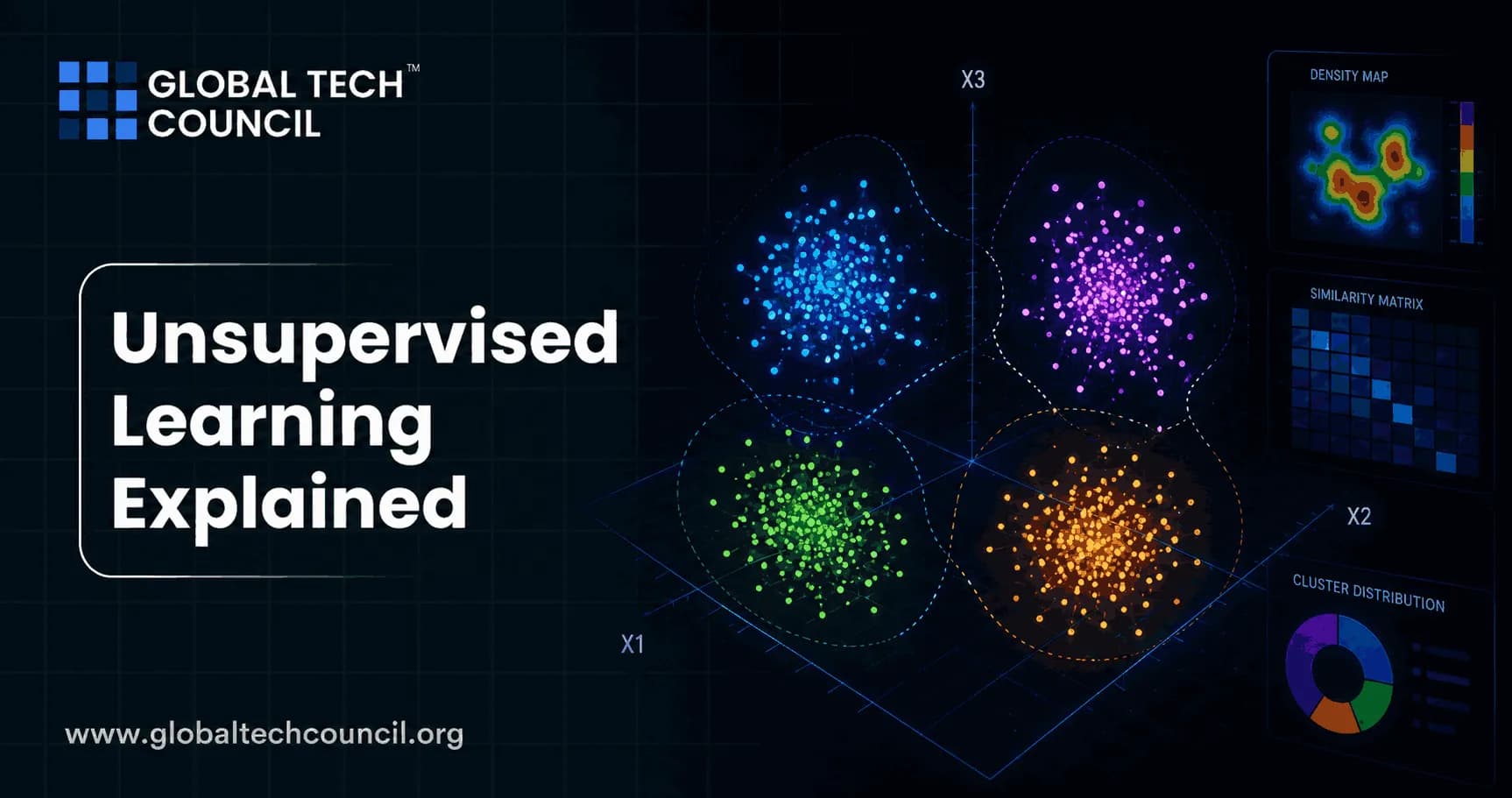
Unsupervised learning finds structure in data that has no labels. You are not telling the model what the right answer is. You are asking it to group similar records, compress noisy features, or flag behavior that does not look normal.
That makes it useful on messy enterprise data: security logs, customer events, medical records, sensor streams, and web behavior. Most business data is unlabeled, and labeling it is slow, expensive, and often politically painful. That is the whole reason these methods keep showing up in production.

Applying unsupervised learning successfully requires more than understanding clustering algorithms. Professionals also need practical skills in data preparation, feature engineering, dimensionality reduction, model evaluation, and production monitoring. A Certified Machine Learning Expert credential helps build this foundation, enabling practitioners to solve real-world machine learning challenges with greater confidence.
What Is Unsupervised Learning?
Unsupervised learning is a branch of machine learning where algorithms learn patterns directly from unlabeled data. There is no target column like fraud, churn, or disease stage. Instead, the algorithm studies the distribution of the data and looks for hidden structure.
Common outputs include:
Clusters - groups of similar data points.
Anomalies - records that differ sharply from normal behavior.
Latent factors - lower dimensional signals that explain variation in the data.
Embeddings - learned vector representations used in search, recommendations, and downstream models.
In practice, unsupervised learning is rarely a one-click answer. It is an exploratory tool. You test assumptions, inspect cluster profiles, validate anomalies with domain experts, and decide whether the patterns mean anything operationally.
Clustering: The Core Task in Unsupervised Learning
Clustering partitions data into groups so that items within a group are more similar to each other than to items in other groups. It is the most recognizable form of unsupervised learning and, in many enterprise teams, the first thing people reach for.
K-means Clustering
K-means is often the first clustering algorithm people learn. It assigns points to k clusters by minimizing the distance between each point and its cluster centroid. It is fast and works well when clusters are roughly spherical and similarly sized.
Use it for customer segmentation, simple behavioral grouping, facility clustering, and preprocessing before forecasting. Avoid it when clusters have irregular shapes, large outliers, or very different densities.
A practical warning: in scikit-learn 1.4, the default n_init for KMeans changed to 'auto'. With init='k-means++', that can mean a single initialization instead of 10. I have seen this quietly shift cluster assignments in small customer datasets. If your segmentation ends up in front of executives, set n_init=10 or higher and fix random_state. Boring detail. Big difference.
Hierarchical Clustering
Hierarchical clustering builds a tree of clusters. You can cut the tree at different levels to get different groupings. It is useful when you need explainability, especially in fields like bioinformatics, supplier analysis, or document grouping.
The drawback is scale. Standard agglomerative methods run in roughly quadratic time and memory, so they become expensive on very large datasets. You may need sampling, dimensionality reduction, or approximate methods first.
Density and Graph Based Clustering
Density based methods such as DBSCAN can find irregularly shaped clusters and mark noise points as outliers. Graph based and community detection methods are strong when relationships matter, such as fraud rings, communication networks, or user behavior graphs.
These methods are often better than K-means for cybersecurity and network data, because attackers rarely form neat circular clusters in feature space.
As organizations increasingly combine unsupervised learning with advanced AI applications, understanding how clustering, anomaly detection, embeddings, and intelligent automation work together becomes increasingly valuable. A Certified AI & Machine Learning Expert credential helps professionals develop this broader perspective, enabling them to design AI-driven solutions that align technical capabilities with practical business objectives.
Beyond Clustering: Patterns, Anomalies, and Representations
Dimensionality Reduction
Dimensionality reduction compresses high dimensional data into fewer features while preserving useful structure. Principal Component Analysis, t-SNE, and UMAP are common choices, though they serve different purposes.
PCA is useful for linear compression and noise reduction.
t-SNE is good for visualization, but poor at preserving global distances.
UMAP is often faster than t-SNE and works well for visual exploration of embeddings.
Use dimensionality reduction before clustering when you have hundreds or thousands of features. It can cut noise, improve speed, and make cluster inspection easier.
Anomaly Detection
Anomaly detection identifies unusual records, sessions, transactions, or machine readings. This is one of the strongest enterprise applications of unsupervised learning, because many anomalies are not known in advance.
Cybersecurity is the classic case. User and entity behavior analytics (UEBA) systems model normal logins, device access, data transfers, and communication patterns. When a user suddenly starts accessing systems at 3 a.m. from a new geography while transferring unusually large files, an unsupervised model can raise a signal even when no labeled attack example exists.
Self-supervised Learning
Self-supervised learning is closely related to unsupervised learning. Instead of requiring human labels, the model creates a training task from the data itself. In text, a model may predict masked words. In images, it may learn whether two augmented views came from the same original image. In retrieval systems, it may learn embeddings that place similar items close together.
Modern self-supervised systems use three broad approaches:
Masked or predictive objectives, such as reconstructing missing tokens or image patches.
Contrastive objectives, where related examples are pulled together and unrelated examples are pushed apart.
Generative objectives, where models learn the probability distribution of the data.
If you work with large volumes of unlabeled text, images, audio, or logs, self-supervised learning is often more valuable than labeling a tiny sample by hand and hoping it generalizes.
Real-World Applications of Unsupervised Learning
Cybersecurity and Fraud Detection
Unsupervised learning is widely used in fraud detection, intrusion detection, and UEBA. K-means, isolation forests, graph analysis, and density based clustering can all detect suspicious shifts in behavior.
Here is a pattern that works in practice. Cluster time series behavior, then map communication patterns as a graph. Accounts that look ordinary on their own can look suspicious as a group. That matters in insider threat detection and coordinated fraud.
Healthcare and Bioinformatics
Healthcare teams use clustering to group patients by risk profile, disease subtype, treatment response, or imaging characteristics. Bioinformatics researchers apply unsupervised learning to gene expression profiles and chemical structures to find biologically meaningful groups without predefined labels.
The scale is real. Clustering and dimensionality reduction sit inside diagnostic and research pipelines that process large volumes of patient and genomic data every day, not just in academic papers.
Supply Chain and Logistics
In supply chain management, clustering helps simplify hard optimization problems. You can group customers into delivery regions, cluster suppliers by performance risk, or segment demand points before route optimization.
This divide-and-solve approach is practical. A vehicle routing problem with thousands of stops becomes more manageable once customers are clustered into sensible delivery zones. Clustering will not solve the routing problem by itself, but it can make the next algorithm faster and easier to tune.
Marketing and Customer Analytics
Customer segmentation is one of the most common uses of unsupervised learning. Retailers, insurers, banks, and streaming platforms group customers by behavior, purchase frequency, product mix, claim cost, engagement, or price sensitivity.
Be careful here. Clusters are not personas unless you validate them. A cluster named high value loyalists may simply reflect customers with missing discount data or a single seasonal campaign. Always profile clusters against raw features and business outcomes before you act on them.
Manufacturing, Telecom, and Cloud Operations
Manufacturers use unsupervised anomaly detection on sensor streams, vibration patterns, and quality metrics to catch defects before they cascade. Telecom operators use the same idea to flag abnormal traffic and equipment behavior before customers notice an outage.
Cloud infrastructure teams also use clustering to group workloads, spot unusual resource consumption, and improve task scheduling across distributed environments.
How to Build a Useful Unsupervised Learning Pipeline
Follow a disciplined process. The algorithm is only one piece.
Start with a clear business question. Are you finding customer groups, detecting fraud, reducing features, or cleaning data?
Clean the input data. Handle missing values, scale numeric features, encode categories, and remove obvious leakage.
Choose the method based on data shape. Use K-means for simple compact clusters, DBSCAN for density patterns, graph methods for relationships, and PCA or UMAP for exploration.
Validate with domain knowledge. Use silhouette score, the Davies-Bouldin index, stability checks, and human review. Metrics alone are not enough.
Monitor drift. Clusters change when customer behavior, attacks, supply constraints, or sensor calibration change.
One common beginner mistake is feeding raw columns with different scales into K-means. A salary column ranging from 30,000 to 300,000 will dominate a binary column such as has_mobile_app. Standardize numeric features first. And if you see Input X contains NaN. KMeans does not accept missing values encoded as NaN natively., fix imputation before clustering rather than dropping rows blindly.
Modern unsupervised learning deployments also rely on technologies such as cloud infrastructure, vector databases, MLOps, distributed computing, automation pipelines, and scalable AI platforms. A Deep Tech Certification helps professionals strengthen these technical capabilities, making it easier to deploy, monitor, and optimize machine learning systems in enterprise environments.
Skills Professionals Should Learn Next
If you want to use unsupervised learning well, learn the full workflow, not just the formulas. You need Python 3.12, pandas, NumPy, scikit-learn, visualization with matplotlib or seaborn, and enough statistics to understand distance metrics and variance.
For deeper work, add PyTorch or TensorFlow, embedding models, vector databases, and graph analytics. If your role touches production systems, study model monitoring, data drift, and security controls too.
Connect this topic with related learning paths in machine learning, artificial intelligence, data science, cybersecurity, and Python programming. If your goal is applied AI engineering, start with machine learning fundamentals, then build a small clustering project on real data: customer transactions, network logs, or sensor readings. Inspect every cluster by hand. That habit will save you from pretty charts that say nothing.
Technical expertise becomes even more valuable when machine learning projects are aligned with business strategy and measurable organizational goals. A Marketing & Business Certification helps professionals develop this broader perspective, enabling them to connect AI initiatives with customer value, operational efficiency, and long-term business growth.
FAQs
1. What is unsupervised learning?
Unsupervised learning is a type of machine learning that analyzes unlabeled data to discover hidden patterns, structures, or relationships without predefined answers. Instead of predicting known outcomes, the algorithm explores the data to identify meaningful groupings and insights.
2. How does unsupervised learning work?
Unsupervised learning algorithms examine datasets without labeled outputs and identify similarities, differences, or statistical relationships among data points. These patterns can then be used for clustering, anomaly detection, dimensionality reduction, and exploratory data analysis.
3. What is the difference between supervised and unsupervised learning?
Supervised learning uses labeled data with known outcomes to train predictive models, while unsupervised learning works with unlabeled data to uncover hidden structures. Supervised learning focuses on prediction, whereas unsupervised learning emphasizes pattern discovery and data exploration.
4. What is clustering in machine learning?
Clustering is an unsupervised learning technique that groups similar data points into clusters based on shared characteristics. It is widely used for customer segmentation, document organization, recommendation systems, biological research, and market analysis.
5. What are the most common clustering algorithms?
Popular clustering algorithms include K-Means, Hierarchical Clustering, DBSCAN (Density-Based Spatial Clustering of Applications with Noise), Gaussian Mixture Models (GMMs), and Mean Shift. Each algorithm has strengths depending on the dataset, cluster shapes, and business objectives.
6. What is K-Means clustering?
K-Means is one of the most widely used clustering algorithms. It partitions data into a predefined number of clusters by assigning each data point to the nearest cluster center and iteratively refining those centers to improve grouping accuracy.
7. What is hierarchical clustering?
Hierarchical clustering creates a tree-like structure, called a dendrogram, that represents relationships between data points. It can build clusters by either merging smaller groups together or splitting larger groups apart, making it useful for exploring data at multiple levels of detail.
8. What is anomaly detection?
Anomaly detection identifies unusual or unexpected observations that differ significantly from normal patterns. Common applications include fraud detection, cybersecurity, equipment failure monitoring, financial risk management, and quality control in manufacturing.
9. What is dimensionality reduction?
Dimensionality reduction simplifies datasets by reducing the number of features while preserving as much useful information as possible. Techniques such as Principal Component Analysis (PCA) help improve computational efficiency, reduce noise, and support data visualization.
10. What industries use unsupervised learning?
Unsupervised learning is widely used in healthcare, finance, retail, manufacturing, telecommunications, cybersecurity, logistics, education, scientific research, digital marketing, and life sciences to analyze complex datasets and discover valuable insights.
11. What are common real-world applications of unsupervised learning?
Applications include customer segmentation, recommendation systems, social network analysis, genomic research, image compression, document clustering, market basket analysis, fraud detection support, predictive maintenance, and network traffic analysis.
12. What are the advantages of unsupervised learning?
Unsupervised learning can uncover hidden patterns without requiring labeled data, making it valuable when labeling is expensive or impractical. It supports exploratory data analysis, identifies natural groupings, and helps generate hypotheses for further investigation.
13. What are the limitations of unsupervised learning?
Interpreting discovered patterns can be challenging because there are no predefined correct answers for comparison. Results may depend on algorithm selection, parameter settings, data quality, and the underlying structure of the dataset, requiring careful evaluation.
14. How is unsupervised learning evaluated?
Evaluation often relies on metrics such as silhouette score, Davies-Bouldin Index, Calinski-Harabasz Index, cluster stability, and domain-specific validation. Human expertise is frequently needed to determine whether discovered patterns are meaningful and actionable.
15. What challenges do unsupervised learning projects face?
Common challenges include noisy or incomplete data, selecting appropriate algorithms, determining the optimal number of clusters, handling high-dimensional datasets, computational complexity, model interpretability, and validating discovered patterns without labeled reference data.
16. How does artificial intelligence use unsupervised learning?
AI systems use unsupervised learning to organize information, identify hidden relationships, improve feature representations, detect anomalies, and prepare data for downstream machine learning tasks. It also supports large-scale data exploration in fields such as computer vision and natural language processing.
17. What trends are shaping unsupervised learning in 2025-2026?
Key trends include self-supervised learning, multimodal AI, foundation models, explainable AI, synthetic data generation, federated learning, automated machine learning (AutoML), edge AI, privacy-enhancing technologies, and more efficient large-scale clustering algorithms.
18. What are best practices for using unsupervised learning?
Best practices include cleaning and preprocessing data, selecting appropriate similarity measures, experimenting with multiple algorithms, validating cluster quality using quantitative and domain-specific methods, visualizing results, documenting assumptions, and continuously refining models as new data becomes available.
19. What should beginners know before learning unsupervised learning?
Beginners should first understand basic statistics, linear algebra, and data preprocessing techniques before exploring clustering and dimensionality reduction algorithms. Learning how to interpret patterns is as important as understanding how the algorithms work, since unsupervised learning focuses on discovering insights rather than predicting predefined outcomes.
20. What is the future of unsupervised learning?
Unsupervised learning is expected to play an increasingly important role as organizations generate vast amounts of unlabeled data. Advances in foundation models, self-supervised learning, explainable AI, and scalable computing are likely to improve the ability to uncover meaningful patterns while supporting more efficient and responsible AI systems across industries. Computers are getting remarkably good at finding hidden patterns, though they still appreciate humans explaining whether those patterns actually matter.
Related Articles
View All
Machine Learning
Supervised vs Unsupervised vs Reinforcement Learning: Key Differences with Real-World Examples
Learn the key differences between supervised, unsupervised, and reinforcement learning with practical examples, use cases, and a clear decision framework.

Machine Learning
Machine Learning in Healthcare: Applications, Benefits, and Challenges
Learn how machine learning in healthcare improves diagnostics, remote monitoring, drug discovery, and operations while raising data, bias, security, and regulatory challenges.

Machine Learning
Machine Learning Projects for Beginners: Portfolio Ideas with Real-World Impact
Beginner machine learning portfolio ideas with practical datasets, tools, evaluation tips, and project paths for healthcare, finance, NLP, vision, and sustainability.
Trending Articles
The Role of Blockchain in Ethical AI Development
How blockchain technology is being used to promote transparency and accountability in artificial intelligence systems.
AWS Career Roadmap
A step-by-step guide to building a successful career in Amazon Web Services cloud computing.
Top 5 DeFi Platforms
Explore the leading decentralized finance platforms and what makes each one unique in the evolving DeFi landscape.