

Generative AI vs Machine Learning: Differences, Overlaps, and Use Cases
 Suyash Raizada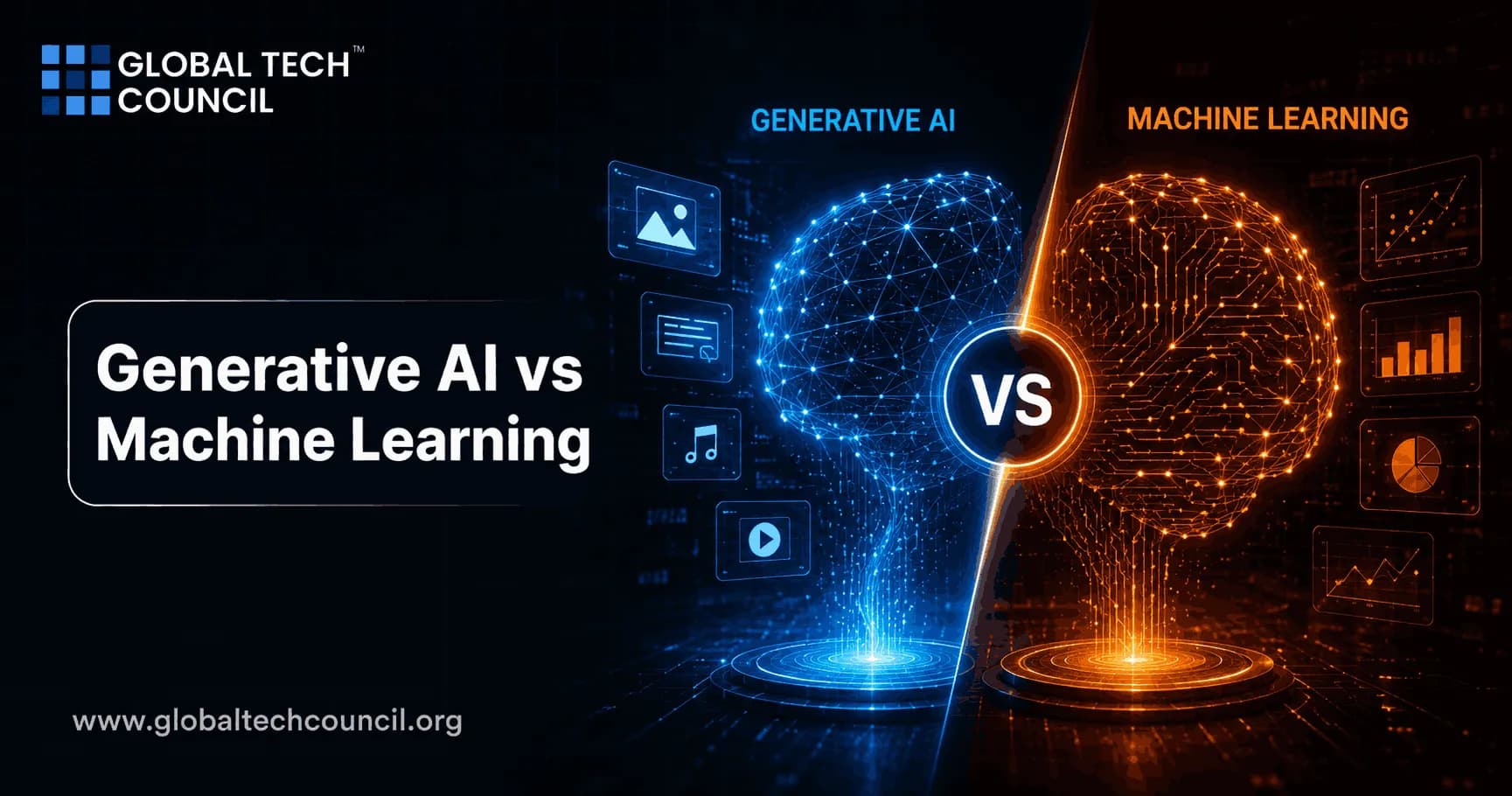
Generative AI vs Machine Learning is not a contest between old and new AI. Generative AI is a specialized branch of machine learning that creates new content, while traditional machine learning is usually built to predict, classify, rank, detect, or optimize using existing data.
If you build AI systems, this distinction matters. Pick a large language model for credit-risk scoring and you may get high cost, weak explainability, and governance headaches. Pick logistic regression for customer-support summarization and you will miss the point entirely. Use the right tool.

Understanding how traditional machine learning and generative AI complement each other begins with a solid foundation in core ML concepts. A Certified Machine Learning Expert credential helps professionals develop practical skills in data preparation, model evaluation, deployment, and decision-making, making it easier to determine the right AI approach for different business scenarios.
What Is Machine Learning?
Machine learning is the wider field. It trains algorithms to identify patterns in data and make decisions or predictions on new examples. The model does not need to be explicitly programmed for every rule. It learns from examples.
Common machine learning tasks include:
Classification: spam or not spam, fraud or not fraud, churn or no churn.
Regression: house prices, delivery time, customer lifetime value.
Clustering: segmenting customers or grouping similar documents.
Recommendation: ranking products, videos, articles, or jobs.
Anomaly detection: identifying unusual login behavior or payment activity.
Reinforcement learning: training agents to act through rewards and penalties.
Traditional machine learning still runs much of the digital economy. Fraud models in banks, demand forecasting in retail, predictive maintenance in factories, and recommendation systems in media platforms are not going away because chatbots arrived.
What Is Generative AI?
Generative AI creates new outputs that resemble the data it was trained on. The output may be text, image, code, audio, video, synthetic tabular data, or a 3D asset. It learns the structure of a data distribution, then samples from that distribution.
Large language models generate text one token at a time. Diffusion models create images by learning how to reverse a noise process. Generative adversarial networks pair a generator against a discriminator. Variational autoencoders learn compressed latent representations that can be sampled.
The practical framing is this: generative AI expands machine learning from prediction into synthesis and interaction. That is the shift most enterprise teams are trying to absorb right now.
As organizations continue adopting AI-powered content generation and intelligent assistants, demand is growing for professionals who understand how these systems are designed and deployed. A Certified Generative AI Expert credential helps learners build practical expertise in prompt engineering, transformer models, retrieval-augmented generation, AI safety, and enterprise generative AI applications.
Generative AI vs Machine Learning: The Core Difference
The simplest split is this:
Machine learning predicts or decides. It answers questions such as: Is this transaction suspicious? Which product should appear next? What will demand be next week?
Generative AI produces. It answers prompts such as: Draft this report. Summarize this contract. Generate Python tests. Create a product image variation.
There is overlap. Generative AI is machine learning. Many generative systems also use classifiers, rankers, embeddings, retrieval systems, and safety models. A production chatbot is rarely just one model sitting behind an API.
Technical Differences That Matter in Real Projects
Objective Function
Traditional supervised models often learn a mapping from input X to output y. A fraud model might estimate the probability that a payment is fraudulent. A demand model might minimize forecast error.
Generative models learn patterns in the full data distribution. A language model predicts the next token, but the practical result is text generation, reasoning assistance, summarization, and code synthesis.
Data and Compute
A gradient boosting model for churn prediction may train well on a few hundred thousand rows if the features are clean. A generative foundation model may require huge corpora, GPUs or TPUs, distributed training, model parallelism, and expensive inference.
Here is a detail beginners learn the hard way: in scikit-learn, a model pipeline can fail before training with ValueError: Input contains NaN, infinity or a value too large for dtype('float64'). That is not glamorous AI work. It is data hygiene. In generative AI projects, the equivalent pain often shows up as context-window truncation, bad chunking in retrieval, or hallucinated answers because the model never saw the relevant source document.
Model Families
Traditional machine learning commonly uses logistic regression, random forests, XGBoost, LightGBM, support vector machines, k-means, PCA, and neural networks. For many tabular business problems, gradient boosting is still a strong first choice. To be blunt, it often beats a large language model on accuracy, cost, and auditability.
Generative AI commonly uses transformer-based large language models, diffusion models, GANs, VAEs, and multimodal architectures that combine text, image, audio, or structured data.
Outputs and Evaluation
Traditional ML outputs are easier to evaluate: accuracy, precision, recall, F1 score, ROC-AUC, mean absolute error, root mean squared error, or business lift.
Generative AI evaluation is messier. You still measure latency, cost, refusal rates, and task success, but you also need factuality checks, toxicity screening, retrieval accuracy, human review, and red-team testing. A response can sound confident and still be wrong.
Where They Overlap
The overlap is where modern AI systems get useful.
Retrieval-augmented generation: search and embeddings retrieve trusted documents, then a generative model answers using that context.
AI agents: a generative model plans actions, while traditional models forecast demand, detect anomalies, or score risk.
Synthetic data: generative models create extra examples, while traditional ML models train or test on them.
Human feedback loops: classifiers and ranking models help evaluate or improve generated responses.
In enterprise systems, this hybrid pattern is normal. A customer-service assistant may use a language model for conversation, a classifier for intent detection, a vector database for retrieval, and a rules engine for escalation.
Successfully implementing hybrid AI solutions also requires expertise in cloud infrastructure, software engineering, MLOps, cybersecurity, and scalable deployment practices. A Deep Tech Certification helps professionals strengthen these advanced technical capabilities, enabling them to build reliable AI systems that combine traditional machine learning with modern generative AI technologies.
Enterprise Use Cases for Generative AI
Knowledge Work and Content
Deloitte's 2024 State of Generative AI in the Enterprise survey reported that 85 percent of surveyed organizations used generative AI for text. That tracks with what teams deploy first: document summarization, report drafting, proposal support, policy search, and internal Q&A.
Generative AI is strong when the input is unstructured and the output must be readable by humans. Contracts, tickets, PDFs, meeting notes, research papers, and support transcripts are good candidates.
Software Development
Code copilots lead enterprise adoption, with roughly half of organizations reporting use of AI-assisted coding tools. Developers use these tools for completion, refactoring, unit test drafts, documentation, and API examples.
Do not treat generated code as production-ready by default. Run tests. Review dependencies. Scan for secrets. Check licenses. A code assistant can save time, but it can also invent a library method that does not exist.
Customer Service and IT Operations
Customer service chatbots rank among the highest-investment generative AI use cases, with a majority of enterprises naming it as a top priority in recent surveys. Automated IT testing, HR support, customer communications, documentation creation, and IT security also saw strong adoption.
Design, Simulation, and Industry Workflows
Generative AI is also moving into product design, digital twins, drug discovery support, claims processing, and supply chain planning. Public examples include 3D digital twin work for manufacturing floors and inventory decision-support systems built on cloud AI platforms.
Enterprise Use Cases for Traditional Machine Learning
Traditional machine learning remains the better fit when you need structured prediction with stable metrics.
Fraud detection: score transactions in milliseconds.
Demand forecasting: predict SKU-level inventory needs.
Recommendation systems: rank products or content.
Quality inspection: detect manufacturing defects with computer vision.
Cybersecurity: identify anomalies in authentication, network traffic, or endpoint behavior.
Credit and risk scoring: support decisions with explainable features and monitored drift.
If the output is a score, label, forecast, or ranked list, start with traditional ML. If the output is a paragraph, image, code file, or conversation, consider generative AI.
Risk and Governance Differences
Both approaches can be biased, brittle, and hard to explain. Generative AI adds extra risks because it creates content.
Hallucination: generated answers may be fluent but false.
Privacy exposure: prompts and outputs may contain sensitive data.
Intellectual property risk: generated content may raise ownership or training-data questions.
Misuse: deepfakes, phishing, synthetic fraud, and disinformation are real concerns.
Security: prompt injection can make a model ignore instructions or reveal data from connected tools.
The EU AI Act treats large generative models as general-purpose AI models and introduces obligations around transparency, safety, cybersecurity, documentation, and risk management. Traditional ML systems may be low risk, high risk, or somewhere between depending on use. A spam filter is not the same as an employment-screening model.
Market Signals: Why This Distinction Matters Now
The investment curve is steep. Gartner forecast worldwide generative AI spending, including hardware, software, and services, to reach 644 billion dollars in 2025. Enterprise generative AI spending has climbed sharply year over year, roughly tripling from 2024 into 2025 by several industry estimates.
Market estimates vary by scope. Different research firms place the generative AI market anywhere from the low tens of billions today to hundreds of billions or more by the mid-2030s, depending on what they count. The broader AI market, including traditional machine learning, remains much larger and is forecast to keep expanding through the next decade.
The signal is clear enough: generative AI is growing quickly, but it is a subset of a larger machine learning discipline.
How to Choose the Right Approach
Use this practical decision guide:
Need a label, score, forecast, or anomaly flag? Choose traditional machine learning first.
Need text, image, code, audio, or a conversational interface? Use generative AI.
Need answers grounded in internal documents? Use retrieval-augmented generation with strong source controls.
Need strict explainability and low latency? Prefer traditional ML unless there is a clear reason not to.
Need an autonomous workflow? Combine generative AI with APIs, traditional models, access controls, and human approval for high-impact steps.
Skills Professionals Should Build
You should not skip machine learning fundamentals and jump straight to prompt writing. Learn data preprocessing, feature engineering, model evaluation, overfitting, bias, drift, and deployment. Then add generative AI skills: prompt design, embeddings, vector search, fine-tuning, evaluation, safety testing, and AI governance.
If you want a structured path, Global Tech Council certification programs in artificial intelligence, machine learning, data science, and cybersecurity cover both sides of this divide. The strongest professionals can explain both a confusion matrix and a retrieval pipeline. That combination is rare, and enterprises need it.
Final Takeaway
Generative AI vs Machine Learning is best understood as subset versus parent field. Generative AI creates new content. Traditional machine learning predicts, classifies, ranks, and optimizes. The best enterprise systems use both.
Your next step: build one small hybrid project. Use a traditional ML model to classify support tickets, then add a retrieval-augmented generative AI layer that drafts a response from approved knowledge-base articles. Measure accuracy, latency, hallucination rate, and human approval rate. That exercise teaches the real difference faster than any diagram.
Technical expertise enables professionals to build effective AI solutions, but understanding business priorities and customer needs is equally important for successful adoption. A Marketing & Business Certification helps professionals develop these strategic skills, allowing them to align AI initiatives with organizational objectives and demonstrate measurable business value.
FAQs
1. What is the difference between Generative AI and Machine Learning?
Machine Learning (ML) is a broad field of artificial intelligence that enables systems to learn patterns from data to make predictions, classifications, or decisions. Generative AI is a specialized subset of AI, often built using advanced machine learning and deep learning techniques, that creates new content such as text, images, audio, video, or code based on learned patterns.
2. What is Machine Learning?
Machine Learning is a branch of artificial intelligence that develops models capable of learning from historical data without being explicitly programmed for every scenario. It is commonly used for prediction, recommendation, anomaly detection, forecasting, classification, and optimization across many industries.
3. What is Generative AI?
Generative AI refers to AI systems designed to generate original content that resembles the data used during training. Depending on the model and application, it can produce written content, software code, images, music, videos, synthetic data, and conversational responses.
4. Is Generative AI a type of Machine Learning?
Yes. Generative AI is generally considered a specialized area within machine learning, particularly deep learning. Many modern generative models use transformer architectures, diffusion models, generative adversarial networks (GANs), or variational autoencoders (VAEs) to create new content.
5. How do traditional Machine Learning models work?
Traditional machine learning models identify relationships between input features and expected outcomes using structured or labeled datasets. Algorithms such as decision trees, random forests, support vector machines, and gradient boosting are commonly used for predictive analytics and decision support.
6. How does Generative AI work?
Generative AI models learn statistical patterns and representations from large datasets during training. Once trained, they generate new outputs by predicting likely sequences, reconstructing learned patterns, or sampling from learned probability distributions depending on the model architecture.
7. What types of data are used in Machine Learning?
Machine learning can process structured, semi-structured, and unstructured data, including spreadsheets, sensor readings, financial records, medical data, images, audio, customer transactions, and text. The appropriate data type depends on the business problem and chosen algorithm.
8. What types of data are used in Generative AI?
Generative AI is commonly trained on large collections of text, images, audio, video, source code, or multimodal datasets. Training data varies by developer, intended use case, licensing requirements, and applicable legal or regulatory considerations.
9. What are common Machine Learning use cases?
Machine learning is widely applied to fraud detection, demand forecasting, predictive maintenance, recommendation systems, credit risk assessment, medical decision support, quality inspection, customer segmentation, cybersecurity, and supply chain optimization.
10. What are common Generative AI use cases?
Generative AI is frequently used for content creation, conversational assistants, document summarization, software development support, image generation, marketing content, product design concepts, synthetic data generation, educational tools, and multilingual translation.
11. Which algorithms are commonly used in Machine Learning?
Machine learning includes algorithms such as linear regression, logistic regression, decision trees, random forests, support vector machines, k-nearest neighbors, Naive Bayes, XGBoost, LightGBM, clustering algorithms, and classical neural networks.
12. Which models power Generative AI?
Generative AI commonly relies on transformer-based language models, diffusion models, GANs, VAEs, autoregressive models, and multimodal architectures. The most suitable model depends on whether the application generates text, images, audio, video, code, or combinations of multiple media types.
13. Which approach requires more computing resources?
Large generative AI models typically require significantly greater computational resources for training than many traditional machine learning algorithms. Inference costs also vary depending on model size, deployment strategy, hardware, latency requirements, and optimization techniques.
14. When should you use Machine Learning instead of Generative AI?
Traditional machine learning is often preferable for structured prediction tasks, forecasting, risk scoring, anomaly detection, recommendation systems, and applications where interpretability, efficiency, or lower computational cost is important. The appropriate choice depends on technical and business requirements.
15. When should you use Generative AI instead of traditional Machine Learning?
Generative AI is often better suited for applications involving natural language generation, creative assistance, document analysis, conversational interfaces, code generation, design ideation, and other tasks requiring the creation or transformation of content rather than prediction alone.
16. Can Generative AI and Machine Learning work together?
Yes. Many modern AI solutions combine generative AI with traditional machine learning to improve overall performance. For example, a machine learning model may detect fraudulent transactions while a generative AI system explains the findings, summarizes reports, or assists analysts with investigations.
17. What challenges do both technologies share?
Both machine learning and generative AI require high-quality data, ongoing evaluation, bias mitigation, security controls, privacy protection, model monitoring, and governance throughout the AI lifecycle. Organizations should also consider regulatory obligations, intellectual property considerations, and responsible AI practices.
18. What are best practices for choosing between Generative AI and Machine Learning?
Begin by clearly defining the business objective and the type of output required. Evaluate data availability, performance requirements, explainability, operational costs, security, privacy, scalability, and compliance obligations before selecting the most appropriate AI approach or combining multiple techniques.
19. What trends are shaping Generative AI and Machine Learning in 2025-2026?
Major trends include multimodal AI, smaller domain-specific foundation models, retrieval-augmented generation (RAG), AI agents, explainable AI, federated learning, synthetic data, edge AI, automated machine learning (AutoML), and stronger governance frameworks for responsible AI deployment.
20. What is the future of Generative AI and Machine Learning?
Generative AI and traditional machine learning are expected to evolve together rather than compete directly. Machine learning will continue powering predictive analytics and structured decision-making, while generative AI expands capabilities in content creation, intelligent assistance, and human-computer interaction. Many enterprise AI systems will combine both approaches to deliver practical, scalable, and trustworthy solutions. Even in the AI world, specialists and generalists tend to work better as teammates than rivals.
Related Articles
View All
Machine Learning
Top Machine Learning Use Cases Across Industries in 2026
Explore the top machine learning use cases across industries in 2026, from predictive maintenance and fraud detection to healthcare AI and CRM automation.

Machine Learning
Decision Trees in Machine Learning: How They Work and When to Use Them
Learn how decision trees work in machine learning, when to use them, their strengths, limits, pruning methods, and role in modern tabular modeling.

Machine Learning
Machine Learning vs Deep Learning: Which Approach Should You Use?
Machine learning vs deep learning explained with practical guidance on data size, interpretability, compute, use cases, and when each approach fits best.
Trending Articles
The Role of Blockchain in Ethical AI Development
How blockchain technology is being used to promote transparency and accountability in artificial intelligence systems.
AWS Career Roadmap
A step-by-step guide to building a successful career in Amazon Web Services cloud computing.
Top 5 DeFi Platforms
Explore the leading decentralized finance platforms and what makes each one unique in the evolving DeFi landscape.