

Machine Learning vs Artificial Intelligence: Key Differences and Examples
 Suyash Raizada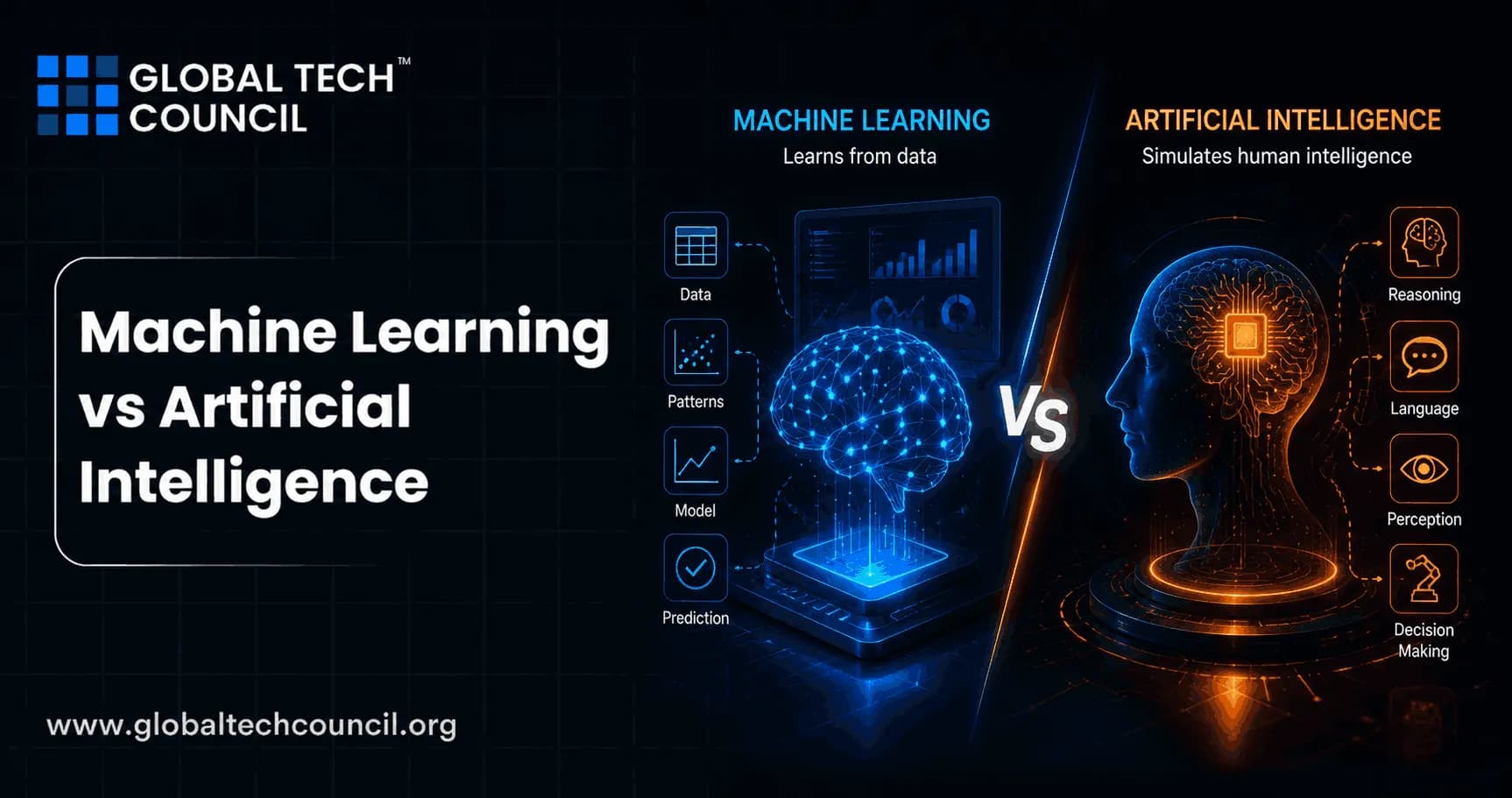
Machine Learning vs Artificial Intelligence is a practical distinction, not just a vocabulary debate. Artificial intelligence is the wider field of building systems that act intelligently. Machine learning is one way to build those systems by training models on data. If you are planning a project, choosing a course, or explaining an AI roadmap to leadership, this difference matters.
Here is the short version. AI is the umbrella. ML sits under it. Most modern AI products use ML, but AI can also use rules, logic, search algorithms, expert systems, planning systems, and optimization methods without ever training a model on data.

Understanding the relationship between AI and machine learning is essential for choosing the right technology for a project. A Certified Machine Learning Expert credential helps professionals develop practical skills in data preparation, model development, evaluation, and deployment, providing a strong foundation for building reliable machine learning solutions.
What Is Artificial Intelligence?
Artificial intelligence refers to computer systems designed to perform tasks that usually require human intelligence. Reasoning, planning, language understanding, perception, decision making, problem solving. All of that counts.
AI is not one algorithm. It is a field. A chess engine, a hospital triage assistant, a warehouse robot, a virtual customer support agent, a fraud monitoring system: each one can be described as AI if it performs intelligent tasks. The internal design may be completely different from one to the next.
Some AI systems use machine learning. Some do not. A classical expert system, for example, may use rules written by domain specialists:
If a patient has symptom A and symptom B, suggest test C.
If a transaction is above a threshold and comes from a new device, send it for review.
If a robot is blocked, search for the next available path.
That is still AI, even if no model is trained.
What Is Machine Learning?
Machine learning is a subset of AI focused on systems that learn patterns from data. Instead of programming every rule by hand, you train a model using examples. The model then makes predictions or decisions on data it has not seen before.
Take spam. You do not write every possible spam rule yourself. You train an ML model on many emails labeled as spam or not spam. The model learns patterns in subject lines, sender behavior, text, links, metadata, and attachments.
Common ML tasks include:
Classification: Predicting a category, such as spam or not spam.
Regression: Predicting a number, such as next month's sales.
Clustering: Grouping similar data points without predefined labels.
Anomaly detection: Finding unusual activity, such as suspicious payments.
Recommendation: Suggesting products, films, courses, or articles.
A small practitioner detail. In scikit-learn, beginners often hit ConvergenceWarning: lbfgs failed to converge (status=1): STOP: TOTAL NO. of ITERATIONS REACHED LIMIT. when using LogisticRegression. The fix is usually not a new algorithm. Scale your features with StandardScaler and raise max_iter from the default 100 to something like 1000. That one setting can decide whether a training run is useful or just noise.
Machine Learning vs Artificial Intelligence: The Core Difference
The core difference comes down to scope. AI describes the goal: build systems that behave intelligently. ML describes a method: train systems on data so they can learn patterns.
AI is broader
AI covers rule-based systems, symbolic reasoning, planning, search, optimization, robotics, natural language systems, and ML. A navigation planner in a robot may use graph search. A compliance workflow may run on deterministic business rules. A game AI may use minimax search or Monte Carlo Tree Search.
ML is data-driven
ML depends on data. The quality of your labels, your sampling method, your data leakage controls, feature engineering, and evaluation design matter as much as the model you pick. To be blunt, a clean logistic regression baseline often beats a poorly trained deep neural network.
AI can work without learning
Traditional AI systems may follow fixed rules. They do not adapt unless someone changes the rules. ML systems can improve when retrained on new data, though that improvement is not automatic. You still need monitoring, versioning, validation, and human review.
While machine learning is a powerful approach within AI, many enterprise solutions also combine rule-based systems, automation, optimization, and intelligent decision-making frameworks. A Certified Artificial Intelligence (AI) Expert credential helps professionals understand these broader AI concepts, enabling them to design solutions that integrate multiple AI techniques to solve real business challenges.
AI vs ML Comparison Table
Aspect | Artificial Intelligence | Machine Learning |
|---|---|---|
Scope | Broad field for building intelligent systems | Subset of AI focused on learning from data |
Main goal | Reasoning, planning, perception, decision making | Prediction, classification, pattern recognition |
Methods | Rules, logic, search, optimization, ML | Supervised, unsupervised, reinforcement learning |
Data dependence | May work with expert rules and limited data | Needs relevant, high-quality training data |
Adaptation | Often static unless redesigned | Can improve through retraining and new data |
Example | Rule-based medical expert system | Model predicting disease risk from patient records |
Examples of Artificial Intelligence
Virtual assistants and chatbots
A digital assistant is an AI system because it interprets language, manages dialog, chooses actions, and returns useful responses. It may use ML for intent detection or speech recognition, while a rule engine handles refunds, escalation, or compliance steps.
Self-driving vehicles
Autonomous vehicle systems combine several AI capabilities. Computer vision models detect lanes, pedestrians, and signs. Planning systems decide safe routes. Control systems manage steering, braking, and acceleration. ML is vital for perception, but the full vehicle stack is far broader than ML alone.
Expert systems
Expert systems are a classic form of AI. They encode knowledge as rules and use inference engines to draw conclusions. Older medical diagnosis tools and legal reasoning systems often worked this way. They can be useful when rules are clear, auditable, and stable.
Robotics
Industrial robots use AI for motion planning, object recognition, task scheduling, and fault handling. In many factories, a rule-based controller still does the safety-critical work, while ML supports visual inspection or predictive maintenance.
Examples of Machine Learning
Email spam filtering
Spam filters learn from labeled messages. Features may include word frequency, sender reputation, embedded URLs, attachment types, and user feedback. The system predicts whether a new email should go to the inbox or the spam folder.
Recommendation engines
Streaming platforms and e-commerce sites use ML to suggest items based on behavior. Techniques may include collaborative filtering, matrix factorization, ranking models, or deep learning methods. The goal is specific: predict what a user is likely to watch, buy, read, or skip.
Fraud detection
Banks and payment platforms train ML models on transaction history to flag suspicious activity. The hard part is not only accuracy. False positives matter. If your fraud model blocks too many legitimate customers, the business impact can be worse than a slightly lower recall score.
Predictive maintenance
Manufacturers use sensor data from motors, pumps, turbines, and vehicles to predict equipment failure. Vibration, temperature, pressure, and usage patterns can feed models that warn teams before breakdowns happen.
Demand forecasting
Retailers use ML to predict demand by product, region, season, promotion, and price. A simple gradient boosting model can be strong here, especially when the dataset has clean time-based features and enough historical cycles.
Why People Confuse AI and ML
The confusion is understandable. Most AI products you see today have ML somewhere inside them. Many modern AI applications are, at their core, ML systems trained on large datasets for tasks such as image classification, forecasting, and large-scale data analysis. ML itself is often defined as the science of building algorithms and statistical models that perform tasks without explicit instructions.
Cloud platforms blur the terms too. Google Cloud, AWS, Microsoft Azure, and IBM sell AI and ML services side by side. In practice, a team may use an AI API for language understanding, an ML platform for model training, and a rules engine for workflow control. The user just sees one intelligent application.
Historical Context and Market Direction
AI research dates back to the 1950s, when computer scientists began building systems for reasoning, games, and symbolic problem solving. Machine learning emerged later as a more specific data-driven approach, with the term taking clearer shape through the following decades.
Since then, ML has become the dominant engineering path for many AI problems. Computer vision, speech recognition, translation, recommendation systems, fraud analytics, and predictive maintenance all rely heavily on it.
Market estimates put the global machine learning market in the tens of billions of dollars, with projections running into the hundreds of billions over the next several years. Forecasts vary by source and methodology, but the direction is clear. Enterprises are investing in ML engineering, MLOps, cloud AI, model governance, and responsible AI.
Which Should You Learn First?
If you are a developer, start with machine learning fundamentals: Python, statistics, model evaluation, feature engineering, and scikit-learn. Then move into deep learning with PyTorch or TensorFlow if your work involves images, text, audio, or large-scale unstructured data.
If you are a product manager, architect, or enterprise leader, start with AI concepts first. You need to understand what AI systems can and cannot do, where rules beat ML, and how risk, bias, privacy, and human oversight affect deployment.
If you are aiming for a technical career, build both tracks:
Learn Python 3.12 and core data libraries such as pandas, NumPy, and scikit-learn.
Train baseline models before reaching for neural networks.
Study model metrics: precision, recall, F1 score, ROC-AUC, calibration, and drift.
Practice deployment with APIs, containers, model registries, and monitoring.
Add governance knowledge, especially for high-impact AI systems.
For structured learning, use the Global Tech Council certification catalog to compare AI, machine learning, data science, and cloud-focused programs. Pick an AI certification if you need strategy and architecture depth. Pick a machine learning path if you want to train, evaluate, and deploy models.
As AI adoption continues to expand, professionals also benefit from expertise in cloud computing, MLOps, distributed systems, automation, and scalable AI infrastructure. A Deep Tech Certification helps strengthen these advanced technical capabilities, preparing practitioners to deploy and manage enterprise-grade AI and machine learning solutions efficiently.
Governance: The Part Beginners Skip
AI and ML systems increasingly fall under governance expectations around transparency, accountability, privacy, fairness, and human oversight. This is not paperwork. It changes how you design the system.
For ML, governance usually means documenting datasets, checking bias, monitoring drift, logging model versions, validating performance after retraining, and defining when a human must review a decision. For broader AI systems, it may also include rule audits, explainability requirements, escalation policies, and compliance checks.
Do not treat governance as something you bolt on after launch. Add it while you design the workflow.
Final Takeaway: Use the Right Term, Then Choose the Right Tool
Machine Learning vs Artificial Intelligence comes down to this. AI is the broader objective of creating intelligent systems. ML is a data-based method used to reach that objective. AI can include ML, but it can also include rules, search, symbolic reasoning, planning, and optimization.
Your next step is simple. If you want to build predictive models, study ML first and ship a small project such as spam classification or demand forecasting. If you want to design intelligent enterprise systems, study AI architecture and governance, then add ML where data-driven learning is actually the right fit.
Building successful AI initiatives requires more than technical expertise. Organizations also need professionals who understand how intelligent technologies support business strategy, customer value, and organizational growth. A Marketing & Business Certification helps develop this business perspective, enabling practitioners to align AI and machine learning projects with measurable business objectives and long-term success.
FAQs
1. What is the difference between artificial intelligence and machine learning?
Artificial intelligence (AI) is the broader field focused on creating systems that perform tasks requiring human-like intelligence, such as reasoning, problem-solving, perception, and decision-making. Machine learning (ML) is a subset of AI that enables systems to learn from data and improve performance without being explicitly programmed for every scenario.
2. What is artificial intelligence (AI)?
Artificial intelligence refers to technologies that enable computers to perform tasks traditionally associated with human intelligence. These tasks include understanding language, recognizing images, making decisions, planning actions, and solving complex problems using a variety of computational techniques.
3. What is machine learning (ML)?
Machine learning is a branch of AI that uses algorithms to identify patterns in data and make predictions or decisions. Instead of relying solely on predefined rules, machine learning models improve through training on historical data and applying learned patterns to new information.
4. How are AI and machine learning related?
Machine learning is one of the primary methods used to build AI systems. While many modern AI applications rely heavily on machine learning, AI also includes rule-based systems, expert systems, search algorithms, robotics, knowledge representation, planning, and other techniques beyond machine learning.
5. Does all artificial intelligence use machine learning?
No. Some AI systems rely on predefined rules, logical reasoning, optimization techniques, or expert systems rather than learning from data. Although machine learning has become a dominant AI approach, it is not the only method used to develop intelligent systems.
6. Does all machine learning belong to artificial intelligence?
Yes. Machine learning is widely recognized as a subfield of artificial intelligence because its purpose is to enable machines to learn from data and perform intelligent tasks such as prediction, classification, and decision support.
7. What are common examples of artificial intelligence?
Examples of AI include virtual assistants, autonomous vehicles, robotics, recommendation systems, fraud detection, computer vision, speech recognition, intelligent search engines, medical decision support systems, and conversational AI applications such as chatbots.
8. What are common examples of machine learning?
Machine learning powers email spam filtering, product recommendations, demand forecasting, customer churn prediction, predictive maintenance, image classification, credit risk assessment, fraud detection, search ranking, and personalized advertising.
9. What are the main types of machine learning?
The primary categories of machine learning are supervised learning, unsupervised learning, and reinforcement learning. Additional approaches include semi-supervised learning, self-supervised learning, transfer learning, and online learning for specialized applications.
10. What technologies are included in artificial intelligence?
Artificial intelligence encompasses machine learning, deep learning, natural language processing (NLP), computer vision, robotics, expert systems, knowledge graphs, automated planning, reasoning systems, reinforcement learning, and increasingly, multimodal foundation models.
11. What are the advantages of artificial intelligence?
AI can automate repetitive tasks, improve operational efficiency, support faster decision-making, enhance customer experiences, analyze complex data, optimize business processes, and assist professionals across industries. Its effectiveness depends on appropriate implementation, governance, and ongoing evaluation.
12. What are the advantages of machine learning?
Machine learning enables systems to improve predictions using historical data, identify hidden patterns, automate data analysis, personalize services, and support scalable decision-making. It is particularly effective when working with large datasets where manual analysis would be impractical.
13. What are the limitations of artificial intelligence?
AI systems may face challenges related to data quality, transparency, fairness, privacy, cybersecurity, regulatory compliance, computational costs, and human oversight. Performance also depends on the quality of system design and the context in which AI is deployed.
14. What are the limitations of machine learning?
Machine learning requires relevant, high-quality data and may be affected by biased datasets, overfitting, model drift, limited interpretability, and changing real-world conditions. Models also require ongoing monitoring and periodic retraining to maintain reliable performance.
15. Which industries use artificial intelligence and machine learning?
AI and machine learning are widely used in healthcare, finance, manufacturing, retail, logistics, transportation, education, cybersecurity, telecommunications, agriculture, government, energy, scientific research, and digital marketing to improve efficiency and support data-driven decision-making.
16. Can artificial intelligence exist without deep learning?
Yes. Deep learning is a specialized subset of machine learning, which itself is a subset of AI. Many AI systems use rule-based reasoning, optimization methods, symbolic AI, or expert systems without employing deep neural networks.
17. What trends are shaping AI and machine learning in 2025-2026?
Major trends include generative AI, multimodal foundation models, agentic AI, explainable AI, edge AI, federated learning, AI governance, responsible AI, synthetic data generation, energy-efficient model design, and increasing enterprise adoption of AI-powered automation.
18. What are best practices for adopting AI and machine learning?
Organizations should define clear business objectives, ensure data quality, select appropriate technologies, implement responsible AI governance, protect sensitive information, validate model performance, monitor deployed systems continuously, and maintain human oversight where appropriate.
19. How should beginners learn artificial intelligence and machine learning?
Beginners should first understand basic programming, mathematics, statistics, and data analysis before studying machine learning algorithms and broader AI concepts. Building practical projects, learning Python, exploring open-source libraries, and understanding ethical AI principles provide a strong foundation for long-term learning.
20. What is the future of artificial intelligence and machine learning?
Artificial intelligence and machine learning are expected to become even more integrated into business operations, healthcare, education, transportation, scientific research, and everyday digital products. Continued advances in computing, foundation models, responsible AI practices, and regulatory frameworks will likely improve the capabilities, accessibility, and trustworthiness of intelligent systems while emphasizing transparency, security, and ethical deployment. AI may be the grand ambition, and machine learning one of its most successful tools, but choosing the right technology still beats choosing the most fashionable acronym.
Related Articles
View All
Machine Learning
Supervised vs Unsupervised vs Reinforcement Learning: Key Differences with Real-World Examples
Learn the key differences between supervised, unsupervised, and reinforcement learning with practical examples, use cases, and a clear decision framework.

Machine Learning
Generative AI vs Machine Learning: Differences, Overlaps, and Use Cases
Learn how generative AI differs from traditional machine learning, where they overlap, and how to choose the right approach for enterprise AI use cases.

Machine Learning
Linear Regression in Machine Learning: Concepts, Assumptions, and Examples
Learn linear regression in machine learning, including key concepts, assumptions, diagnostics, examples, and when to use simpler models over complex ones.
Trending Articles
The Role of Blockchain in Ethical AI Development
How blockchain technology is being used to promote transparency and accountability in artificial intelligence systems.
AWS Career Roadmap
A step-by-step guide to building a successful career in Amazon Web Services cloud computing.
Top 5 DeFi Platforms
Explore the leading decentralized finance platforms and what makes each one unique in the evolving DeFi landscape.