

Decision Trees in Machine Learning: How They Work and When to Use Them
 Suyash Raizada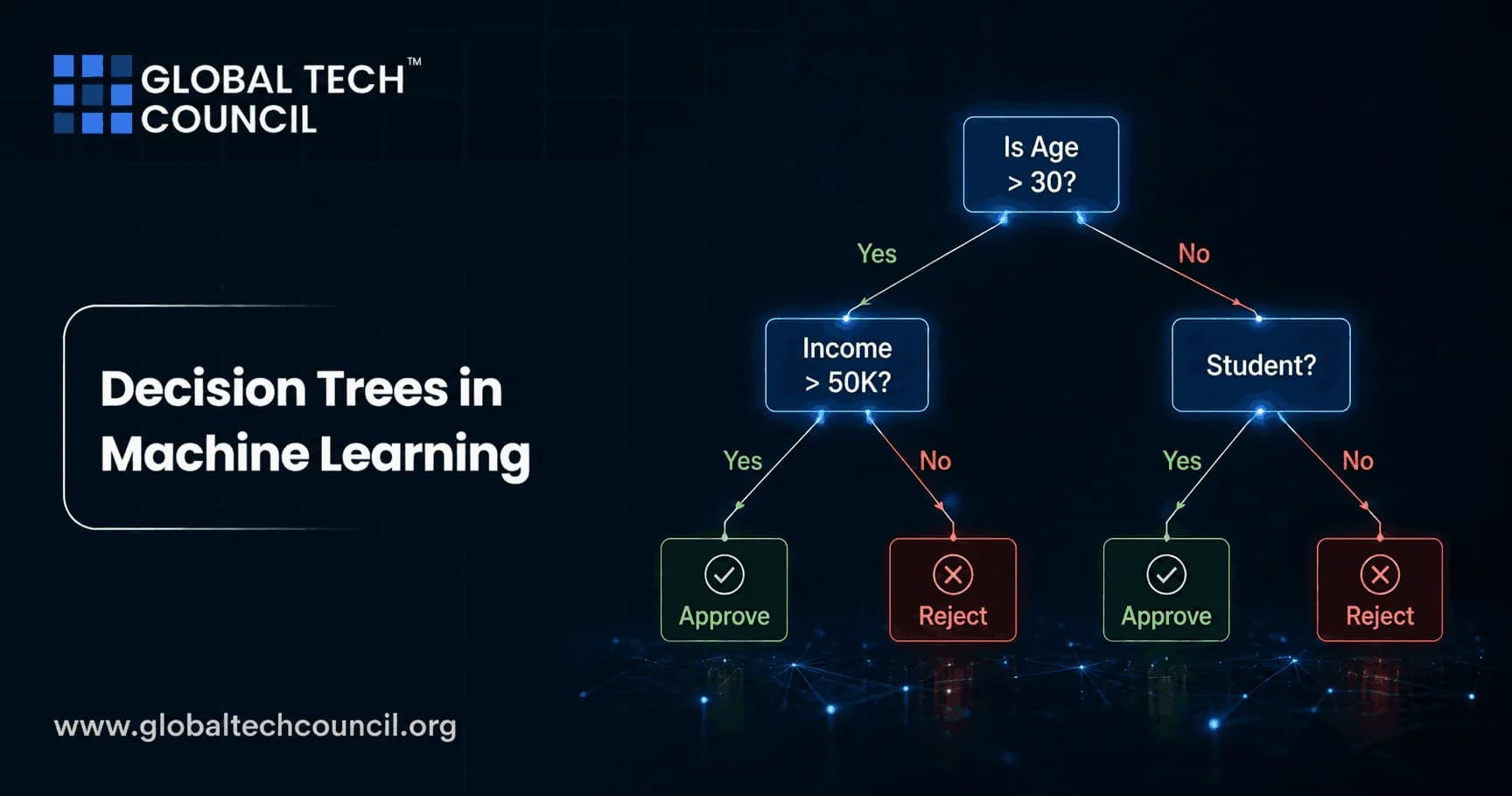
Decision Trees in Machine Learning are supervised learning models that predict an outcome by moving each record through a series of feature-based questions. If you have worked with tabular data, you have probably seen the appeal: a tree can say why it made a prediction, not just what it predicted.
That matters. In credit risk, churn prediction, clinical triage, pricing, and fraud detection, a model that produces readable rules is often easier to defend than a black-box model with a slightly better score. Still, a single decision tree is not a magic answer. It is interpretable, fast, and useful, but it can overfit badly if you let it grow without limits.

Building a strong understanding of decision trees is an essential step in learning supervised machine learning because the concepts behind splitting, feature selection, and model evaluation extend to many advanced algorithms. A Certified Machine Learning Expert credential helps professionals strengthen these practical skills, preparing them to develop reliable predictive models for real-world business applications.
What Is a Decision Tree?
A decision tree is a non-parametric supervised learning model. Non-parametric means it does not assume a fixed mathematical form for the relationship between inputs and outputs. Instead, it learns a hierarchy of splits from the training data.
The structure is simple:
Root node: The first split in the tree.
Internal nodes: Feature tests such as age > 30 or account_balance <= 5000.
Branches: The route an observation takes after each test.
Leaf nodes: The final prediction.
In a classification tree, a leaf returns a class label or class probability, such as approved, rejected, spam, or not spam. In a regression tree, a leaf returns a continuous value, often the average target value of the training records that reached that leaf.
Take a small loan risk tree. It might ask whether the applicant has missed payments, then check debt-to-income ratio, then check employment length. Each path becomes an if-then rule. That is why business users usually understand decision trees faster than logistic regression coefficients or neural network weights.
Decision trees also provide an excellent foundation for understanding more advanced AI techniques, including ensemble learning and modern predictive systems. A Certified AI & Machine Learning Expert credential helps professionals connect these concepts, giving them the knowledge needed to evaluate, implement, and optimize a wide range of machine learning models across different industries.
How Decision Trees Work
Decision tree learning uses recursive partitioning. The algorithm starts with all training records at the root. It then searches for the split that best separates the target variable. Each child node repeats the same process on its subset of data.
The search is greedy. It does not test every possible full tree, because that would be computationally expensive. Instead, it picks the best split at the current node and moves on. Good enough, most of the time. Risky, sometimes.
Common split criteria
Different decision tree algorithms use different measures to judge split quality:
Gini impurity: Common in CART classification trees. A pure node has low Gini impurity.
Entropy and information gain: Used in ID3 and C4.5 style trees. The goal is to reduce uncertainty after a split.
Variance reduction or squared error: Used for regression trees, where the goal is to create child nodes with tighter target values.
Breiman, Friedman, Olshen, and Stone formalized CART in 1984. Ross Quinlan introduced ID3 in the 1980s and later C4.5 in 1993. Modern libraries such as scikit-learn implement CART-style trees for both classification and regression.
A practical scikit-learn detail that bites beginners
Here is a real one: scikit-learn decision trees do not accept raw string categories in the usual workflow. If you pass a column containing values like premium or basic directly into DecisionTreeClassifier, you can hit:
ValueError: could not convert string to float: 'premium'
You still need proper encoding, often with OneHotEncoder inside a ColumnTransformer. Another default to watch: max_depth=None. That means the tree grows until leaves are pure or another stopping rule blocks it. On a small dataset, this can give you a beautiful training score and a disappointing test score. Set max_depth, min_samples_leaf, or ccp_alpha early instead of waiting for the model to embarrass you in validation.
Classification Trees vs Regression Trees
The decision tree algorithm can handle two major supervised learning tasks.
Classification trees
Use a classification tree when the target is categorical. Examples include:
Customer will churn or not churn
Transaction is fraudulent or legitimate
Email is spam or not spam
Patient risk is low, medium, or high
The leaf can return the most common class among training samples in that node. Many implementations also return probabilities based on class proportions.
Regression trees
Use a regression tree when the target is numeric. Examples include:
Predicting house prices
Estimating delivery time
Forecasting customer lifetime value
Estimating machine failure time from sensor readings
A regression tree commonly predicts the mean target value of records in the leaf. This makes it easy to inspect, although single regression trees can produce blocky predictions because each leaf has one output value.
Strengths of Decision Trees in Machine Learning
Decision trees remain popular because they solve several practical problems at once.
Interpretability: You can visualize the tree and explain individual decisions through a path from root to leaf.
Low preprocessing burden: Trees do not need feature scaling. Standardization helps many models, but not basic decision trees.
Non-linear patterns: Hierarchical splits can capture interactions that a simple linear model misses.
Mixed feature types: Trees work well with structured business data that contains numeric, binary, and categorical features, after suitable encoding where required.
Fast inference: A prediction only needs to evaluate a limited number of splits.
This is why decision trees are still taught early in machine learning programs and certification paths, including Global Tech Council learning tracks such as the Certified Machine Learning Expert™ and related Python and data science courses.
Limitations You Should Not Ignore
To be blunt, a single decision tree is easy to misuse.
Overfitting: Deep trees memorize training data, especially when leaves contain only one or two samples.
Instability: A small data change can alter an early split, which changes the whole tree.
Weak performance on complex unstructured data: Raw images, long text, and high-dimensional sparse features usually need other approaches or strong feature engineering.
Biased split behavior: Some tree methods can favor variables with many possible split points if not handled carefully.
Step-like predictions: Regression trees predict constant values in leaves, which may be too coarse for smooth functions.
If your main goal is the highest possible accuracy on structured data, start with gradient boosted trees after you build a simple baseline. XGBoost, LightGBM, CatBoost, and scikit-learn HistGradientBoosting often beat a single tree by a wide margin on tabular tasks. A single tree is better when explanation matters more than squeezing out the last percentage point.
When to Use Decision Trees
Use a decision tree when the problem fits the model's strengths.
You need clear decision rules. If auditors, clinicians, credit officers, or managers must understand the model, a decision tree is a strong candidate.
Your data is structured and tabular. Trees are a natural fit for rows and columns: account activity, demographics, transactions, lab values, machine readings, and operational metrics.
You need a quick baseline. A shallow tree can reveal whether features have predictive signal before you spend time tuning complex models.
You are learning ensembles. Random forests and gradient boosted decision trees are built from decision trees. Learn the single tree first.
You need rule extraction. A tree can convert model behavior into human-readable if-then logic for documentation or review.
Do not use a single decision tree as your first choice for raw computer vision, natural language processing, speech, or massive sparse datasets. For those, neural networks, linear models with good text features, or tree ensembles over engineered features are usually better.
How to Control Overfitting
Good decision tree modeling is mostly about restraint. Let the tree grow forever and it will often memorize noise.
Use these controls:
max_depth: Limits how many levels the tree can grow.
min_samples_split: Requires a minimum number of samples before a node can split.
min_samples_leaf: Prevents tiny leaves that memorize outliers.
max_leaf_nodes: Caps the total number of terminal nodes.
Cost-complexity pruning: In scikit-learn,
ccp_alphacan prune subtrees that add complexity without enough gain.
For many tabular datasets, setting min_samples_leaf to 5, 10, or even 50 is a useful first test. The right value depends on dataset size and class imbalance, so tune it with cross-validation rather than guessing.
Successfully deploying machine learning models in production requires more than algorithm knowledge alone. A Deep Tech Certification helps professionals build expertise in cloud computing, software engineering, scalable infrastructure, and cybersecurity, enabling them to create secure and enterprise-ready AI solutions that perform reliably in real-world environments.
Decision Trees vs Random Forests vs Gradient Boosting
A single decision tree gives you maximum readability. A random forest gives you better stability by averaging many trees trained on random samples and feature subsets. Gradient boosting builds trees sequentially, where each new tree focuses on errors from earlier trees.
Here is the practical view:
Single decision tree: Best for explainability, teaching, and quick rule discovery.
Random forest: Good default when you want stronger accuracy with less tuning.
Gradient boosted trees: Often the best choice for tabular prediction performance, but tuning and monitoring matter more.
In production, many teams use a shallow decision tree for explanation or policy discussion, then compare it against tree ensembles for predictive performance. That is a sensible workflow.
Real-World Use Cases
Decision trees and tree-based models appear across industries:
Finance: Credit risk, fraud detection, collections prioritization, and loan review support.
Healthcare: Risk stratification, diagnostic support, and treatment pathway triage where explainability is valuable.
Marketing: Churn prediction, lead scoring, campaign response modeling, and customer segmentation.
Manufacturing: Predictive maintenance, quality inspection, defect classification, and sensor-based alerts.
Digital platforms: Spam filtering, content moderation signals, and recommendation pipeline components.
Regulated settings deserve special care. A readable tree does not automatically make a model fair, calibrated, or compliant. You still need validation, bias checks, documentation, and monitoring after deployment.
Where Decision Trees Are Headed
Single trees are mature. The active work is mostly around tree ensembles, interpretability, constraints, calibration, and scale. Google has published and maintained decision forest tooling for large-scale use cases, while mainstream Python libraries continue to improve support for pruning, missing-value behavior, monotonic constraints, and faster training.
AutoML systems also keep decision trees and ensembles in their search spaces because they are hard to beat on business data. That pattern is unlikely to change soon. Deep learning dominates many unstructured-data tasks, but for clean tabular prediction, tree-based models are still workhorses.
Your Next Step
If you are learning Decision Trees in Machine Learning, build one from scratch on a small dataset, then train the same task with scikit-learn. Visualize the tree. Change max_depth from 2 to None and compare train versus test accuracy. You will understand overfitting in ten minutes.
After that, move to random forests and gradient boosted trees. For a structured path, explore Global Tech Council's Certified Machine Learning Expert™ program and related data science or Python certification options. Focus on model evaluation, feature engineering, and explainability, because those are the skills that turn a classroom decision tree into a reliable production model.
Technical expertise delivers the model, but business impact comes from communicating insights effectively and aligning analytical outcomes with organizational objectives. A Marketing & Business Certification helps professionals strengthen these strategic communication and business skills, making it easier to translate machine learning results into actionable decisions and measurable value.
FAQs
1. What is a decision tree in machine learning?
A decision tree is a supervised machine learning algorithm used for classification and regression tasks. It models decisions as a tree-like structure of nodes and branches, where each split is based on a feature that helps separate the data into more homogeneous groups.
2. Why are decision trees important?
Decision trees are popular because they are easy to understand, require relatively little data preparation, and provide interpretable decision rules. They are widely used for predictive modeling, business decision-making, risk assessment, and as building blocks for ensemble methods such as Random Forest and Gradient Boosting.
3. How does a decision tree work?
A decision tree begins with the entire dataset at the root node and repeatedly splits the data into smaller subsets based on feature values. The algorithm selects splits that best separate the target variable until stopping criteria are met or leaf nodes are reached.
4. What are the main components of a decision tree?
A decision tree consists of a root node, internal decision nodes, branches, and leaf nodes. The root node represents the initial dataset, decision nodes apply feature-based rules, branches represent possible outcomes, and leaf nodes contain the final prediction or class label.
5. How does a decision tree choose the best split?
The algorithm evaluates potential splits using measures of impurity or information gain. Common splitting criteria include Gini Impurity, Information Gain based on Entropy, Gain Ratio, and Mean Squared Error (MSE) for regression trees.
6. What is Gini Impurity?
Gini Impurity measures how often a randomly selected observation would be incorrectly classified if it were assigned according to the class distribution in a node. Lower Gini values indicate purer nodes and are commonly used in classification trees.
7. What is Information Gain?
Information Gain measures how much uncertainty is reduced after splitting the data on a particular feature. It is calculated using entropy and helps identify the feature that provides the most informative partition of the dataset.
8. Can decision trees perform both classification and regression?
Yes. Classification trees predict categorical outcomes, while regression trees predict continuous numerical values. Although the overall tree structure is similar, the splitting criteria and prediction methods differ depending on the task.
9. What are the advantages of decision trees?
Decision trees are easy to visualize, require minimal feature scaling, support both numerical and categorical data, capture nonlinear relationships, provide interpretable decision rules, and can model complex interactions between variables.
10. What are the limitations of decision trees?
Decision trees are prone to overfitting, especially when allowed to grow without constraints. They can also be sensitive to small changes in the training data, which may produce substantially different tree structures and predictions.
11. What is pruning in decision trees?
Pruning is the process of reducing the size of a decision tree by removing unnecessary branches that contribute little to predictive performance. Pruning helps improve generalization, reduce overfitting, and simplify model interpretation.
12. What are the most important decision tree hyperparameters?
Common hyperparameters include maximum tree depth, minimum samples required to split a node, minimum samples per leaf, maximum number of leaf nodes, splitting criterion, and cost-complexity pruning parameters. Proper tuning helps balance model complexity and predictive accuracy.
13. How do decision trees compare with Random Forest?
A decision tree builds a single predictive model that is easy to interpret but may overfit the data. Random Forest combines many decision trees using bagging, improving predictive accuracy and robustness while reducing the interpretability of individual decisions.
14. What industries use decision trees?
Decision trees are widely used in healthcare, banking, insurance, retail, manufacturing, telecommunications, logistics, education, cybersecurity, and marketing. Common applications include credit risk assessment, customer churn prediction, medical diagnosis support, fraud detection, and operational decision-making.
15. Which Python libraries support decision trees?
Popular libraries include Scikit-learn, NumPy, Pandas, SciPy, Matplotlib, Graphviz, Yellowbrick, XGBoost, LightGBM, and CatBoost. Scikit-learn offers efficient implementations for both decision tree classification and regression.
16. What common mistakes should beginners avoid?
Common mistakes include allowing trees to grow too deep, ignoring overfitting, skipping cross-validation, relying solely on training accuracy, overlooking class imbalance, introducing data leakage, and failing to tune key hyperparameters.
17. What are best practices for using decision trees?
Best practices include cleaning and preprocessing data, selecting relevant features, tuning hyperparameters through cross-validation, applying pruning where appropriate, evaluating models on independent test data, interpreting feature importance carefully, and comparing results with alternative algorithms.
18. How do decision trees fit into the machine learning lifecycle?
Decision trees are commonly used throughout the machine learning lifecycle for baseline modeling, feature importance analysis, and production deployment. They integrate well into automated pipelines that include preprocessing, model evaluation, deployment, monitoring, and periodic retraining.
19. What trends are shaping decision trees in 2025-2026?
Current trends include explainable AI, hybrid ensemble models, AutoML integration, cloud-native machine learning platforms, distributed training, feature store integration, responsible AI governance, and tighter connections with MLOps frameworks for enterprise deployment.
20. What is the future of decision trees?
Decision trees are expected to remain an important part of machine learning because of their interpretability, flexibility, and role as the foundation of many ensemble algorithms. While more advanced methods continue to evolve, decision trees will remain valuable for education, explainable AI, and structured data applications where transparent decision-making is essential. Sometimes the clearest path through a complex problem really is just a series of well-placed questions instead of an unnecessarily mysterious algorithm.
Related Articles
View All
Machine Learning
Top Machine Learning Use Cases Across Industries in 2026
Explore the top machine learning use cases across industries in 2026, from predictive maintenance and fraud detection to healthcare AI and CRM automation.

Machine Learning
Generative AI vs Machine Learning: Differences, Overlaps, and Use Cases
Learn how generative AI differs from traditional machine learning, where they overlap, and how to choose the right approach for enterprise AI use cases.

Machine Learning
Machine Learning vs Deep Learning: Which Approach Should You Use?
Machine learning vs deep learning explained with practical guidance on data size, interpretability, compute, use cases, and when each approach fits best.
Trending Articles
The Role of Blockchain in Ethical AI Development
How blockchain technology is being used to promote transparency and accountability in artificial intelligence systems.
AWS Career Roadmap
A step-by-step guide to building a successful career in Amazon Web Services cloud computing.
Top 5 DeFi Platforms
Explore the leading decentralized finance platforms and what makes each one unique in the evolving DeFi landscape.