

Machine Learning vs Deep Learning: Which Approach Should You Use?
 Suyash Raizada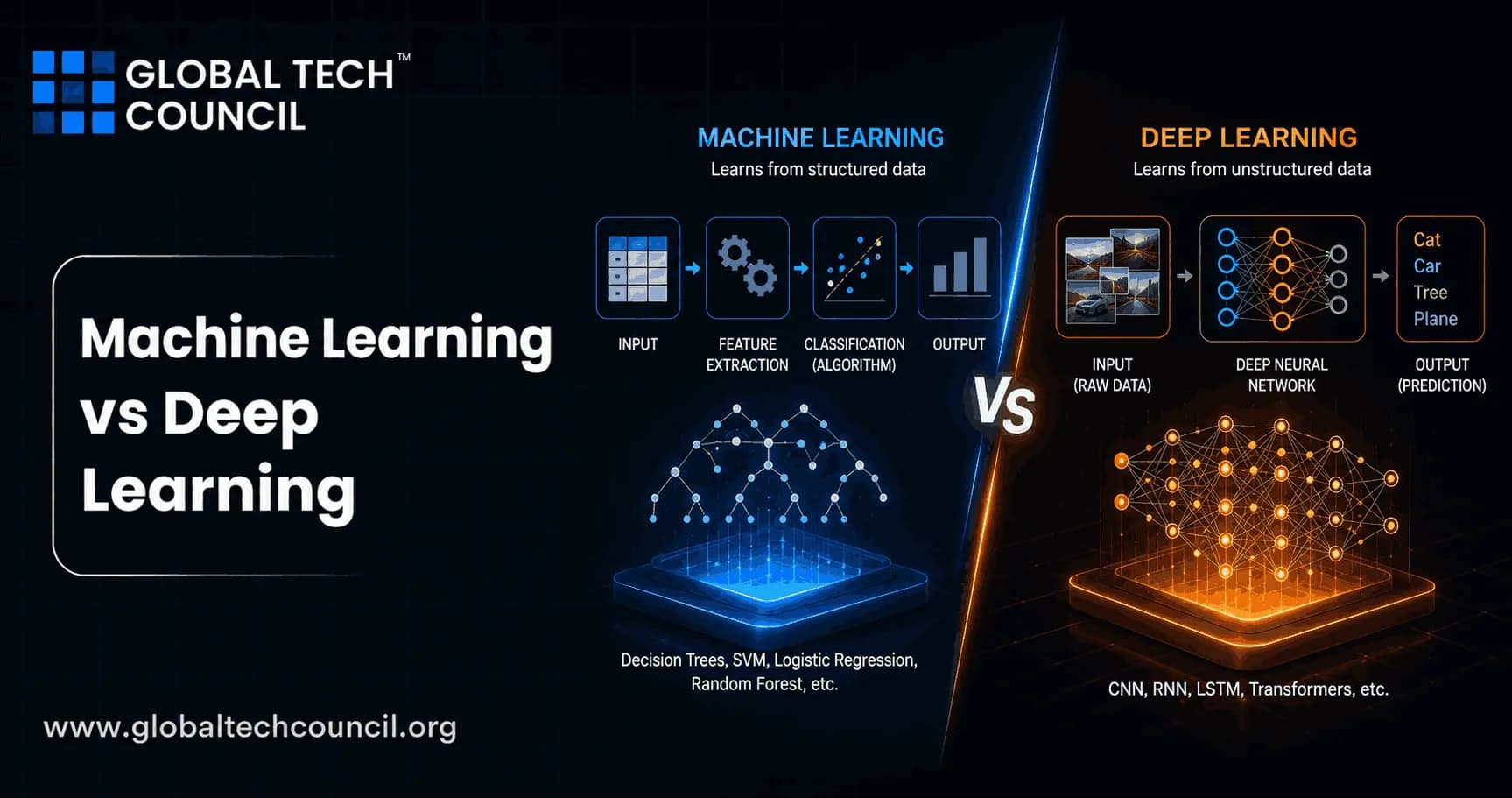
Machine learning vs deep learning is not a contest where one method replaces the other. Deep learning is a subset of machine learning, best suited to large and complex data such as images, audio, and raw text. Traditional machine learning is often the better choice for structured data, smaller datasets, faster delivery, and explainable decisions.
The practical answer is simple. Start with the simplest model that can meet your accuracy, cost, and governance requirements. If a tuned gradient boosting model solves the problem on tabular data, do not jump to a neural network just because it sounds more advanced. If you are classifying radiology images or building speech recognition, deep learning is usually the right tool.

Choosing between traditional machine learning and deep learning requires a solid understanding of model selection, data preparation, evaluation techniques, and deployment considerations. A Certified Machine Learning Expert credential helps professionals build these practical skills, making it easier to identify the right approach for different business and technical challenges.
AI, Machine Learning, and Deep Learning: The Actual Hierarchy
Artificial intelligence is the broader field of building systems that perform tasks associated with human intelligence. Machine learning sits inside AI and focuses on algorithms that learn patterns from data. Deep learning sits inside machine learning and uses multi-layer artificial neural networks.
So all deep learning is machine learning. Not all machine learning is deep learning. This distinction matters when you plan architecture, budget, hiring, and training.
Traditional machine learning includes algorithms such as:
Linear regression and logistic regression
Decision trees and random forests
Gradient boosting methods such as XGBoost, LightGBM, and CatBoost
Support vector machines
Naive Bayes and k-nearest neighbors
Deep learning uses neural network architectures such as convolutional neural networks, recurrent neural networks, transformers, autoencoders, and diffusion models. These models learn layered representations from raw or semi-processed data.
Machine Learning vs Deep Learning: Core Differences
1. Data Requirements
Traditional machine learning can work well with hundreds, thousands, or tens of thousands of examples, especially when the data is structured and the features are meaningful. A churn prediction model with 20,000 customers and 40 well-built features can be perfectly usable.
Deep learning usually needs much more data. For image, speech, and language tasks, thousands of examples may be a starting point, while production-quality models often need hundreds of thousands or millions of labeled samples. Transfer learning can reduce that burden, but it does not remove the need for clean, representative data.
2. Data Type
Use traditional machine learning when your data lives in rows and columns: transactions, customer records, sensor summaries, claims data, pricing tables, time series features, or CRM exports.
Use deep learning when the input is high-dimensional or unstructured. Think medical images, audio clips, surveillance video, raw text, satellite imagery, or logs with complex patterns. This is where neural networks earn their keep.
3. Feature Engineering
Traditional machine learning depends heavily on feature engineering. You might create rolling averages, frequency counts, ratios, lag variables, calendar flags, or text features such as TF-IDF scores.
Deep learning learns many features automatically. A convolutional network can learn edges, textures, shapes, and object parts from pixels. A transformer can learn relationships between words or tokens without you manually defining grammar rules.
That said, automatic feature learning is not magic. Poor labels, data leakage, class imbalance, and weak validation will still ruin the model.
4. Training Time and Compute
Most traditional machine learning models train on CPUs. A random forest or logistic regression model may finish in seconds or minutes. Gradient boosting can take longer, but it is still manageable on standard hardware for many business datasets.
Deep learning often needs GPUs or accelerators because training involves large matrix operations across many layers. You also deal with batch size, learning rate schedules, optimizer settings, mixed precision, checkpointing, and memory limits.
A very ordinary deep learning failure looks like this: RuntimeError: CUDA out of memory. Tried to allocate 256.00 MiB. Beginners often respond by changing the model first. Usually you should reduce batch size, enable gradient accumulation, resize input images, or use mixed precision before redesigning the network.
5. Interpretability
Machine learning models are often easier to explain. Logistic regression coefficients, tree splits, feature importance, partial dependence plots, and SHAP values can help stakeholders understand the drivers behind a prediction.
Deep learning models are harder to inspect. Tools such as saliency maps, Grad-CAM, integrated gradients, and attention visualization help, but they rarely provide the same level of comfort as an interpretable linear or tree-based model.
If you work in credit risk, insurance, healthcare, hiring, or regulated financial services, this point is not academic. The NIST AI Risk Management Framework stresses transparency, accountability, and risk controls. A black box model can create approval friction even when its accuracy is higher.
As organizations increasingly combine predictive analytics with advanced AI applications, professionals benefit from understanding how traditional machine learning and deep learning complement broader artificial intelligence strategies. A Certified AI & Machine Learning Expert credential helps build this broader perspective, enabling practitioners to design AI solutions that balance performance, scalability, and responsible deployment.
When Traditional Machine Learning Is the Better Choice
Choose machine learning first when the problem is structured, explainable, and business-facing.
Fraud detection: Transaction amount, merchant category, device fingerprint, location distance, and account age are strong tabular features.
Customer churn: Usage frequency, support tickets, billing history, plan changes, and engagement scores work well in gradient boosting models.
Credit risk: Regulators and internal review teams often need clear reasoning, not just a high AUC score.
Demand forecasting: Calendar effects, seasonality, promotions, pricing, and lagged sales values are classic machine learning inputs.
Operational classification: Ticket routing, lead scoring, quality checks, and SLA prediction rarely need a deep model at the start.
My blunt recommendation: for tabular enterprise data, benchmark XGBoost or LightGBM before trying a neural network. Tree-based models remain extremely hard to beat on structured datasets. Watch the details though. In XGBoost, max_depth, learning_rate, subsample, and early stopping can quietly change your result more than the algorithm choice itself.
When Deep Learning Is the Better Choice
Use deep learning when the data contains patterns humans cannot easily convert into clean features.
Computer vision: Image classification, object detection, defect inspection, OCR, and medical imaging.
Speech and audio: Speech recognition, speaker identification, wake word detection, and audio event classification.
Natural language processing: Semantic search, summarization, translation, question answering, and large-scale document classification.
Complex recommendation: Ranking systems that combine user behavior, text, images, and contextual signals.
Sensor intelligence: High-frequency IoT streams, vibration analysis, video analytics, and anomaly detection in complex equipment.
Deep learning is also the stronger path when transfer learning is available. Fine-tuning a pretrained ResNet, EfficientNet, or BERT model can outperform a classical baseline when your task is close to the data the model has already seen.
But do not ignore cost. Deep learning adds training time, monitoring complexity, data labeling expense, and infrastructure overhead. If your team cannot maintain the model after deployment, the model is too expensive no matter how impressive the demo looks.
A Practical Decision Framework
Use this checklist before choosing between machine learning and deep learning.
Check the data shape. Rows and columns usually point to traditional machine learning. Images, audio, video, and raw text usually point to deep learning.
Count the labeled examples. Small-to-medium data favors machine learning. Very large datasets make deep learning more realistic.
Define the accuracy target. If a simple model meets the business threshold, stop there.
Assess explainability needs. If a human must justify the decision, prefer interpretable models or add strong explanation tooling.
Estimate compute and maintenance cost. CPU-friendly models are easier to train, deploy, monitor, and retrain.
Build a baseline first. Always. A logistic regression or gradient boosting baseline gives you a performance floor and exposes data issues early.
One small engineering note: library defaults change. In scikit-learn 1.2, OneHotEncoder introduced sparse_output to replace the older sparse parameter. That kind of change can break a training pipeline during an upgrade. Pin versions, record preprocessing steps, and save model metadata with the artifact.
Deploying modern AI solutions also requires expertise in cloud infrastructure, MLOps, distributed computing, automation pipelines, GPU-based workloads, and scalable AI platforms. A Deep Tech Certification helps professionals strengthen these advanced technical capabilities, preparing them to build, deploy, and maintain enterprise-grade machine learning and deep learning systems.
Quick Comparison Table
Scenario | Best Fit | Why |
|---|---|---|
Customer churn prediction | Machine learning | Structured data, explainable features, fast iteration |
Credit risk scoring | Machine learning | Auditability and governance matter |
Medical image analysis | Deep learning | High-dimensional image patterns |
Speech transcription | Deep learning | Audio signals require representation learning |
Large text summarization | Deep learning | Semantic understanding across long documents |
Inventory forecasting | Machine learning | Time series and tabular business signals |
What This Means for Your Career or Team
You should not learn deep learning by skipping machine learning. That shortcut creates weak intuition. Start with supervised learning, model evaluation, bias-variance trade-offs, feature engineering, cross-validation, and deployment basics. Then move into neural networks, backpropagation, CNNs, transformers, GPUs, and model monitoring.
If you are building a structured learning path, Global Tech Council programs such as the Certified Machine Learning Expert™, Certified Artificial Intelligence (AI) Expert™, and Certified Data Scientist™ map to this progression. Machine learning gives you the base. Deep learning extends it for perception and language-heavy systems.
For enterprises, the safest strategy is layered. Build a machine learning baseline, document its performance, then test deep learning only when the data type or accuracy target justifies the added cost. This approach keeps engineering honest and prevents teams from buying complexity they do not need.
Final Recommendation
Use traditional machine learning for structured data, limited datasets, interpretability, and fast deployment. Use deep learning for large-scale unstructured data, complex pattern recognition, and tasks where accuracy gains justify extra compute and governance work.
Your next step: take one real dataset from your domain and build two baselines. Train a logistic regression or gradient boosting model first. Then, only if the data type demands it, test a neural network. Compare accuracy, training cost, explanation quality, and deployment effort. The better approach will become obvious.
Technical expertise delivers the foundation for successful AI implementations, but long-term value also depends on aligning technology with business priorities and customer needs. A Marketing & Business Certification helps professionals develop this broader business perspective, enabling them to connect machine learning and deep learning initiatives with organizational strategy, measurable outcomes, and sustainable growth.
FAQs
1. What is the difference between machine learning and deep learning?
Machine learning is a branch of artificial intelligence that enables computers to learn patterns from data using algorithms such as decision trees, support vector machines, and random forests. Deep learning is a specialized subset of machine learning that uses multi-layer artificial neural networks to learn complex patterns, particularly from large and unstructured datasets like images, audio, and text.
2. How does machine learning work?
Machine learning algorithms analyze historical data to identify relationships between inputs and outputs. After training, the model applies these learned patterns to make predictions or classifications on new data. Many traditional machine learning methods require feature selection or engineering before training.
3. How does deep learning work?
Deep learning uses artificial neural networks with multiple hidden layers to automatically learn hierarchical representations from raw data. Instead of relying heavily on manually engineered features, deep learning models identify increasingly complex patterns during the training process.
4. What types of data are best suited for machine learning?
Traditional machine learning performs well with structured and tabular data, such as financial records, customer databases, sales reports, sensor measurements, and operational metrics. It is often preferred when datasets are moderate in size and features are clearly defined.
5. What types of data are best suited for deep learning?
Deep learning excels with large volumes of unstructured or semi-structured data, including images, videos, speech, natural language, medical scans, and complex sensor data. These models are particularly effective when relationships within the data are difficult to capture through manual feature engineering.
6. What are common machine learning algorithms?
Popular machine learning algorithms include linear regression, logistic regression, decision trees, random forests, support vector machines (SVMs), k-nearest neighbors (KNN), Naive Bayes, gradient boosting methods such as XGBoost, and clustering algorithms like K-Means.
7. What are common deep learning models?
Common deep learning architectures include Artificial Neural Networks (ANNs), Convolutional Neural Networks (CNNs), Recurrent Neural Networks (RNNs), Long Short-Term Memory (LSTM) networks, Transformers, Autoencoders, and Generative Adversarial Networks (GANs).
8. Which approach requires more data?
Deep learning generally requires significantly larger datasets than traditional machine learning to achieve strong performance. Machine learning algorithms often produce good results with smaller datasets, especially when high-quality features are available.
9. Which approach requires more computing power?
Deep learning typically requires greater computational resources, including high-performance GPUs or specialized AI hardware, because of the complexity of neural network training. Many traditional machine learning models can be trained efficiently using standard CPUs and modest computing resources.
10. Which approach is easier to interpret?
Many traditional machine learning models, such as decision trees and linear regression, are generally easier to explain and interpret. Deep learning models are often considered less transparent because their decision-making process involves numerous interconnected neural network parameters.
11. What are the advantages of machine learning?
Machine learning often requires less training data, consumes fewer computing resources, provides faster model development for many tasks, and offers better interpretability for certain algorithms. It is well suited for structured business data and many predictive analytics applications.
12. What are the advantages of deep learning?
Deep learning can automatically learn complex feature representations, achieve state-of-the-art performance in computer vision and natural language processing, handle large-scale unstructured data, and improve performance on tasks involving highly complex patterns.
13. What are the limitations of machine learning?
Traditional machine learning often depends on manual feature engineering, may struggle with highly complex unstructured data, and can reach performance limits on problems involving images, speech, or natural language compared with advanced deep learning models.
14. What are the limitations of deep learning?
Deep learning models typically require substantial training data, greater computational resources, longer training times, specialized expertise, and more complex deployment and maintenance. They may also present challenges related to interpretability, energy consumption, and operational cost.
15. Which industries use machine learning and deep learning?
Both approaches are widely used in healthcare, finance, retail, manufacturing, transportation, cybersecurity, education, telecommunications, agriculture, scientific research, digital marketing, and autonomous systems. The choice depends on the specific business problem, available data, and technical requirements.
16. Can machine learning and deep learning be used together?
Yes. Many organizations combine traditional machine learning and deep learning within the same workflow. For example, deep learning may extract features from images or text, while traditional machine learning models perform downstream classification, forecasting, or decision-making tasks.
17. What trends are shaping machine learning and deep learning in 2025-2026?
Key trends include multimodal AI, foundation models, generative AI, explainable AI, edge AI, federated learning, automated machine learning (AutoML), synthetic data generation, energy-efficient model architectures, and stronger governance for responsible AI deployment.
18. What are best practices for choosing between machine learning and deep learning?
Clearly define the business objective, evaluate the quantity and quality of available data, consider computational resources, assess model interpretability requirements, estimate maintenance costs, compare multiple approaches, and validate results using appropriate evaluation metrics before deployment.
19. How should beginners decide which approach to learn first?
Most beginners benefit from learning traditional machine learning first because it builds a strong understanding of data preprocessing, statistics, model evaluation, and core algorithms. After mastering these fundamentals, learning deep learning becomes more approachable and provides access to advanced AI applications involving vision, language, and generative models.
20. What is the future of machine learning and deep learning?
Machine learning and deep learning are expected to complement rather than replace one another as AI adoption continues to expand across industries. Traditional machine learning will remain highly effective for many structured data problems, while deep learning will continue driving advances in areas such as generative AI, computer vision, robotics, and natural language understanding. Choosing the right tool will increasingly depend on the problem being solved rather than assuming the biggest neural network automatically wins. After all, using deep learning to predict next month's office coffee order is a bit like launching a rocket to cross the street.
Related Articles
View All
Machine Learning
Top Machine Learning Use Cases Across Industries in 2026
Explore the top machine learning use cases across industries in 2026, from predictive maintenance and fraud detection to healthcare AI and CRM automation.

Machine Learning
Generative AI vs Machine Learning: Differences, Overlaps, and Use Cases
Learn how generative AI differs from traditional machine learning, where they overlap, and how to choose the right approach for enterprise AI use cases.

Machine Learning
Deep Learning Fundamentals: Concepts Every ML Beginner Should Know
Learn deep learning fundamentals, including neural networks, backpropagation, loss functions, CNNs, transformers, regularization, deployment, and ethics.
Trending Articles
The Role of Blockchain in Ethical AI Development
How blockchain technology is being used to promote transparency and accountability in artificial intelligence systems.
AWS Career Roadmap
A step-by-step guide to building a successful career in Amazon Web Services cloud computing.
Top 5 DeFi Platforms
Explore the leading decentralized finance platforms and what makes each one unique in the evolving DeFi landscape.