

Gradient Boosting Explained: Building Powerful Ensemble Models
 Suyash Raizada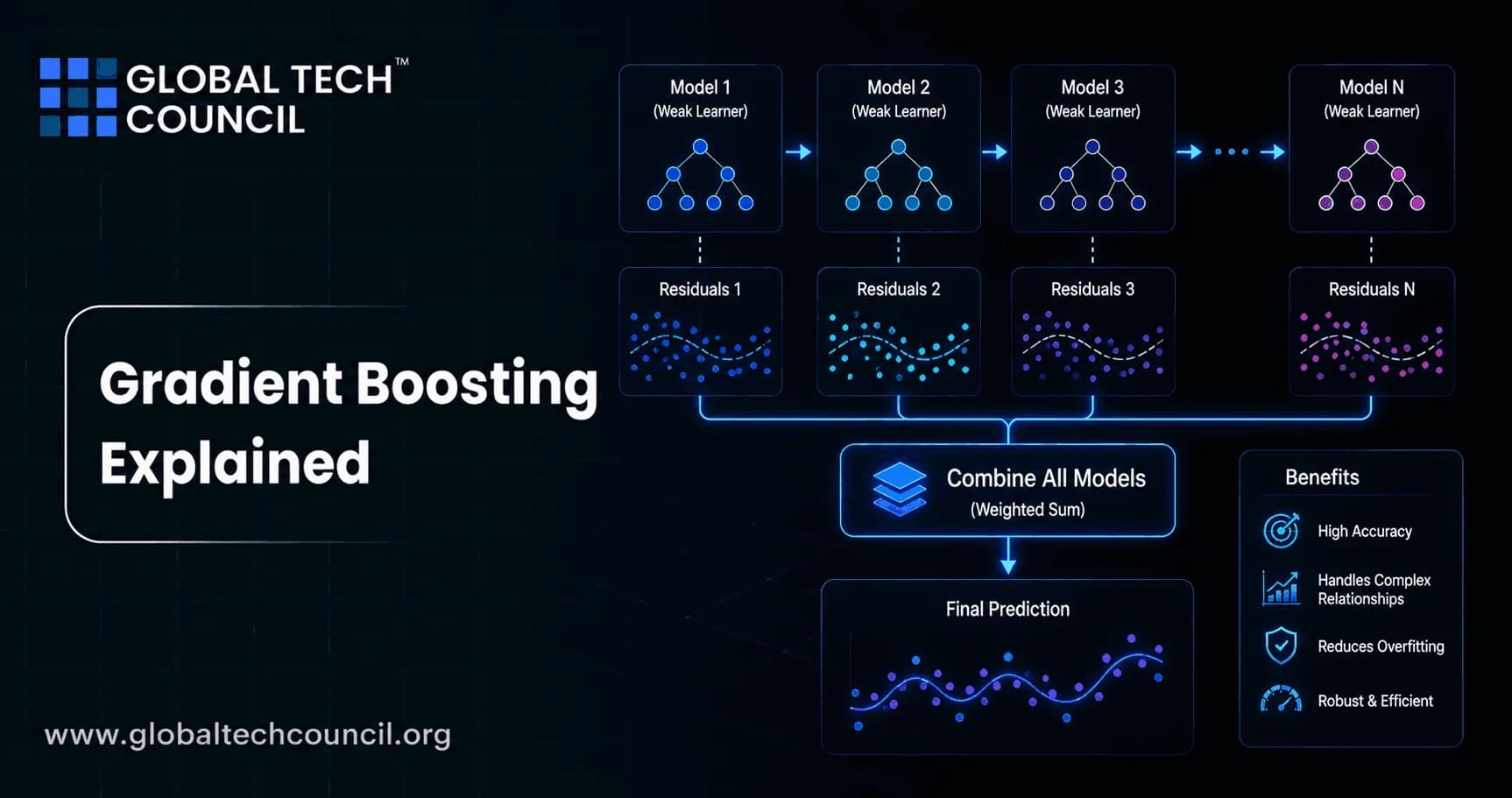
Gradient boosting is one of the most useful techniques you can learn for tabular machine learning. If your data lives in rows and columns, such as loan applications, patient records, transactions, churn data, or pricing tables, gradient boosted decision trees are often the first serious baseline you should train.
The idea is simple. Build many small models in sequence. Each new model focuses on the mistakes made by the current ensemble. Do that carefully, control overfitting, and you get a model that is hard to beat on structured data.

Building expertise in algorithms like gradient boosting starts with understanding the core principles of machine learning. A Certified Machine Learning Expert credential helps professionals strengthen their knowledge of model selection, feature engineering, evaluation techniques, and optimization, making it easier to apply machine learning effectively to real-world structured datasets.
What Is Gradient Boosting?
Gradient boosting is an ensemble learning method. Instead of depending on one decision tree, it combines many weak learners, usually shallow trees, into a stronger model. A weak learner is not useless. It is just limited on its own. A tree with a depth of 3, for example, can capture a few useful splits but will miss many patterns.
Jerome Friedman formalized gradient boosting in his work on gradient boosting machines, where model training is treated as gradient descent in function space. That sounds abstract, but the working process is practical:
Start with a simple prediction, such as the mean target value for regression.
Calculate the current model's errors, or pseudo residuals.
Train a small decision tree to predict those residuals.
Add that tree to the ensemble, scaled by a learning rate.
Repeat until validation performance stops improving or a tree limit is reached.
For squared error regression, this looks very close to fitting trees to residuals. For classification, the model optimizes a differentiable loss function such as log loss. That is where the word gradient matters. Each added tree follows the negative gradient of the loss, nudging predictions in the direction that reduces error.
As gradient boosting continues to play a major role in enterprise analytics, professionals increasingly benefit from understanding how it fits alongside other modern AI techniques. A Certified AI & Machine Learning Expert credential provides broader knowledge of ensemble learning, deep learning, model deployment, and AI workflows, helping practitioners choose the right approach for different business problems.
How Gradient Boosted Decision Trees Work
Most production use of gradient boosting means gradient boosted decision trees, often shortened to GBDT. Decision trees dominate because they handle nonlinear relationships, feature interactions, monotonic patterns, missing values in some implementations, and mixed feature scales without heavy preprocessing.
The Role of the Learning Rate
The learning rate controls how much each new tree changes the model. A value of 0.1 is a common starting point in libraries such as scikit-learn. Lower values, such as 0.03 or 0.01, often improve validation performance, but you need more trees.
This is a quiet setting that trips up many beginners. On a churn dataset, increasing tree depth from 3 to 8 may make training AUC look great while validation AUC drops. The model has started memorizing noise. I usually reduce the learning rate before making trees deeper. Boring advice, yes. It works.
Sequential Learning, Not Independent Voting
Gradient boosting is different from a random forest. A random forest trains many trees independently using bagging and random feature selection, then averages their predictions or votes. Gradient boosting trains trees sequentially. Tree 57 depends on what trees 1 through 56 already missed.
This is why gradient boosting can be more accurate than random forests on many structured datasets. It is also why it is more sensitive. Bad hyperparameters, label leakage, or noisy targets can hurt quickly.
Popular Gradient Boosting Libraries
Modern machine learning teams rarely implement gradient boosting from scratch. They use optimized libraries that add regularization, sparse data handling, parallel training, categorical feature support, and GPU options.
scikit-learn: Good for learning and solid baselines. Its GradientBoostingClassifier, GradientBoostingRegressor, and histogram-based gradient boosting estimators are documented as strong choices for structured classification and regression tasks.
XGBoost: Introduced by Tianqi Chen and Carlos Guestrin, XGBoost became a standard in machine learning competitions and enterprise workflows because of regularization, sparse-aware split finding, and efficient tree construction.
LightGBM: Built by Microsoft, LightGBM uses techniques such as gradient-based one-side sampling and exclusive feature bundling to train quickly on large datasets.
CatBoost: Developed by Yandex, CatBoost is often the best first choice when your dataset has many categorical variables. Its ordered boosting approach helps reduce target leakage from categorical encoding.
If you are learning for applied work, start with scikit-learn to understand the mechanics. Then train the same dataset with XGBoost, LightGBM, and CatBoost. You will learn more from comparing validation curves than from memorizing parameter names.
Where Gradient Boosting Performs Best
Gradient boosting is strongest on structured data. That includes spreadsheets, database tables, CRM exports, claims records, risk tables, sensor aggregates, and transaction histories.
Common Use Cases
Credit risk: Predicting default probability, creditworthiness, and portfolio risk from borrower, account, and payment features.
Fraud detection: Classifying suspicious transactions using merchant, device, velocity, geolocation, and account behavior features.
Healthcare analytics: Supporting risk stratification, readmission prediction, and disease progression modeling from clinical variables.
Marketing analytics: Predicting churn, response likelihood, customer lifetime value, and next-best action.
Operations forecasting: Estimating demand, delivery delays, inventory risk, and service workload from time-aggregated business data.
For image, audio, and large language tasks, deep learning is usually the better primary tool. For tabular business data, gradient boosting still earns its place. To be blunt, replacing a well-tuned LightGBM model with a neural network on a 100,000-row customer table often adds complexity without better results.
Key Hyperparameters You Must Understand
You do not need to tune every setting on day one. Focus on the parameters that change model behavior the most.
Number of trees: More trees reduce bias, but too many can overfit unless early stopping is used.
Learning rate: Smaller values train more cautiously. Pair them with more trees.
Maximum depth or number of leaves: Controls how complex each tree can be. Shallow trees generalize better on smaller datasets.
Subsampling: Training each tree on a fraction of rows can reduce variance.
Column sampling: Using a fraction of features per tree can improve generalization and speed.
L1 and L2 regularization: Common in XGBoost and LightGBM, these penalties reduce overly complex tree weights.
Early stopping: Stop training when validation loss no longer improves. Use it whenever you can.
Here is a practical rule: build a validation set before tuning. Never tune on the test set. In regulated settings such as lending or healthcare, keep a time-based holdout if the model will be used on future data. Random splits can make performance look cleaner than production reality.
Gradient Boosting vs Random Forest
Both methods use many trees, but they solve different problems.
Use random forest when you need a stable baseline fast, have noisy labels, or want fewer tuning decisions.
Use gradient boosting when accuracy matters, your validation process is sound, and you can spend time tuning.
Avoid gradient boosting as a blind default when the dataset is tiny, labels are unreliable, or the organization cannot support model monitoring.
Random forests are forgiving. Gradient boosting is sharper. That sharpness is useful, but it can cut you if you ignore validation leakage or push tree complexity too far.
Interpretability and Governance
Gradient boosting models are easier to inspect than many deep neural networks, but they are not transparent in the way a single decision tree is. A model with 800 trees is not something a risk officer can read line by line.
Use explanation tools:
Feature importance for a rough ranking of influential variables.
Partial dependence plots to inspect average feature effects.
SHAP values to explain individual predictions and global patterns.
Model cards to document training data, metrics, limitations, and intended use.
In finance, healthcare, and insurance, explanation is not optional. Monitor drift. Track calibration. Keep training data snapshots. If a model changes a credit decision or clinical workflow, you need more than a high AUC score.
Deploying gradient boosting models in enterprise environments also requires expertise in cloud infrastructure, software engineering, cybersecurity, and scalable AI systems. A Deep Tech Certification helps professionals build these advanced technical capabilities, enabling them to implement secure, reliable, and production-ready machine learning solutions across modern technology platforms.
How to Learn Gradient Boosting the Right Way
Do not begin by chasing leaderboard tricks. Build the basics first:
Train a decision tree and inspect where it fails.
Train a random forest and compare stability.
Train gradient boosting with shallow trees.
Add early stopping and tune learning rate.
Compare XGBoost, LightGBM, and CatBoost on the same validation split.
Explain predictions with SHAP and check whether the results make domain sense.
If you are building a professional learning path, pair hands-on practice with structured study through Global Tech Council's machine learning, artificial intelligence, and data science certification programs. These are natural next steps for learners who want to move from model training to production-ready machine learning practice.
The Future of Gradient Boosting
Gradient boosting is mature, but it is not standing still. Distributed training, GPU acceleration, automated machine learning, and better categorical handling continue to make these models faster and easier to apply. Cloud platforms and data warehouses now include gradient boosted trees in managed machine learning workflows, which tells you something: enterprises still trust them.
The next useful skill is not memorizing another parameter. Build a clean tabular project. Use a real validation split, train CatBoost or LightGBM, explain the model, and write down where it fails. Then deepen your foundation with a machine learning or data science certification from Global Tech Council so you can connect gradient boosting to deployment, governance, and business decision-making.
Delivering successful machine learning projects also requires the ability to communicate technical findings and align AI initiatives with organizational priorities. A Marketing & Business Certification helps professionals strengthen these business and communication skills, making it easier to present model outcomes, demonstrate business value, and support informed strategic decision-making.
Building Technology Skills Through Competitions
Technology learning can also begin at an early stage through structured academic competitions. The World Tech Olympiad (WTO) is a global technology competition for students from Class 2 to Class 12, offering age-appropriate tracks in areas such as Robotics, Artificial Intelligence, Coding, Computational Thinking, and Cybersecurity.
The Robotics track gives students an opportunity to explore how machines work, how programmed instructions control robotic systems, and how technology can be used to solve real-world problems. Through structured learning and competition, students can develop practical technology awareness along with problem-solving, logical-thinking, and computational skills.
The World Tech Olympiad provides both individual and institutional participation pathways. Parents can directly enroll their children, while schools can register their institution and bring eligible students into the competition. This makes the Robotics Olympiad a practical way for schools and families to introduce students to emerging technologies and encourage early interest in technology-driven learning.
FAQs
1. What is gradient boosting in machine learning?
Gradient boosting is an ensemble machine learning technique that builds a series of decision trees sequentially, with each new tree learning to correct the prediction errors of the previous trees. By combining many relatively simple models, gradient boosting can produce highly accurate predictions for both classification and regression tasks.
2. Why is gradient boosting important?
Gradient boosting is widely used because it often delivers excellent predictive performance on structured and tabular datasets. It is capable of modeling complex nonlinear relationships, handling diverse data types, and achieving strong results across many real-world business and scientific applications.
3. How does gradient boosting work?
Gradient boosting starts with an initial prediction and iteratively trains new decision trees to reduce the residual errors made by earlier trees. Each tree contributes a small improvement, and the final prediction is the combined output of all trees in the ensemble.
4. What does the term "gradient" mean in gradient boosting?
The term "gradient" refers to the optimization process used to minimize a chosen loss function. At each iteration, the algorithm estimates the direction in which prediction errors decrease most rapidly and builds a new tree to move the model toward lower overall error.
5. What are ensemble learning methods?
Ensemble learning combines multiple machine learning models to improve predictive performance compared with using a single model. Common ensemble approaches include bagging, boosting, and stacking, each using different strategies to combine individual learners.
6. What is the difference between boosting and bagging?
Bagging trains multiple models independently and combines their predictions to reduce variance, as seen in Random Forests. Boosting trains models sequentially, with each model correcting previous mistakes, primarily reducing bias while also improving overall predictive accuracy.
7. What types of problems can gradient boosting solve?
Gradient boosting supports regression, binary classification, multiclass classification, ranking, anomaly detection, and certain forecasting workflows. It is especially effective for structured datasets found in finance, healthcare, retail, insurance, manufacturing, and marketing.
8. What are weak learners in gradient boosting?
Weak learners are simple models, usually shallow decision trees, that perform only slightly better than random guessing individually. When combined through boosting, these weak learners collectively produce a powerful predictive model.
9. What is the learning rate in gradient boosting?
The learning rate controls how much each newly added tree contributes to the overall model. Lower learning rates often improve generalization but typically require more boosting iterations to achieve strong performance.
10. What is overfitting in gradient boosting?
Overfitting occurs when the model learns noise and random fluctuations in the training data rather than meaningful patterns. Limiting tree depth, applying regularization, using early stopping, and tuning hyperparameters can help reduce overfitting.
11. What are the main hyperparameters of gradient boosting?
Important hyperparameters include the number of trees, learning rate, maximum tree depth, minimum samples per leaf, subsampling ratio, column sampling ratio, and regularization settings. Proper tuning can substantially improve model performance.
12. What are popular gradient boosting libraries?
Widely used implementations include XGBoost, LightGBM, CatBoost, Scikit-learn's Gradient Boosting models, and HistGradientBoosting. Each library offers different optimizations for speed, scalability, categorical features, and memory efficiency.
13. How does gradient boosting compare with Random Forest?
Random Forest builds many independent decision trees using bagging and random feature selection, while gradient boosting builds trees sequentially to reduce prediction errors. Gradient boosting often achieves higher predictive accuracy on structured data but generally requires more careful hyperparameter tuning.
14. What industries commonly use gradient boosting?
Gradient boosting is widely used in banking, insurance, healthcare, cybersecurity, telecommunications, retail, manufacturing, logistics, digital marketing, and scientific research. Common applications include fraud detection, credit scoring, customer churn prediction, demand forecasting, predictive maintenance, and risk assessment.
15. What tools support gradient boosting development?
Popular tools include Python libraries such as Scikit-learn, XGBoost, LightGBM, CatBoost, Pandas, NumPy, SHAP, Optuna, Hyperopt, MLflow, and cloud-based machine learning platforms for scalable training and deployment.
16. What mistakes should beginners avoid?
Common mistakes include using default hyperparameters without evaluation, neglecting feature engineering, introducing data leakage, failing to use cross-validation, ignoring class imbalance, overtraining models, and evaluating performance using only the training dataset.
17. What are best practices for gradient boosting?
Best practices include preparing high-quality data, applying appropriate preprocessing, performing systematic hyperparameter tuning, using cross-validation, monitoring validation performance, preventing overfitting with regularization and early stopping, and documenting experiments for reproducibility.
18. How does gradient boosting fit into MLOps?
Gradient boosting models integrate well with MLOps workflows through automated training pipelines, experiment tracking, model versioning, deployment automation, monitoring, and scheduled retraining. These practices improve reproducibility and simplify production model management.
19. What trends are shaping gradient boosting in 2025-2026?
Key trends include GPU-accelerated training, distributed computing, AutoML integration, explainable AI with feature attribution methods, cloud-native deployment, feature stores, hybrid workflows combining tabular models with foundation models, and stronger governance for enterprise AI systems.
20. What is the future of gradient boosting?
Gradient boosting is expected to remain one of the leading approaches for structured machine learning problems because of its balance of accuracy, flexibility, and efficiency. Although deep learning continues to dominate many unstructured data applications, gradient boosting remains highly competitive for tabular data and is likely to evolve alongside modern MLOps, explainable AI, and automated machine learning platforms. Sometimes a collection of small, steadily improving trees quietly outperforms far more glamorous models, which is an awkward truth for anyone hoping complexity automatically wins.
Related Articles
View All
Machine Learning
MLOps Explained: Practices for Managing ML Models at Scale
MLOps explained for professionals managing ML models at scale, covering pipelines, versioning, testing, monitoring, governance, and future trends.
Machine Learning
Model Training Explained: How Machine Learning Models Learn
Model training explained with the learning loop, loss functions, backpropagation, gradient descent, mini-batches, validation, and practical debugging tips.

Machine Learning
Feature Selection Explained: Choosing the Right Inputs for ML Models
Feature selection helps ML models use the right inputs, reduce noise, improve speed, and support explainability without leaking test data.
Trending Articles
The Role of Blockchain in Ethical AI Development
How blockchain technology is being used to promote transparency and accountability in artificial intelligence systems.
AWS Career Roadmap
A step-by-step guide to building a successful career in Amazon Web Services cloud computing.
Top 5 DeFi Platforms
Explore the leading decentralized finance platforms and what makes each one unique in the evolving DeFi landscape.