

Self-Supervised Learning Explained: The Foundation of Modern AI Models
 Suyash Raizada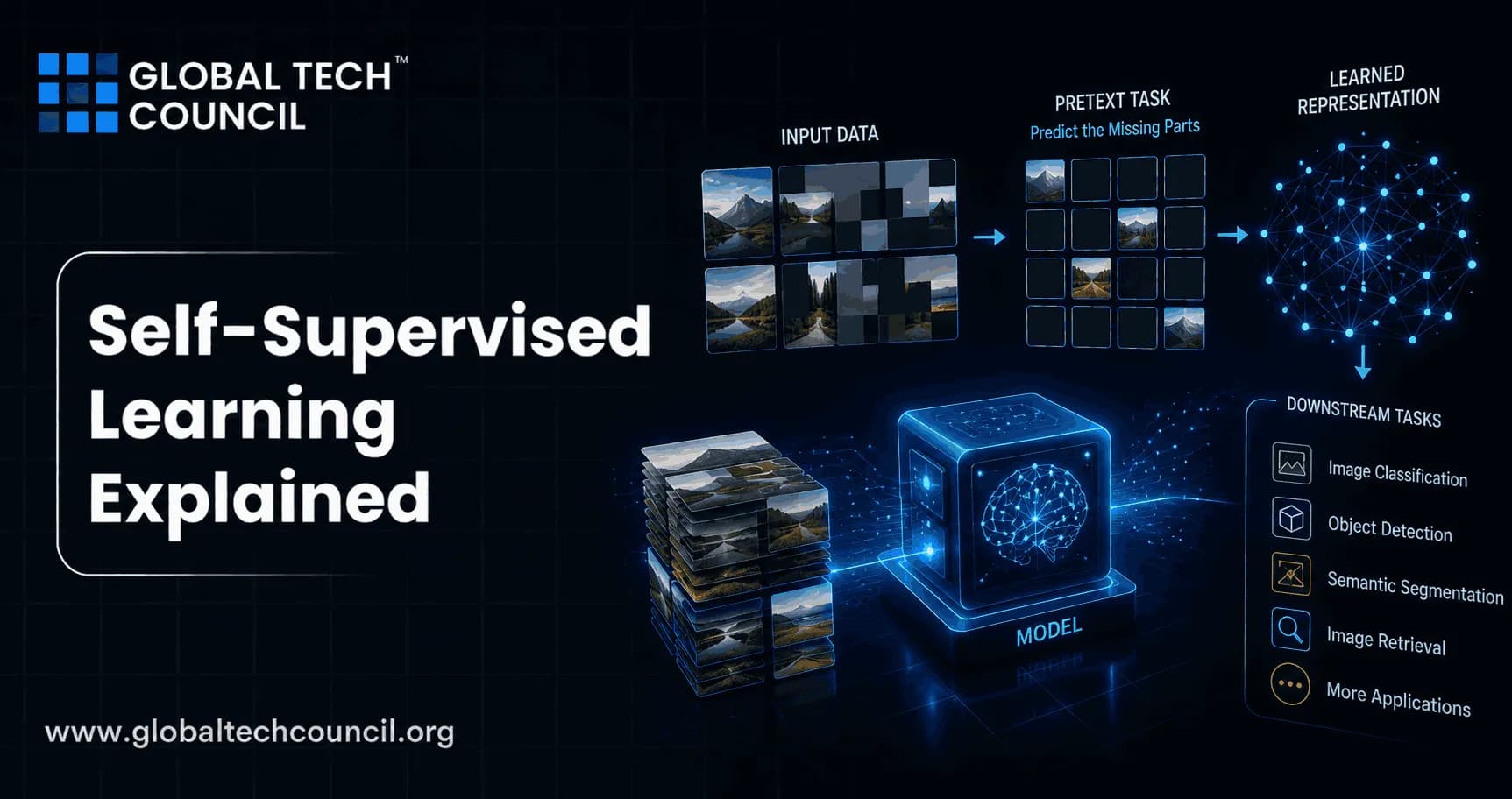
Self-supervised learning is the training pattern behind many modern AI models, from BERT-style search systems to GPT-style assistants and wav2vec 2.0 speech recognition. The short version: instead of waiting for humans to label every sentence, image, or audio clip, the model builds a training signal from the raw data itself.
That sounds simple. It is not. The design of the pretext task, the data pipeline, and the fine-tuning strategy can decide whether you get a useful foundation model or an expensive pile of embeddings. If you work in machine learning, data science, NLP, computer vision, or enterprise AI planning, self-supervised learning is now core knowledge.

As self-supervised learning becomes a core component of modern AI systems, professionals benefit from building a strong foundation in machine learning concepts, model training, evaluation, and deployment. A Certified Machine Learning Expert credential helps develop these practical skills, making it easier to understand and implement advanced learning techniques across real-world applications.
What Is Self-Supervised Learning?
Self-supervised learning, often shortened to SSL, is a machine learning approach where the model learns from unlabeled data by generating its own labels. No person writes the label. It comes from the input itself.
For example, take this sentence:
The model predicts the missing word from context.
Hide the word missing, and the model can learn by trying to reconstruct it. The original sentence supplies the answer. That is the core trick.
SSL sits between supervised and unsupervised learning. It uses unlabeled data, but the training objective looks supervised because there is still a target to predict. The target is just created automatically.
Common Self-Supervised Learning Objectives
Masked language modeling: Hide tokens and train the model to predict them. BERT and T5 use this family of objectives.
Next token prediction: Predict the next token from previous tokens. GPT-style generative models use this objective at large scale.
Contrastive learning: Pull two transformed views of the same sample closer in embedding space, while pushing unrelated samples apart. SimCLR and MoCo are well-known examples in vision.
Reconstruction: Corrupt part of the input and train the model to rebuild it, as seen in autoencoders and related generative methods.
Distillation-style SSL: Train one network view to match another without explicit negative samples, used in methods such as BYOL and DINO.
A practical detail many beginners miss: BERT does not mask every word. In the original BERT setup, 15 percent of tokens are selected for prediction. Of those selected tokens, 80 percent are replaced with [MASK], 10 percent with a random token, and 10 percent are left unchanged. That odd-looking 80-10-10 split reduces the mismatch between pretraining and real inference, where [MASK] tokens never appear.
Why Self-Supervised Learning Became the Default for Foundation Models
Labeled data is expensive. Unlabeled data is everywhere.
That economic fact explains much of modern AI. A company may have millions of support tickets, product images, call recordings, or log messages. It rarely has high-quality labels for all of them. Self-supervised learning lets you train useful representations before spending money on task-specific annotation.
IBM describes SSL as a key technique for training complex deep learning systems, including large language models, image models, and vision encoders. Stanford HAI has framed the idea as models making their own puzzles from raw data and learning by solving them. That framing is accurate: SSL turns data into a puzzle factory.
As organizations increasingly adopt foundation models and enterprise AI solutions, professionals need a broader understanding of how self-supervised learning integrates with deep learning, natural language processing, computer vision, and intelligent automation. A Certified AI & Machine Learning Expert credential helps build this comprehensive perspective, enabling practitioners to design AI solutions that are both technically effective and aligned with real-world business needs.
After pretraining, you can adapt the model to downstream tasks such as:
Text classification
Question answering
Information extraction
Image classification
Object detection
Medical image segmentation
Speech recognition
Anomaly detection
This is the "pretrain once, adapt many times" pattern. It is not magic. Fine-tuning still needs careful validation, clean labels, and domain knowledge. But it is usually a better starting point than training from scratch.
How Self-Supervised Learning Powers Language Models
Large language models are the clearest example of self-supervised learning at scale.
BERT uses masked language modeling to learn bidirectional context. That made it valuable for search, classification, entity extraction, and other NLP tasks where understanding the whole sentence matters.
GPT-style models use next token prediction. Given a prefix, the model predicts the next token, then the next, and so on. The objective is simple, but trained on massive text corpora with transformer architectures, it produces surprisingly flexible behavior: summarization, translation, coding assistance, question answering, and dialogue.
There is a catch. Next token prediction teaches statistical continuation, not truthfulness. This is why instruction tuning, preference optimization, reinforcement learning from human feedback, retrieval-augmented generation, and evaluation pipelines matter. If you are building enterprise AI, do not confuse fluent output with verified output.
Self-Supervised Learning in Computer Vision
In vision, self-supervised learning often focuses on representation learning. The goal is to train an image encoder that understands useful visual structure without needing labeled images.
Contrastive methods such as SimCLR create two augmented views of the same image. One view might be cropped, color-jittered, and blurred. The model learns that both views belong together. At the same time, it learns to separate views that come from different images.
MoCo introduced a memory queue to handle many negative examples efficiently. BYOL and DINO showed that strong representations can also be learned without the classic negative-pair setup, using teacher-student style training.
Here is the trade-off. Contrastive SSL can work very well, but it is sensitive to augmentations. In medical imaging, an aggressive crop may remove the pathology you are trying to learn. In satellite imagery, color jitter can distort information tied to land cover or sensor characteristics. Use domain-aware augmentations. Do not copy an ImageNet recipe blindly.
Speech and Audio: Why wav2vec 2.0 Matters
Speech annotation is painfully expensive because transcription takes time and expertise. Self-supervised learning changed that equation.
Meta AI's wav2vec 2.0 learns speech representations from raw audio, then fine-tunes on smaller labeled transcription sets. The wav2vec 2.0 research reported a word error rate of 4.8 percent using only 10 minutes of labeled audio in a low-resource setup, after self-supervised pretraining on much larger unlabeled speech data.
That number is why SSL matters in the real world. It shows that unlabeled data can reduce dependence on scarce labels, especially in low-resource languages, call-center audio, and specialized vocabulary domains.
What a Real SSL Pipeline Looks Like
A typical self-supervised learning workflow has four stages:
Collect unlabeled data: Text, images, audio, video, logs, or sensor streams. Quality matters more than people admit.
Choose a pretext task: Mask tokens, predict the next token, contrast views, reconstruct missing patches, or combine objectives.
Pretrain the model: Train at scale, and watch for collapse, loss stability, representation quality, and compute cost.
Fine-tune or adapt: Use labeled data, prompting, adapters, LoRA, or task-specific heads depending on the model and use case.
One practitioner warning: SSL training can fail quietly. In contrastive learning, a bad batch sampler or weak augmentations may produce embeddings that look numerically stable but perform poorly downstream. In PyTorch, you may not see a dramatic error. You will just get a classifier that refuses to improve. In transformer pretraining, the classic ugly failure is simpler: RuntimeError: CUDA out of memory. Long sequences, large batch sizes, and AdamW optimizer states eat GPU memory fast. Gradient accumulation is often the first fix, not a bigger model.
Benefits for Practitioners and Enterprises
Lower labeling cost: Use raw data first, then label only the examples needed for fine-tuning and evaluation.
Better low-label performance: SSL often beats training from scratch when labels are scarce.
Reusable models: One pretrained encoder can support several downstream teams.
Domain adaptation: You can adapt models to legal documents, medical images, industrial audio, or internal logs.
Faster experimentation: Fine-tuning a pretrained model is usually quicker than starting with random weights.
My view: if you have fewer than a few thousand labeled examples and plenty of unlabeled domain data, SSL should be on your shortlist. If you have a small, clean labeled dataset and no meaningful unlabeled pool, a supervised baseline may be cheaper and easier to defend.
Successfully deploying self-supervised learning models also requires expertise in cloud infrastructure, MLOps, distributed computing, GPU optimization, and scalable AI platforms. A Deep Tech Certification helps professionals strengthen these advanced technical capabilities, preparing them to build, deploy, and manage enterprise-grade AI systems efficiently.
Risks and Governance Concerns
Self-supervised learning does not remove governance work. In some ways, it raises the stakes, because it encourages training on very large raw datasets.
Key risks to manage
Data provenance: Know where training data came from and whether it can be used for model training.
Privacy: Raw text, audio, and logs may contain personal or sensitive information.
Bias: SSL models learn patterns in data, including social bias, historical imbalance, and noisy correlations.
Downstream misuse: A general pretrained model can be reused in settings far from the original intent.
Evaluation gaps: Good benchmark scores do not guarantee safety in production.
For regulated industries, document dataset sources, filtering rules, model cards, fine-tuning data, and evaluation results. This is not paperwork for its own sake. It is how you keep foundation model projects auditable.
Where Self-Supervised Learning Is Going
The next phase is multimodal. Models are being trained across text, images, audio, video, and structured signals. Labels are even harder to obtain in these mixed settings, so SSL will stay central.
Expect more hybrid objectives too. Contrastive learning, masked modeling, clustering, distillation, and generative training are already being combined. The goal is not just better benchmark performance. It is better transfer, stability, and domain adaptation.
For working professionals, this creates a clear learning path. Start with core machine learning, then study transformers, representation learning, PyTorch or TensorFlow training loops, and model evaluation. Global Tech Council's AI, machine learning, and data science certifications can support that progression, especially when paired with hands-on projects such as fine-tuning BERT or training a small contrastive image encoder.
How to Start Learning Self-Supervised Learning
Do not begin with a billion-parameter model. Build something small and inspect it.
Fine-tune a pretrained BERT model on a text classification dataset.
Train a small SimCLR-style encoder on CIFAR-10 and compare it with a supervised baseline.
Experiment with masking ratios, batch size, temperature, and augmentations.
Track downstream accuracy, not only pretraining loss.
Write a short model card covering data, objective, limitations, and intended use.
If you want a practical next step, take one unlabeled dataset from your own domain and design a pretext task for it. Then test whether the learned representation improves a real downstream task. That experiment will teach you more about self-supervised learning than another slide deck.
Technical expertise is essential for developing advanced AI solutions, but organizations also need professionals who understand how these technologies create business value. A Marketing & Business Certification helps build this strategic perspective, enabling practitioners to connect AI initiatives with customer needs, organizational objectives, and long-term business growth.
FAQs
1. What is self-supervised learning?
Self-supervised learning is a machine learning approach in which models learn from unlabeled data by creating their own training tasks. Instead of relying on manually labeled datasets, the model predicts hidden or missing parts of the data, enabling it to learn meaningful representations that can later be adapted for various downstream tasks.
2. How does self-supervised learning work?
Self-supervised learning generates supervisory signals directly from the input data. For example, a language model may predict missing words in a sentence, while a vision model may reconstruct masked portions of an image. Through these prediction tasks, the model learns patterns, relationships, and contextual information.
3. How is self-supervised learning different from supervised learning?
Supervised learning requires labeled datasets with known target outputs, whereas self-supervised learning uses unlabeled data and automatically generates learning objectives. This significantly reduces the need for expensive and time-consuming manual data annotation.
4. How is self-supervised learning different from unsupervised learning?
Unsupervised learning focuses on discovering hidden structures, clusters, or relationships in unlabeled data without predefined targets. Self-supervised learning creates prediction tasks from the data itself, allowing models to learn rich feature representations that can later support supervised or other machine learning tasks.
5. Why has self-supervised learning become so important?
Self-supervised learning enables organizations to leverage enormous volumes of unlabeled data that would otherwise be impractical to annotate manually. This approach has become a key driver behind advances in large language models, computer vision, speech recognition, and multimodal AI systems.
6. What are common examples of self-supervised learning tasks?
Common tasks include masked language modeling, next-token prediction, image masking, image reconstruction, contrastive learning, sentence ordering, audio reconstruction, and predicting missing segments of time-series data. These tasks help models learn meaningful representations without requiring human-generated labels.
7. What is masked language modeling?
Masked language modeling is a self-supervised learning technique in which selected words or tokens are hidden from the model during training. The model learns contextual relationships by predicting the missing tokens based on the surrounding text.
8. What is next-token prediction?
Next-token prediction trains a model to predict the next word, token, or symbol in a sequence based on the preceding context. This approach is widely used in modern generative AI systems and large language models for text generation and language understanding.
9. What is contrastive learning?
Contrastive learning teaches models to recognize similarities and differences between data samples. During training, related examples are encouraged to have similar representations, while unrelated examples are separated, improving feature learning for applications such as computer vision and recommendation systems.
10. What industries use self-supervised learning?
Self-supervised learning is used in healthcare, finance, autonomous vehicles, cybersecurity, retail, manufacturing, telecommunications, robotics, education, scientific research, and digital marketing. Its ability to learn from large amounts of unlabeled data makes it valuable across many industries.
11. What are common real-world applications?
Applications include large language models, conversational AI, image recognition, document understanding, speech recognition, recommendation systems, autonomous driving, medical imaging, anomaly detection, search engines, and multimodal AI systems that combine text, images, audio, and video.
12. What are the advantages of self-supervised learning?
Self-supervised learning reduces dependence on labeled datasets, improves scalability, enables better feature extraction, supports transfer learning, and often improves performance on downstream machine learning tasks. It also allows organizations to make greater use of existing unlabeled data.
13. What are the limitations of self-supervised learning?
Training self-supervised models can require extensive computational resources, large datasets, specialized hardware, and significant engineering effort. Performance also depends on the quality of the training objective and the diversity of the available data.
14. How does self-supervised learning support foundation models?
Many modern foundation models are initially trained using self-supervised learning on vast datasets. This pretraining allows models to develop broad knowledge and general-purpose representations that can later be fine-tuned or adapted for specialized tasks with relatively smaller labeled datasets.
15. What is transfer learning in self-supervised models?
Transfer learning allows pretrained self-supervised models to be adapted for specific applications such as sentiment analysis, medical diagnosis support, document classification, or object detection. Fine-tuning generally requires fewer labeled examples than training a model entirely from scratch.
16. What challenges do self-supervised learning projects face?
Common challenges include high computational costs, data quality issues, model interpretability, bias in training data, privacy concerns, energy consumption, selecting effective pretraining objectives, and ensuring reliable performance across different domains and real-world conditions.
17. What trends are shaping self-supervised learning in 2025-2026?
Major trends include multimodal foundation models, generative AI, efficient pretraining techniques, synthetic data generation, edge AI, responsible AI, explainable AI, retrieval-augmented systems, energy-efficient model architectures, and privacy-enhancing machine learning methods.
18. What are best practices for implementing self-supervised learning?
Best practices include using diverse and representative datasets, selecting appropriate pretraining objectives, validating downstream performance carefully, monitoring for bias and fairness, documenting model development, optimizing computational efficiency, protecting sensitive data, and retraining models when necessary.
19. What should beginners know before learning self-supervised learning?
Beginners should first understand supervised learning, unsupervised learning, deep learning, neural networks, and transformer architectures before studying self-supervised techniques. Familiarity with Python, linear algebra, probability, and machine learning frameworks such as PyTorch or TensorFlow provides a strong foundation for exploring this rapidly evolving area.
20. What is the future of self-supervised learning?
Self-supervised learning is expected to remain a foundational technology for modern AI as organizations continue generating massive amounts of unlabeled data. Future research will likely focus on more efficient training methods, stronger multimodal capabilities, improved reasoning, better model transparency, and responsible AI deployment across industries. The less time humans spend labeling billions of examples, the more time they have for inventing entirely new datasets that computers will inevitably want to learn from.
Related Articles
View All
Machine Learning
Model Training Explained: How Machine Learning Models Learn
Model training explained with the learning loop, loss functions, backpropagation, gradient descent, mini-batches, validation, and practical debugging tips.

Machine Learning
Semi-Supervised Learning Explained: Training Models with Limited Labeled Data
Semi-supervised learning uses limited labeled data plus larger unlabeled datasets to train accurate models while reducing annotation effort.

Machine Learning
Explainable AI (XAI): Making Machine Learning Models Transparent and Trustworthy
Explainable AI makes model decisions clear enough to trust, audit, challenge, and improve, especially in regulated and high-risk machine learning systems.
Trending Articles
The Role of Blockchain in Ethical AI Development
How blockchain technology is being used to promote transparency and accountability in artificial intelligence systems.
AWS Career Roadmap
A step-by-step guide to building a successful career in Amazon Web Services cloud computing.
Top 5 DeFi Platforms
Explore the leading decentralized finance platforms and what makes each one unique in the evolving DeFi landscape.