

Machine Learning Pipeline Explained: Building Scalable ML Workflows
 Suyash Raizada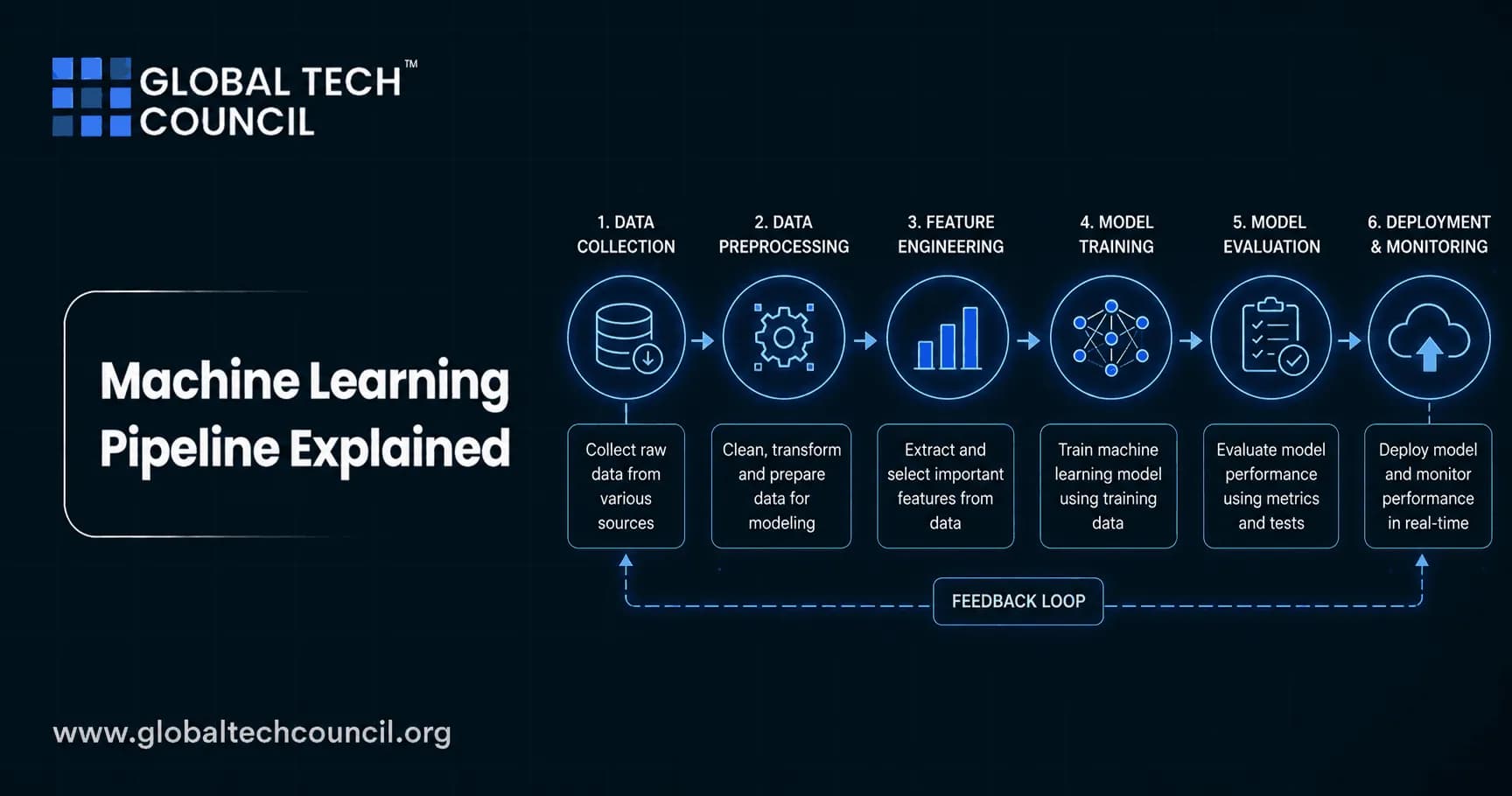
A machine learning pipeline turns raw data into repeatable predictions through a set of automated steps: ingestion, preprocessing, feature engineering, training, evaluation, deployment, and monitoring. That sounds tidy. In practice, the value is not the diagram. The value is that you can retrain a model at 2 a.m., reproduce last month's result, block a bad release, and explain which data produced which model.
If your ML work still depends on notebooks copied between folders, you do not have an ML system yet. You have experiments. Useful, but fragile.

Building reliable machine learning pipelines requires a solid understanding of data preparation, model training, validation, and deployment. A Certified Machine Learning Expert credential helps professionals develop these practical skills, providing the foundation needed to design repeatable, scalable, and production-ready machine learning workflows.
What Is a Machine Learning Pipeline?
A machine learning pipeline is a structured workflow that breaks the ML lifecycle into discrete, testable, reusable stages. Each stage takes defined inputs, creates defined outputs, and passes artifacts to the next step. Those artifacts may include cleaned datasets, feature tables, model binaries, metrics files, Docker images, or deployment manifests.
Microsoft Azure Machine Learning and Google Cloud Vertex AI both treat pipelines as first-class workflow objects. That matters because production ML is less about training one good model and more about running the same process consistently across development, staging, and production.
Good pipelines give you:
Reproducibility: You can connect a model version to its data, code, parameters, and metrics.
Automation: Data or code changes can trigger training, validation, and deployment gates.
Scalability: Expensive steps can run on distributed compute while lightweight checks run locally or in CI.
Governance: Teams can audit which model was approved, when, and why.
As organizations deploy increasingly sophisticated AI systems, professionals must understand how machine learning pipelines support the complete lifecycle of model development and operations. A Certified AI & Machine Learning Expert credential expands this knowledge by covering advanced AI workflows, model governance, deployment strategies, and best practices for building enterprise-scale intelligent systems.
Core Stages of a Scalable ML Workflow
1. Data Ingestion
Ingestion collects data from databases, object storage, APIs, event logs, queues, data warehouses, or streaming systems such as Apache Kafka. Batch ingestion is still common for fraud scoring, churn prediction, and demand forecasting. Streaming ingestion fits use cases where latency matters, such as anomaly detection or real-time personalization.
Do not start with the model. Start with data contracts. If a column changes from integer to string in a source system, your pipeline should fail loudly, not train silently on garbage.
2. Data Preprocessing
Preprocessing cleans and normalizes data. Typical tasks include handling missing values, removing duplicates, parsing timestamps, encoding categories, scaling numeric values, and splitting datasets.
A common supervised learning split is 70 to 80 percent for training, 10 to 15 percent for validation, and 10 to 15 percent for testing. Time-series projects are different. Random splits often leak future information into training, so use chronological splits instead.
A small practitioner warning: library defaults bite. In scikit-learn 1.2, OneHotEncoder introduced sparse_output and deprecated sparse. Code that worked in older environments can later fail with TypeError: OneHotEncoder.__init__() got an unexpected keyword argument 'sparse'. Pin versions in your pipeline image. Record them with every run.
3. Feature Engineering and Feature Management
Feature engineering turns raw records into predictive signals. Examples include 30-day transaction counts, session duration, rolling averages, distance between GPS points, product affinity scores, and lag features for time series.
At team scale, a feature store becomes useful. Tools such as Feast help keep offline training features and online serving features consistent. Without that discipline, you get training-serving skew: the model sees one definition during training and another in production. Accuracy looks fine in validation, then drops after deployment. Painful. Common.
4. Model Training
Training selects an algorithm and fits parameters on prepared data. The tool depends on the problem. Use XGBoost or LightGBM for many tabular problems before jumping to deep learning. Use PyTorch or TensorFlow when the data is text, images, audio, or large-scale sequence data.
For large datasets, training may need distributed processing. Spark can handle preprocessing at scale. PyTorch Distributed Data Parallel can train neural networks across GPUs. But distributed training is not free. If your dataset fits in memory and a single XGBoost model gets the result, adding Kubernetes and multi-node training is often wasted complexity.
5. Evaluation and Validation
Evaluation compares a candidate model against a baseline or the current production model. Metrics should match the business risk. Accuracy is poor for imbalanced fraud data. Precision, recall, F1 score, ROC-AUC, PR-AUC, latency, calibration error, and cost-sensitive metrics are often more useful.
Validation should include hard gates. For example:
Reject deployment if recall falls below the production baseline.
Reject deployment if prediction latency exceeds the service-level target.
Reject deployment if a protected group shows a major fairness regression.
Reject deployment if the model was trained on unapproved data.
6. Deployment and Serving
Deployment packages the model for use. The serving pattern depends on the application:
Online inference: A model runs behind an API for low-latency predictions.
Batch scoring: A scheduled job scores large datasets and writes results to a warehouse.
Embedded inference: A compressed model runs on edge devices or mobile apps.
Docker is the usual packaging layer. Kubernetes, managed endpoints in Vertex AI, Azure ML online endpoints, or AWS SageMaker endpoints can handle serving and scaling. Model registries track versions and promotion stages, so teams can move a model from development to staging to production with rollback options.
7. Monitoring, Feedback, and Retraining
Deployment is not the finish line. Models decay. Customer behavior changes, products change, sensors drift, fraud tactics adapt, and upstream data pipelines break.
Monitor both system and model signals:
CPU, memory, request rate, error rate, and latency.
Input feature distributions and missing value rates.
Prediction distribution shifts.
Label-based metrics when ground truth arrives later.
Data drift and concept drift indicators.
Retraining should not be automatic without checks. Trigger retraining when drift or performance decay appears, but require validation before promotion. A freshly trained bad model is still a bad model.
Pipeline Architecture Patterns That Scale
Separate Training Pipelines from Serving Pipelines
Training and serving have different needs. Training needs throughput, experiment tracking, access to historical data, and flexible compute. Serving needs reliability, low latency, controlled versions, and safe rollback.
Keep them separate. A serving API should not depend on a training job being healthy. A training job should not block live predictions. This separation is standard in mature ML systems and is reflected in cloud ML platform designs.
Use Step-Based Orchestration
Pipeline tools model workflows as graphs. Each node runs a task, consumes upstream outputs, and creates downstream artifacts. Apache Airflow, Kubeflow Pipelines, Prefect, Dagster, Azure ML pipelines, and Vertex AI Pipelines all follow this general idea.
Use orchestration when you need scheduling, retries, caching, lineage, conditional execution, and visibility. Do not use a pile of shell scripts once the workflow has more than a few dependent steps. You will regret it during the first partial failure.
Make Components Reusable
Build pipeline steps as reusable components with clear interfaces. A preprocessing component should not know which model will consume its output. A training component should accept configuration rather than hard-coded paths. An evaluation component should produce metrics in a format that CI/CD systems can read.
This modular design helps teams reuse feature generation, validation, and deployment logic across projects. It also makes failures easier to isolate.
MLOps Practices Inside a Machine Learning Pipeline
A scalable machine learning pipeline usually includes MLOps controls. At minimum, you need:
Version control: Track code, configuration, schemas, and infrastructure definitions.
Experiment tracking: Record parameters, metrics, artifacts, and environment details with tools such as MLflow or managed cloud alternatives.
Model registry: Store approved models with versions, metadata, and promotion status.
Automated tests: Test data schemas, feature logic, training code, and serving behavior.
CI/CD gates: Run validation before allowing a model into production.
Observability: Monitor infrastructure, data quality, drift, and prediction quality.
If you are building these skills, Global Tech Council learning paths in machine learning, data science, cloud computing, programming, and cybersecurity map closely to pipeline work. Pipeline work crosses all of those areas. You write Python, manage data, deploy services, monitor systems, and secure access to models and datasets.
Successfully operating modern AI platforms also requires expertise in cloud architecture, software engineering, infrastructure automation, and cybersecurity. A Deep Tech Certification helps professionals strengthen these advanced technical capabilities, enabling them to build secure, scalable, and resilient machine learning systems that meet enterprise performance and governance requirements.
Real-World Example: Autonomous Driving ML Pipeline
Autonomous driving shows why pipelines matter. A typical workflow may ingest drive logs from vehicles, send selected scenes for human labeling, restructure data for faster access, prepare training datasets, train perception models, evaluate model checkpoints, and run resimulation plus regression tests.
That is not a single notebook. It is a production system with safety constraints, large files, human-in-the-loop labeling, model comparison, and repeatable test scenarios. The same pattern appears in less dramatic domains too: fraud detection, credit risk, predictive maintenance, ad ranking, healthcare triage, and recommendation systems.
Common Mistakes to Avoid
Training without data validation: Bad source data can create a model that looks valid but fails in production.
Using random splits for time-series data: This often causes leakage and inflated metrics.
Skipping model baselines: You need to prove the new model beats a simple or current model.
Ignoring latency: A high-AUC model that takes 900 ms per request may be unusable.
No rollback plan: Every production model needs versioned deployment and a fast way back.
Overengineering too early: Kubernetes, feature stores, and distributed training are useful, but not for every small project.
How to Start Building Your First Scalable ML Pipeline
Pick one supervised learning problem with clear labels and a measurable metric.
Create a reproducible preprocessing script with schema checks.
Train a baseline model using scikit-learn, XGBoost, PyTorch, or TensorFlow.
Track parameters, metrics, and artifacts in MLflow or a managed ML platform.
Package the model in Docker and run batch scoring or an API endpoint.
Add monitoring for input data quality and prediction behavior.
Automate the workflow with Airflow, Prefect, Kubeflow Pipelines, Azure ML, or Vertex AI.
Start small. Build one end-to-end pipeline before chasing complex infrastructure, then add orchestration, CI/CD, a model registry, and drift monitoring as the workflow grows. If you want a structured path, pair hands-on pipeline projects with Global Tech Council training in machine learning, data science, cloud, and DevOps-related skills.
Delivering business value from machine learning depends not only on technical implementation but also on aligning AI initiatives with organizational goals and communicating outcomes effectively. A Marketing & Business Certification helps professionals strengthen these business and communication skills, making it easier to demonstrate the impact of machine learning projects and support informed strategic decision-making.
Building Technology Skills Through Competitions
Technology learning can also begin at an early stage through structured academic competitions. The World Tech Olympiad (WTO) is a global technology competition for students from Class 2 to Class 12, offering age-appropriate tracks in areas such as Robotics, Artificial Intelligence, Coding, Computational Thinking, and Cybersecurity.
The Robotics track gives students an opportunity to explore how machines work, how programmed instructions control robotic systems, and how technology can be used to solve real-world problems. Through structured learning and competition, students can develop practical technology awareness along with problem-solving, logical-thinking, and computational skills.
The World Tech Olympiad provides both individual and institutional participation pathways. Parents can directly enroll their children, while schools can register their institution and bring eligible students into the competition. This makes the Robotics Olympiad a practical way for schools and families to introduce students to emerging technologies and encourage early interest in technology-driven learning.
FAQs
1. What is a machine learning pipeline?
A machine learning pipeline is a structured sequence of processes that automates the flow of data from collection and preparation through model training, evaluation, deployment, and monitoring. Pipelines improve consistency, efficiency, and reproducibility throughout the machine learning lifecycle.
2. Why are machine learning pipelines important?
Machine learning pipelines reduce manual work, minimize errors, and ensure that every stage of model development follows a repeatable process. They also make it easier for teams to collaborate, scale machine learning projects, and maintain models in production environments.
3. What are the main stages of a machine learning pipeline?
A typical pipeline includes data collection, data validation, preprocessing, feature engineering, feature selection, model training, hyperparameter tuning, model evaluation, deployment, monitoring, and periodic retraining. Some organizations also include governance and compliance checks throughout the workflow.
4. How does data collection fit into a machine learning pipeline?
Data collection is the starting point of the pipeline and involves gathering relevant information from databases, APIs, sensors, applications, or other sources. Reliable, representative, and high-quality data provides the foundation for effective machine learning models.
5. Why is data preprocessing important in a pipeline?
Data preprocessing prepares raw data for machine learning by cleaning missing values, removing duplicates, scaling numerical features, encoding categorical variables, and correcting inconsistencies. Consistent preprocessing helps improve model accuracy and prevents discrepancies between training and production environments.
6. What is feature engineering in a machine learning pipeline?
Feature engineering transforms existing data into more informative inputs that improve model performance. This stage may include creating new variables, selecting relevant features, aggregating data, applying domain-specific transformations, or reducing dimensionality.
7. What happens during model training?
During model training, a machine learning algorithm learns patterns from historical data by adjusting its internal parameters to minimize prediction errors. Different algorithms and hyperparameter settings may be evaluated to identify models that perform well on validation data.
8. What is hyperparameter tuning?
Hyperparameter tuning is the process of finding the most effective configuration settings for a machine learning model. Common techniques include grid search, random search, Bayesian optimization, and automated optimization frameworks that balance performance and computational efficiency.
9. How is a machine learning model evaluated?
Models are evaluated using validation and test datasets along with performance metrics appropriate to the problem type. Classification metrics may include accuracy, precision, recall, F1-score, and ROC-AUC, while regression models often use MAE, RMSE, and R².
10. What is model deployment?
Model deployment is the process of making a trained machine learning model available for real-world use. Deployment options include cloud services, APIs, web applications, mobile devices, edge computing platforms, and embedded systems.
11. Why is model monitoring necessary?
Model monitoring tracks prediction quality, system performance, latency, data drift, concept drift, and operational health after deployment. Continuous monitoring helps identify when a model's performance changes and signals when retraining or updates may be needed.
12. What is data drift?
Data drift occurs when the statistical properties of incoming data differ from the data used during training. Significant drift can reduce prediction accuracy and should be monitored so organizations can determine whether retraining or pipeline adjustments are appropriate.
13. What is concept drift?
Concept drift occurs when the relationship between input features and the target variable changes over time. Regular evaluation and retraining can help maintain model performance when business conditions, user behavior, or external environments evolve.
14. What tools are commonly used to build machine learning pipelines?
Popular tools include Scikit-learn Pipelines, TensorFlow Extended (TFX), Kubeflow, MLflow, Apache Airflow, Prefect, Kedro, Metaflow, Amazon SageMaker, Google Vertex AI, Azure Machine Learning, and Databricks for orchestrating end-to-end workflows.
15. What are the benefits of automated machine learning pipelines?
Automated pipelines improve reproducibility, reduce manual intervention, accelerate experimentation, support collaboration, simplify deployment, enhance governance, and enable organizations to scale machine learning projects more efficiently across teams and environments.
16. What common mistakes should beginners avoid?
Common mistakes include introducing data leakage, skipping data validation, using inconsistent preprocessing between training and production, neglecting experiment tracking, failing to monitor deployed models, ignoring documentation, and overlooking security or governance requirements.
17. What are best practices for building scalable machine learning pipelines?
Best practices include versioning data and models, automating testing, using modular pipeline components, validating data quality, implementing continuous integration and deployment (CI/CD), monitoring model performance, documenting workflows, and maintaining reproducible experiments.
18. How do machine learning pipelines relate to MLOps?
Machine learning pipelines are a core component of MLOps, providing automated workflows for data preparation, model training, deployment, monitoring, retraining, and governance. MLOps extends pipelines with operational practices that improve scalability, reliability, and collaboration across the model lifecycle.
19. What trends are shaping machine learning pipelines in 2025-2026?
Key trends include AI-assisted pipeline generation, AutoML integration, cloud-native orchestration, feature stores, vector databases, foundation model workflows, LLMOps, real-time inference pipelines, federated learning, and increased adoption of governance and responsible AI practices.
20. What is the future of machine learning pipelines?
Machine learning pipelines are expected to become increasingly intelligent, automated, and scalable as organizations expand AI adoption. Future pipelines will likely integrate traditional machine learning, foundation models, AI agents, and continuous governance into unified platforms that simplify development while improving reliability and operational efficiency. In the end, even the smartest AI usually depends on a well-organized pipeline quietly making sure nothing important falls off the conveyor belt.
Related Articles
View All
Machine Learning
Model Deployment Explained: Moving Machine Learning from Notebook to Production
Learn what model deployment means, how models move from notebooks to production, and which MLOps practices keep systems reliable after release.
Machine Learning
Model Training Explained: How Machine Learning Models Learn
Model training explained with the learning loop, loss functions, backpropagation, gradient descent, mini-batches, validation, and practical debugging tips.

Machine Learning
XGBoost Explained: Why It Wins Machine Learning Competitions
XGBoost explained for practitioners: learn why gradient boosted trees still dominate tabular machine learning competitions and enterprise prediction tasks.
Trending Articles
The Role of Blockchain in Ethical AI Development
How blockchain technology is being used to promote transparency and accountability in artificial intelligence systems.
AWS Career Roadmap
A step-by-step guide to building a successful career in Amazon Web Services cloud computing.
Top 5 DeFi Platforms
Explore the leading decentralized finance platforms and what makes each one unique in the evolving DeFi landscape.