

MLOps Explained: Practices for Managing ML Models at Scale
 Suyash Raizada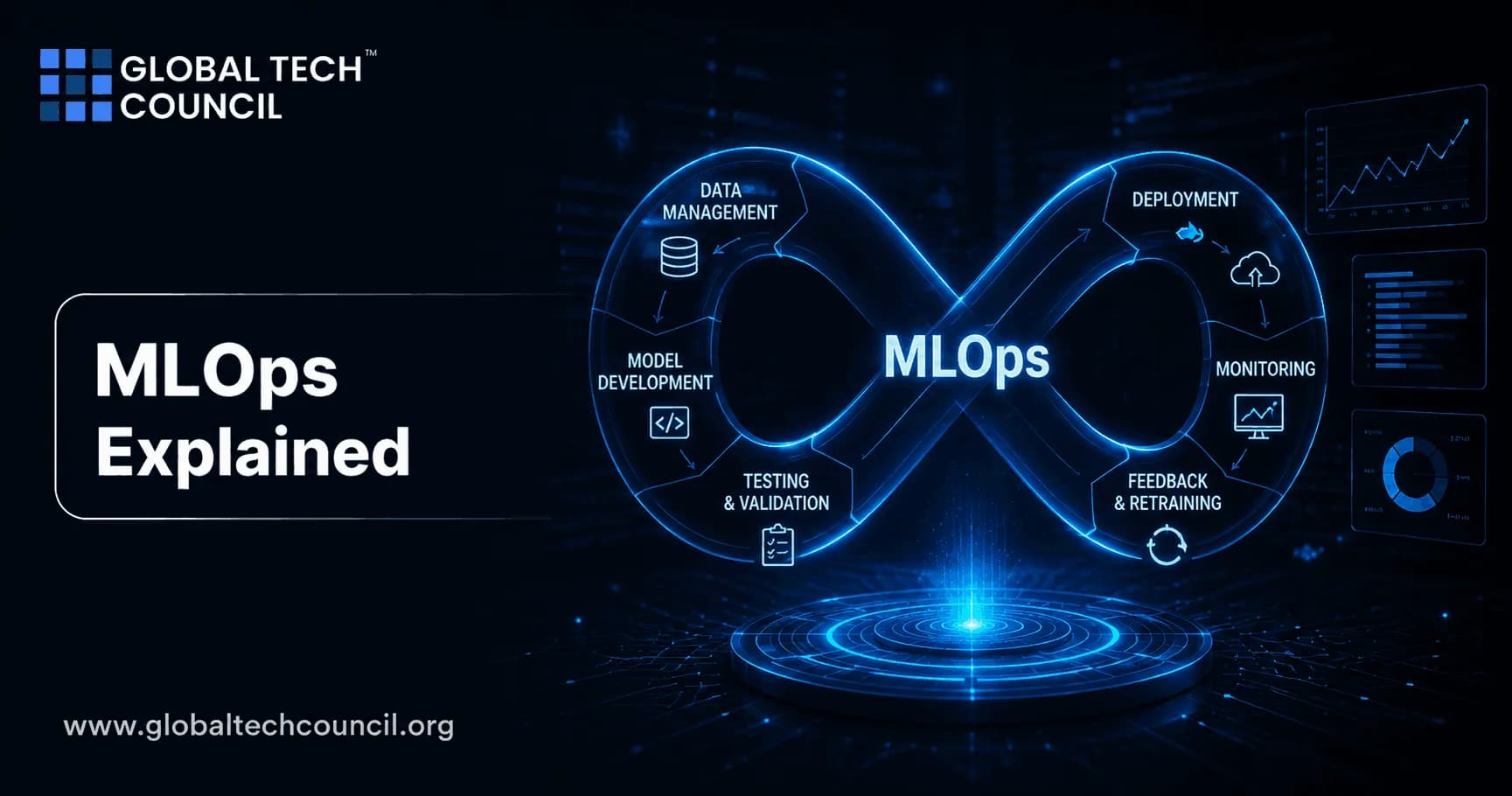
MLOps is the operating system for production machine learning. It gives you a disciplined way to build, test, deploy, monitor, and improve ML models after the notebook work is done. If your team runs one model in a lab, you can survive with scripts and manual checks. If you have dozens of models affecting credit decisions, fraud alerts, recommendations, pricing, or patient risk scores, you need MLOps.
The pressure is real. Fortune Business Insights estimates the global MLOps market at 2.98 billion USD in 2025 and projects 89.91 billion USD by 2034. Grand View Research places the 2025 market near 3.03 billion USD and forecasts 16.61 billion USD by 2030. The exact figure varies by scope, but the direction is not disputed. Organizations are moving from ML experiments to business-critical production systems.

As machine learning adoption continues to expand across industries, building a strong foundation in model development and lifecycle management has become increasingly important. A Certified Machine Learning Expert credential helps professionals develop practical skills in training, evaluating, deploying, and maintaining machine learning models, making it an ideal starting point before advancing into production-scale MLOps practices.
What MLOps Means in Practice
MLOps combines machine learning workflows with software engineering and IT operations. It covers the full lifecycle: data ingestion, feature engineering, training, evaluation, deployment, monitoring, retraining, and governance.
That sounds broad because it is. A model is not a self-contained product. It depends on data pipelines, feature definitions, environment versions, infrastructure, approval workflows, security controls, and user feedback. Change one of those and the model can behave differently.
Successfully managing machine learning systems in production requires expertise that extends beyond model building. A Certified MLOps Expert credential helps professionals develop hands-on knowledge of automated pipelines, model versioning, deployment strategies, monitoring, governance, and continuous improvement, preparing them to manage enterprise AI systems with confidence.
Here is a common example. You train a fraud model with scikit-learn and forget to set random_state in train_test_split. Your validation AUC changes between runs. No code bug. No magic. Just a different split. In a notebook, that is annoying. In a regulated deployment, it is a reproducibility problem.
Why MLOps Matters at Scale
Traditional software can be tested against expected outputs. ML systems are harder. They depend on data distributions, and those distributions move. Customer behavior changes. Sensors drift. Fraud patterns mutate. A model that worked last quarter can become unreliable without ever throwing a system error.
MLOps helps you answer practical questions:
Which dataset version trained the model currently in production?
Who approved the model promotion?
What changed between version 14 and version 15?
Is latency rising because of the model, the feature store, or the serving layer?
Has prediction drift crossed an alert threshold?
Can you roll back safely?
Without these answers, ML becomes operational guesswork. To be blunt, that is not acceptable for enterprise AI.
Core MLOps Practices for Managing ML Models at Scale
1. Build automated ML pipelines
Manual training is the first thing to remove. A production-grade pipeline should pull approved data, build features, train the model, run evaluation tests, package artifacts, and publish results. Pipeline definitions belong in version control, not in someone's local folder.
Common orchestration tools include Apache Airflow, Kubeflow Pipelines, Prefect, Dagster, and cloud-native options such as Vertex AI Pipelines, Azure Machine Learning pipelines, and Amazon SageMaker Pipelines. The best choice depends on your stack. If your team already runs Kubernetes well, Kubeflow may fit. If not, a managed cloud pipeline is usually faster to operate.
2. Version code, data, features, and models
Git solves only part of the problem. You also need versioned datasets, feature definitions, training parameters, metrics, container images, and model artifacts.
A practical setup usually includes:
Source control: GitHub, GitLab, Bitbucket, or an internal Git service.
Data versioning: DVC, lakehouse table versions, object storage paths with immutable naming, or metadata catalogs.
Experiment tracking: MLflow, Weights & Biases, Neptune, or managed platform tracking.
Model registry: A central place to store model versions, signatures, owners, metrics, and promotion status.
One detail that catches teams during upgrades: MLflow 2.9 deprecated model registry stages in favor of model aliases. If your deployment script still depends on stage transitions such as moving a model to Production, check your MLflow version before a platform migration.
3. Add continuous testing for ML
CI for ML is not just unit tests. You need checks for data, features, model behavior, and deployment packages.
Start with these tests:
Schema checks: Are required columns present? Are data types correct?
Range checks: Are ages, prices, dates, and sensor readings within valid boundaries?
Missing value checks: Has the null rate changed sharply?
Training checks: Does the pipeline complete with the pinned environment?
Regression checks: Does the new model beat or match the current baseline on approved evaluation data?
Security checks: Are secrets excluded from images, notebooks, and logs?
Beginners often discover this the hard way through errors like ValueError: Input X contains NaN. That message is useful, but it arrives too late if the bad batch has already reached production scoring. Validate early.
4. Monitor infrastructure and model behavior
Production monitoring must cover two layers. First, the system: latency, throughput, memory, CPU, GPU use, error rate, and endpoint availability. Second, the model: prediction distribution, input drift, data quality, calibration, and business outcomes.
Tools such as Prometheus, Grafana, OpenTelemetry, Evidently, WhyLabs, Arize AI, and cloud monitoring services can help. The exact tool matters less than the discipline. Define thresholds. Send alerts to an owner. Track incidents. Review them.
Do not monitor only accuracy if labels arrive weeks later. For fraud and credit models, delayed labels are normal. In that case, track proxy signals such as score distribution shift, approval rate movement, feature drift, manual review rates, and complaint volume.
5. Use governed promotion workflows
At scale, model deployment should not be a Slack message followed by a manual upload. Use promotion gates.
Train the candidate model.
Store it in the registry with metadata and metrics.
Run automated validation.
Send it for review if the use case is sensitive.
Deploy to staging.
Run smoke tests and shadow traffic if needed.
Promote to production with rollback ready.
This is where MLOps meets risk management. For financial services, healthcare, insurance, and public sector use cases, you need lineage, approvals, access controls, and audit trails. The European Union AI Act raises the bar on transparency, documentation, and risk controls for AI systems. MLOps is one way to turn those requirements into repeatable workflows.
A Typical MLOps Architecture
A mature architecture usually includes these components:
Data ingestion pipelines for batch, streaming, or event data.
Feature engineering jobs and, where useful, a feature store.
Experiment tracking for parameters, metrics, code versions, and artifacts.
Scalable training infrastructure using CPUs, GPUs, or distributed compute.
A model registry for versioning and deployment approval.
Serving infrastructure for batch scoring, real-time APIs, or edge deployment.
Monitoring for infrastructure, data quality, drift, and model outcomes.
Governance controls for identity, access, lineage, and review.
Keep the architecture as simple as your risk level allows. A small team with five internal models does not need a platform that looks like a hyperscaler. A bank running hundreds of decision models does.
Building scalable MLOps platforms also requires a broader understanding of cloud computing, software engineering, cybersecurity, container orchestration, and infrastructure automation. A Deep Tech Certification helps professionals strengthen these advanced technical capabilities, enabling them to design resilient AI platforms that support reliable machine learning operations at enterprise scale.
Common MLOps Use Cases
Financial services
Fraud detection models need frequent retraining because attackers adapt. Credit scoring models need stronger governance because decisions must be explainable and auditable. In both cases, MLOps supports traceability from source data to deployed endpoint.
E-commerce and digital platforms
Recommendation, search ranking, and pricing models change as user behavior changes. A/B testing, canary rollout, and business metric monitoring matter as much as offline accuracy.
Manufacturing and IoT
Predictive maintenance and visual inspection models often combine edge devices with cloud retraining. You need telemetry, versioned deployments, and a way to handle new equipment types or defect classes.
Healthcare and life sciences
Clinical risk models require strict validation, privacy controls, and monitoring for population drift. A small distribution shift can have serious consequences.
Skills You Need to Work in MLOps
MLOps is not only for data scientists. Strong teams usually include ML engineers, platform engineers, data engineers, security specialists, and domain experts.
If you are building your learning path, focus on:
Python 3.12 and common ML libraries such as scikit-learn, PyTorch, and TensorFlow.
Docker, container registries, and basic Kubernetes concepts.
CI/CD with GitHub Actions, GitLab CI, Jenkins, or cloud-native services.
Data validation, experiment tracking, and model registries.
Monitoring with logs, metrics, traces, and drift reports.
Cloud fundamentals across AWS, Microsoft Azure, or Google Cloud.
Security basics, including secrets management, IAM, and software supply chain risk.
MLOps sits at the intersection of machine learning, artificial intelligence, data science, cloud computing, and cybersecurity. If you want to close gaps in any of those areas, the Global Tech Council learning paths across those five domains give you a structured route.
Where MLOps Is Heading
The market forecasts are aggressive for a reason. Analysts at firms such as Fortune Business Insights, Grand View Research, Global Market Insights, Mordor Intelligence, and KBV Research all point to strong double-digit growth through the 2030s.
Expect five shifts:
Closer links between MLOps, DataOps, and AIOps: Teams want fewer disconnected tools.
More responsible AI controls: Fairness checks, explainability, and documentation will become standard in regulated sectors.
Better observability: Model monitoring will move closer to software observability practices.
Template-based deployments: Reusable pipelines will cut setup time for common use cases.
Industry-specific platforms: Finance, healthcare, and manufacturing will need workflows aligned to their own rules.
Here is the practical next step. Take one model you already know and productionize it properly. Put the pipeline in Git. Track experiments. Register the model. Deploy it behind an API. Add drift monitoring. Then look at the machine learning, cloud, data science, and cybersecurity certifications from Global Tech Council to fill the gaps you find while building.
elivering successful AI initiatives also requires the ability to connect technical outcomes with organizational goals and communicate value to stakeholders across the business. A Marketing & Business Certification helps professionals develop these business-focused skills, enabling them to position machine learning projects more effectively and support informed strategic decision-making.
FAQs
1. What is MLOps?
MLOps (Machine Learning Operations) is a set of practices that combines machine learning, software engineering, DevOps, and data engineering to manage the entire lifecycle of machine learning models. It focuses on building, deploying, monitoring, maintaining, and governing ML systems efficiently and reliably at scale.
2. Why is MLOps important?
MLOps helps organizations move machine learning models from experimentation to production while improving reliability, scalability, collaboration, and operational efficiency. It also supports reproducibility, governance, monitoring, and continuous improvement throughout the model lifecycle.
3. How is MLOps different from DevOps?
DevOps primarily focuses on developing, testing, deploying, and maintaining software applications. MLOps extends DevOps principles by addressing machine learning-specific challenges such as data versioning, feature engineering, model training, model evaluation, model drift, and continuous retraining.
4. What are the stages of the MLOps lifecycle?
A typical MLOps lifecycle includes data collection, data preparation, feature engineering, model development, training, validation, deployment, monitoring, maintenance, retraining, governance, and retirement. While workflows vary by organization, these stages help ensure models remain accurate and reliable over time.
5. What is model versioning in MLOps?
Model versioning tracks changes to machine learning models, datasets, configurations, and training code over time. Maintaining version history improves reproducibility, supports auditing, enables rollback to previous models, and simplifies collaboration across teams.
6. What is data versioning?
Data versioning records changes made to datasets used for training, validation, and testing machine learning models. It helps teams reproduce experiments, compare model performance across different datasets, and maintain consistency throughout the development lifecycle.
7. What is feature engineering in MLOps?
Feature engineering involves creating, transforming, selecting, and managing input variables that improve machine learning performance. Many organizations use feature stores to standardize reusable features and ensure consistency between training and production environments.
8. What is Continuous Integration (CI) in MLOps?
Continuous Integration automatically validates code, data pipelines, and machine learning components whenever changes are introduced. Automated testing helps identify issues early, improves software quality, and supports faster collaboration among development teams.
9. What is Continuous Delivery and Continuous Deployment (CD)?
Continuous Delivery automates the preparation of machine learning models for deployment while allowing human approval before release. Continuous Deployment extends automation by releasing validated models directly into production according to predefined policies and organizational controls.
10. What is model deployment?
Model deployment is the process of making a trained machine learning model available for real-world use through applications, APIs, batch processing systems, edge devices, or cloud infrastructure. Deployment strategies should consider scalability, latency, security, and reliability requirements.
11. Why is model monitoring important?
Model monitoring tracks prediction quality, system performance, resource usage, latency, and operational health after deployment. Continuous monitoring helps identify issues such as performance degradation, unexpected behavior, or infrastructure problems before they significantly affect users.
12. What is model drift?
Model drift occurs when a deployed model's performance declines because the relationship between input data and real-world outcomes changes over time. Common forms include data drift, concept drift, and feature drift, all of which may require investigation, retraining, or model replacement.
13. What are feature stores?
Feature stores are centralized repositories that manage reusable machine learning features across multiple projects. They promote consistency between training and inference, reduce duplicated engineering effort, and improve collaboration among data scientists and machine learning engineers.
14. Which tools are commonly used in MLOps?
Common MLOps tools include MLflow, Kubeflow, TensorFlow Extended (TFX), Apache Airflow, Docker, Kubernetes, DVC, Weights & Biases, SageMaker, Vertex AI, Azure Machine Learning, Databricks, and Git-based version control systems. Tool selection depends on organizational needs, infrastructure, and governance requirements.
15. What are the benefits of implementing MLOps?
MLOps improves deployment speed, reproducibility, collaboration, scalability, operational reliability, model governance, compliance support, resource utilization, and long-term maintainability. It also reduces manual processes and helps organizations manage growing numbers of machine learning models more effectively.
16. What challenges do organizations face with MLOps?
Common challenges include managing large datasets, coordinating cross-functional teams, maintaining data quality, detecting model drift, integrating legacy systems, controlling infrastructure costs, ensuring security, meeting regulatory obligations, and standardizing workflows across multiple projects.
17. How does MLOps support responsible AI?
MLOps supports responsible AI by incorporating governance, documentation, monitoring, fairness assessments, audit trails, security controls, human oversight, and lifecycle management into machine learning operations. These practices help organizations maintain transparency and respond to changing operational or regulatory requirements.
18. What are best practices for implementing MLOps?
Organizations should automate testing, use version control for code and data, establish reproducible training pipelines, monitor production models continuously, document experiments, implement robust security measures, define governance policies, and regularly review model performance against business objectives.
19. What trends are shaping MLOps in 2025-2026?
Emerging trends include LLMOps for foundation models, AI agent lifecycle management, unified AI platforms, automated model monitoring, synthetic data integration, explainable AI tooling, edge AI deployment, GitOps for machine learning, stronger governance frameworks, and increased adoption of cloud-native MLOps architectures.
20. What is the future of MLOps?
MLOps is expected to become a foundational discipline for organizations deploying AI at scale, supporting both traditional machine learning and modern foundation models. Future platforms will likely provide greater automation, improved governance, enhanced observability, and tighter integration with software engineering and data engineering workflows. As AI systems become more complex, well-designed MLOps practices will be essential for maintaining reliability, compliance, and business value. It turns out even brilliant machine learning models need a little operational supervision, much like office coffee machines with suspicious confidence.
Related Articles
View All
Machine Learning
Model Training Explained: How Machine Learning Models Learn
Model training explained with the learning loop, loss functions, backpropagation, gradient descent, mini-batches, validation, and practical debugging tips.

Machine Learning
Feature Selection Explained: Choosing the Right Inputs for ML Models
Feature selection helps ML models use the right inputs, reduce noise, improve speed, and support explainability without leaking test data.

Machine Learning
Gradient Boosting Explained: Building Powerful Ensemble Models
Gradient boosting explained for practitioners: learn how boosted trees work, when to use XGBoost, LightGBM, or CatBoost, and how to tune models safely.
Trending Articles
The Role of Blockchain in Ethical AI Development
How blockchain technology is being used to promote transparency and accountability in artificial intelligence systems.
AWS Career Roadmap
A step-by-step guide to building a successful career in Amazon Web Services cloud computing.
Top 5 DeFi Platforms
Explore the leading decentralized finance platforms and what makes each one unique in the evolving DeFi landscape.