

What Is Machine Learning? A Beginner's Guide to Core Concepts
 Suyash Raizada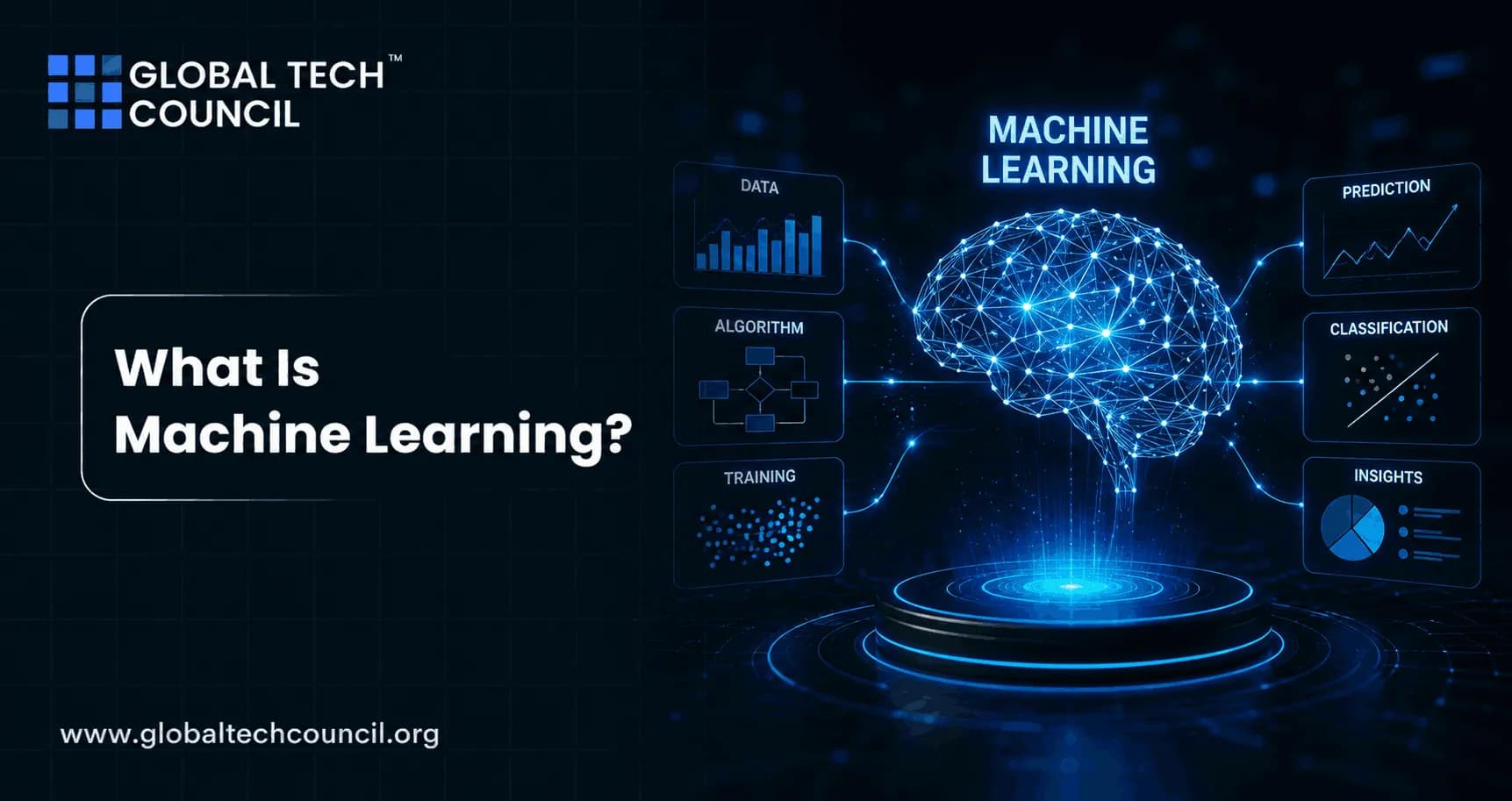
What is machine learning? Machine learning is a branch of artificial intelligence where computer systems learn patterns from data, then use those patterns to make predictions, classify information, detect anomalies, or support decisions without a developer writing every rule by hand.
You already meet machine learning every day. It helps banks flag unusual card activity, streaming platforms recommend videos, email systems filter spam, and language models generate text. The idea is simple. The practice is not. Good machine learning depends on clean data, careful evaluation, and knowing when a simpler method beats a larger model.

Developing reliable machine learning solutions requires more than understanding algorithms. Professionals must also learn data preparation, feature engineering, model evaluation, deployment, and performance monitoring to build systems that deliver consistent business value. A Certified Machine Learning Expert credential helps establish these practical skills, providing a structured foundation for applying machine learning across real-world projects.
What Is Machine Learning in Practical Terms?
Machine learning, often shortened to ML, uses algorithms that learn statistical relationships from training data and generalize to new examples. Instead of writing a rule such as "if a transaction is over $500 and from another country, flag it," you train a model on many past transactions, including examples of fraud and normal activity. The model finds patterns that would be too messy to spell out by hand.
Traditional programming still matters. You write code to collect data, train models, test performance, deploy services, monitor errors, and protect the system. The difference is that part of the decision logic comes from learned parameters rather than fixed instructions.
Machine learning can work with many data types:
Tabular data: customer records, financial transactions, sensor readings, inventory data.
Text: emails, support tickets, contracts, search queries.
Images and video: medical scans, product photos, traffic footage.
Audio: voice commands, call center recordings, machine noise.
Deep learning is a subset of machine learning based on neural networks with multiple layers. It powers many current computer vision systems, speech tools, and large language models. Still, do not assume deep learning is always the best answer. For business datasets that live in rows and columns, gradient boosted trees or logistic regression are often faster, cheaper, and easier to explain.
Core Machine Learning Concepts Beginners Should Know
Data, Features, and Labels
A dataset is the starting point. Features are the input variables the model uses. In a house price model, features might include floor area, number of bedrooms, location, age of the building, and recent sale prices nearby.
Labels, also called targets, are the answers you want the model to learn in supervised learning. In that same example, the label is the final sale price. In a spam classifier, the label is spam or not spam.
Feature quality matters more than beginners expect. A model trained on messy or biased data will learn messy or biased patterns. Simple issue, big damage. I once watched a fraud model look excellent in testing because a data field had been added after the fraud investigation was complete. That is target leakage. In production, the field did not exist at decision time, and performance collapsed.
Training, Validation, and Testing
Most ML workflows split data into three groups:
Training set: used to fit the model's parameters.
Validation set: used to tune settings such as tree depth, learning rate, or regularization strength.
Test set: used once near the end to estimate performance on unseen data.
Do not tune repeatedly on the test set. You will fool yourself. Treat it like a final exam.
Metrics depend on the problem. Accuracy is easy to understand, but it can hide failure when classes are imbalanced. If only 1 percent of transactions are fraudulent, a model that predicts "not fraud" every time is 99 percent accurate and completely useless. For classification, look at precision, recall, F1 score, ROC-AUC, and confusion matrices. For regression, common metrics include mean absolute error and mean squared error.
A Small Practitioner Gotcha
If you build your first classifier in scikit-learn, you may run into this warning:
ConvergenceWarning: lbfgs failed to converge (status=1): STOP: TOTAL NO. of ITERATIONS REACHED LIMIT.
It often shows up with LogisticRegression because the default max_iter value of 100 is not enough for your data. Scaling numeric features with StandardScaler and raising max_iter to 1000 usually clears it. Tiny detail. Real impact.
Main Types of Machine Learning
Supervised Learning
Supervised learning trains models on labeled examples. Each input has a known output. This is the most common form of production machine learning, especially in finance, insurance, retail, and operations.
Common supervised algorithms include:
Linear regression and logistic regression
Decision trees and random forests
Gradient boosted trees such as XGBoost, LightGBM, and CatBoost
Support vector machines
Neural networks
Use supervised learning for credit scoring, churn prediction, demand forecasting, spam filtering, image classification, and medical decision support. If you have enough high-quality labeled history, this is usually where to start.
Unsupervised Learning
Unsupervised learning works with data that has no labels. The goal is to find structure, groups, unusual points, or compressed representations.
Common methods include k-means clustering, principal component analysis, and DBSCAN. These help with customer segmentation, anomaly detection, topic grouping, and dimensionality reduction. Be careful with clustering. It always gives you groups, but the groups are not always meaningful. Validate them with domain knowledge.
Semi-Supervised and Self-Supervised Learning
Semi-supervised learning combines a small labeled dataset with a larger unlabeled dataset. This helps when labels are expensive, such as medical imaging or legal document review.
Self-supervised learning creates training tasks from unlabeled data. For example, language models can learn by predicting masked words or the next token in a sequence. This approach sits at the core of modern transformer models and many generative AI systems.
Reinforcement Learning
Reinforcement learning trains an agent to choose actions in an environment to maximize cumulative reward. The agent learns through trial and error.
It shows up in game playing, robotics, control systems, autonomous navigation, and some trading simulations. For most business analytics teams, reinforcement learning is not the first tool to reach for. It needs careful reward design and safe experimentation. A bad reward function can teach exactly the wrong behavior.
As organizations increasingly combine predictive models with modern AI systems, professionals benefit from understanding how traditional machine learning, deep learning, and intelligent automation work together. A Certified AI & Machine Learning Expert credential helps build this broader perspective, enabling practitioners to design AI-driven solutions that align technical capabilities with practical business objectives.
Where Machine Learning Is Used
Machine learning has moved from research labs into daily business systems. Industry forecasts put the global machine learning market in the tens of billions of dollars for 2024 and 2025, with strong growth expected through the end of the decade. The demand comes from data volume, cheaper computing, cloud ML services, and the push for better prediction.
Common use cases include:
Finance: fraud detection, credit risk, anti-money laundering alerts, portfolio risk analysis.
E-commerce: recommendations, search ranking, price optimization, customer segmentation.
Healthcare: medical image analysis, triage support, readmission risk prediction, clinical workflow support.
Cybersecurity: malware detection, phishing detection, intrusion alerts, unusual login behavior.
Manufacturing: predictive maintenance, visual inspection, demand forecasting, quality control.
Customer service: chatbots, ticket routing, sentiment analysis, response suggestions.
Generative AI gets most of the attention, but traditional machine learning is still doing the heavy lifting. To be blunt, a chatbot is not a credit risk engine. Use generative AI for language interaction and content tasks. Use domain-specific ML for high-precision prediction on structured data.
Machine Learning Workflow: From Data to Deployment
A real ML project usually follows these steps:
Define the problem. Decide what prediction or decision the model should support.
Collect and inspect data. Check missing values, duplicates, outliers, and data lineage.
Prepare features. Encode categories, scale numeric fields when needed, process text or images.
Train baseline models. Start simple. A baseline stops you from overvaluing a complex model.
Evaluate fairly. Use validation data, task-specific metrics, and error analysis.
Deploy. Serve predictions through an API, batch job, embedded model, or analytics platform.
Monitor. Track drift, latency, failed predictions, data quality, and business outcomes.
Monitoring is not optional. Customer behavior changes, fraud patterns shift, and product catalogs evolve. A model that worked last quarter can go stale fast.
Modern machine learning projects often rely on advanced technologies such as cloud computing, distributed data platforms, MLOps pipelines, automation, and scalable AI infrastructure. A Deep Tech Certification helps professionals strengthen their understanding of these technologies, making it easier to deploy, monitor, and maintain machine learning solutions in production environments.
Ethics, Regulation, and Responsible Machine Learning
Machine learning systems can affect credit access, healthcare support, hiring, insurance, and public services. That means governance matters.
The European Union Artificial Intelligence Act entered into force in August 2024, with phased application running through 2025 and 2026. It classifies AI systems by risk: unacceptable, high, limited, and minimal. High-risk systems face stricter requirements for data governance, transparency, documentation, human oversight, and reliability. General purpose AI models carry their own transparency and safety obligations.
Even if you do not operate in the EU, the direction is clear. Document your datasets, evaluate bias, secure model endpoints, explain model behavior where possible, and keep humans in the loop for sensitive decisions.
How to Start Learning Machine Learning
If you are new, build skills in this order:
Python basics: functions, lists, dictionaries, files, virtual environments.
Data handling: NumPy, pandas, SQL, data cleaning.
Statistics: distributions, correlation, sampling, confidence intervals.
Core ML: regression, classification, clustering, model evaluation.
Deployment basics: APIs, Docker, cloud services, monitoring.
Responsible AI: fairness, privacy, explainability, security, regulation.
For structured study, Global Tech Council's Certified Machine Learning Expert is a strong next step after Python and basic statistics. If your goal is broader AI strategy, pair it with the Certified Artificial Intelligence Expert. Developers who want production skills should also look at related data science, Python, cloud, and cybersecurity courses as part of a wider learning path.
Final Takeaway
Machine learning is the practice of teaching computers to learn useful patterns from data. Start with one small supervised learning project: predict churn, classify support tickets, or forecast weekly demand. Keep the model simple, measure it honestly, and write down what fails. That habit will teach you more than chasing the largest model on day one.
Technical expertise becomes even more valuable when it is combined with strong business and strategic decision-making skills. A Marketing & Business Certification helps professionals understand how machine learning initiatives support organizational goals, improve customer experiences, optimize operations, and create measurable business value, allowing technical solutions to deliver meaningful outcomes across industries.
FAQs
1. What is machine learning?
Machine learning (ML) is a branch of artificial intelligence (AI) that enables computers to learn patterns from data and make predictions or decisions without being explicitly programmed for every scenario. Instead of following only fixed rules, machine learning models improve their performance by analyzing examples and identifying relationships within data.
2. How does machine learning work?
Machine learning works by training algorithms on datasets containing examples. During training, the model identifies patterns and relationships, which it later uses to make predictions or classifications on new, unseen data. Performance is typically evaluated using testing or validation data before deployment.
3. What is the difference between artificial intelligence and machine learning?
Artificial intelligence is the broader field focused on creating systems that perform tasks requiring human-like intelligence. Machine learning is a subset of AI that specifically uses data-driven algorithms to learn from experience rather than relying solely on manually written rules.
4. Why is machine learning important?
Machine learning helps automate complex decision-making, analyze large volumes of data, improve predictions, personalize user experiences, and optimize business processes. It is widely used across industries because it can adapt to changing data more effectively than many traditional rule-based systems.
5. What are the main types of machine learning?
The three primary categories are supervised learning, unsupervised learning, and reinforcement learning. Some educational resources also discuss semi-supervised learning and self-supervised learning, which combine or extend these approaches for specific use cases.
6. What is supervised learning?
Supervised learning trains models using labeled data, where the correct output is already known. The algorithm learns the relationship between inputs and outputs so it can make predictions for new data, making it common for tasks such as classification and regression.
7. What is unsupervised learning?
Unsupervised learning works with unlabeled data, allowing algorithms to discover hidden structures, patterns, or groups without predefined answers. Common applications include customer segmentation, anomaly detection, and clustering.
8. What is reinforcement learning?
Reinforcement learning trains an agent to make decisions through trial and error. The agent receives rewards or penalties based on its actions and gradually learns strategies that maximize long-term rewards, making it useful in robotics, gaming, and optimization problems.
9. What is training data?
Training data is the dataset used to teach a machine learning model. High-quality, representative, and well-prepared training data is essential because the model's performance depends heavily on the accuracy, diversity, and completeness of the information it learns from.
10. What is a machine learning model?
A machine learning model is the mathematical representation created during the training process. Once trained, the model applies learned patterns to new data to make predictions, classifications, recommendations, or other automated decisions.
11. What are common machine learning algorithms?
Popular machine learning algorithms include linear regression, logistic regression, decision trees, random forests, support vector machines (SVMs), k-nearest neighbors (KNN), gradient boosting methods, neural networks, and clustering algorithms such as k-means. The appropriate algorithm depends on the problem, data, and performance requirements.
12. What are common applications of machine learning?
Machine learning is used in recommendation systems, fraud detection, medical diagnosis support, predictive maintenance, image recognition, speech recognition, natural language processing, cybersecurity, financial forecasting, autonomous vehicles, digital advertising, and supply chain optimization.
13. What is overfitting in machine learning?
Overfitting occurs when a model learns the training data too closely, including random noise, instead of general patterns. As a result, it performs well on training data but poorly on new, unseen data. Proper validation and regularization techniques help reduce this risk.
14. What is the difference between machine learning and deep learning?
Deep learning is a specialized subset of machine learning that uses multi-layer neural networks to process complex data such as images, audio, and text. While all deep learning is machine learning, not all machine learning models use deep neural networks.
15. What skills are useful for learning machine learning?
Useful skills include statistics, probability, linear algebra, programming languages such as Python, data analysis, data visualization, SQL, and an understanding of algorithms. Familiarity with machine learning libraries and cloud platforms can also support practical development.
16. What challenges does machine learning present?
Challenges include poor data quality, biased datasets, limited interpretability, privacy concerns, model drift, computational costs, security risks, regulatory compliance, and the need for ongoing monitoring as data and real-world conditions change.
17. What trends are shaping machine learning in 2025-2026?
Major trends include generative AI, multimodal models, edge AI, automated machine learning (AutoML), responsible AI, explainable AI, synthetic data, federated learning, privacy-enhancing technologies, and increasing integration of machine learning into enterprise software and business workflows.
18. What are best practices for building machine learning systems?
Best practices include defining clear objectives, collecting high-quality data, selecting appropriate algorithms, validating models thoroughly, monitoring production performance, addressing bias and fairness, documenting development decisions, protecting sensitive data, and updating models as conditions evolve.
19. What should beginners know before learning machine learning?
Beginners should understand that machine learning combines mathematics, programming, and data analysis rather than relying on a single skill. Building small practical projects, learning core concepts gradually, and using reputable educational resources can provide a strong foundation before tackling more advanced topics. Machine learning models can be highly capable, but their results still depend on the quality of the data and the way they are designed and evaluated.
20. What is the future of machine learning?
Machine learning is expected to become even more integrated into healthcare, finance, manufacturing, education, transportation, cybersecurity, and everyday digital products. Advances in computing, AI research, and responsible governance are likely to make machine learning systems more capable, efficient, and accessible while increasing the importance of transparency, privacy, and ethical deployment. Machines may keep getting better at recognizing patterns, but they still rely on humans to decide which problems are worth solving in the first place.
Related Articles
View All
Machine Learning
Machine Learning Certification Guide: Choose the Right Program
A practical 2026 guide to choosing the right machine learning certification based on role, skill level, curriculum, projects, cloud stack, and career goals.

Machine Learning
Machine Learning Interview Questions and Answers for Beginners and Professionals
Prepare for machine learning interviews with beginner and professional questions on ML basics, algorithms, metrics, MLOps, deep learning, and generative AI.

Machine Learning
Machine Learning Projects for Beginners: Portfolio Ideas with Real-World Impact
Beginner machine learning portfolio ideas with practical datasets, tools, evaluation tips, and project paths for healthcare, finance, NLP, vision, and sustainability.
Trending Articles
The Role of Blockchain in Ethical AI Development
How blockchain technology is being used to promote transparency and accountability in artificial intelligence systems.
AWS Career Roadmap
A step-by-step guide to building a successful career in Amazon Web Services cloud computing.
Top 5 DeFi Platforms
Explore the leading decentralized finance platforms and what makes each one unique in the evolving DeFi landscape.