

The Machine Learning Lifecycle: A Step-by-Step Guide
 Suyash Raizada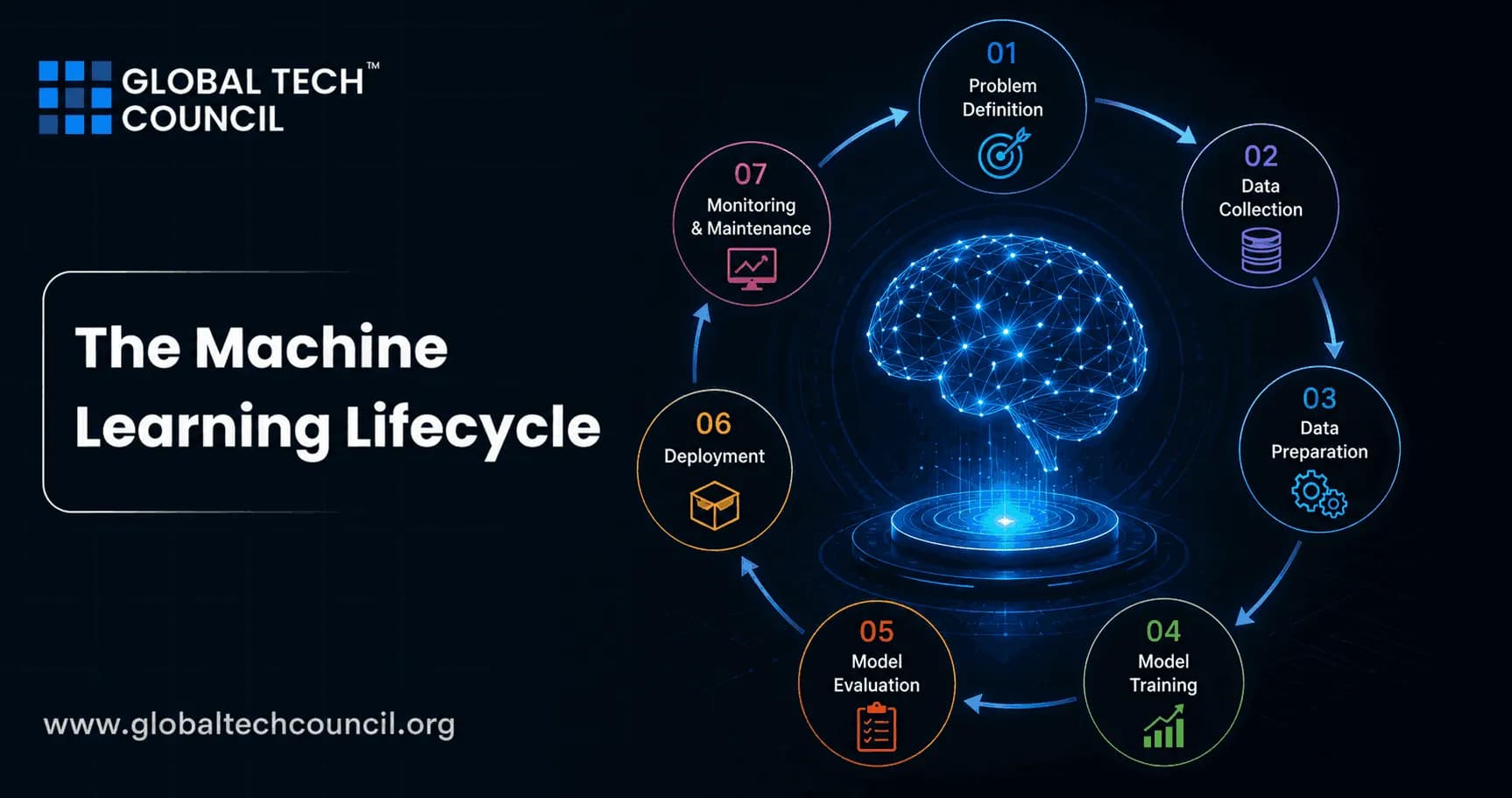
The machine learning lifecycle is the repeatable path that turns a business question into a working, monitored, and improving ML system. It is not just model training. The real work sits in problem framing, data governance, feature design, testing, deployment, monitoring, and retraining. Miss one of those steps and your model can look excellent in a notebook, then fall apart the first week it meets production traffic.
Guidance from AWS, Databricks, Snowflake, MLflow, IBM, and Microsoft now describes the lifecycle as an iterative loop supported by MLOps. That framing matters. A model is software plus data plus assumptions, and all three change over time.

Building reliable machine learning systems requires more than understanding algorithms. Professionals must also develop expertise in data governance, feature engineering, model evaluation, deployment, monitoring, and continuous improvement. A Certified Machine Learning Expert credential provides a structured pathway to mastering these practical skills and applying them throughout the machine learning lifecycle.
What Is the Machine Learning Lifecycle?
The machine learning lifecycle is a structured process for building and maintaining ML systems. Most teams organize it into 6 to 10 stages, usually grouped under planning, data engineering, model development, deployment, and operations.
Snowflake describes the flow as data preparation, feature engineering, model training, evaluation, deployment, and monitoring. The AWS Well-Architected Machine Learning Lens adds business goal identification and ML problem framing as explicit stages. Databricks uses an eight-step view that starts with scoping the use case and ends with monitoring drift and retraining.
The shared idea is simple. The lifecycle is not linear. Production feedback should change your data collection, your features, your evaluation criteria, and sometimes the original business question itself.
Step 1: Define the Business Goal
Start with the decision the model will support. Not the algorithm. Not the dashboard. The decision.
Ask yourself:
Who will use the prediction?
What action changes because of it?
What KPI proves the model helped?
What constraints matter here: latency, cost, compliance, explainability, or safety?
Take a churn model. Judging it only by AUC misses the point. If the retention team can contact just 10,000 customers per week, precision in the top decile matters more than a headline ranking metric. If the model triggers a loan review, fairness and explainability are not optional.
This is where a lot of ML projects quietly go wrong. A technically strong model can still be useless when the success metric is disconnected from the actual workflow.
Step 2: Frame the ML Problem
Translate the business goal into an ML task. Decide whether you are solving classification, regression, ranking, recommendation, forecasting, anomaly detection, or clustering.
Define:
The target variable
The prediction window
The available input signals
Batch versus real-time inference
Human review versus automated action
Acceptable false positive and false negative rates
Be strict here. If you are predicting whether a user will cancel in 30 days, do not train on features collected after the cancellation signal. That is leakage, and it happens more often than people admit.
As organizations increasingly integrate predictive models with broader AI solutions, professionals benefit from understanding how machine learning fits into intelligent automation and enterprise AI strategies. A Certified AI & Machine Learning Expert credential helps build this broader perspective, enabling practitioners to design AI systems that combine technical accuracy with real business impact.
Step 3: Acquire and Govern the Data
Data comes from transaction systems, logs, sensors, CRM platforms, warehouses, external APIs, and sometimes a spreadsheet nobody wants to own. Before modeling, check ownership, lineage, access rules, retention policies, and compliance needs.
For enterprise teams, this is often the real bottleneck. A NeurIPS retrospective on deploying ML systems grouped the major challenges into data management, model learning, model verification, and model deployment. The lesson was blunt: failures often happen well outside the modeling step.
Good governance answers practical questions:
Where did this dataset come from?
Who approved access?
Which version trained the model?
Can we reproduce the training run later?
Does the data contain regulated or sensitive fields?
Step 4: Clean, Explore, and Validate the Data
Expect dirty data. Missing values, duplicate rows, changed schemas, broken timestamps, outliers, and inconsistent categories are all normal.
Run exploratory data analysis before you train. Look at distributions, class imbalance, seasonality, correlations, rare categories, and drift between historical periods. Use profiling tools if they help, but do not skip manual inspection.
A small example from real project work. A fraud feature that counted transactions in the previous 24 hours looked fine offline, then dropped sharply in production. The training pipeline used UTC timestamps. The serving API used local merchant time. Same feature name, different meaning. The model did not fail. The lifecycle did.
Data validation should become code. Use schema checks, null thresholds, accepted value ranges, and tests for feature freshness. If a source column changes from customer_id as a string to an integer and strips leading zeros, you want the pipeline to fail loudly, not silently mislabel everyone.
Step 5: Engineer and Select Features
Feature engineering turns raw inputs into signals a model can use. Common techniques include encoding categories, scaling numeric values, aggregating events, creating rolling windows, extracting text features, and building domain-specific ratios.
Keep features versioned. Training-serving skew is one of the fastest ways to break a production model. If training computes a 7-day rolling average with closed='left' but serving includes the current event, your offline metrics are inflated and you will not know until users complain.
Watch library changes too. In scikit-learn 1.2, OneHotEncoder renamed the sparse parameter to sparse_output, with the old parameter deprecated. A small change like that can break older pipelines during environment rebuilds if you did not pin your versions.
Do not overbuild. For many tabular business problems, XGBoost, LightGBM, CatBoost, or a regularized logistic regression will beat a neural network on cost, interpretability, and maintenance. Deep learning is the wrong choice when you have limited data, strict latency budgets, and a need to explain every prediction.
Step 6: Train Models and Track Experiments
Now train. Choose model families based on the problem, not fashion.
Linear models: strong baselines, easy to explain, fast to serve.
Tree ensembles: often the best choice for structured tabular data.
Deep learning: useful for images, speech, text, embeddings, and large-scale pattern learning.
Probabilistic models: helpful when uncertainty matters.
Track every experiment. Log the dataset version, code version, hyperparameters, metrics, random seeds, feature definitions, and environment details. MLflow, Weights and Biases, Azure Machine Learning, Databricks, and Amazon SageMaker all support experiment tracking and model registries.
Ad hoc notebooks are fine for exploration. They are not enough for production. Convert training into reproducible pipelines before you promote anything.
Step 7: Evaluate, Validate, and Test
Accuracy is not enough. Evaluate the model against both technical and business criteria.
Use:
Held-out test sets
Cross-validation where appropriate
Precision, recall, F1, ROC-AUC, PR-AUC, RMSE, MAE, or calibration metrics
Segment-level performance checks
Fairness and bias checks
Latency and memory tests
Scenario tests for edge cases
For imbalanced fraud detection, ROC-AUC can look impressive while precision is poor at the action threshold. For medical triage, calibration may matter more than raw ranking quality, because clinicians need reliable risk estimates rather than a good sort order.
The ML Test Score, a well-known production ML checklist from Google researchers, recommends checking data invariants, feature generation consistency, numerical stability, dependency changes, computational performance, and model staleness. That is practical advice. Use it.
Step 8: Register and Approve the Model
A model registry stores the approved model with its metadata. This usually includes training code, dataset version, feature definitions, environment files, evaluation reports, owner, approval status, and deployment history.
Registries support promotion paths such as development, staging, and production. They also make rollbacks possible. If model version 18 harms conversion, you should be able to return to version 17 without guessing which artifact was actually deployed.
This is where governance becomes visible. Microsoft's AI lifecycle guidance emphasizes lineage logging, publisher tracking, lifecycle events, and alerts for model changes or drift. IBM's MLOps guidance treats monitoring for accuracy drift, bias, and fairness as part of responsible lifecycle management.
Step 9: Deploy and Integrate the Model
Deployment depends on how predictions get used.
Batch scoring: good for daily recommendations, risk lists, and offline reports.
Real-time API: needed for fraud checks, personalization, search ranking, and pricing.
Streaming inference: useful for IoT, telemetry, and event-driven systems.
Embedded models: common in mobile, edge, and browser-based applications.
Use Docker containers, CI/CD, infrastructure monitoring, canary releases, shadow deployments, and A/B tests where the risk justifies the overhead. For a low-risk internal report, batch deployment may be plenty. For a fraud model blocking payments, use a staged rollout and a human fallback.
Production concerns are not side issues. Latency, authentication, throughput, cost, failover, logging, and data privacy decide whether the model survives real traffic.
Production-grade machine learning also depends on modern technologies such as cloud infrastructure, MLOps, containerization, CI/CD pipelines, distributed computing, and scalable AI platforms. A Deep Tech Certification helps professionals strengthen these advanced technical capabilities, making it easier to deploy, monitor, and optimize machine learning systems across enterprise environments.
Step 10: Monitor, Maintain, and Retrain
Once the model is live, monitor both system behavior and model behavior.
Track:
Prediction latency
Error rates
Request volume
Feature distributions
Data drift
Concept drift
Accuracy once labels arrive
Cost per prediction
Fairness and segment-level changes
Prometheus, Grafana, the ELK stack, Azure Application Insights, Datadog, Evidently AI, WhyLabs, and Alibi Detect are common choices depending on your stack. The tool matters less than the alert path. If drift is detected and nobody owns the response, your monitoring is theater.
Retraining should be triggered by evidence, not habit. Use scheduled retraining for stable domains. Use drift-triggered retraining for fast-moving systems such as fraud, demand forecasting, ad ranking, and recommendations.
Real-World Examples of the Lifecycle
DeepMind's work on Google data center cooling is often cited because the ML system reportedly cut cooling energy use by up to 40 percent. The impact came from the full lifecycle: historical data, live sensor signals, forecasting models, integration with control systems, and continuous monitoring.
UPS built its ORION route optimization system on GPS signals, traffic patterns, road networks, and delivery constraints to improve routing decisions across its fleet. Netflix, reported to have more than 230 million subscribers in public case studies, depends on many ML models for recommendations and personalization. At that scale, deployment and monitoring are not optional extras.
Public repositories now collect hundreds of ML system design case studies, including collections with more than 300 examples from over 80 companies. The pattern holds across all of them. Production ML succeeds when teams manage the whole lifecycle, not just the training step.
Where MLOps Fits
MLOps is the engineering discipline that makes the machine learning lifecycle repeatable. It connects data validation, training pipelines, experiment tracking, the model registry, deployment automation, monitoring, and retraining into one system.
If you are learning this for a technical role, pair machine learning theory with MLOps practice. Global Tech Council learning paths in machine learning, data science, artificial intelligence, cloud engineering, and cybersecurity map onto these stages directly. Security belongs in that list, because model endpoints, datasets, notebooks, and CI/CD pipelines all add attack surface.
Next Step: Build the Lifecycle, Not Just the Model
Pick one realistic project and implement the full lifecycle. Define the KPI, version the dataset, train two baselines, track experiments, register the best model, deploy a simple API, and monitor drift. Keep it small. Make it reproducible.
If career growth is the goal, run that project alongside a Global Tech Council machine learning or AI certification path. Employers can teach a new library quickly. What they pay for is a practitioner who understands how models behave after deployment.
Technical expertise is only one part of delivering successful machine learning initiatives. Organizations also need professionals who can connect AI investments with strategic goals, customer value, and measurable business outcomes. A Marketing & Business Certification helps build this business perspective, enabling practitioners to align machine learning projects with organizational growth, operational efficiency, and long-term success.
FAQs
1. What is the machine learning lifecycle?
The machine learning lifecycle is the end-to-end process of designing, building, deploying, and maintaining machine learning models. It includes everything from defining a business problem and collecting data to monitoring model performance after deployment, ensuring models remain accurate and useful over time.
2. Why is the machine learning lifecycle important?
A structured lifecycle helps organizations develop reliable, scalable, and maintainable machine learning solutions. It reduces project risks, improves model quality, supports collaboration between teams, and encourages continuous improvement as data and business requirements evolve.
3. What are the main stages of the machine learning lifecycle?
While workflows vary by organization, the lifecycle typically includes problem definition, data collection, data preparation, exploratory data analysis, feature engineering, model selection, training, validation, deployment, monitoring, retraining, and governance.
4. How does problem definition influence machine learning success?
Clearly defining the business objective is one of the most important steps in the lifecycle. Well-defined goals help determine the appropriate data, success metrics, algorithms, evaluation methods, and deployment strategy, reducing the likelihood of developing models that solve the wrong problem.
5. Why is data collection important?
Machine learning models depend on high-quality, relevant, and representative data. Collecting accurate and diverse datasets improves the model's ability to learn meaningful patterns and reduces the risk of bias, poor generalization, or unreliable predictions.
6. What happens during data preparation?
Data preparation involves cleaning, organizing, and transforming raw data into a format suitable for machine learning. Common tasks include handling missing values, removing duplicates, correcting inconsistencies, encoding categorical variables, scaling numerical features, and addressing data quality issues.
7. What is exploratory data analysis (EDA)?
Exploratory Data Analysis (EDA) is the process of examining data to understand its characteristics, identify trends, detect anomalies, and discover relationships between variables. Visualization and statistical analysis help guide feature selection and model development.
8. What is feature engineering?
Feature engineering involves selecting, creating, or transforming variables that improve a model's predictive performance. Well-designed features often enable machine learning algorithms to identify patterns more effectively while improving model accuracy and efficiency.
9. How do developers choose the right machine learning algorithm?
Algorithm selection depends on the business objective, data type, dataset size, available computational resources, interpretability requirements, and desired performance. Developers often compare multiple algorithms before selecting the one that best balances accuracy, efficiency, and maintainability.
10. What happens during model training?
During training, the selected algorithm analyzes the training dataset to learn relationships between input features and desired outputs. The model adjusts its internal parameters iteratively to minimize prediction errors and improve performance according to the chosen objective function.
11. How is a machine learning model evaluated?
Models are evaluated using separate validation and test datasets that were not used during training. Depending on the problem, evaluation metrics may include accuracy, precision, recall, F1 score, ROC-AUC, mean absolute error (MAE), or root mean squared error (RMSE).
12. What is model deployment?
Model deployment is the process of making a trained machine learning model available for real-world use. Deployment may involve integrating the model into websites, mobile applications, cloud services, business software, or edge devices while ensuring reliability and scalability.
13. Why is model monitoring necessary?
Machine learning models can lose accuracy over time due to changing data patterns, user behavior, or business conditions. Continuous monitoring helps identify model drift, data drift, performance degradation, and operational issues that may require retraining or adjustment.
14. What is model retraining?
Model retraining updates an existing machine learning model using new or expanded datasets. Regular retraining helps maintain prediction quality as environments evolve and ensures the model continues to reflect current patterns and business requirements.
15. What role does MLOps play in the machine learning lifecycle?
MLOps applies DevOps principles to machine learning by automating model development, testing, deployment, monitoring, version control, and maintenance. It supports collaboration between data scientists, software engineers, and operations teams while improving reliability and scalability.
16. What are common challenges throughout the machine learning lifecycle?
Common challenges include poor data quality, biased datasets, insufficient documentation, feature drift, model drift, security concerns, privacy compliance, computational costs, deployment complexity, and maintaining consistent performance across changing environments.
17. What trends are shaping the machine learning lifecycle in 2025-2026?
Key trends include generative AI integration, automated machine learning (AutoML), foundation models, explainable AI, responsible AI governance, privacy-enhancing technologies, synthetic data generation, edge AI, continuous MLOps automation, and stronger regulatory oversight of AI systems.
18. What are best practices for managing the machine learning lifecycle?
Best practices include defining measurable objectives, maintaining high-quality data pipelines, documenting experiments, implementing version control, validating models thoroughly, monitoring production systems continuously, applying security and governance controls, and retraining models as business conditions change.
19. What should beginners understand about the machine learning lifecycle?
Beginners should recognize that building a successful machine learning system involves much more than selecting an algorithm. Data preparation, evaluation, deployment, monitoring, governance, and continuous improvement are all essential parts of creating reliable AI solutions that deliver value over time.
20. What is the future of the machine learning lifecycle?
The machine learning lifecycle is expected to become increasingly automated, collaborative, and governed through advances in MLOps, AI-assisted development, cloud infrastructure, and responsible AI practices. Organizations that combine strong technical processes with effective data management, security, and ongoing monitoring will be better positioned to develop trustworthy and scalable machine learning systems. Building a model is only the beginning; keeping it useful is where the real work quietly refuses to clock out.
Related Articles
View All
Machine Learning
Machine Learning Certification Guide: Choose the Right Program
A practical 2026 guide to choosing the right machine learning certification based on role, skill level, curriculum, projects, cloud stack, and career goals.

Machine Learning
Machine Learning Algorithms Explained: A Practical Beginner Guide
A practical beginner guide to Machine Learning Algorithms, covering supervised, unsupervised, ensemble, neural network, and reinforcement learning methods.

Machine Learning
What Is Machine Learning? A Beginner's Guide to Core Concepts
Learn what machine learning is, how models learn from data, the main ML types, real use cases, ethical issues, and where beginners should start.
Trending Articles
The Role of Blockchain in Ethical AI Development
How blockchain technology is being used to promote transparency and accountability in artificial intelligence systems.
AWS Career Roadmap
A step-by-step guide to building a successful career in Amazon Web Services cloud computing.
Top 5 DeFi Platforms
Explore the leading decentralized finance platforms and what makes each one unique in the evolving DeFi landscape.