

Naive Bayes Algorithm Explained: Fast Classification for Text and Data
 Suyash Raizada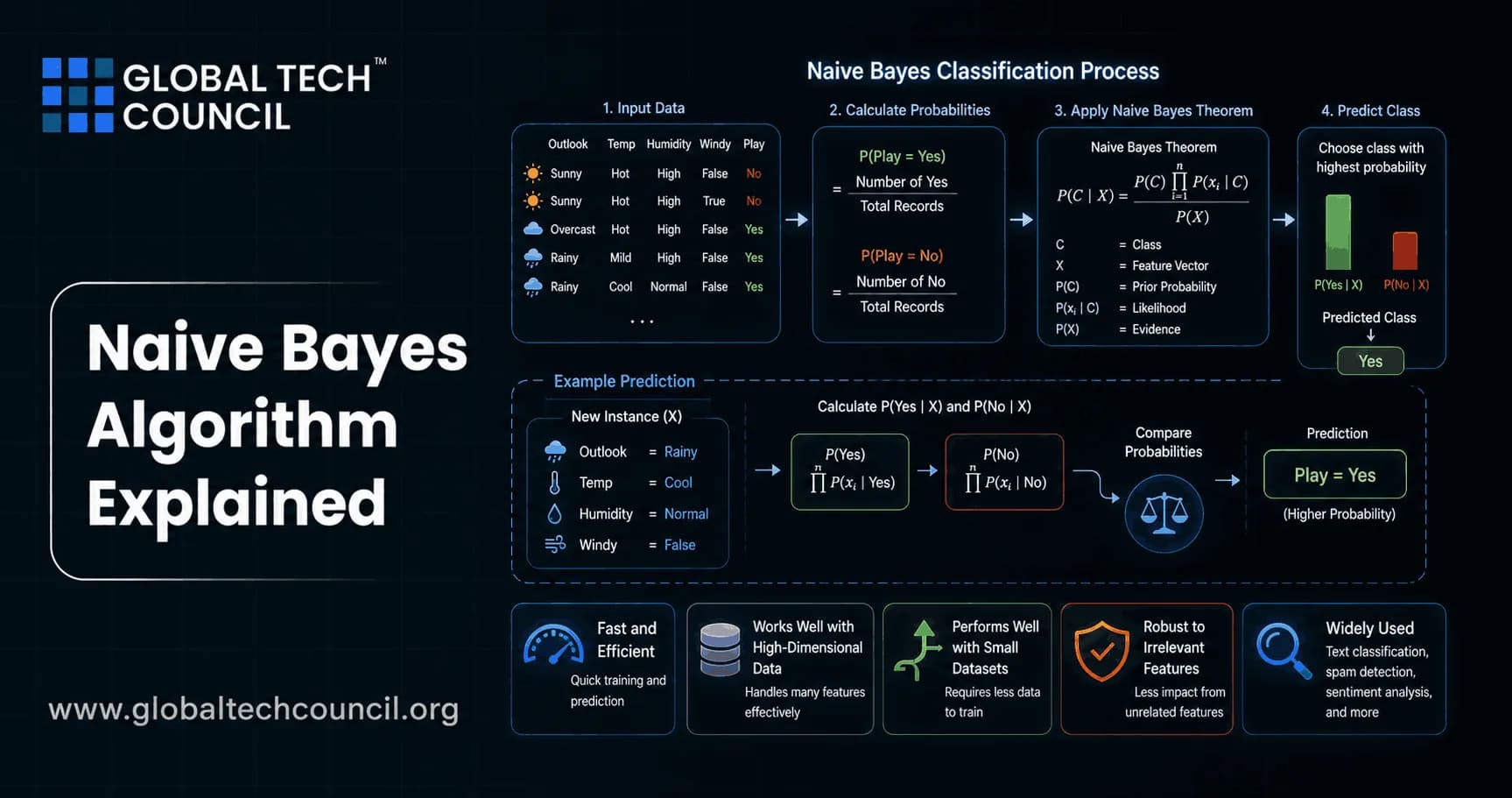
Naive Bayes is often the fastest useful classifier you can train for text: spam detection, sentiment analysis, document tagging, and plenty of tabular problems too. It is simple. Do not confuse simple with weak. With TF-IDF features and careful preprocessing, Naive Bayes can still beat heavier models when latency, cost, and interpretability matter.
Here is the short version. Naive Bayes uses Bayes theorem to estimate which class is most probable for a given input. It assumes features are conditionally independent once the class is known. That assumption is rarely true in real data, and never in language. Yet the model works surprisingly well, because word distributions usually carry enough signal to separate classes.

Building a solid understanding of probabilistic algorithms like Naive Bayes is an important part of mastering machine learning fundamentals. A Certified Machine Learning Expert credential helps professionals develop practical skills in supervised learning, feature engineering, model evaluation, and classification techniques, providing a strong foundation for solving real-world predictive analytics problems.
What Is the Naive Bayes Algorithm?
Naive Bayes is a family of supervised probabilistic classifiers. It predicts a class label by comparing posterior probabilities across the possible classes.
The main equation is:
P(C | x) = P(x | C)P(C) / P(x)
Here:
C is the class, such as spam or not spam.
x is the input feature vector, such as word counts from an email.
P(C) is the prior probability of the class.
P(x | C) is the likelihood of seeing those features given the class.
P(C | x) is the posterior probability used for the prediction.
Since P(x) is the same for every class in a single prediction, the classifier usually chooses:
argmax C P(x | C)P(C)
That is the whole idea. Estimate class priors. Estimate feature likelihoods. Pick the class with the highest score.
While Naive Bayes remains an effective baseline for many classification tasks, modern AI projects often combine probabilistic models with deep learning and other advanced techniques. A Certified AI & Machine Learning Expert credential helps professionals understand these complementary approaches, enabling them to choose the right algorithm for different datasets, performance requirements, and deployment scenarios.
Why Is It Called Naive?
The word naive comes from the conditional independence assumption. The model treats each feature as independent of the others, given the class.
For text, that means a spam classifier may treat the words free, prize, and click as separate signals even though they tend to show up together. Human language is not independent. Neither are most business features. But this shortcut turns a hard probability problem into a counting problem.
That is why Naive Bayes trains fast on high-dimensional sparse data, like a document-term matrix with 100,000 columns. In practice you can train a text classifier in seconds where a neural model would need far more compute.
Main Types of Naive Bayes Classifiers
Gaussian Naive Bayes
Use Gaussian Naive Bayes when features are continuous and roughly follow a normal distribution. It shows up in a lot of introductory examples, but it is not your first pick for sparse text.
Multinomial Naive Bayes
Multinomial Naive Bayes is the workhorse for text classification. It handles count-style features such as word counts or TF-IDF values. In scikit-learn, MultinomialNB is a common baseline for spam detection, topic classification, and sentiment analysis.
A real gotcha: MultinomialNB expects non-negative features. If you pass standardized features from StandardScaler, you will hit this error: ValueError: Negative values in data passed to MultinomialNB (input X). Feed it CountVectorizer or TfidfVectorizer output directly, or pick a model built for signed numeric features.
Bernoulli Naive Bayes
Bernoulli Naive Bayes works with binary features. For text, it tracks whether a word appears rather than how often. This helps when document length varies heavily or when presence matters more than frequency.
Complement Naive Bayes
Complement Naive Bayes is built for imbalanced data, especially text. Instead of using only statistics from each class, it uses information from the complement of a class. The scikit-learn documentation notes that ComplementNB is particularly useful for imbalanced text classification.
How Naive Bayes Works in a Text Pipeline
A practical Naive Bayes workflow usually looks like this:
Collect labeled data. For example, emails labeled spam or non-spam.
Clean the text. Lowercase it, strip noise, and handle tokens consistently.
Create features. Use bag of words, n-grams, or TF-IDF.
Estimate priors. Count how often each class appears.
Estimate likelihoods. Count how strongly each feature appears in each class.
Apply smoothing. Avoid zero probabilities for unseen words.
Predict and evaluate. Use accuracy, precision, recall, and F1 score on held-out data.
Smoothing deserves attention. In scikit-learn, the alpha parameter controls additive smoothing. A common value is 1.0, called Laplace smoothing. For short text, changing alpha from 1.0 to 0.1 can quietly shift recall, especially on rare classes. Test it. Do not accept the default blindly.
Naive Bayes with TF-IDF
Raw word counts often work. TF-IDF often works better.
TF-IDF cuts the weight of common words and raises the value of terms that are more specific to a document. In a technology news classifier, for instance, the term kernel may be far more useful than system.
Rennie and colleagues showed that weighted Naive Bayes methods using TF-IDF and document length normalization can compete with support vector machines in document classification. A more recent PLOS ONE study on news classification reported Naive Bayes with TF-IDF based feature extraction reaching about 95 percent of BERT accuracy while using a fraction of BERT's inference cost.
That result matters. If your support team needs to classify thousands of tickets per minute, a smaller classifier may be the right engineering choice. BERT is not always the answer.
Where Naive Bayes Performs Well
Reach for Naive Bayes when the problem has many sparse features and you need a fast, interpretable baseline.
Email spam filtering: learn word patterns linked with spam and non-spam messages.
Sentiment analysis: classify reviews as positive, negative, or neutral.
Document categorization: route news stories, support tickets, or knowledge base articles.
Content moderation: flag basic policy categories before human review.
Intent classification: build a lightweight chatbot intent model for narrow domains.
Healthcare decision support: estimate class probabilities from symptoms or test indicators, with proper clinical governance.
IBM describes Naive Bayes as a generative learning method, because it models how features are distributed within each class. That differs from discriminative models such as logistic regression, which focus directly on separating classes.
Where Naive Bayes Is the Wrong Choice
Be blunt with yourself. Naive Bayes is not magic.
It is a poor fit when feature interactions drive the result. Fraud detection is a good example. A single field may be harmless, but a combination of merchant, time, device, and transaction pattern can be risky. Tree-based models or gradient boosting usually handle that better.
It also struggles when you need calibrated probabilities. Naive Bayes can produce values that look overconfident, because the independence assumption double-counts correlated evidence. If calibration matters, test CalibratedClassifierCV in scikit-learn or compare against logistic regression.
Naive Bayes vs Logistic Regression vs BERT
Pick the model based on the job.
Choose Naive Bayes for a first baseline, high-volume text classification, limited compute, and explainable word-level signals.
Choose logistic regression when you want a stronger linear baseline and better probability behavior.
Choose BERT or another transformer when context and word order matter, such as legal clauses, medical notes, or nuanced intent detection.
My default for a new text classification project is simple: start with TF-IDF plus ComplementNB or logistic regression. If error analysis shows context failures, then move to a transformer. Do not spend GPU budget before you know the baseline.
Governance, Privacy, and Explainability
Regulations usually govern the AI system, not Naive Bayes as a standalone algorithm. Still, the model has useful traits for regulated settings. It is transparent, cheap to audit, and grounded in statistics anyone can follow.
You should still check:
Whether training data contains personal information.
Whether labels encode historical bias.
Whether false positives and false negatives affect users differently.
Whether probability scores are being treated as decisions without human review.
For teams building production AI, connect this topic with broader Global Tech Council learning paths in machine learning, data science, Python programming, AI governance, and cybersecurity. Those give readers certification-backed training that goes well beyond a single algorithm.
Deploying machine learning models in production also requires expertise in cloud platforms, software engineering, cybersecurity, and scalable AI infrastructure. A Deep Tech Certification helps professionals strengthen these advanced technical skills, making it easier to build secure, reliable, and enterprise-ready machine learning solutions that extend beyond model development alone.
Simple Python Example with scikit-learn
This minimal example trains a text classifier using TF-IDF and Multinomial Naive Bayes:
from sklearn.pipeline import make_pipeline
from sklearn.feature_extraction.text import TfidfVectorizer
from sklearn.naive_bayes import MultinomialNB
from sklearn.metrics import classification_report

X_train = [
    'free prize click now',
    'limited offer claim reward',
    'project meeting at ten',
    'please review the quarterly report'
]
y_train = ['spam', 'spam', 'ham', 'ham']

X_test = ['claim your free reward', 'review meeting report']
y_test = ['spam', 'ham']

model = make_pipeline(TfidfVectorizer(), MultinomialNB(alpha=1.0))
model.fit(X_train, y_train)

predictions = model.predict(X_test)
print(classification_report(y_test, predictions))
This is not production code, but the pattern is real. For production, add train-test splitting, cross-validation, class imbalance checks, model persistence, monitoring, and a rollback plan.
What to Learn Next
If you want to use Naive Bayes well, build three small projects: a spam classifier, a sentiment classifier, and a ticket-routing classifier. Compare CountVectorizer, TfidfVectorizer, MultinomialNB, ComplementNB, and logistic regression. Track F1 score, not just accuracy.
Then move into certification-level study in machine learning and data science through Global Tech Council's related training paths. Start with probabilistic classification, then add feature engineering, model evaluation, NLP, and responsible AI practices. That sequence turns Naive Bayes into more than a textbook formula. You will know when to use it, when to tune it, and when to replace it.
Successfully applying machine learning also depends on communicating technical insights to business stakeholders and aligning analytical outcomes with organizational goals. A Marketing & Business Certification helps professionals develop these strategic communication skills, enabling them to present AI-driven recommendations clearly and demonstrate measurable business value.
FAQs
1. What is the Naive Bayes algorithm?
Naive Bayes is a probabilistic supervised machine learning algorithm used primarily for classification tasks. It applies Bayes' Theorem while assuming that input features are conditionally independent given the target class, making it both simple and computationally efficient for many real-world applications.
2. Why is Naive Bayes important?
Naive Bayes is valued for its speed, simplicity, and effectiveness, especially when working with high-dimensional datasets such as text. It often serves as a strong baseline model and remains widely used in email filtering, sentiment analysis, document classification, and medical diagnosis support.
3. How does Naive Bayes work?
The algorithm calculates the probability that a data point belongs to each possible class using Bayes' Theorem. It combines prior probabilities with the likelihood of observing the input features and assigns the class with the highest posterior probability.
4. What is Bayes' Theorem?
Bayes' Theorem is a mathematical formula used to update the probability of an event based on new evidence. In machine learning, it provides a framework for estimating the probability that an observation belongs to a particular class after considering its features.
5. Why is it called "Naive" Bayes?
The algorithm is called "naive" because it assumes that all input features are independent of one another within each class. Although this assumption is often unrealistic, Naive Bayes can still perform remarkably well across many classification problems.
6. What are the main types of Naive Bayes algorithms?
Common variants include Gaussian Naive Bayes for continuous numerical data, Multinomial Naive Bayes for count-based data such as word frequencies, Bernoulli Naive Bayes for binary features, and Complement Naive Bayes for certain imbalanced text classification tasks.
7. What machine learning problems can Naive Bayes solve?
Naive Bayes is primarily used for classification problems, including spam detection, sentiment analysis, topic classification, document categorization, language identification, medical diagnosis support, fraud detection, customer segmentation support, and recommendation systems.
8. Why is Naive Bayes effective for text classification?
Text datasets often contain thousands of independent word features represented as counts or frequencies. Naive Bayes efficiently estimates class probabilities using these features, making it particularly suitable for document classification, spam filtering, and natural language processing tasks.
9. What are the advantages of Naive Bayes?
Key advantages include fast training and prediction, low computational requirements, strong performance on high-dimensional data, robustness with relatively small datasets, simple implementation, and the ability to generate probabilistic predictions.
10. What are the limitations of Naive Bayes?
Naive Bayes relies on the independence assumption, which may not hold in many real-world datasets. Its performance can decline when features are highly correlated or when important feature interactions influence the target variable.
11. How does Naive Bayes handle continuous data?
Gaussian Naive Bayes assumes that continuous features follow a normal (Gaussian) distribution within each class. It estimates the mean and variance for every feature-class combination to calculate class probabilities during prediction.
12. How does Naive Bayes compare with logistic regression?
Naive Bayes is generally faster to train and can perform well with smaller datasets or high-dimensional text data. Logistic regression often provides better predictive performance when feature independence assumptions are violated, though the best choice depends on the specific dataset and application.
13. What industries use Naive Bayes?
Naive Bayes is used in cybersecurity, healthcare, finance, telecommunications, education, marketing, retail, legal technology, publishing, and customer service. Typical applications include spam detection, document organization, customer feedback analysis, fraud screening, and automated content classification.
14. What preprocessing is important for Naive Bayes?
Effective preprocessing may include text tokenization, stop-word removal, stemming or lemmatization, vectorization using methods such as Bag of Words or TF-IDF, handling missing values, encoding categorical variables where appropriate, and ensuring consistent feature representation across datasets.
15. Which Python libraries support Naive Bayes?
Popular libraries include Scikit-learn, NumPy, Pandas, NLTK, spaCy, Gensim, Hugging Face Transformers, and SciPy. Scikit-learn provides implementations of Gaussian, Multinomial, Bernoulli, and Complement Naive Bayes classifiers through a consistent API.
16. What common mistakes should beginners avoid?
Common mistakes include using the wrong Naive Bayes variant for the data type, skipping essential text preprocessing, ignoring class imbalance, evaluating models using only accuracy, introducing data leakage, and assuming the independence assumption always reflects reality.
17. What are best practices for using Naive Bayes?
Best practices include selecting the appropriate algorithm variant, applying suitable preprocessing, evaluating models with cross-validation, comparing performance against baseline and alternative classifiers, monitoring precision and recall for imbalanced datasets, and validating results on independent test data.
18. How does Naive Bayes fit into the machine learning lifecycle?
Naive Bayes can be integrated into end-to-end machine learning workflows that include preprocessing, feature engineering, model training, evaluation, deployment, monitoring, and periodic retraining. Its simplicity also makes it useful for rapid prototyping and benchmarking new datasets.
19. What trends are shaping Naive Bayes in 2025-2026?
Although newer deep learning methods dominate many advanced NLP applications, Naive Bayes continues to be widely used for lightweight classification, edge computing, interpretable AI workflows, hybrid machine learning pipelines, educational purposes, and resource-constrained environments where speed is important.
20. What is the future of Naive Bayes?
Naive Bayes is expected to remain a valuable algorithm for fast, interpretable, and computationally efficient classification tasks, particularly in text analytics and structured data applications. While modern transformer models have expanded the capabilities of natural language processing, Naive Bayes continues to offer practical advantages for many production systems, baseline modeling, and educational settings. Sometimes a model that makes boldly simplistic assumptions still gets the job done, which is either inspiring or mildly concerning depending on your perspective.
Related Articles
View All
Machine Learning
K-Means Clustering Explained: How to Find Groups in Unlabeled Data
Learn how K-Means clustering finds groups in unlabeled data, how to choose k, preprocess features, evaluate clusters, and avoid common production mistakes.
Machine Learning
Logistic Regression Explained: Classification Made Simple
Logistic regression explained in clear terms, with practical examples, Python tips, use cases, metrics, and guidance for machine learning learners.

Machine Learning
Semi-Supervised Learning Explained: Training Models with Limited Labeled Data
Semi-supervised learning uses limited labeled data plus larger unlabeled datasets to train accurate models while reducing annotation effort.
Trending Articles
The Role of Blockchain in Ethical AI Development
How blockchain technology is being used to promote transparency and accountability in artificial intelligence systems.
AWS Career Roadmap
A step-by-step guide to building a successful career in Amazon Web Services cloud computing.
Top 5 DeFi Platforms
Explore the leading decentralized finance platforms and what makes each one unique in the evolving DeFi landscape.