

Logistic Regression Explained: Classification Made Simple
 Suyash Raizada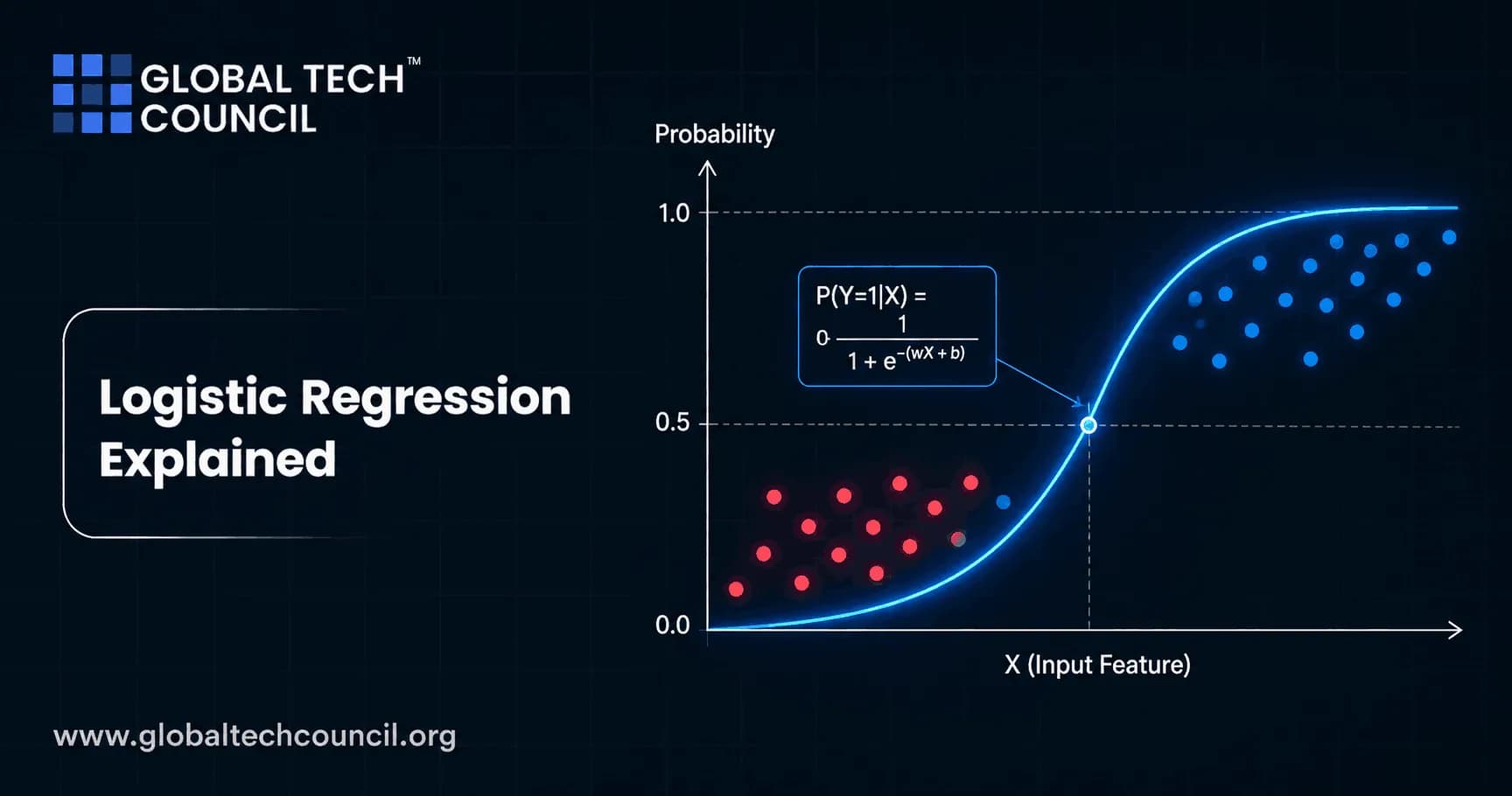
Logistic regression is the classification model you should understand before you reach for larger machine learning systems. It predicts the probability of a categorical outcome, usually a yes or no event, using a simple mathematical curve called the logistic function. If you work with churn, credit risk, fraud flags, patient outcomes, lead scoring, or pass or fail results, this model is still one of the cleanest starting points.
Do not let the word regression confuse you. Linear regression predicts a number. Logistic regression predicts a class probability. That difference matters in production, because most business decisions are not simply about predicting a value. They are about deciding whether something is likely enough to act on.

Understanding logistic regression is a key milestone in developing strong machine learning fundamentals because it introduces probability-based prediction, model interpretation, and classification concepts that appear throughout applied AI. A Certified Machine Learning Expert credential helps professionals strengthen these core skills, making it easier to build reliable predictive models for real-world business applications.
What Is Logistic Regression?
Logistic regression is a supervised learning algorithm used for classification. In binary classification, the target has two possible values, such as 1 and 0, approved and rejected, fraudulent and legitimate, churn and retained.
The model starts with a linear score:
z = b + w1x1 + w2x2 + ... + wnxn
That score can be any real number. Logistic regression then passes it through the sigmoid function:
P(Y = 1) = 1 / (1 + e^-z)
The sigmoid function squeezes the output into a value between 0 and 1. That value is interpreted as a probability. For example, a churn model may output 0.82, meaning the model estimates an 82 percent probability that the customer will leave.
By default, many examples use 0.5 as the classification threshold. If the probability is at least 0.5, predict class 1. Otherwise, predict class 0. In real work, that threshold is rarely sacred. A fraud team may use a lower threshold to catch more suspicious transactions, even if it means reviewing more false alarms.
How Logistic Regression Works in Plain Terms
Think of logistic regression as a scoring system with a probability layer on top. Each feature gets a weight. Positive weights push the prediction toward class 1. Negative weights push it toward class 0.
For a loan default model, the model may learn patterns like these:
Higher debt-to-income ratio increases the estimated probability of default.
Longer credit history may reduce the estimated probability of default.
Recent missed payments may strongly increase risk.
The model is trained by finding the parameter values that make the observed outcomes most likely. This is usually done with maximum likelihood estimation. In machine learning libraries, optimization algorithms such as LBFGS, liblinear, SAG, or SAGA estimate those parameters.
Although logistic regression remains one of the most widely used classification algorithms, modern AI projects often require comparing it with ensemble methods, deep learning models, and other advanced approaches. A Certified AI & Machine Learning Expert credential provides this broader understanding, enabling professionals to evaluate and select the most appropriate techniques for different datasets and business requirements.
Why Logistic Regression Is Still Used
Logistic regression survives because it is fast, interpretable, and hard to beat as a first model for structured data. You should not treat it as a beginner-only algorithm. In regulated domains, its transparency is often the point.
It Produces Probabilities
A class label alone is often not enough. A probability lets you rank cases by risk, set action thresholds, and measure calibration. Credit scoring, medical screening, fraud detection, and retention campaigns all benefit from probability scores.
It Is Interpretable
Each coefficient describes a change in log odds. If you exponentiate a coefficient, you get an odds ratio. This is why logistic regression is common in epidemiology, social science, and finance. A stakeholder can ask, Which variables moved this prediction? and you can give a direct answer.
It Is a Strong Baseline
Before training gradient boosting or neural networks, train logistic regression. To be blunt, if a complex model only improves your AUC from 0.812 to 0.816 while making explanations painful, you may not have a good reason to deploy it. Start simple. Measure properly. Then add complexity only when it pays for itself.
Binary, Multiclass, and Regularized Logistic Regression
The standard version handles two classes. Many real problems have more. Logistic regression can be extended through multinomial logistic regression or one-vs-rest classification.
Binary logistic regression: Predicts one of two outcomes, such as default or no default.
Multinomial logistic regression: Predicts one of several unordered classes, such as product category A, B, or C.
Ordinal logistic regression: Handles ordered categories, such as low, medium, and high risk.
Modern implementations also support regularization. L2 regularization shrinks coefficients and helps reduce overfitting. L1 regularization can drive some coefficients to zero, which is useful when you want feature selection. In scikit-learn, LogisticRegression uses L2 regularization by default with C=1.0, where a smaller C means stronger regularization.
A Practical Python Example
Here is a small, working example using scikit-learn. The pipeline matters. Scaling the features is not decoration, especially when you use solvers such as LBFGS or SAGA.
from sklearn.datasets import load_breast_cancer
from sklearn.model_selection import train_test_split
from sklearn.pipeline import make_pipeline
from sklearn.preprocessing import StandardScaler
from sklearn.linear_model import LogisticRegression
from sklearn.metrics import accuracy_score, roc_auc_score

X, y = load_breast_cancer(return_X_y=True)
X_train, X_test, y_train, y_test = train_test_split(
    X, y, test_size=0.25, random_state=42, stratify=y
)

model = make_pipeline(
    StandardScaler(),
    LogisticRegression(max_iter=1000, solver="lbfgs")
)

model.fit(X_train, y_train)
proba = model.predict_proba(X_test)[:, 1]
pred = model.predict(X_test)

print("Accuracy:", accuracy_score(y_test, pred))
print("ROC AUC:", roc_auc_score(y_test, proba))
A real beginner trap: if you skip scaling on wide numeric data, scikit-learn may print ConvergenceWarning: lbfgs failed to converge (status=1): STOP: TOTAL NO. OF ITERATIONS REACHED LIMIT. The model may still return predictions, which makes the warning easy to ignore. Do not ignore it. Scale the data, increase max_iter, or check whether your features are poorly conditioned.
Where Logistic Regression Works Best
Use logistic regression when your data is tabular, your outcome is categorical, and you need a model people can inspect. It is especially useful when the relationship between features and log odds is roughly linear after sensible preprocessing.
Finance and Credit Risk
Banks and lenders use logistic models to estimate default probability, approve or reject applications, and assign risk bands. The probability output makes it suitable for threshold-based decisioning and portfolio monitoring.
Marketing and Customer Churn
Subscription teams use logistic regression to estimate churn probability. Features may include support tickets, failed payments, usage decline, contract length, or campaign response. You can rank customers by risk and choose an intervention threshold.
Fraud Detection
Logistic regression can score transactions as likely fraudulent or legitimate. It will not catch every complex fraud pattern, but it is fast and explainable. For high-volume systems, a simple scoring model can work as an initial filter before deeper review.
Healthcare and Biomedical Research
Clinical researchers use logistic regression to estimate odds of disease, treatment response, readmission, or adverse events. The odds ratio format is familiar to medical researchers and easier to communicate than the internal mechanics of many black-box models.
Where Logistic Regression Is the Wrong Tool
Logistic regression is not magic. It assumes a linear relationship between features and log odds unless you add transformations or interaction terms. If your data has complex non-linear boundaries, tree ensembles or neural networks may perform better.
Be careful in these cases:
Highly non-linear patterns: Try gradient boosting, random forests, or engineered interaction features.
Severe class imbalance: Accuracy can mislead you. Track precision, recall, F1 score, ROC AUC, and precision-recall AUC.
Strong multicollinearity: Coefficients can become unstable. Regularization helps, but interpretation still needs care.
Uncalibrated decisions: Do not assume a 0.7 score is always a true 70 percent probability. Check calibration curves.
Evaluation Metrics You Should Use
For logistic regression, do not stop at accuracy. You need metrics that match the cost of mistakes.
Confusion matrix: Shows true positives, false positives, true negatives, and false negatives.
Precision: Of the cases predicted positive, how many were actually positive?
Recall: Of the actual positives, how many did the model catch?
F1 score: Balances precision and recall.
ROC AUC: Measures ranking quality across thresholds.
Log loss: Penalizes confident wrong probabilities.
If you deploy a churn model, a false positive may waste a discount. A false negative may lose a customer. Those costs are not equal. Pick your threshold based on the business trade-off, not a classroom default.
Logistic Regression in Modern Machine Learning Workflows
Logistic regression is built into major machine learning tools, including scikit-learn, TensorFlow, PyTorch, R, Stata, IBM analytics platforms, and AWS machine learning services. AutoML systems also include it as a candidate model because it trains quickly and gives a reliable benchmark.
It also fits the current demand for explainable AI. In high-stakes settings, organizations often need to justify why a prediction was made. Logistic regression gives compliance, risk, and data teams a model they can document without pretending that explanations are obvious when they are not.
Moving machine learning models from experimentation to production also requires expertise in cloud platforms, software engineering, cybersecurity, and scalable deployment practices. A Deep Tech Certification helps professionals develop these advanced technical capabilities, allowing them to build secure, reliable, and enterprise-ready AI systems that perform effectively beyond the development environment.
How to Learn Logistic Regression Properly
If you want to build classification systems, learn logistic regression before you jump into deep learning. Work through these steps:
Train a binary classifier on a clean tabular dataset.
Inspect coefficients and convert them to odds ratios.
Change the classification threshold and measure precision and recall.
Add L1 and L2 regularization and compare results.
Test calibration using probability bins or calibration curves.
For a structured path, treat this topic as part of your machine learning foundation, then connect it to feature engineering, model evaluation, and deployment. Global Tech Council's machine learning, artificial intelligence, data science, and Python programming certification paths are natural learning routes for professionals who want to turn this algorithm into production-ready skill.
Next Step
Build one logistic regression model this week. Use scikit-learn, choose a real binary dataset, and write down the threshold trade-off you would defend to a business owner. After that, study model evaluation and regularization in depth through a Global Tech Council machine learning or data science certification path.
Building an effective classification model is only part of creating business value. A Marketing & Business Certification helps professionals strengthen their strategic thinking and communication skills, making it easier to explain predictive insights, support data-driven decision-making, and align machine learning initiatives with broader organizational objectives.
FAQs
1. What is logistic regression?
Logistic regression is a supervised machine learning algorithm used for classification tasks. Despite its name, it is designed to predict the probability that an observation belongs to a particular category rather than estimating continuous numerical values.
2. Why is logistic regression important?
Logistic regression is widely used because it is simple, interpretable, computationally efficient, and often serves as a strong baseline classification model. It is commonly applied in healthcare, finance, marketing, cybersecurity, and many other domains where understanding prediction factors is important.
3. How does logistic regression work?
Logistic regression calculates a weighted combination of input features and transforms the result into a probability using the sigmoid (logistic) function. Based on a chosen probability threshold, the model assigns each observation to a predicted class.
4. What is the sigmoid function?
The sigmoid function is an S-shaped mathematical function that converts any real-valued input into a probability between 0 and 1. This allows logistic regression to estimate the likelihood that an observation belongs to a specific class.
5. What types of classification problems can logistic regression solve?
Logistic regression supports binary classification, multiclass classification, and ordinal classification with appropriate extensions. Common examples include spam detection, customer churn prediction, fraud detection, disease diagnosis support, and credit risk assessment.
6. What is the difference between logistic regression and linear regression?
Linear regression predicts continuous numerical values, while logistic regression predicts class probabilities for categorical outcomes. Logistic regression uses the sigmoid function to produce probabilities, whereas linear regression models a direct linear relationship between inputs and outputs.
7. What assumptions does logistic regression make?
Logistic regression assumes independent observations, limited multicollinearity among features, a linear relationship between input variables and the log-odds of the outcome, and sufficient sample size. Unlike linear regression, it does not require normally distributed input variables.
8. What are coefficients in logistic regression?
Coefficients represent the influence of each feature on the predicted outcome. A positive coefficient increases the predicted probability of the target class, while a negative coefficient decreases it, assuming other variables remain constant.
9. What are odds and odds ratios?
Odds compare the probability of an event occurring to the probability of it not occurring. An odds ratio describes how the odds change with a one-unit increase in a predictor and is commonly used to interpret logistic regression models in fields such as medicine and economics.
10. What is the decision threshold?
The decision threshold is the probability cutoff used to assign observations to a class. Although 0.5 is a common default for binary classification, the threshold may be adjusted based on business objectives, class imbalance, or the costs of false positives and false negatives.
11. What are the advantages of logistic regression?
Logistic regression is easy to interpret, trains quickly, performs well on many structured datasets, produces probabilistic predictions, requires relatively few computational resources, and supports regularization techniques to reduce overfitting.
12. What are the limitations of logistic regression?
Logistic regression assumes a linear relationship between predictors and the log-odds of the target, which may limit performance on highly nonlinear problems. It can also be affected by multicollinearity, outliers, and missing data if these issues are not addressed during preprocessing.
13. What is regularization in logistic regression?
Regularization reduces overfitting by penalizing excessively large coefficient values. Common techniques include L1 regularization (Lasso), which can perform feature selection, and L2 regularization (Ridge), which shrinks coefficients while retaining all features.
14. What industries use logistic regression?
Logistic regression is widely used in healthcare, banking, insurance, retail, marketing, telecommunications, cybersecurity, manufacturing, education, and government. Typical applications include disease prediction, loan approval, customer retention analysis, fraud detection, and risk assessment.
15. Which Python libraries support logistic regression?
Popular libraries include Scikit-learn, Statsmodels, NumPy, Pandas, SciPy, Matplotlib, Seaborn alternatives, TensorFlow, and PyTorch. Scikit-learn provides optimized implementations for binary and multiclass logistic regression with extensive model evaluation tools.
16. What common mistakes should beginners avoid?
Common mistakes include failing to preprocess data, ignoring class imbalance, overlooking multicollinearity, using inappropriate evaluation metrics, introducing data leakage, relying solely on accuracy, and skipping hyperparameter tuning or cross-validation.
17. What are best practices for using logistic regression?
Best practices include cleaning and scaling data where appropriate, selecting relevant features, evaluating multiple performance metrics such as precision, recall, F1-score, and ROC-AUC, validating models through cross-validation, and interpreting coefficients alongside domain knowledge.
18. How does logistic regression fit into the machine learning lifecycle?
Logistic regression is frequently used as a baseline model during experimentation and can also serve as a production model for many business applications. It integrates well with preprocessing pipelines, automated evaluation, deployment, monitoring, and periodic retraining within MLOps workflows.
19. What trends are shaping logistic regression in 2025-2026?
Current trends include greater integration with AutoML platforms, explainable AI frameworks, cloud-native MLOps, privacy-preserving machine learning, feature stores, and hybrid modeling approaches that combine interpretable statistical models with more complex AI systems.
20. What is the future of logistic regression?
Logistic regression is expected to remain one of the most widely used classification algorithms because of its simplicity, transparency, and efficiency. Although advanced machine learning and deep learning models continue to expand AI capabilities, logistic regression remains an essential tool for interpretable predictive modeling, benchmarking, and applications where explainability is a priority. Sometimes the most dependable solution is not the fanciest algorithm but the one that quietly turns probabilities into practical decisions.
Related Articles
View All
Machine Learning
Naive Bayes Algorithm Explained: Fast Classification for Text and Data
Naive Bayes algorithm explained for fast text and data classification, with variants, TF-IDF workflows, use cases, trade-offs, and Python tips.

Machine Learning
K-Nearest Neighbors (KNN) Explained: A Simple Guide with Examples
Learn how K-Nearest Neighbors works for classification, regression, recommendations, and vector search, with examples, tuning tips, and practical limits.

Machine Learning
Machine Learning Algorithms Explained: A Simple Guide
Machine learning has become one of the most talked-about areas in technology, yet many people still see it as confusing or overly technical. In reality, the central idea is straightforward. Machine learning allows computers to learn patterns from data and use those patterns to make predictions,…
Trending Articles
The Role of Blockchain in Ethical AI Development
How blockchain technology is being used to promote transparency and accountability in artificial intelligence systems.
AWS Career Roadmap
A step-by-step guide to building a successful career in Amazon Web Services cloud computing.
Top 5 DeFi Platforms
Explore the leading decentralized finance platforms and what makes each one unique in the evolving DeFi landscape.