

Support Vector Machines (SVM): Theory, Kernels, and Use Cases
 Suyash Raizada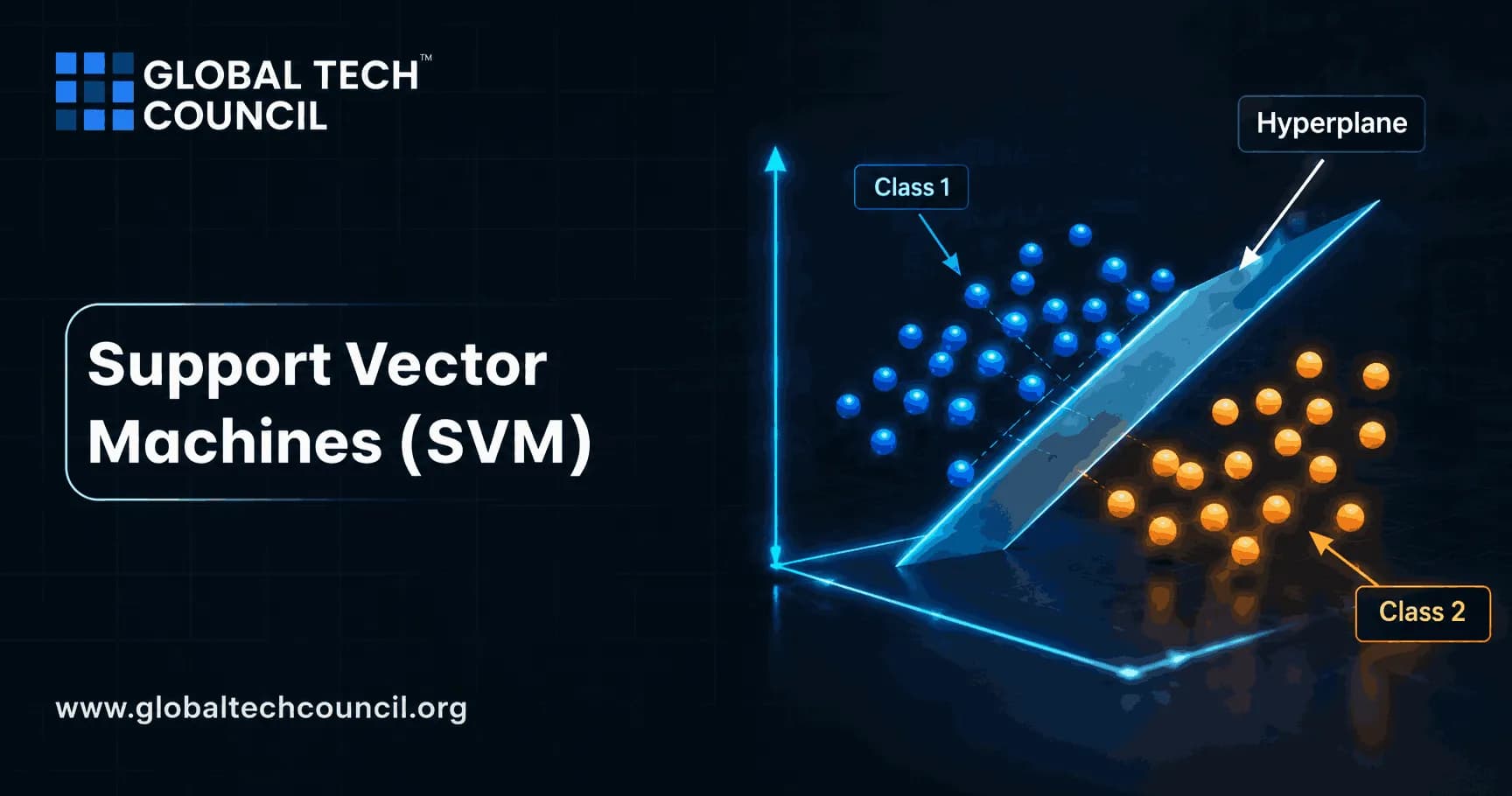
Support Vector Machines are supervised machine learning models built around a simple but powerful idea: draw the decision boundary that leaves the widest possible gap between classes. That gap is the margin. In practice, SVMs still earn their place in projects where the dataset is small or medium sized, features are high dimensional, and you need a model that generalizes well without a deep learning stack.
They are not fashionable in the way transformer models are. Good. That is part of their value. SVMs are mature, well studied, available in scikit-learn, and still common in healthcare, finance, manufacturing, text classification, computer vision, and anomaly detection.

Developing a strong understanding of margin-based learning algorithms like Support Vector Machines is an essential part of mastering machine learning fundamentals. A Certified Machine Learning Expert credential helps professionals build practical expertise in supervised learning, feature engineering, model evaluation, and algorithm selection, providing a solid foundation for solving real-world AI challenges.
What Is a Support Vector Machine?
A Support Vector Machine, or SVM, is a supervised learning algorithm used for classification, regression, and outlier detection. For binary classification, it tries to find a hyperplane written as w · x + b = 0 that separates two classes.
The important part is not just separation. The SVM searches for the separating hyperplane with the largest margin, meaning the maximum distance between the boundary and the closest training points from each class. Those closest points are the support vectors. Move them, and the boundary changes. Move most other points, and often nothing changes.
This is why SVMs can work well in high-dimensional spaces. In text classification, for example, a bag-of-words or TF-IDF matrix may contain tens of thousands of features, yet a linear SVM can still perform strongly because the margin objective controls complexity.
As organizations combine traditional machine learning algorithms with modern AI techniques, understanding where SVMs fit within the broader AI landscape becomes increasingly valuable. A Certified AI & Machine Learning Expert credential helps professionals develop this broader perspective by covering supervised learning, deep learning, ensemble methods, and practical AI deployment strategies for diverse business applications.
The Core Theory Behind SVMs
Hard Margin and Soft Margin
A hard-margin SVM assumes the classes are perfectly separable. Real data rarely behaves that nicely. Labels are noisy. Sensors drift. Medical records contain coding errors. A soft-margin SVM allows some violations through slack variables and penalizes them using the regularization parameter C.
Large C: The model tries harder to classify training points correctly. This can reduce bias but often narrows the margin.
Small C: The model tolerates more margin violations. This can improve generalization when the data is noisy.
Default in scikit-learn: C = 1.0 for SVC, a moderate starting point rather than a magic value.
The typical SVM classification objective uses hinge loss. A point correctly classified and outside the margin receives no loss. A point inside the margin, or on the wrong side of the boundary, is penalized. Simple idea. Strong effect.
Multiclass SVMs and SVR
SVMs were originally framed for binary classification, but libraries extend them to multiclass tasks. scikit-learn's SVC uses a one-vs-one strategy internally for multiclass classification. For regression, Support Vector Regression, or SVR, uses an epsilon-insensitive tube: prediction errors inside a chosen epsilon band are ignored, while larger errors are penalized.
If you are preparing for Global Tech Council's Certified Machine Learning Expert™ or Certified Data Science Developer® learning paths, pay close attention to this distinction. Certification questions often test whether you understand the margin and loss function, not just whether you can identify the acronym.
The Kernel Trick: Why SVMs Handle Non-Linear Data
The kernel trick is the reason SVMs became famous. Instead of manually transforming data into a higher-dimensional feature space, the algorithm replaces dot products with a kernel function. The model can learn a linear separator in that implicit feature space, which becomes a non-linear boundary in the original input space.
In plain English: you get non-linear classification without explicitly creating every transformed feature. That matters because some transformed spaces are extremely large, or even infinite dimensional.
Linear Kernel
The linear kernel is just the standard dot product: K(x, x') = x · x'. Use it when your data is roughly linearly separable or when your feature matrix is high dimensional and sparse.
Text classification is the classic case. If you have 50,000 TF-IDF features and 20,000 labeled documents, start with a linear SVM or logistic regression before trying an RBF kernel. To be blunt, an RBF SVM on a large sparse text matrix is often slow for no useful gain.
Polynomial Kernel
The polynomial kernel models interactions between features. A common form is K(x, x') = (gamma x · x' + r)^d, where d is the degree.
Polynomial kernels can help when you believe feature interactions matter, such as certain engineered tabular datasets. They can also overfit quickly. Degree 2 or 3 is already enough for many problems. Degree 7 is usually a warning sign unless you have a clear reason and strong validation results.
RBF Kernel
The Radial Basis Function kernel, also called the Gaussian kernel, is the usual default for non-linear SVMs. scikit-learn's SVC uses kernel='rbf' by default. Its form is K(x, x') = exp(-gamma ||x - x'||²).
The gamma parameter controls how far the influence of each training point reaches. High gamma creates very local decision regions. Low gamma creates smoother, broader boundaries. The RBF kernel is flexible, but that flexibility makes tuning important.
A small implementation detail that bites people: scikit-learn changed the default gamma from 'auto' to 'scale' in version 0.22. If you rerun an old notebook and get different validation accuracy, check this before blaming the data.
How to Choose the Right SVM Kernel
Use this practical order. It saves time.
Scale your features. Use StandardScaler inside a scikit-learn Pipeline. Do not scale before splitting data, because that leaks information from validation data into training.
Try a linear baseline. It is fast and often surprisingly hard to beat on sparse or high-dimensional data.
Try RBF next. For small to medium tabular datasets, RBF is usually the best non-linear starting point.
Tune C and gamma together. Use a logarithmic grid such as 0.001, 0.01, 0.1, 1, 10, 100.
Watch the support vector count. If most training samples become support vectors, prediction will be slower and the model may be fitting noise.
A typical mistake is setting both C and gamma high. The training score looks excellent. The validation score collapses. You have drawn a boundary that memorizes quirks in the training set.
Performance Characteristics and Limits
SVMs are strong, but they are not free. Standard kernel SVM training often scales between O(n²) and O(n³) with the number of samples. Once you pass roughly 100,000 dense samples, you should seriously consider alternatives such as stochastic gradient descent classifiers, gradient boosting, random forests, or neural networks.
Prediction can also be slower than expected because the model compares new points with support vectors. More support vectors means more work at inference time.
Where SVMs shine:
Small and medium-sized datasets
High-dimensional feature spaces
Clear margin-based classification problems
Structured tabular data with careful preprocessing
Domains where limited labeled data makes deep learning impractical
Where SVMs are often the wrong choice:
Massive dense datasets
End-to-end image, speech, or language modeling
Projects that require probability estimates as the primary output
Streaming data where frequent retraining is required
Yes, scikit-learn can produce probabilities with probability=True in SVC, but it uses additional cross-validation internally and slows training. If calibrated probabilities are central to your project, compare with logistic regression or calibrated gradient boosting.
Building production-ready machine learning systems involves more than selecting the right algorithm. A Deep Tech Certification helps professionals strengthen their expertise in cloud computing, distributed systems, software engineering, and cybersecurity, enabling them to deploy scalable, secure, and reliable AI solutions in enterprise environments.
Real-World Use Cases for Support Vector Machines
Healthcare and Biomedical Research
Recent PubMed-indexed healthcare reviews still report SVM use in diagnostic classification, risk stratification, biomarker analysis, and outlier detection. The attraction is easy to understand: clinical datasets often have many variables but limited samples. SVMs can be a good fit when validation is strict and preprocessing is defensible.
Text Analytics and NLP
SVMs have a long record in spam detection, sentiment analysis, topic classification, and document routing. A linear SVM on TF-IDF features remains a solid baseline. Do not skip it just because a transformer model is available. If your labeled dataset has 3,000 documents, the SVM may be cheaper, faster, and easier to validate.
Computer Vision and Pattern Recognition
Before deep learning dominated vision, SVMs were widely used with features such as HOG descriptors for object and face recognition. They still appear in classical image pipelines, especially where features are engineered and datasets are not huge.
Finance and Manufacturing
SVMs are used in credit risk modeling, fault detection, quality prediction, and machinery condition monitoring. In these settings, the input is often structured tabular data, and an SVM can act as a strong benchmark against tree-based models.
Cybersecurity and Anomaly Detection
One-class SVMs learn a boundary around normal observations and flag points outside it as anomalies. This is useful when abnormal examples are rare, such as early fraud signals or unusual network traffic. If you are also studying security analytics, Global Tech Council's Certified Cyber Security Expert™ can pair well with machine learning training for this type of work.
SVMs vs Modern Machine Learning Models
My practical view: SVMs are not outdated, but they are no longer the default for every supervised learning problem. For tabular data with many rows, gradient boosting libraries such as XGBoost, LightGBM, and CatBoost often win on speed and accuracy. For unstructured data at scale, deep learning is usually the right path.
Still, SVMs remain one of the best models to understand if you want to think clearly about margins, regularization, kernels, and generalization. Those ideas transfer. They show up in modern classifiers, metric learning, and representation learning even when the SVM itself is not used in production.
Next Step: Build and Tune One Properly
Pick a real dataset, not a toy one. Use a scikit-learn Pipeline with StandardScaler, compare linear and RBF kernels, tune C and gamma with cross-validation, and inspect the number of support vectors. If you want a structured path through these concepts, continue with Global Tech Council's Certified Machine Learning Expert™, then add Certified Data Science Developer® if your goal is applied model building across business datasets.
Successfully implementing machine learning projects also requires the ability to communicate technical outcomes in a way that supports organizational decision-making. A Marketing & Business Certification helps professionals develop the business strategy and communication skills needed to explain AI solutions, demonstrate measurable value, and align technical initiatives with broader business objectives.
FAQs
1. What is a Support Vector Machine (SVM)?
A Support Vector Machine (SVM) is a supervised machine learning algorithm used for classification, regression, and outlier detection. It works by identifying the optimal decision boundary, known as a hyperplane, that best separates different classes while maximizing the margin between them.
2. Why are Support Vector Machines important?
SVMs are valued for their strong theoretical foundation, effectiveness in high-dimensional spaces, and ability to model both linear and nonlinear decision boundaries. They remain widely used in applications involving text classification, image recognition, bioinformatics, and scientific research.
3. How does an SVM work?
An SVM analyzes training data to identify the hyperplane that separates different classes with the largest possible margin. During prediction, new data points are classified based on which side of the decision boundary they fall, helping improve generalization to unseen data.
4. What is a hyperplane in SVM?
A hyperplane is the mathematical boundary that separates different classes in the feature space. In two dimensions it appears as a line, in three dimensions as a plane, and in higher dimensions as a generalized separating surface.
5. What are support vectors?
Support vectors are the training examples located closest to the separating hyperplane. These observations play a critical role because they determine the position of the decision boundary and influence the model's ability to classify future observations.
6. What is the margin in an SVM?
The margin is the distance between the separating hyperplane and the nearest support vectors from each class. SVM aims to maximize this margin because larger margins generally improve the model's ability to generalize to new data.
7. What is the kernel trick?
The kernel trick allows SVMs to solve nonlinear classification problems without explicitly transforming data into higher-dimensional feature spaces. Instead, kernel functions compute similarities efficiently, enabling complex decision boundaries while reducing computational complexity.
8. What are the most common SVM kernels?
Common kernel functions include the Linear Kernel, Polynomial Kernel, Radial Basis Function (RBF) Kernel, and Sigmoid Kernel. The choice of kernel depends on the complexity of the data, computational requirements, and the nature of the classification problem.
9. When should you use a linear kernel?
A linear kernel is often appropriate when data is approximately linearly separable or when working with high-dimensional datasets such as text classification. It is computationally efficient and can provide strong performance with relatively simple decision boundaries.
10. When is the RBF kernel a good choice?
The Radial Basis Function (RBF) kernel is commonly used when relationships between features and target classes are nonlinear. It offers flexibility for modeling complex patterns but generally requires careful tuning of hyperparameters such as gamma and the regularization parameter.
11. What are the key SVM hyperparameters?
Important hyperparameters include the regularization parameter (C), kernel type, gamma for RBF and other nonlinear kernels, polynomial degree, and kernel coefficient settings. Proper tuning through cross-validation can significantly influence model performance.
12. What are the advantages of SVM?
SVMs perform well in high-dimensional feature spaces, work effectively with smaller datasets, support nonlinear classification through kernels, provide robust theoretical guarantees, and are less prone to overfitting when properly regularized.
13. What are the limitations of SVM?
SVMs can become computationally expensive on very large datasets, require careful hyperparameter tuning, may be sensitive to feature scaling, and generally provide less interpretable models than simpler algorithms such as decision trees or logistic regression.
14. What are common applications of SVM?
SVMs are used for text classification, spam detection, handwriting recognition, image classification, facial recognition, bioinformatics, medical diagnosis support, fraud detection, sentiment analysis, and fault detection in industrial systems.
15. Which industries use Support Vector Machines?
Industries including healthcare, finance, cybersecurity, telecommunications, manufacturing, retail, pharmaceuticals, education, scientific research, and marketing use SVMs for predictive modeling, classification, anomaly detection, and decision-support applications.
16. Which Python libraries support SVM?
Popular libraries include Scikit-learn, LIBSVM, NumPy, Pandas, SciPy, Matplotlib, TensorFlow, PyTorch, and Yellowbrick. Scikit-learn provides efficient implementations for classification, regression, hyperparameter tuning, and model evaluation.
17. What common mistakes should beginners avoid?
Common mistakes include neglecting feature scaling, choosing unsuitable kernels, failing to tune hyperparameters, ignoring class imbalance, evaluating only training accuracy, introducing data leakage, and applying SVMs to massive datasets without considering computational costs.
18. What are best practices for using SVM?
Best practices include cleaning and scaling data, selecting an appropriate kernel, tuning hyperparameters with cross-validation, comparing multiple algorithms, monitoring evaluation metrics beyond accuracy, documenting experiments, and validating performance on independent test datasets.
19. What trends are shaping SVM applications in 2025-2026?
Current trends include hybrid AI pipelines, explainable AI techniques, GPU-assisted optimization, AutoML integration, edge AI deployments, scientific computing applications, anomaly detection systems, and combining SVMs with deep learning features for specialized prediction tasks.
20. What is the future of Support Vector Machines?
Support Vector Machines are expected to remain valuable for classification problems involving structured data, smaller datasets, and high-dimensional feature spaces where strong theoretical performance is important. While deep learning dominates many large-scale unstructured data applications, SVMs continue to offer reliable, interpretable, and efficient solutions for numerous real-world tasks. Sometimes drawing one exceptionally well-placed boundary beats constructing an entire forest of models, much to the disappointment of unnecessary complexity.
Related Articles
View All
Machine Learning
Top Machine Learning Use Cases Across Industries in 2026
Explore the top machine learning use cases across industries in 2026, from predictive maintenance and fraud detection to healthcare AI and CRM automation.

Machine Learning
Generative AI vs Machine Learning: Differences, Overlaps, and Use Cases
Learn how generative AI differs from traditional machine learning, where they overlap, and how to choose the right approach for enterprise AI use cases.

Machine Learning
Supervised Learning Explained: Algorithms, Examples, and Use Cases
Learn supervised learning with clear explanations of algorithms, classification, regression, real use cases, evaluation metrics, and practical model-building tips.
Trending Articles
The Role of Blockchain in Ethical AI Development
How blockchain technology is being used to promote transparency and accountability in artificial intelligence systems.
AWS Career Roadmap
A step-by-step guide to building a successful career in Amazon Web Services cloud computing.
Top 5 DeFi Platforms
Explore the leading decentralized finance platforms and what makes each one unique in the evolving DeFi landscape.