

Neural Networks Explained: Structure, Training, and Applications
 Suyash Raizada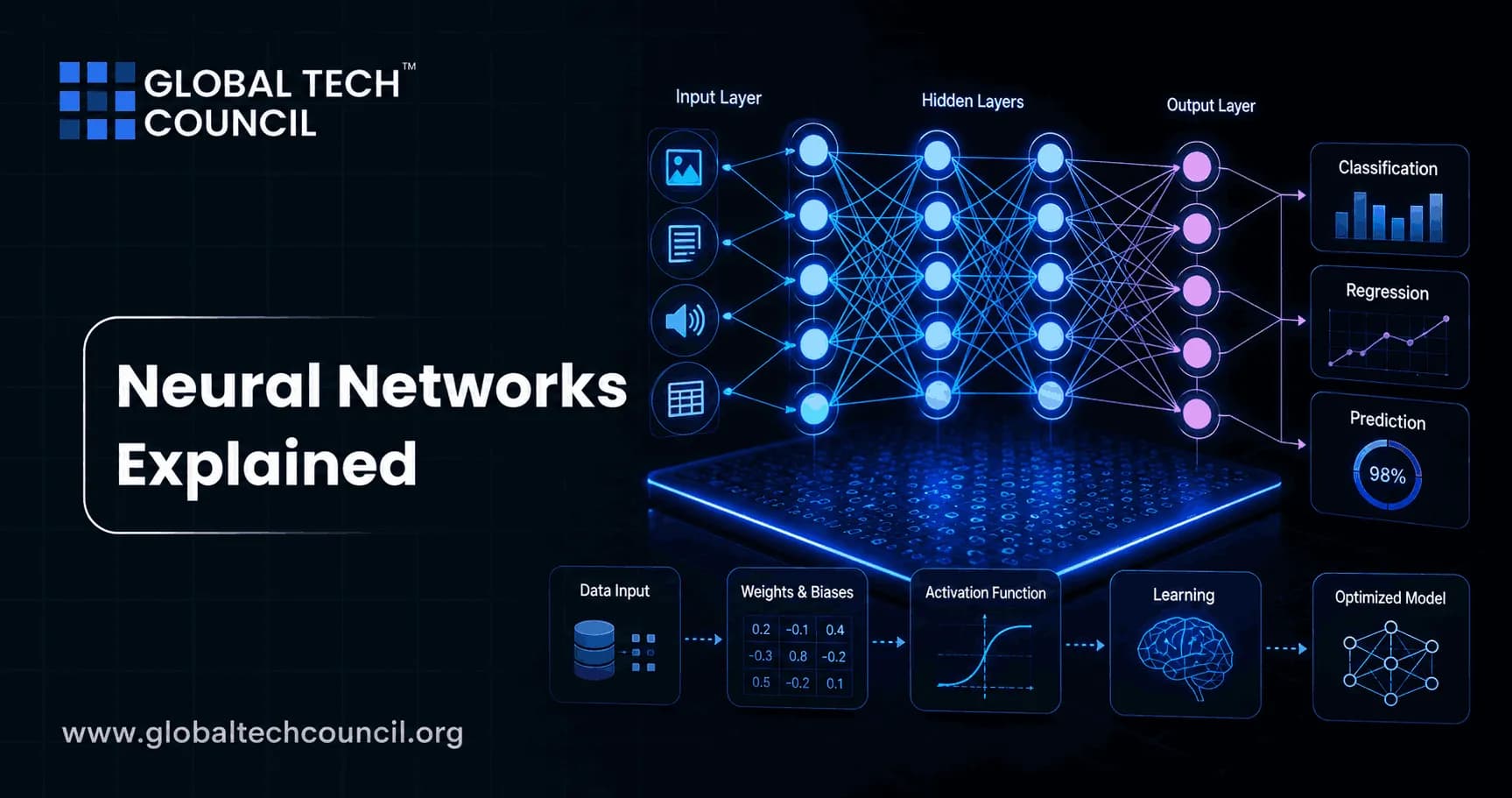
Neural networks explained in plain terms: they are layered mathematical systems that learn patterns from examples. Give a network enough clean data, the right architecture, and a measurable objective, and it can classify images, predict fraud, recommend products, summarize text, or detect abnormal network traffic. Give it poor labels or the wrong metric, and it will confidently learn the wrong thing. That is the part beginners underestimate.
Neural networks now sit behind computer vision, natural language processing, speech recognition, recommendation engines, financial risk models, and many generative AI tools. They are not magic. They are function approximators trained through repeated error correction. Once you see the structure and training loop, the field becomes much less mysterious.

Building a solid understanding of neural networks begins with mastering the fundamentals of machine learning and model development. A Certified Machine Learning Expert credential helps professionals strengthen their knowledge of supervised learning, model evaluation, feature engineering, and neural network fundamentals, providing the practical foundation needed to work confidently with modern AI systems.
What Is a Neural Network?
An artificial neural network is a set of connected units, often called neurons, arranged in layers. Each neuron receives input values, multiplies them by learned weights, adds a bias, and passes the result through an activation function. The network uses these small calculations, repeated thousands or billions of times, to map inputs to outputs.
A typical network has three broad parts:
Input layer: Receives raw or processed features, such as pixels, words, sensor readings, or transaction attributes.
Hidden layers: Transform the data into useful intermediate representations.
Output layer: Produces a prediction, such as a class label, probability score, generated token, or numeric value.
Here is the key idea. Early layers usually learn simple patterns. In an image model, those may be edges or color contrasts. Deeper layers combine them into shapes, object parts, and eventually higher-level concepts such as faces, vehicles, tumors, or road signs. In text models, layers learn token relationships, grammar patterns, entities, intent, and context.
As neural networks become central to applications such as computer vision, natural language processing, and predictive analytics, professionals increasingly need expertise that spans both traditional machine learning and modern AI techniques. A Certified AI & Machine Learning Expert credential helps develop these capabilities, covering model development, deep learning concepts, deployment practices, and real-world AI applications in a structured way.
How a Neuron Works
A neuron performs a compact calculation:
output = activation(weighted sum of inputs + bias)
The activation function matters because it introduces nonlinearity. Without it, stacking layers would collapse into a single linear transformation. Common activations include ReLU, sigmoid, tanh, GELU, and softmax. ReLU is common in many feedforward and convolutional networks because it is simple and fast, but it can create inactive neurons if learning rates are careless. GELU is widely used in transformer models.
A small implementation detail can ruin a training run. In PyTorch, torch.nn.CrossEntropyLoss expects raw logits and integer class labels. If you apply softmax before passing outputs into that loss, training may look slow or unstable because the loss function already applies log-softmax internally. Another classic beginner error is the shape mismatch: RuntimeError: mat1 and mat2 shapes cannot be multiplied. It usually means the flattened feature size after a convolution layer is not what you thought it was. Print tensor shapes. Do it early.
Major Neural Network Architectures
Feedforward Neural Networks
Feedforward networks pass information in one direction, from input to output. They work well for structured data, tabular prediction, regression, and simple classification tasks. If your dataset has rows and columns rather than images, text, or graphs, start here or with gradient-boosted trees. To be blunt, a deep neural network is often the wrong first choice for a small spreadsheet.
Convolutional Neural Networks
Convolutional neural networks, or CNNs, use filters that scan local regions of an image or signal. CNNs are strong for image classification, object detection, medical imaging, manufacturing inspection, facial recognition, video analysis, and image compression. They reduce the number of parameters compared with fully connected image models and exploit spatial structure naturally.
Recurrent Neural Networks
Recurrent neural networks, or RNNs, process sequences while maintaining a memory of previous steps. LSTMs and GRUs improved older RNNs by handling longer dependencies more effectively. RNNs still appear in time series forecasting, speech, and signal applications, although transformers have replaced them in many language tasks.
Transformer-Based Neural Networks
Transformers use attention mechanisms to model relationships between tokens or patches. They power large language models, translation systems, code assistants, search ranking, document understanding, image generation pipelines, and multimodal AI. Their strength is context. Their cost is compute, memory, and careful data governance.
Generative Adversarial Networks
Generative adversarial networks, or GANs, train two models together: a generator creates synthetic samples, and a discriminator tries to distinguish them from real data. GANs have been used for photorealistic image generation, image-to-image translation, super-resolution, and synthetic data creation. They can be hard to train. Mode collapse is real, not a textbook footnote.
Graph Neural Networks
Graph neural networks, or GNNs, model data with nodes and edges. That fits social networks, fraud rings, supply chains, molecules, knowledge graphs, transaction networks, and traffic systems. If relationships between entities are central to the problem, a GNN may outperform a model that treats each row independently.
How Neural Networks Are Trained
Training means adjusting weights and biases until the network reduces prediction error on examples. The standard loop is simple to describe and demanding to execute well.
Define the problem. Decide what the model should predict and what business or technical decision it supports.
Collect data. Gather representative examples. Bad sampling creates bad models.
Preprocess inputs. Clean records, normalize numeric values, tokenize text, resize images, or build graph structures.
Choose an architecture. Use CNNs for images, transformers for language, GNNs for relational data, and simpler models when they are enough.
Run the forward pass. The network produces predictions.
Measure loss. A loss function quantifies error, such as cross-entropy for classification or mean squared error for regression.
Backpropagate gradients. Backpropagation computes how each parameter contributed to the error.
Update parameters. Optimizers such as SGD, Adam, or AdamW adjust weights.
Validate. Test on held-out data and track metrics such as accuracy, precision, recall, F1 score, AUC, latency, and calibration.
Deploy and monitor. Watch drift, bias, security exposure, and performance decay.
Hyperparameters matter more than newcomers expect. A learning rate of 1e-3 with Adam may train a small CNN nicely, while the same value can destabilize fine-tuning on a transformer. Batch size, weight decay, dropout, warmup steps, initialization, and class imbalance handling all change outcomes. Keep experiment logs. Future you will be grateful.
Learning Paradigms You Should Know
Supervised Learning
Supervised learning uses labeled examples. An image has a class label. A transaction is marked fraudulent or legitimate. A patient scan is annotated by clinicians. This is still the workhorse for many enterprise neural network projects because the target is explicit.
Self-Supervised Learning
Self-supervised learning creates training signals from the data itself. A model may predict masked words, missing image patches, or the next item in a sequence. This approach reduced dependence on manual labels and helped make large foundation models practical.
Unsupervised and Semi-Supervised Learning
Unsupervised learning finds structure without labels, often through clustering, dimensionality reduction, or representation learning. Semi-supervised learning mixes small labeled datasets with larger unlabeled datasets. This is useful when expert labels are expensive, such as radiology, cybersecurity incident review, or legal document classification.
Where Neural Networks Are Used
Healthcare and Life Sciences
Neural networks support medical imaging analysis, tumor detection, organ abnormality screening, ECG and EEG interpretation, drug discovery, molecule property prediction, and personalized risk scoring. The U.S. Food and Drug Administration tracks hundreds of AI and machine learning-enabled medical devices, showing that clinical use is no longer theoretical. Still, healthcare models need strict validation because a high test-set score does not automatically mean safe clinical performance.
Finance
Banks and fintech teams use neural networks for fraud detection, credit risk scoring, anti-money laundering alerts, portfolio analysis, customer churn prediction, and market forecasting. GNNs are especially useful when fraud depends on relationships between accounts, devices, merchants, and transfers.
Retail and Recommendation Systems
Recommendation engines learn from user behavior to rank products, films, news, courses, or music. Neural networks also support demand forecasting, inventory planning, dynamic pricing, promotion targeting, and customer segmentation. Accuracy is not the only metric here. Diversity, novelty, fairness, and user trust matter too.
Transportation and Autonomous Systems
Autonomous vehicles use neural networks for lane detection, object recognition, traffic sign reading, sensor fusion, and motion planning support. Transport operators also apply models to route planning, staff scheduling, elevator demand prediction, airport operations, and fleet maintenance.
Cybersecurity
Neural networks can detect anomalies in network traffic, classify malware, flag suspicious login behavior, and support intrusion detection. They are useful when attack patterns are too varied for hand-written rules. Do not treat them as a replacement for security engineering. Models need logging, threat modeling, adversarial testing, and response workflows. The NIST AI Risk Management Framework 1.0 highlights characteristics such as validity, reliability, safety, security, accountability, transparency, explainability, privacy, and fairness, all of which apply when AI touches risk decisions.
Science, Engineering, and Creative Work
In scientific computing, neural networks help with protein structure prediction, materials discovery, weather modeling, climate analysis, and simulation acceleration. Creative teams use generative models for image synthesis, music generation, visual design, video workflows, and synthetic training data. Use synthetic data carefully. It can fill gaps, but it can also amplify hidden bias if the generator learned a narrow distribution.
Practical Trade-Offs for Professionals
Neural networks are powerful, but they are not always the best answer. Use them when the problem has complex patterns, enough representative data, and measurable feedback. Avoid them when rules are simple, data volume is tiny, interpretability is the dominant requirement, or latency and compute budgets are tight.
If you are building your skill path, connect theory with implementation. Train a small CNN on CIFAR-10, fine-tune a transformer with Hugging Face Transformers, build a fraud graph with PyTorch Geometric, and deploy one model behind an API. That combination teaches more than reading architecture diagrams alone.
Building production-ready neural network solutions also requires expertise beyond model architecture, including cloud computing, software engineering, cybersecurity, and scalable infrastructure. A Deep Tech Certification helps professionals strengthen these advanced technical skills, enabling them to design secure and efficient AI systems that meet enterprise performance and reliability requirements.
Use this topic as a bridge into Global Tech Council learning paths across AI, machine learning, data science, programming, and cybersecurity. Pair the theory here with hands-on certification tracks in machine learning, artificial intelligence, data science, Python programming, and AI security.
What to Learn Next
Start with the training loop, not the newest model headline. Build one neural network end to end: prepare data, train, validate, save the model, serve predictions, and monitor mistakes. Then pick a specialization. Choose CNNs if you work with images, transformers if you work with language, GNNs if your data is relational, and cybersecurity modeling if your goal is threat detection. Your next concrete step: implement a small project in Python 3.12 with PyTorch 2.x, document every metric, and compare it with a simpler baseline before you call the neural network a success.
Technical expertise delivers greater impact when it is paired with the ability to communicate AI outcomes and align projects with organizational objectives. A Marketing & Business Certification helps professionals strengthen these business and communication skills, making it easier to explain complex AI solutions, demonstrate measurable value, and support strategic decision-making.
FAQs
1. What are neural networks?
Neural networks are machine learning models inspired by the structure and function of biological neurons. They consist of interconnected layers of artificial neurons that learn complex patterns from data, making them suitable for tasks such as image recognition, natural language processing, speech recognition, and predictive analytics.
2. Why are neural networks important in artificial intelligence?
Neural networks enable computers to solve problems that are difficult to address using traditional rule-based programming. Their ability to automatically learn hierarchical representations from large datasets has driven major advances in computer vision, generative AI, autonomous systems, healthcare, finance, and many other fields.
3. What is the basic structure of a neural network?
A typical neural network consists of an input layer, one or more hidden layers, and an output layer. Data flows through these interconnected layers, where each neuron performs mathematical operations before passing information to the next layer until a prediction is generated.
4. What are artificial neurons?
Artificial neurons are the fundamental processing units of a neural network. Each neuron receives input values, applies weights and a bias, performs a mathematical calculation, passes the result through an activation function, and produces an output for subsequent layers.
5. What are weights and biases?
Weights determine the influence of each input on a neuron's output, while biases allow the model to shift activation thresholds independently of the input values. During training, both are updated to reduce prediction errors and improve model performance.
6. What are activation functions?
Activation functions introduce nonlinearity into neural networks, allowing them to learn complex relationships that linear models cannot represent. Common activation functions include ReLU, Sigmoid, Tanh, Softmax, GELU, and Leaky ReLU, depending on the model architecture and learning task.
7. How do neural networks process information?
Neural networks process information through forward propagation, where input data passes layer by layer through weighted connections and activation functions. Each hidden layer extracts progressively more abstract features before the output layer produces the final prediction.
8. How are neural networks trained?
Training involves feeding labeled or unlabeled data into the network, calculating prediction errors using a loss function, computing gradients through backpropagation, and updating parameters with optimization algorithms. This process repeats over multiple epochs until performance stabilizes or predefined stopping criteria are met.
9. What is backpropagation?
Backpropagation is an algorithm that calculates how much each weight and bias contributes to the model's prediction error. These gradients allow optimization algorithms to update parameters efficiently and improve predictive accuracy during training.
10. What is gradient descent?
Gradient descent is an optimization technique that minimizes the loss function by adjusting model parameters in the direction that reduces prediction errors. Common optimizers include Stochastic Gradient Descent (SGD), Adam, AdamW, RMSprop, and Adagrad.
11. What are epochs, batches, and iterations?
An epoch represents one complete pass through the entire training dataset. A batch is a subset of training data processed together, while an iteration is a single parameter update performed after processing one batch. Mini-batch training is widely used because it balances efficiency and learning stability.
12. What types of neural networks are commonly used?
Common neural network architectures include Feedforward Neural Networks (FNNs), Convolutional Neural Networks (CNNs), Recurrent Neural Networks (RNNs), Long Short-Term Memory (LSTM) networks, Transformers, Graph Neural Networks (GNNs), Autoencoders, and Generative Adversarial Networks (GANs). Each architecture is designed for specific types of data and applications.
13. What are the main applications of neural networks?
Neural networks are widely used for image classification, object detection, speech recognition, machine translation, recommendation systems, fraud detection, medical diagnosis support, financial forecasting, predictive maintenance, robotics, autonomous vehicles, and generative AI applications.
14. What challenges do neural networks face?
Common challenges include overfitting, underfitting, large computational requirements, extensive data needs, lengthy training times, hyperparameter optimization, limited interpretability, potential bias in training data, and deployment complexity for large-scale systems.
15. Which tools and frameworks are used for neural networks?
Popular frameworks include TensorFlow, Keras, PyTorch, JAX, Hugging Face Transformers, ONNX, and Lightning. Supporting libraries such as NumPy, Pandas, OpenCV, and Matplotlib are also commonly used throughout the development process.
16. What are best practices for building neural networks?
Best practices include using high-quality data, selecting appropriate architectures, applying proper preprocessing, monitoring validation performance, preventing overfitting with regularization techniques, documenting experiments, using reproducible pipelines, and evaluating models on independent test datasets.
17. How do neural networks compare with traditional machine learning models?
Traditional machine learning models often perform well on structured datasets with engineered features and may require fewer computational resources. Neural networks generally excel on complex, high-dimensional, or unstructured data such as images, audio, text, and video, particularly when sufficient training data is available.
18. How do neural networks fit into MLOps?
Neural networks are integrated into MLOps workflows through automated training pipelines, experiment tracking, model versioning, deployment automation, continuous monitoring, performance evaluation, and periodic retraining. These practices help maintain consistent model quality in production environments.
19. What trends are shaping neural networks in 2025-2026?
Key trends include multimodal foundation models, efficient transformer architectures, parameter-efficient fine-tuning, edge AI deployment, federated learning, energy-efficient neural network optimization, synthetic data generation, explainable AI, and increasing adoption of AI agents built on neural network technologies.
20. What is the future of neural networks?
Neural networks are expected to remain a core technology for artificial intelligence as research continues to improve efficiency, scalability, reasoning capabilities, and responsible deployment. Future systems will likely combine neural networks with symbolic reasoning, retrieval techniques, and specialized hardware to solve increasingly complex real-world problems while balancing performance, transparency, and sustainability. Even the smartest neural network begins with random weights and absolutely no idea what it's doing, which is an unexpectedly human way to start learning.
Related Articles
View All
Machine Learning
PyTorch Tutorial for Beginners: Training Neural Networks Step by Step
Learn PyTorch step by step with tensors, DataLoaders, nn.Module, training loops, evaluation, and model saving for beginner neural networks.
Machine Learning
Model Training Explained: How Machine Learning Models Learn
Model training explained with the learning loop, loss functions, backpropagation, gradient descent, mini-batches, validation, and practical debugging tips.

Machine Learning
Semi-Supervised Learning Explained: Training Models with Limited Labeled Data
Semi-supervised learning uses limited labeled data plus larger unlabeled datasets to train accurate models while reducing annotation effort.
Trending Articles
The Role of Blockchain in Ethical AI Development
How blockchain technology is being used to promote transparency and accountability in artificial intelligence systems.
AWS Career Roadmap
A step-by-step guide to building a successful career in Amazon Web Services cloud computing.
Top 5 DeFi Platforms
Explore the leading decentralized finance platforms and what makes each one unique in the evolving DeFi landscape.