

Evaluating Agentic AI: Metrics and Benchmarks for Reliable Tool Use and Task Completion
 Suyash Raizada
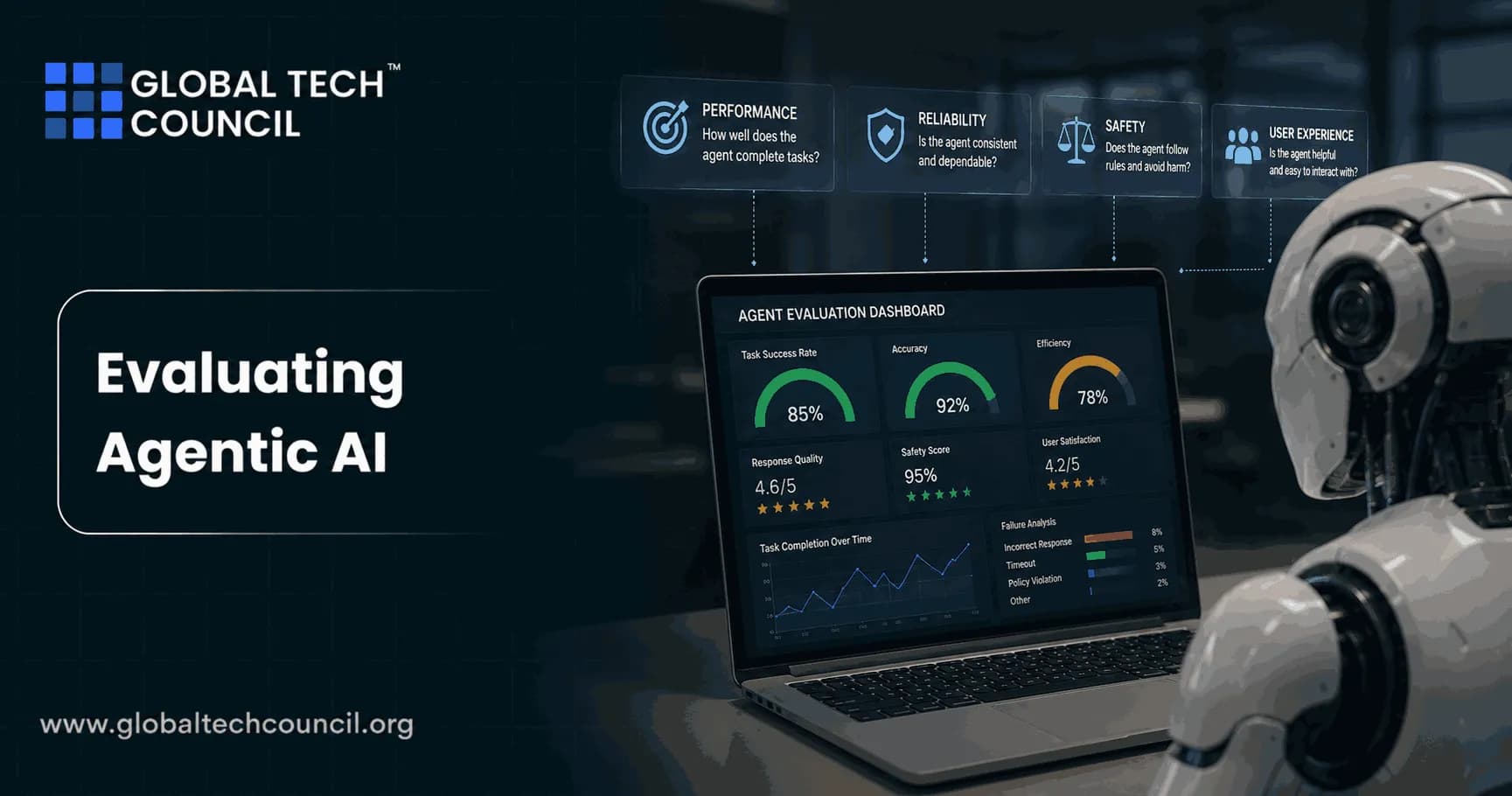
Evaluating agentic AI is shifting from ad-hoc prompt checks to systematic, multi-dimensional measurement. Unlike single-turn chatbot responses, agentic systems plan across steps, call tools and APIs, use memory, and make decisions under uncertainty. That makes evaluation less about one accuracy score and more about understanding whether an agent reliably completes tasks, uses tools correctly, stays within policy, and does so at an acceptable cost and latency. Professionals looking to strengthen their understanding of agentic AI evaluation can explore the Certified Agentic AI Expert certification as part of their learning journey.
Industry guidance from major cloud providers and enterprise frameworks increasingly recommends combining offline benchmarks with continuous production telemetry and human-in-the-loop feedback. The goal is to measure real workflow performance, not just isolated model behavior.

Why Evaluating Agentic AI Is Difficult
Agentic AI behaves like a system, not a single model call. Three properties create evaluation complexity. For professionals developing these systems and their evaluation workflows, the Certified Agentic AI Developer certification may be relevant to building practical technical knowledge.
Multi-step execution: An agent can succeed early and fail late, or vice versa, and the final outcome depends on the entire action sequence.
Tool dependence: Correctness often depends on selecting the right tool and passing correct parameters, not only generating well-formed text.
Non-determinism: Even with identical inputs, runs can vary due to stochastic sampling, tool latency, and changing external states.
Policy and research perspectives have identified a persistent gap: reliability and behavioral consistency are poorly captured by static benchmarks. For enterprise teams, this is a practical issue because workflow-specific success criteria and risk tolerance vary significantly by domain.
Core Metric Families for Evaluating Agentic AI
Effective evaluation programs treat metrics as a scorecard rather than a single number. In practice, teams track a set of KPIs aligned to business outcomes and operational risk.
1) Task Success and Outcome Quality
Task success rate: Percentage of tasks completed according to ground-truth or defined acceptance criteria.
Partial completion rate: Tasks where some required subtasks were completed, but the end-to-end objective was not met.
Outcome quality and goal alignment: Rubric-based scoring for whether outputs meet domain requirements, for example, correct format, correct fields updated, and correct business logic applied.
For enterprise agents, task success should be defined in the language of the workflow: ticket resolved, record updated correctly, data pipeline completed, or compliance step executed with audit evidence.
2) Tool Use Accuracy
Tool use is where many agent failures become visible. Tool metrics should separate selection, parameterization, and sequencing.
Tool selection accuracy: How often the agent chooses the correct tool for a subtask, compared with a reference policy or human labels.
Tool parameter accuracy: Whether arguments match required schemas and identifiers, for example, correct ticket ID, correct date range, and valid JSON structure.
Action sequence correctness: Whether the tool call order respects dependencies and rules, for example, authentication before data retrieval, and approval before a destructive action.
These metrics are especially important for agents operating across internal systems, where a single incorrect parameter can create downstream data quality or security incidents.
3) Reliability and Robustness
Reliability focuses on consistency and recovery, not just average performance.
Consistency across runs: Variability when executing the same task multiple times, often tracked as success variance or output divergence.
Error rate: Frequency of tool failures, timeouts, invalid actions, and system exceptions.
Failure mode distribution: Breakdown of failures by category, such as hallucination, tool error, misinterpretation, planning dead-end, or timeout.
Recovery rate: Percentage of failures the agent can resolve via retry, re-planning, or fallback strategies without human intervention.
Tracking failure mode distribution is one of the most actionable practices because it shows where to direct engineering effort: tool wrappers, prompt constraints, memory policies, or escalation logic.
4) Quality and Safety Signals
Factual accuracy: Correctness of statements relative to trusted sources.
Hallucination rate: Frequency of unsupported or fabricated content, which is especially risky in summarization and decision support contexts.
Policy compliance and controllability: Whether outputs and actions follow instruction hierarchies, security controls, and governance rules.
In regulated environments, these measures should be tied to auditable logs and clear decision rules. This is also where in-the-loop evaluation can serve as a runtime guardrail.
5) Efficiency and Cost
End-to-end latency: Total time to complete a task and latency per agent loop.
LLM cost per task: Token usage multiplied by model pricing, tracked per successful and per failed run.
Tool cost: API charges and compute time where relevant.
Memory and context utilization: Whether the agent uses relevant stored context effectively rather than repeatedly requesting information or making avoidable calls.
Enterprise frameworks increasingly treat cost per successful outcome as a first-class KPI, because agent workflows can silently expand token usage through loops and retries.
6) Human Interaction Metrics
Human-in-the-loop intervention rate: Frequency of human approvals, overrides, or corrections.
Escalation rate: Percentage of tasks routed to humans due to uncertainty, policy constraints, or repeated failure.
Clarification ratio: How often the agent requests clarifying information versus proceeding with insufficient context.
These metrics help organizations tune autonomy boundaries. If escalation is too high, the agent is not delivering operational value. If escalation is too low in risky workflows, controls may be insufficient.
Offline vs. In-the-Loop Evaluation: How to Use Both
Modern evaluation guidance distinguishes two complementary modes.
Offline Evaluation (Development and Test)
Offline evaluation compares agent versions, prompts, planning strategies, and tool sets against curated task suites. It is well suited for regression testing and benchmarking before deployment and can be applied to individual tools as well as full end-to-end runs.
For teams building these capabilities, structured training in AI governance, machine learning, and data science can directly support the design of acceptance criteria, scoring rubrics, and test methodology. Exploring a Deep Tech Certification may also complement broader learning about the technical foundations of emerging AI systems.
In-the-Loop Evaluation (Runtime Guardrails)
In-the-loop evaluation runs during execution and can influence control flow. For example, if a risk or confidence score crosses a defined threshold, the agent can stop, request clarification, or escalate for human approval. This mode is particularly relevant for workflow optimization and regulatory risk management.
In practice, in-the-loop checks are most effective when they are specific and enforceable, such as blocking a tool call that attempts to access restricted data or preventing destructive actions without prior approval.
Benchmarks That Matter: Synthetic Tasks, Real Task Replay, and Production Telemetry
No single benchmark type is sufficient. High-performing teams combine controlled testing with real-world observability.
Synthetic Task Benchmarks for Controlled Comparison
Synthetic benchmarks are standardized tasks that simulate realistic workflows. Enterprise guidance often recommends starting with 50 to 100 tasks to balance coverage and manageability. Examples include:
Download sales data, clean it, and upload to SharePoint.
Monitor server metrics and open a ticket if CPU utilization exceeds 80 percent.
For each task, record a vector of outcomes including success, partial completion, tool call success rate, action accuracy, latency, and cost. Synthetic tasks are strong for regression testing and A-B comparisons, but they cannot fully replace in-context evaluation of reliability and socio-technical risk.
Real Task Replay for Enterprise Realism
Real task replay runs agents against anonymized historical tickets, workflows, or cases. This method is often more predictive of production performance because it includes messy inputs, incomplete user context, and domain-specific edge cases.
Measure: resolution rate, time to resolution, error and escalation rates, tool misfires, and recovery behavior.
Compare: agent versions against each other and against historical human baselines where available.
Production Evaluation and Observability
Production evaluation treats agents like distributed systems. A common pattern is step-level instrumentation using OpenTelemetry alongside monitoring stacks such as Prometheus, Grafana, or Datadog. At minimum, logs should capture:
Inputs and outputs per step
Tool calls, parameters, and responses
Timestamps for latency attribution
Error categories and retry behavior
Escalations and human overrides
This supports dashboards that show not only the overall success rate, but also why the agent fails and whether failures are trending toward hallucination, tool instability, or planning errors.
Putting It Together: A Practical Evaluation Scorecard
For most organizations, the most effective approach is a scorecard that aggregates multiple dimensions. A practical structure includes:
Effectiveness: task success rate, partial completion rate, rubric score
Tool use accuracy: selection accuracy, parameter accuracy, sequence correctness
Reliability: consistency across runs, error rate, recovery rate, failure mode distribution
Efficiency: latency per task, cost per task, cost per successful task
Safety and governance: policy violations, blocked actions, audit completeness
Human factors: escalation rate, intervention rate, user satisfaction
Over time, teams can set domain-specific thresholds. An IT operations agent might prioritize low false positives and high tool call success, while a customer support agent might emphasize CSAT and hallucination suppression tied to a curated knowledge base.
Assessing Candidates for Emerging AI Roles
Agentic AI systems can plan tasks, use tools, and execute multi-step workflows with varying degrees of autonomy. As organisations explore these capabilities, they also need professionals who can design, monitor, and evaluate such systems. HireValid can be explored by employers looking for structured ways to assess candidates for emerging technology roles.
Conclusion: Evaluating Agentic AI as an Evolving System
Evaluating agentic AI requires moving beyond single-score benchmarking toward continuous, multi-dimensional measurement of workflows. The most robust evaluation programs combine offline benchmarks, real task replay, and production telemetry, with human feedback closing the loop. This approach aligns with guidance from cloud providers, enterprise frameworks, and policy research: reliability, consistency, and governance cannot be inferred from static tests alone.
As agentic systems become more autonomous and tool-integrated, evaluation will increasingly resemble system assurance: instrumented execution, auditable logs, clear acceptance criteria, and metric vectors that capture success, reliability, cost, and safety together. For teams building or governing these systems, structured skills in AI engineering, data science, and cybersecurity can directly improve evaluation design and operational readiness. Professionals who want to connect emerging technology with business applications can also explore Marketing Certification as part of their wider professional development.
FAQs
1. What is Agentic AI evaluation?
Agentic AI evaluation is the process of measuring how reliably an AI agent plans tasks, uses tools, follows instructions, and achieves its intended goals. It assesses task accuracy, execution quality, efficiency, safety, and the agent's ability to recover from errors in realistic environments.
2. Why is evaluating Agentic AI important?
Evaluating Agentic AI helps developers identify failures, measure reliability, control operational costs, and verify that agents behave within their authorized boundaries. Proper evaluation is essential before deploying autonomous systems in customer support, software development, enterprise operations, or other consequential workflows.
3. What are the key metrics for evaluating Agentic AI systems?
Key metrics include task completion rate, tool-call accuracy, execution time, cost per successful task, instruction adherence, factual accuracy, recovery rate, and safety violations. The most relevant metrics depend on the agent's purpose, risk level, and operating environment.
4. How do you measure AI agent task completion?
Task completion can be measured by checking whether the agent achieves predefined success criteria. Evaluation may use exact-match answers, database state changes, successful API responses, test results, or human review. A completed workflow should produce the intended outcome, not merely a convincing final response.
5. What is tool-use accuracy in Agentic AI?
Tool-use accuracy measures whether an AI agent selects the appropriate tool, supplies valid arguments, follows the required sequence, and correctly interprets the result. It helps identify failures such as incorrect API calls, invalid parameters, unnecessary tool usage, and actions performed without authorization.
6. What are the best benchmarks for evaluating AI agents?
Useful benchmarks include τ-bench for evaluating agents in simulated customer-service tasks, SWE-bench for software engineering tasks, WebArena for web-based interactions, and GAIA for general assistant capabilities. Each benchmark measures different skills, so results should be interpreted according to the intended application.
7. How does task success rate help evaluate Agentic AI?
Task success rate measures the proportion of evaluation tasks completed according to predefined criteria.
For example, if an agent successfully completes 85 out of 100 tasks, its task success rate is 85%. This metric provides a straightforward measure of overall effectiveness, but it should be combined with safety, cost, and reliability metrics.
8. What is the difference between pass rate and task completion rate?
Pass rate typically measures the proportion of test cases that satisfy specified evaluation criteria. Task completion rate measures the proportion of assigned tasks that reach their intended outcome. The terms can overlap, so teams should define the exact success conditions before comparing results.
9. How do developers evaluate an AI agent's ability to use APIs?
Developers can evaluate API use by checking tool selection, argument validity, authentication, response handling, error recovery, and the final system state. Tests should include malformed requests, rate limits, unavailable services, permission failures, and unexpected responses to assess how safely the agent handles real-world conditions.
10. How can developers measure the reliability of autonomous AI agents?
Reliability can be measured through repeated task execution, success-rate consistency, error frequency, recovery performance, and behavior under changing conditions. Developers should test across multiple runs because an agent may succeed on one attempt and fail on another due to model variability or environmental differences.
11. What is trajectory evaluation in Agentic AI?
Trajectory evaluation examines the sequence of actions an agent takes to complete a task, rather than judging only its final output. It can reveal unnecessary tool calls, inefficient planning, policy violations, and incorrect intermediate decisions, even when the agent eventually reaches the correct result.
12. How do you measure the efficiency of an AI agent?
Efficiency metrics include task duration, number of tool calls, token consumption, computational resource usage, and cost per successful task. These metrics help teams identify unnecessary reasoning loops and excessive tool usage while ensuring that optimization does not compromise accuracy or safety.
13. How should developers evaluate AI agent safety?
Safety evaluation tests whether an agent respects permissions, protects sensitive information, rejects unauthorized actions, and handles malicious instructions appropriately. Teams should measure policy violations, unauthorized tool calls, data exposure incidents, and the effectiveness of human approval mechanisms.
14. What is the role of human evaluation in Agentic AI benchmarking?
Human evaluation helps assess qualities that automated tests may miss, such as usefulness, clarity, judgment, and adherence to complex business requirements. Human reviewers can also investigate ambiguous failures and determine whether an agent's actions were appropriate in context.
15. How can developers evaluate multi-agent systems?
Multi-agent systems should be evaluated on overall task success, coordination quality, communication overhead, duplicate work, conflict resolution, and cost. Testing should also examine whether one agent's errors propagate to other agents and whether the system can recover when an individual agent fails.
16. What is the difference between offline and online evaluation of Agentic AI?
Offline evaluation tests agents against predefined datasets, simulations, or recorded scenarios before deployment. Online evaluation measures performance in live or controlled production environments. Offline tests support repeatability, while online evaluation helps reveal real-world issues involving changing data, users, and external systems.
17. How can businesses create a reliable Agentic AI evaluation framework?
Businesses should define success criteria, build representative test scenarios, select task-specific metrics, and establish safety thresholds. They should compare agent performance against a baseline, track costs and failure patterns, and repeat evaluations after model, prompt, tool, or workflow changes.
18. Why are benchmark scores not enough to evaluate AI agents?
Benchmark scores represent performance on particular tasks under specific testing conditions. They may not reflect production complexity, changing data, security requirements, or business-specific constraints. Organizations should combine public benchmark results with internal evaluations, adversarial testing, and controlled real-world pilots.
19. How often should Agentic AI systems be evaluated?
Agentic AI systems should be evaluated before deployment and whenever important models, prompts, tools, permissions, or workflows change. Production monitoring should continue after launch, with periodic regression tests and additional assessments following incidents or significant changes in operating conditions.
20. What are the best practices for benchmarking Agentic AI in 2026?
Best practices include using realistic tasks, defining objective success criteria, testing multiple runs, tracking tool-use quality, measuring cost and latency, and assessing safety separately from task completion. Teams should combine established benchmarks with domain-specific tests and maintain continuous evaluation as agents and their environments evolve.
Related Articles
View All
Agentic AI
Evaluating AI Agents: Key Metrics, Benchmarks, and Testing Frameworks for Reliability
Learn how evaluating AI agents differs from LLM evaluation, with key reliability metrics, modern benchmarks, and hybrid testing frameworks for production.

Agentic AI
Building Autonomous AI Agents with LLMs: Tool Use, Planning, and Memory Explained
Learn how to build autonomous AI agents with LLMs using tool calling, planning loops, and memory systems like RAG, plus safety and evaluation best practices.

Agentic AI
Agentic AI in the Enterprise: High-Impact Use Cases Across Customer Support, DevOps, and Analytics
Explore agentic AI in the enterprise with real use cases in customer support, DevOps, and analytics, plus guardrails and KPIs to deploy safely and measure ROI.
Trending Articles
The Role of Blockchain in Ethical AI Development
How blockchain technology is being used to promote transparency and accountability in artificial intelligence systems.
AWS Career Roadmap
A step-by-step guide to building a successful career in Amazon Web Services cloud computing.
Top 5 DeFi Platforms
Explore the leading decentralized finance platforms and what makes each one unique in the evolving DeFi landscape.