

AI Agents 101: What They Are, How They Work, and Real-World Use Cases
 Suyash Raizada
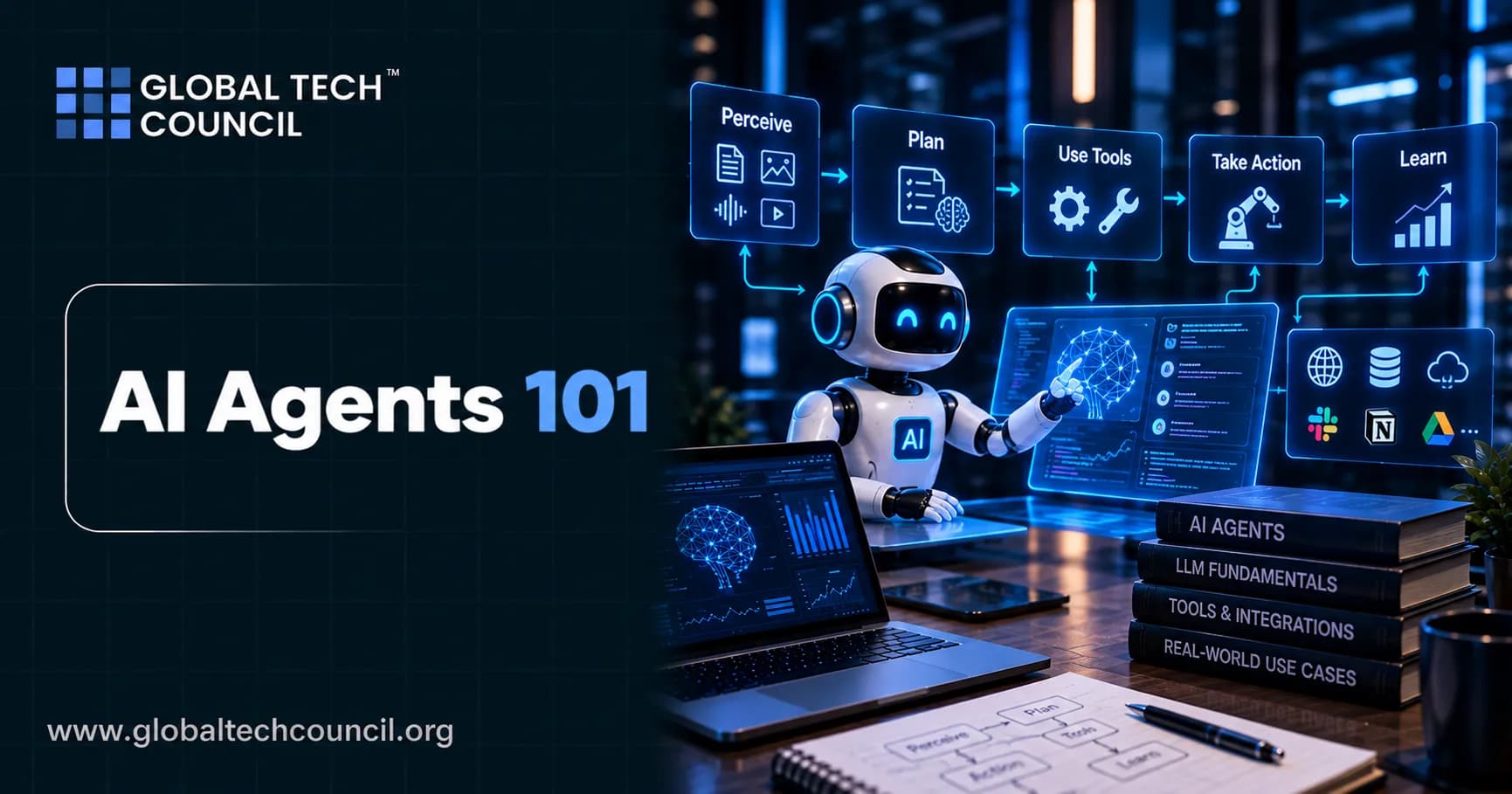
AI agents are moving artificial intelligence from simple prompt-response interactions to agentic AI systems that can plan, take actions, and adapt over time. Instead of only generating text, an AI agent can orchestrate tools, APIs, data sources, and even other agents to pursue a goal inside a real digital environment such as a CRM, ticketing platform, cloud console, or database. This shift is a primary reason enterprises are now operationalizing large language models (LLMs) at scale, particularly for workflows that previously required human coordination across multiple systems. Professionals interested in developing expertise in this area can explore Certified Agentic AI Expert.
What Are AI Agents?
An AI agent is a software system that perceives or receives information about an environment, operates toward one or more goals, plans what to do next across multiple steps, takes actions via tools or integrations, and adapts based on outcomes and memory. IBM describes AI agents as systems that autonomously perform tasks by designing workflows with available tools, typically combining LLMs with external tools and orchestration logic. MIT Sloan characterizes agentic AI as semi-autonomous or fully autonomous systems capable of acting independently within digital environments. Those looking to build practical skills in designing and implementing these systems can also explore Certified Agentic AI Developer.

Key Characteristics of AI Agents
Autonomy: Once given a goal and permissions, the agent can proceed with limited supervision.
Goal-directed behavior: The system optimizes toward outcomes rather than simply responding to isolated prompts.
Tool use: Agents connect to APIs, databases, search, RAG pipelines, transaction systems, and enterprise applications.
Reasoning and planning: They decompose complex tasks into steps, sequence actions, and revise plans as needed.
Memory and context: Agents maintain state across steps and can store longer-term preferences and facts.
This is the practical difference between an AI agent and a basic chatbot. A chatbot may be useful for Q&A, but an agent is designed to do work across systems and complete multi-step workflows.
How AI Agents Work: A Technical Overview
Most modern AI agents are architectures built around LLMs, combined with tool access and control logic. The LLM provides flexible reasoning and language understanding, while tools and orchestration provide reliability, grounding, and the ability to take real actions in connected systems.
Core Components in an AI Agent Architecture
Perception and input interface
Accepts natural language, structured data, events, alerts, documents, and system triggers.
Reasoning and planning engine
Typically an LLM combined with an orchestration layer for task decomposition, tool selection, and workflow control.
Tools and environment access
A catalog of callable capabilities including search, RAG, SQL queries, CRM updates, IT actions, and code execution.
The agent selects tools, passes arguments, and interprets results.
Memory and state management
Short-term memory for current task context.
Long-term memory often implemented using vector databases, knowledge stores, or knowledge graphs.
Policy and guardrails
Permissions, spending limits, compliance rules, safety filters, and escalation conditions.
Audit logs for actions and tool calls, which are essential for enterprise governance.
The Execution Cycle: Plan, Act, Observe, Iterate
Receive a goal or trigger (for example, resolve an incident, process an invoice batch, or triage a support request).
Interpret and plan by breaking down the goal into steps and selecting the appropriate tools and data sources.
Act by calling APIs, running queries, updating records, sending messages, or coordinating with other agents.
Observe results from tools, systems, or human feedback.
Iterate until the goal is achieved or constraints and guardrails stop execution.
MIT Sloan also highlights multi-agent systems, where specialized agents collaborate. For example, a research agent gathers sources, a writing agent drafts a report, and an operations agent updates systems and notifies stakeholders.
Types of AI Agents in Practice
Reactive agents: Respond to triggers with minimal planning, common in monitoring and simple automation scenarios.
Deliberative or planning agents: Perform explicit multi-step planning, suited for complex or conditional workflows.
Learning agents: Adapt over time using feedback loops, reinforcement learning patterns, or continual improvement processes.
Multi-agent systems: Multiple role-based agents that communicate, coordinate, and cross-check work to complete larger tasks.
Real-World AI Agent Use Cases
AI agents deliver the most value where work spans multiple systems, requires repeated tool usage, and benefits from structured guardrails. IBM and MIT Sloan both point to enterprise adoption in customer service, IT operations, and business process automation as clear indicators of growing agentic AI deployment.
1) Customer Service and Support Operations
A customer service agent can handle multi-step requests end-to-end:
Identify the customer and authenticate context.
Retrieve account details from CRM and billing systems.
Use RAG over knowledge bases to troubleshoot issues.
Apply policy checks for refunds, credits, or replacements.
Update the ticket and notify the customer.
Unlike a chatbot that only suggests answers, an agent can complete the workflow, log actions, and escalate when confidence is low.
2) IT Operations and AIOps
In IT operations, agents can monitor telemetry and respond to incidents:
Detect anomalies in logs and metrics.
Correlate alerts across services.
Propose remediation steps such as restarting services or rolling back configurations.
Execute approved runbooks and open incident reports.
Escalate to engineers when risk thresholds are exceeded.
This pattern aligns with MIT Sloan guidance that agentic systems require governance and clear operational boundaries, particularly when they can initiate actions autonomously.
3) Back-Office Document Processing
Agents can automate high-volume workflows such as invoice processing or contract review support:
Ingest documents, extract fields, and validate against schemas.
Cross-check with ERP records and procurement rules.
Route exceptions to human approvers.
Trigger payments or update records when conditions are met.
Enterprises frequently report improved processing times and cost efficiency when these workflows are well-constrained and properly monitored.
4) Sales and Marketing Orchestration
Sales and marketing agents can coordinate multi-channel execution:
Segment audiences using CRM and analytics data.
Draft personalized outreach with compliance checks applied.
Schedule follow-ups and log activities in CRM.
Coordinate handoffs between marketing, SDRs, and account teams.
5) Research, Analysis, and Knowledge Work
Research agents gather information from internal and external sources, synthesize findings, and draft reports using retrieval-augmented generation. When combined with organizational memory, they can maintain consistency with prior decisions, terminology, and preferred formats across projects.
6) Coding and DevOps Workflows
In software delivery, agents can read issue descriptions, propose code changes, run tests, and open pull requests. In multi-agent setups, one agent can focus on implementation while a second reviews for security and reliability policy compliance.
7) Sector-Specific Applications
Finance: KYC and AML support by cross-referencing documents, transactions, and watchlists, with escalation to human analysts for review.
Healthcare: Triage support that gathers symptom information and retrieves guideline-based next steps, operating under strict oversight and regulatory compliance.
Manufacturing and supply chain: Monitoring inventory levels, forecasting demand, and coordinating reorders through integrated enterprise systems.
Design Considerations, Risks, and Governance
Agentic AI introduces new operational risks because the system can initiate real actions. MIT Sloan emphasizes governance, monitoring, and clear operational boundaries, while IBM highlights modular enterprise patterns with tool catalogs and policy controls as foundational safeguards.
Reliability and Robustness
Looping and brittle behavior: Agents can get stuck repeating ineffective steps when planning logic is weak or underspecified.
Tool misuse: Incorrect arguments or misinterpreted outputs can cause operational errors with downstream consequences.
Common mitigations include workflow templates, schema validation for tool inputs and outputs, execution time limits, and human-in-the-loop checkpoints for high-impact actions.
Safety, Privacy, and Compliance
Define roles and permissions per agent and per tool.
Maintain audit logs for every tool call, decision point, and data access event.
Align agent behavior with internal policies and sector-specific regulations, particularly in finance and healthcare.
Human-Agent Collaboration
Agents are most effective when embedded in workflows that clearly define when the agent can act independently and when it must escalate to a human. Interfaces that expose options, assumptions, and action summaries help teams intervene quickly and build operational trust over time.
Skills and Learning Paths for Building AI Agents
As agent frameworks and enterprise platforms mature, teams increasingly need skills that blend AI engineering with software integration and governance practice. Relevant learning paths include:
Prompting and orchestration: Designing goals, step plans, and tool routing logic.
RAG and knowledge integration: Grounding agent behavior in approved sources and internal data.
API and tool integration: Building safe, typed, and observable tool interfaces.
Security and risk controls: Permissions, auditability, and policy enforcement across agent actions.
Professionals looking to formalize these skills can explore Global Tech Council programs including Generative AI Certification, Machine Learning Certification, Data Science Certification, Cybersecurity Certification, and Python Programming Certification, depending on whether the focus is agent design, data grounding, or secure enterprise deployment. Those interested in broader technology learning pathways can also explore Deep Tech Certification.
Assessing Candidates for Emerging AI Roles
Agentic AI systems can plan tasks, use tools, and execute multi-step workflows with varying degrees of autonomy. As organisations explore these capabilities, they also need professionals who can design, monitor, and evaluate such systems. HireValid can be explored by employers looking for structured ways to assess candidates for emerging technology roles.
Conclusion: Why AI Agents Matter Now
AI agents represent a practical shift in how organizations apply AI: from generating answers to executing outcomes. By combining LLM reasoning with tools, memory, and governance controls, agentic AI can automate complex workflows across customer service, IT operations, back-office processing, research, and software delivery. The highest-value deployments begin with well-understood processes, strong guardrails, and clear escalation paths. As platforms standardize tool catalogs and monitoring capabilities, AI agents are positioned to become a default architecture for operationalizing AI across the enterprise. Professionals exploring the business and marketing applications of emerging technologies can also consider Marketing Certification.
FAQs
1. What are AI agents?
AI agents are software systems that use artificial intelligence to pursue specific goals by interpreting information, making decisions, and taking actions. Depending on their design, they can use external tools, access approved data sources, and complete tasks with varying levels of autonomy.
2. How do AI agents work?
AI agents typically receive a goal, interpret the request, determine an appropriate action, and use available tools to gather information or perform tasks. They evaluate the results and may repeat the process until the objective is achieved or human assistance is needed.
3. What is the difference between AI agents and traditional AI systems?
Traditional AI systems often perform specific tasks, such as classifying images, predicting outcomes, or generating text. AI agents can combine these capabilities with planning, tool use, and feedback loops to complete multistep tasks rather than producing only a single prediction or response.
4. What is the difference between AI agents and chatbots?
Chatbots primarily communicate with users by answering questions and generating responses. AI agents can go further by interacting with external systems, coordinating workflows, and executing authorized actions. However, some modern chatbots also include agent-like capabilities, so the distinction depends on their functionality.
5. What are the main components of an AI agent?
An AI agent may include a reasoning model, a goal or task definition, a planning mechanism, tool integrations, memory, and an execution loop. Production systems may also include access controls, monitoring, evaluation mechanisms, and human approval workflows.
6. What role do large language models play in AI agents?
Large language models (LLMs) help agents understand instructions, interpret context, generate plans, and select appropriate tools. When connected to external systems, an LLM-based agent can retrieve information, execute supported actions, and use the resulting feedback to guide subsequent steps.
7. What are the different types of AI agents?
Common classifications include simple reflex agents, model-based reflex agents, goal-based agents, utility-based agents, and learning agents. In modern generative AI applications, developers also build tool-using agents, planning agents, and multi-agent systems. These classifications describe different aspects of agent design.
8. What is an autonomous AI agent?
An autonomous AI agent can perform assigned tasks with limited ongoing human intervention. Its autonomy depends on the permissions, tools, instructions, and safeguards configured by its developers. Greater autonomy does not automatically mean greater accuracy or reliability.
9. What are real-world use cases of AI agents?
AI agents can support customer service, software development, research, data analysis, document processing, sales operations, and IT troubleshooting. They are especially useful for workflows that involve multiple steps, access to relevant information, and clearly defined actions.
10. How are AI agents used in customer service?
AI agents can categorize support requests, retrieve relevant documentation, summarize customer histories, suggest solutions, and perform approved account-related tasks. They can also escalate complex cases to human representatives when the request requires judgment or exceeds their permissions.
11. How can businesses use AI agents in marketing?
Marketing teams can use AI agents to research audiences, analyze campaign performance, organize content workflows, qualify leads, and prepare reports. Human review remains important for brand messaging, factual accuracy, customer communications, and campaign decisions with significant business impact.
12. How do AI agents help with software development?
AI agents can assist with understanding codebases, generating code, writing tests, investigating errors, and proposing fixes. With suitable tools and permissions, they can also run tests and prepare code changes for review. Developers should validate outputs before merging or deploying changes.
13. What is the difference between single-agent and multi-agent systems?
A single-agent system uses one primary agent to manage a task or workflow. A multi-agent system distributes work among multiple agents, which may have specialized roles and coordinate their outputs. Multi-agent systems can help with complex tasks but often introduce additional cost and coordination challenges.
14. What are the benefits of using AI agents in business?
AI agents can reduce repetitive work, speed up information retrieval, support employees with complex workflows, and improve consistency in routine processes. Their actual value depends on task suitability, integration quality, operating costs, and the reliability of their actions.
15. What are the main limitations of AI agents?
AI agents can misunderstand instructions, generate inaccurate information, choose unsuitable tools, or fail when data and workflows are unclear. They may also require substantial monitoring and maintenance. Appropriate testing, access restrictions, validation, and human oversight help manage these limitations.
16. Are AI agents safe to use?
AI agents can be used safely when they are designed with suitable security and governance controls. Important measures include least-privilege access, data protection, tool-call validation, activity logging, prompt injection defenses, and human approval for high-risk actions. No single safeguard eliminates every risk.
17. How do AI agents use tools and external data?
AI agents can access external capabilities through APIs, approved connectors, databases, search systems, and software applications. The agent selects a tool based on the task, submits a structured request, and uses the returned result to determine its next step.
18. How can businesses measure AI agent performance?
Businesses can track task completion rates, accuracy, processing time, operating costs, tool-use success, and the frequency of human intervention. They should also measure error severity, security incidents, user satisfaction, and compliance with business policies.
19. How can a business get started with AI agents?
Businesses should begin by selecting a well-defined, low-risk workflow with measurable outcomes. They can identify the required data and tools, establish permissions, test the agent against realistic scenarios, and launch a limited pilot. Successful results can then guide gradual expansion.
20. What is the future of AI agents?
AI agents are expected to become more integrated into business software, digital services, and everyday workflows. Advances in planning, memory, tool use, and multi-agent coordination may expand their capabilities, while reliability, security, governance, and human accountability will remain essential.
Related Articles
View All
Agentic AI
Building Autonomous AI Agents with LLMs: Tool Use, Planning, and Memory Explained
Learn how to build autonomous AI agents with LLMs using tool calling, planning loops, and memory systems like RAG, plus safety and evaluation best practices.

Agentic AI
Agentic AI in the Enterprise: High-Impact Use Cases Across Customer Support, DevOps, and Analytics
Explore agentic AI in the enterprise with real use cases in customer support, DevOps, and analytics, plus guardrails and KPIs to deploy safely and measure ROI.
Agentic AI
How to Use Meta Muse for Free: A Complete Guide
Learn how to use Meta Muse for free, get started with Meta’s personal AI agent, connect supported apps, and explore features for shopping, travel, emails, and everyday tasks.
Trending Articles
The Role of Blockchain in Ethical AI Development
How blockchain technology is being used to promote transparency and accountability in artificial intelligence systems.
AWS Career Roadmap
A step-by-step guide to building a successful career in Amazon Web Services cloud computing.
Top 5 DeFi Platforms
Explore the leading decentralized finance platforms and what makes each one unique in the evolving DeFi landscape.