

Building Autonomous AI Agents with LLMs: Tool Use, Planning, and Memory Explained
 Suyash Raizada
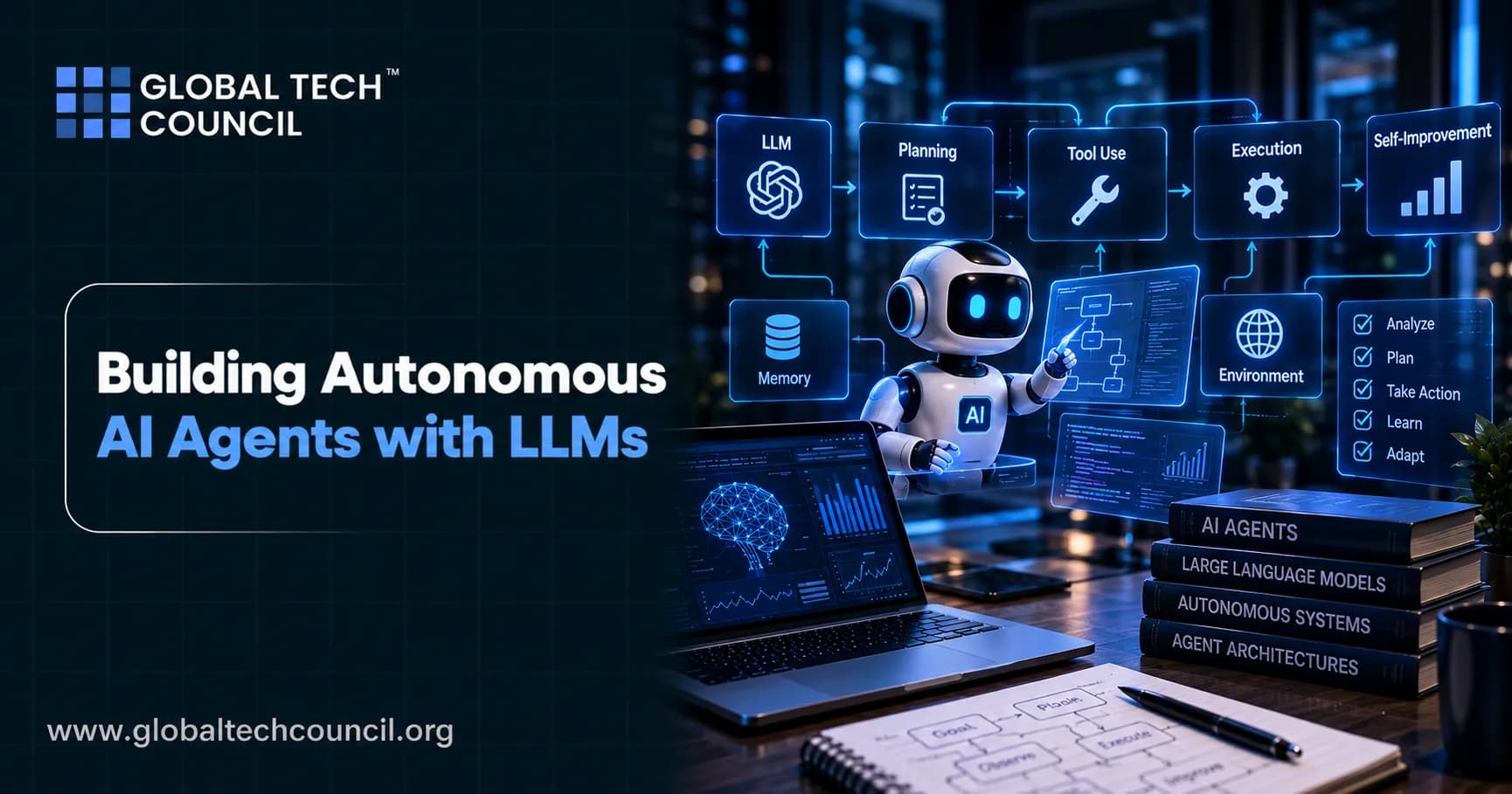
Building autonomous AI agents with LLMs is moving quickly from experimental demos to production-grade systems that can plan multi-step work, call tools, and persist memory with minimal supervision. Instead of treating a large language model (LLM) as a standalone chatbot, modern agentic AI designs wrap the model in a broader cognitive architecture that includes perception, reasoning and planning, memory, and execution. This systems engineering approach is what enables real autonomy, reliability, and governance in enterprise environments. Professionals looking to develop their expertise in agentic AI can explore the Certified Agentic AI Expert certification.
This guide explains the three practical building blocks behind agentic AI systems: tool use, planning, and memory. It also covers common architectural patterns, safety considerations, and how professionals can deepen relevant skills through certifications in AI, machine learning, data science, programming, and cybersecurity.

What Is an LLM-Based Autonomous Agent?
An LLM-based autonomous agent is a software system that uses an LLM as a reasoning engine, connected to external capabilities so it can observe the environment, decide what to do next, and act to complete a goal. Effective agents combine four core functions:
Perception: ingesting text, code, and often images or other modalities from the environment.
Reasoning and planning: breaking a goal into sub-tasks, exploring options, and selecting next actions.
Tool use and execution: calling APIs, querying data stores, running code, or controlling browsers and enterprise systems.
Memory: maintaining short-term working context and long-term knowledge through retrieval and structured stores.
A key insight from practitioners is that autonomy comes from architecture, not only from scaling the model. Larger context windows, native tool calling, and multimodal inputs all contribute, but production systems still require careful orchestration, safety controls, and observability. Developers interested in building and implementing these systems can also explore the Certified Agentic AI Developer certification.
Architectural Patterns Powering Agentic AI
Several patterns have become common in real-world agentic AI deployments.
1) ReAct-Style Interleaved Planning and Acting
Agents often fail when they commit to a long plan upfront. A widely adopted pattern is short-horizon planning combined with execution: the agent thinks one to a few steps ahead, takes an action using a tool, observes the result, and replans. This reduces cascading errors and allows the system to correct course when the environment changes.
2) Workflow-Based Agents
Many teams implement agents as explicit workflows with defined states, transitions, branching logic, and error handling. Compared with a single free-form agent loop, workflows are easier to debug, test, and govern. This approach also aligns with enterprise requirements such as audit trails, approval steps, and clear ownership of each stage.
3) Multi-Agent Systems with Specialization
Complex tasks often benefit from multiple specialized agents that collaborate, such as:
Planner: decomposes the task and proposes a sequence of steps.
Executor: performs tool calls and tracks results.
Reviewer or critic: checks outputs for correctness, policy alignment, or risk.
Safety checker: validates sensitive actions and enforces constraints.
This separation of duties improves reliability, especially when combined with explicit evaluation and veto mechanisms.
4) Tool Abstraction Layers and Standardized Interfaces
To scale tool integrations, tools are commonly described using declarative manifests that include a name, description, and parameter schema. Many modern LLMs accept structured tool specifications and return structured arguments for execution. Protocol-level efforts such as Model Context Protocol (MCP) reflect a broader industry direction: hosting tools on separate servers and exposing them as discoverable capabilities that compatible agents can use.
Tool Use in Autonomous AI Agents: APIs, Orchestration, and Safety
Tool use is the difference between an LLM that can describe an action and an agent that can perform one. Because LLMs are fundamentally prediction engines, tools provide grounded access to computation, external systems, and real-time data.
Common Tool Categories in Production Systems
Knowledge tools: web search, document retrieval, and vector search for RAG.
Data tools: SQL queries, data warehouse connectors, and BI APIs.
Productivity tools: email, calendar, task trackers, and CRM platforms.
Engineering tools: code execution sandboxes, CI/CD APIs, and issue trackers.
Enterprise tools: ERP, HRIS, ITSM, and security tooling accessed via APIs.
How to Orchestrate Tool Use Reliably
Reliable orchestration requires supervisory logic beyond the LLM itself. Common controls include:
Routing rules: defining which tools may be used for which intents and in what order.
Preconditions: requiring data validation, permissions checks, or a reviewer step before execution.
Rate limits and cooldowns: preventing loops, runaway costs, or repeated failing calls.
Structured state: storing intermediate results and tool outputs in a machine-readable form.
Safety Mechanisms That Should Be Treated as Non-Negotiable
Once an agent can act, it can also cause harm. Production systems typically rely on a layered safety posture:
Sandboxed execution: running code and high-risk tools in restricted environments with minimal permissions.
Human-in-the-loop gates: requiring approval for sensitive actions such as payments, account changes, or data deletion.
Secondary verification: using a reviewer agent to validate tool arguments and expected outcomes before execution.
Logging and auditability: recording tool calls, inputs, outputs, and decisions to support investigation and rollback.
Prompt injection defenses: treating retrieved content and web inputs as untrusted, and validating critical instructions through policy checks.
For teams operating in regulated environments, pairing agent development with strong security practices is essential. Upskilling in cybersecurity fundamentals directly supports agent engineering, particularly in access control, threat modeling, and secure API design. A broader understanding of emerging technologies can also be supported through Deep Tech Certification.
Planning and Reasoning: How Agents Break Down Multi-Step Work
Planning converts a high-level goal into actionable steps. In agentic AI, planning typically combines natural language reasoning with more structured search or decomposition techniques.
Planning Paradigms Used in LLM Agents
Chain-of-Thought reasoning: step-by-step reasoning to derive a plan or solution, sometimes sampled multiple times to improve consistency.
Tree-of-Thought or Graph-of-Thought: exploring multiple reasoning branches, evaluating options, and expanding the most promising paths.
Search-augmented planning: combining LLM proposals with systematic search methods such as Monte Carlo Tree Search for large decision spaces.
Hierarchical task decomposition: splitting work into sub-goals, often with a dedicated planner agent and an executor agent.
Why Interleaved Planning Outperforms Long Fixed Plans
Most real environments are uncertain: tools fail, inputs change, and hidden constraints emerge late. A robust agent uses a loop like the following:
Plan the next 1 to 3 steps.
Execute via tools.
Observe results and update state.
Replan using the new information.
This pattern reduces the cost of being wrong and improves debuggability, because each decision point can be traced to a specific observation and state snapshot.
Error Correction Through Reflection and Critique
Modern systems often include explicit self-checking mechanisms:
Reflection: reviewing actions and outputs after each step to detect mistakes and revise the plan.
Self-critique prompts: asking the model to identify inconsistencies and propose fixes before acting.
Critic agents: separate agents that rate or veto steps before execution.
These approaches connect directly to established software engineering disciplines: testing, code review, staged deployments, and change control. Teams with strong programming and DevOps skills consistently build more reliable agent systems.
Memory in LLM Agents: Working, Long-Term, Episodic, and Procedural
Memory is one of the most significant bottlenecks in autonomous agents. Without it, an agent repeats work, loses context, and struggles to maintain continuity across long-running tasks.
Working Memory: Managing the Context Window
The model context window functions as working memory, but it is limited and costly to fill. Common management strategies include:
Chunking: splitting long documents into smaller sections for targeted retrieval.
Summarization: compressing long conversations or outputs into concise, persistent notes.
Relevance filtering: including only the most pertinent history for the current step.
Expanded context windows help reduce pressure, but they do not eliminate the need for disciplined context management, particularly in long-running workflows.
Long-Term Semantic Memory with RAG
Retrieval-augmented generation (RAG) is the dominant approach for long-term memory in enterprise agents. Documents, tickets, emails, and logs are embedded and stored in a vector database. At runtime, the agent retrieves relevant chunks and uses them to ground its reasoning and reduce hallucinations. Long-term knowledge can also reside in SQL or graph databases, accessed through natural language interfaces and query tools.
Episodic and User Memory
Agents often store interaction histories and outcomes as episodic memory, then retrieve summaries to guide future actions. User memory stores preferences and constraints such as writing style, approval thresholds, or preferred tools. In enterprise settings, user memory must align with privacy policies, access control requirements, and data retention rules.
Procedural Memory: Reusable Workflows
A powerful form of memory is procedural or workflow memory: reusable sequences of actions that proved effective in the past. For example, an agent can store a successful routine for generating a monthly report across multiple systems, including all validations and approval steps. Over time, procedural memory reduces rediscovery costs and increases overall reliability.
Real-World Use Cases for Autonomous AI Agents
Tool use, planning, and memory come together in applications such as:
Customer support automation: retrieving product knowledge, updating tickets via ITSM APIs, and escalating complex cases with full context preserved.
Autonomous research and reporting: planning search steps, tracking consulted sources, and producing structured summaries.
Software engineering and DevOps: reading repositories, proposing patches, running tests in sandboxes, and opening pull requests.
Back-office operations: orchestrating CRM and ERP workflows with built-in approvals and compliance checks.
Document processing pipelines: extracting entities, validating business rules, and loading structured outputs into data systems.
Key Challenges: Reliability, Security, and Evaluation
Even well-designed architectures face significant limitations:
Hallucinations and brittle planning: tool grounding reduces errors but does not guarantee correctness for novel or ambiguous tasks.
Memory at scale: summarization quality, retrieval precision, and controlled forgetting remain difficult design problems.
Security risks: prompt injection, tool misuse, and data exfiltration require sandboxing and strict access control.
Evaluation gaps: autonomy is difficult to benchmark universally, so teams rely on task-specific success rates, cost, latency, and human satisfaction scores.
Assessing Candidates for Emerging AI Roles
Agentic AI systems can plan tasks, use tools, and execute multi-step workflows with varying degrees of autonomy. As organisations explore these capabilities, they also need professionals who can design, monitor, and evaluate such systems. HireValid can be explored by employers looking for structured ways to assess candidates for emerging technology roles.
Conclusion: A Practical Blueprint for Building Autonomous AI Agents with LLMs
Building autonomous AI agents with LLMs is best approached as a disciplined engineering effort. Pair the LLM with robust tool interfaces, short-horizon planning loops, and multi-layer memory. Then add governance: sandboxes, approvals, observability, and systematic evaluation. This is the path from a chat-based prototype to an agentic AI system capable of operating safely in production.
For professionals aiming to design and deploy agentic AI, the most valuable foundation combines machine learning, data engineering, secure software development, and systems thinking. Relevant learning paths include certifications in AI and machine learning, data science, programming, and cybersecurity, all of which map directly to the skills required for agent planning, tool orchestration, and safe memory design. Professionals who want to connect emerging technology knowledge with wider business capabilities can also explore Marketing Certification.
FAQs
1. What are autonomous AI agents powered by LLMs?
Autonomous AI agents powered by large language models (LLMs) are systems that use language models to interpret goals, make decisions, select actions, and complete tasks with varying levels of independence. They can combine reasoning, external tools, memory, and feedback to work toward specific objectives.
2. How do LLMs help AI agents make decisions?
LLMs help AI agents interpret instructions, understand context, generate plans, and select appropriate next steps. When connected to tools and external data sources, they can use retrieved information and action results to guide subsequent decisions.
3. What is tool use in autonomous AI agents?
Tool use allows an AI agent to interact with external systems instead of relying exclusively on its language model. Tools may include web search, calculators, databases, APIs, code execution environments, and business applications that help the agent complete tasks.
4. How does tool calling work in LLM-based AI agents?
The agent identifies a task that requires an external capability and requests a tool call with structured arguments. The application validates the request, executes the tool if authorized, and returns the result to the model, which can then decide what to do next.
5. Why is planning important for autonomous AI agents?
Planning helps an agent break a complex goal into smaller, manageable steps. It can identify dependencies, determine which tools are needed, establish an execution order, and adjust the approach when a step fails or new information becomes available.
6. What are the common planning strategies used in AI agents?
Common strategies include step-by-step planning, ReAct-style reasoning and action loops, Plan-and-Execute workflows, and hierarchical planning. The appropriate method depends on task complexity, the need for adaptability, available tools, and reliability requirements.
7. What is memory in an autonomous AI agent?
Memory allows an AI agent to retain or retrieve useful information across steps or interactions. Depending on the implementation, this may include conversation history, task progress, user preferences, previously observed facts, or summaries of earlier activities.
8. What is the difference between short-term and long-term memory in AI agents?
Short-term memory maintains information relevant to the current interaction or task, such as recent tool results and intermediate decisions. Long-term memory stores selected information for future retrieval, often through databases, document stores, or vector search systems.
9. How do AI agents use vector databases for memory?
Vector databases store numerical representations of information called embeddings. An agent can retrieve semantically related records using a query, helping it find relevant documents or past information even when the wording differs from the original content.
10. How do tool use, planning, and memory work together?
Planning determines the steps needed to reach a goal, tool use enables the agent to perform actions, and memory provides relevant context from previous steps or interactions. Together, these capabilities help an agent manage multistep tasks and adapt based on observed results.
11. Which technologies are commonly used to build LLM-based AI agents?
Developers commonly use LLM APIs, agent orchestration frameworks, tool-calling interfaces, databases, retrieval-augmented generation systems, and workflow engines. The technology stack may also include monitoring, evaluation, authentication, and permission-management components for production deployments.
12. What is retrieval-augmented generation (RAG), and how does it support AI agents?
Retrieval-augmented generation combines information retrieval with language generation. An agent can search approved documents or databases for relevant information and provide that context to the LLM, improving access to current or domain-specific knowledge without relying entirely on model training.
13. How can developers make autonomous AI agents more reliable?
Developers can improve reliability by defining clear objectives, limiting available tools, validating inputs and outputs, implementing bounded retries, and testing realistic scenarios. Structured workflows, external verification, and human approval for high-impact actions can further reduce errors.
14. What are the biggest challenges in building autonomous AI agents?
Common challenges include hallucinations, incorrect tool calls, poor planning, unreliable memory retrieval, context-window limitations, high inference costs, and unpredictable behavior. Security risks and difficulties measuring task completion can also complicate production deployment.
15. How can developers secure tool access in autonomous AI agents?
Developers should enforce least-privilege permissions, authenticate tool requests, validate arguments, and restrict access to approved resources. Sensitive actions should use independent authorization checks, with human approval where appropriate, rather than relying solely on the LLM's judgment.
16. How can developers prevent memory errors in AI agents?
Developers should validate stored information, distinguish verified facts from model-generated assumptions, manage conflicting records, and retrieve only context relevant to the current task. Memory should also have appropriate access controls, retention rules, and deletion mechanisms.
17. Can autonomous AI agents work without human supervision?
Some agents can complete well-defined, low-risk tasks with minimal supervision. However, complete independence is not appropriate for every workflow. Financial transactions, sensitive data handling, legal decisions, and other high-impact operations may require human review and strict operational controls.
18. How can businesses measure the performance of autonomous AI agents?
Businesses can measure task completion rates, output accuracy, successful tool execution, recovery from errors, response time, and cost per completed task. Security incidents, policy compliance, human intervention rates, and consistency across repeated tests are also important indicators.
19. What are the real-world applications of autonomous AI agents?
Autonomous AI agents can support customer service, software development, market research, document processing, sales operations, data analysis, and IT support. Their effectiveness depends on the quality of available information, the capabilities of connected tools, and the controls governing their actions.
20. What is the future of autonomous AI agents built with LLMs?
Future systems are likely to combine more sophisticated planning, better memory management, specialized tools, and collaboration between multiple agents. Progress will depend on improving reliability, reducing operating costs, strengthening security, and making agent behavior easier to evaluate and control.
Related Articles
View All
Agentic AI
Agentic AI Explained: How Autonomous AI Agents Plan, Act, and Learn in Real Time
Agentic AI enables autonomous systems to plan tasks, use tools, execute multi-step workflows, and adapt to real-time feedback. Discover how AI agents work, their real-world applications, key benefits, risks, governance practices, and the skills needed to build reliable agentic AI systems.
Agentic AI
AI Agents 101: What They Are, How They Work, and Real-World Use Cases
AI agents are goal-driven systems that plan and take actions using tools and APIs. Learn how they work, key types, risks, and real-world enterprise use cases.

Agentic AI
Evaluating Agentic AI: Metrics and Benchmarks for Reliable Tool Use and Task Completion
Learn how evaluating agentic AI uses multi-dimensional metrics and benchmarks to measure task success, tool use accuracy, reliability, cost, and safety in real workflows.
Trending Articles
The Role of Blockchain in Ethical AI Development
How blockchain technology is being used to promote transparency and accountability in artificial intelligence systems.
AWS Career Roadmap
A step-by-step guide to building a successful career in Amazon Web Services cloud computing.
Top 5 DeFi Platforms
Explore the leading decentralized finance platforms and what makes each one unique in the evolving DeFi landscape.