

Agentic AI in the Enterprise: High-Impact Use Cases Across Customer Support, DevOps, and Analytics
 Suyash Raizada
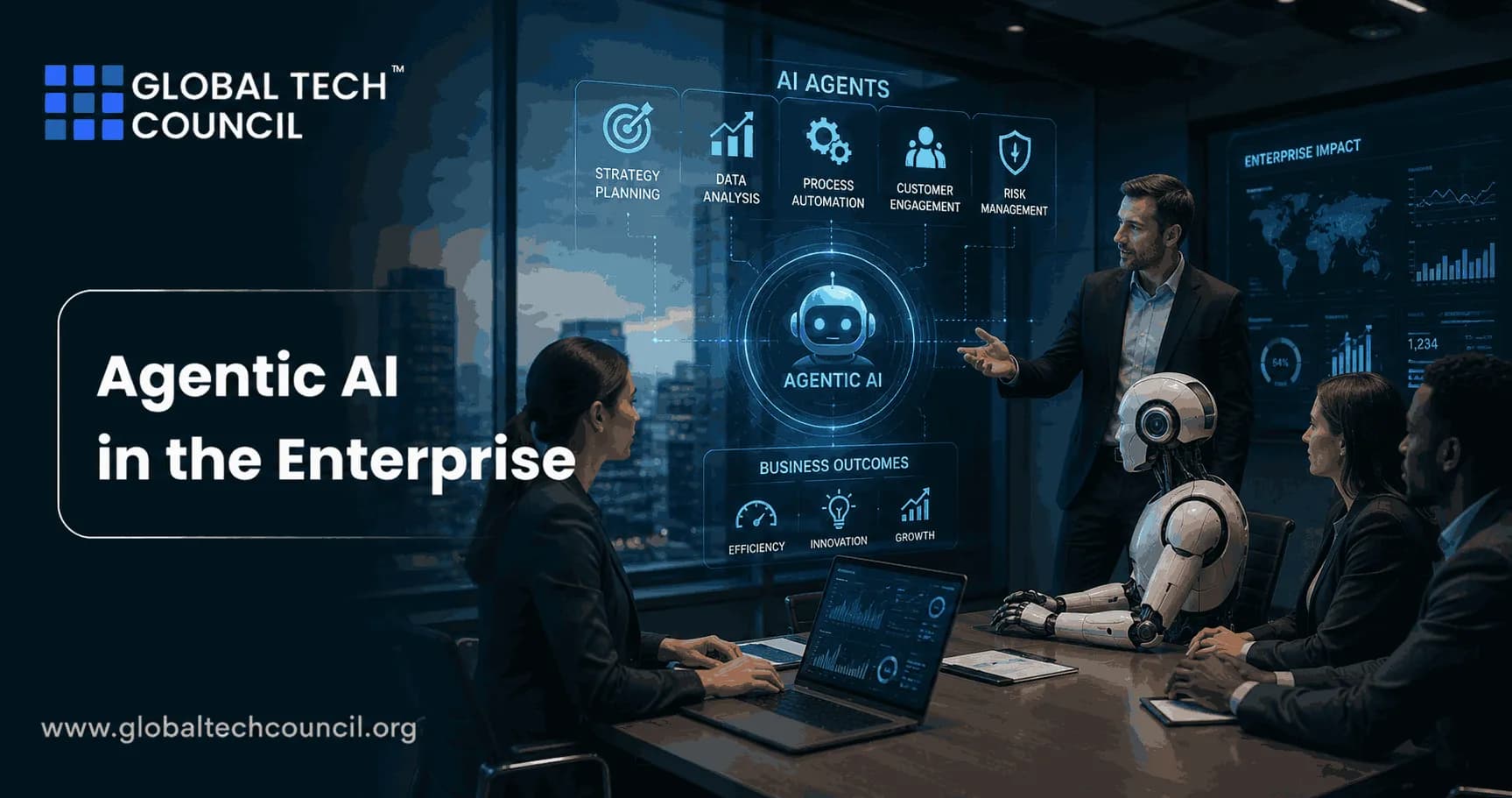
Agentic AI in the enterprise is rapidly moving from experimentation to early production, particularly in domains where work is high-volume, decision-intensive, and distributed across multiple systems. Unlike a classic chatbot that only answers questions, agentic AI systems can accept a goal, plan steps, select tools, call APIs, and execute actions within defined guardrails. Customer support, DevOps, and analytics are emerging as the highest-impact starting points for most organizations precisely because of these characteristics. Professionals seeking to understand how to design, evaluate, and oversee these systems can explore the Certified Agentic AI Expert certification as part of their learning journey.
Multiple industry analysts project that by 2028, roughly 25% to 33% of enterprise processes and software will include agentic capabilities, automating approximately 15% of work decisions. Yet only a small minority of enterprises have agents deployed at full scale today. The gap reflects that the primary challenge is not the underlying model but operational readiness: data foundations, security, governance, and measurable ROI.

What Is Agentic AI in the Enterprise?
Across leading enterprise definitions, agentic AI refers to AI agents that can:
Accept high-level goals instead of single-turn prompts
Plan and decompose work into multi-step workflows
Use tools and systems by querying knowledge bases, calling APIs, and updating business applications
Act with bounded autonomy using approval flows, policies, and audit trails
This changes AI from a source of helpful insight into a system that moves work forward. In practice, agentic AI often coordinates multiple specialized agents, each focused on a narrow capability, retrieving policy, validating an order, opening an incident, or drafting a customer response, while maintaining context across systems such as CRM, ERP, ITSM, and analytics platforms.
Agentic AI vs. Chatbots and Classic Automation
LLM chatbots: typically generate answers but do not execute multi-step actions across enterprise tools.
RPA and rule-based workflows: reliable for predictable paths but brittle when exceptions occur.
Agentic AI: goal-directed orchestration that can choose next actions dynamically, re-plan when conditions change, and handle partial ambiguity within defined constraints.
Organizations building and maintaining these workflows may also explore the Certified Agentic AI Developer certification to develop relevant skills in agent development and implementation.
Adoption Reality: Experimentation Is High, Scaled Deployment Is Low
Current adoption is wide but shallow. Many organizations report using agents in at least one workflow, while a very small percentage have successfully scaled agents across mission-critical operations. Two forces explain the gap:
Trust and autonomy constraints: only a minority of organizations report confidence in fully autonomous agents, so most deployments rely on human-in-the-loop approvals.
Data and governance readiness: agents amplify both value and risk. Without governed knowledge, access controls, and observability, they can scale errors rather than outcomes.
High-Impact Use Case 1: Agentic AI in Customer Support
Customer support is one of the fastest paths to measurable value because the work is continuous, high-volume, and directly tied to business KPIs such as time-to-resolution, containment rate, and customer satisfaction. Agentic AI in support goes well beyond FAQ deflection by coordinating understanding, retrieval, actions, escalation, and learning across systems.
What Customer Support Agents Do in Production Workflows
Autonomous ticket triage and routing: classify intent, extract key entities, set priority, and route to the correct queue or agent.
Multi-system resolution: execute steps such as password resets, order adjustments, refunds, and account updates by calling internal APIs across CRM, billing, and order systems.
Knowledge base automation: draft and update articles from resolved cases and product changes, then link them to future incidents.
Multi-channel continuity: maintain context across chat, email, and voice while grounding responses in CRM history and policy.
Examples That Illustrate the Pattern
Financial services: virtual assistants enhanced with modern LLMs handle common inquiries and simple transactions, reducing resolution time for routine requests.
Emergency response: AI-powered case management has demonstrated strong burst scalability during crisis events by automating intake, triage, and routing.
Retail and service operations: agents answer customer questions using live ERP and inventory data and can coordinate follow-up actions such as replacements or scheduling.
KPIs to Track for Customer Support Agents
First response time and time to resolution
Self-service containment and deflection rate
Reopen rate and handoff quality to human agents
Policy compliance and auditability of actions taken
High-Impact Use Case 2: Agentic AI in DevOps and IT Operations
DevOps and IT operations are well suited to agentic AI because teams already rely on runbooks, tickets, telemetry, and automation. Agentic capabilities make that automation more adaptive by correlating signals, selecting actions, and coordinating cross-tool workflows. The most significant near-term gains typically come from standard incidents, CI/CD quality gates, and ITSM workflows.
Core DevOps and IT Capabilities Enabled by Agentic AI
Code generation and refactoring support: propose fixes, improve performance, and keep documentation aligned with code changes.
CI/CD monitoring and release orchestration: detect failing builds, suggest remediations, re-run jobs, or initiate rollback workflows under policy constraints.
Bug and incident triage: correlate logs, traces, and alerts to cluster related incidents and propose probable root causes.
ITSM automation: create structured tickets from conversations, route them correctly, and execute common remediation steps such as access resets or device health checks.
Security operations support: run constrained playbooks for investigation, enrichment, and reporting when integrated with approved tools and least-privilege access.
Practical Deployment Patterns That Work
ChatOps integration: agents embedded in Slack or Teams that can open tickets, query observability tools, and summarize incidents for responders.
Pipeline agents: agents acting as CI/CD gates that validate policies, run tests, and stop risky releases.
Policy checks as code: security and compliance agents that validate infrastructure-as-code and deployment configuration against organizational rules.
KPIs to Track for DevOps and IT Agents
MTTR and incident recurrence rates
Change failure rate and rollback frequency
Engineer toil reduction measured in time saved on repetitive tasks
Security and compliance findings per release cycle
High-Impact Use Case 3: Agentic AI in Analytics and Decision Automation
Analytics is a natural fit for agentic AI because the workflow is inherently multi-step: retrieve data, join sources, validate assumptions, run analysis, explain results, and trigger actions. Enterprises also face a persistent knowledge retrieval problem, with research indicating that information friction can cost millions annually in mid-sized organizations. Agents that search across documents, dashboards, and systems can materially reduce that loss. Organizations exploring the broader technical foundations behind these systems can also consider a Deep Tech Certification as part of their professional development.
Core Analytics Patterns for Agentic AI
Cross-system knowledge retrieval: answer business questions that require navigating documents, email, databases, and BI tools rather than relying on simple keyword search.
Automated research and synthesis: pull from multiple repositories, extract findings, and assemble structured reports for regulated or data-heavy domains.
Continuous monitoring and anomaly detection: watch KPIs, detect deviations, and proactively alert teams or trigger workflows.
Decision automation: evaluate transactions, invoices, or policy checks and either auto-approve low-risk cases or escalate with a supporting rationale.
Examples That Illustrate Value
Research-intensive work: biomedical research agents reduce time spent on manual literature review by automating search, extraction, and summarization.
Financial services decision support: advisor tooling delivers answers significantly faster by grounding responses in large volumes of internal and market data.
Enterprise finance and planning: agents answer budget, accrual, and policy questions by pulling live ERP data and generating decision-ready summaries.
KPIs to Track for Analytics Agents
Time to insight for recurring reports and investigations
Decision turnaround time and escalation rates
Accuracy and grounding measured via evaluation sets and human review
Audit readiness for actions and recommendations
Guardrails That Determine Success: Data, Security, and Governance
Most agent failures trace back to missing foundations rather than model quality. Enterprise leaders should treat agentic AI as a production system requiring controls comparable to other automation and decisioning platforms.
Enterprise-Ready Controls to Put in Place
Grounding and knowledge governance: connect agents to curated knowledge bases, enforce versioning, and continuously improve content quality.
Least-privilege access: scope agent permissions tightly, use short-lived credentials, and separate duties for read vs. write actions.
Human-in-the-loop approvals: require approvals for high-impact actions such as refunds, production changes, or access provisioning.
Observability and audit logging: record tool calls, decisions, inputs, outputs, and approvals to support incident response and compliance reviews.
Evaluation and testing: simulate workflows, test for policy adherence, and validate performance on representative edge cases before expanding autonomy.
How to Start: A Practical Rollout Plan for Agentic AI in the Enterprise
Select a bounded, high-volume workflow in customer support, DevOps, or analytics with clear KPIs and known pain points.
Map systems and actions the agent must access, then reduce scope to only what is necessary for the first release.
Build a governed data foundation including a curated knowledge layer, standardized identifiers, and reliable API access.
Design guardrails first using approvals, policy checks, and role-based access controls before increasing autonomy.
Measure ROI and reliability using agreed metrics such as MTTR, containment rate, time to insight, and compliance outcomes.
Expand iteratively by adding tools, workflows, and autonomy only after the agent performs reliably under real load.
Teams implementing agentic systems typically benefit from upskilling across AI engineering, data governance, and security. Global Tech Council certifications in AI, Machine Learning, Data Science, Cybersecurity, and Cloud computing support workforce readiness for agent design, deployment, and oversight.
Assessing Candidates for Emerging AI Roles
Agentic AI systems can plan tasks, use tools, and execute multi-step workflows with varying degrees of autonomy. As organisations explore these capabilities, they also need professionals who can design, monitor, and evaluate such systems. HireValid can be explored by employers looking for structured ways to assess candidates for emerging technology roles.
Conclusion
Agentic AI in the enterprise is becoming a practical automation layer for cross-system work, with early production value most visible in customer support, DevOps, and analytics. Industry projections point to substantial integration of agentic capabilities into enterprise software and processes over the next few years. The organizations that realize measurable ROI will be those that treat agents as governed production systems: grounded in trusted data, constrained by least-privilege access, monitored end-to-end, and deployed with human approvals where risk is high.
Start with a bounded workflow, measure rigorously, and scale autonomy only when reliability and governance are proven. Done well, agentic AI becomes not just a new interface to information but an operational capability that moves work forward across the enterprise. Professionals interested in connecting emerging technology knowledge with business needs can explore Marketing Certification as another learning option.
FAQs
1. What is Agentic AI in the enterprise?
Agentic AI in the enterprise refers to AI systems that can plan tasks, use tools, access approved business data, and execute multistep workflows with varying levels of autonomy. Organizations use these systems to streamline operations, improve decision-making, and reduce repetitive manual work while maintaining appropriate human oversight.
2. What are the most impactful enterprise use cases for Agentic AI?
High-impact enterprise use cases include customer support automation, DevOps incident management, business intelligence, data analysis, IT service management, sales operations, and document processing. The strongest opportunities involve repetitive, measurable workflows that require information gathering and coordinated actions across multiple systems.
3. How does Agentic AI improve customer support?
Agentic AI can retrieve customer information, classify enquiries, troubleshoot common issues, update support tickets, and recommend relevant solutions. With suitable permissions, it can also perform approved account actions. Complex complaints, sensitive requests, and uncertain cases should be escalated to human support teams.
4. Can Agentic AI automate customer service workflows?
Yes. Agentic AI can automate workflows such as ticket categorization, order-status checks, refund eligibility verification, appointment scheduling, and follow-up communications. Businesses should validate important information, protect customer data, and require approval for actions with significant financial or customer impact.
5. How is Agentic AI used in DevOps?
In DevOps, Agentic AI can investigate alerts, summarize logs, identify likely causes of failures, suggest code changes, and assist with deployment workflows. It can help engineers resolve incidents faster, provided that production changes remain subject to appropriate testing, access controls, and approval policies.
6. Can Agentic AI help with incident management and troubleshooting?
Agentic AI can correlate monitoring alerts, examine logs, retrieve relevant runbooks, and recommend troubleshooting steps. Some systems can execute predefined diagnostic actions automatically. Production remediation should use restricted permissions, clear rollback procedures, and human authorization for high-risk changes.
7. How does Agentic AI improve enterprise data analytics?
Agentic AI can query approved datasets, summarize trends, identify anomalies, generate reports, and help explain business performance. It can also coordinate multiple analytical steps, allowing teams to move from a business question to supporting evidence more efficiently.
8. What role does Agentic AI play in business intelligence?
Agentic AI enhances business intelligence by allowing users to ask questions in natural language and receive data-backed explanations. Agents can retrieve relevant metrics, compare performance across periods, and prepare summaries, provided that the underlying data, calculations, and access permissions are reliable.
9. What are the benefits of Agentic AI for enterprise productivity?
Agentic AI can reduce repetitive work, accelerate information retrieval, coordinate cross-functional workflows, and help employees focus on higher-value activities. Its impact depends on task complexity, integration quality, model reliability, and the cost of monitoring and correcting errors.
10. How can enterprises use Agentic AI in IT service management?
Enterprises can use Agentic AI to classify IT requests, troubleshoot common technical problems, retrieve knowledge-base articles, create tickets, and route incidents to appropriate teams. Access changes, software installations, and account recovery should follow established identity verification and authorization procedures.
11. What is the difference between enterprise Agentic AI and traditional automation?
Traditional automation generally follows predefined rules and workflows. Agentic AI can interpret context, select tools, and adapt its plan when circumstances change. Traditional automation remains effective for predictable tasks, while agentic systems are useful for workflows that require flexible reasoning and information gathering.
12. How can Agentic AI improve enterprise sales and marketing?
Agentic AI can research accounts, summarize customer interactions, prepare sales briefs, update CRM records, analyze campaign performance, and draft personalized communications. Organizations should verify generated claims, follow data protection requirements, and obtain appropriate approval before sending external messages or changing campaign settings.
13. What are the biggest risks of Agentic AI in enterprise environments?
Major risks include inaccurate decisions, unauthorized actions, data exposure, prompt injection, excessive permissions, unreliable integrations, and unexpected operating costs. Enterprises can mitigate these risks through least-privilege access, validation, monitoring, audit logs, and human approval for consequential actions.
14. How can businesses implement Agentic AI securely?
Businesses should begin with a narrowly defined use case, identify required data and tools, and establish explicit permissions. They should test the system against realistic and adversarial scenarios, monitor performance, document accountability, and expand access gradually after meeting defined security and reliability requirements.
15. What is human-in-the-loop control in enterprise Agentic AI?
Human-in-the-loop control requires a person to review or approve selected actions before an AI agent proceeds. Enterprises can apply this pattern to financial transactions, production deployments, sensitive customer requests, access-control changes, and other high-impact operations.
16. How can enterprises measure Agentic AI ROI?
Enterprises can measure return on investment by tracking time saved, cost per completed task, resolution rates, incident recovery time, error frequency, customer satisfaction, and employee productivity. They should compare these results with a baseline and account for integration, infrastructure, supervision, and maintenance costs.
17. Which departments benefit most from enterprise Agentic AI?
Customer support, IT operations, DevOps, data analytics, finance operations, sales, and human resources can benefit from agentic workflows. The best starting point is usually a department with clear processes, accessible data, measurable outcomes, and manageable consequences if the system fails.
18. How does Agentic AI integrate with existing enterprise software?
Agentic AI can connect to enterprise software through APIs, approved connectors, databases, workflow platforms, and controlled computer-use interfaces. Integration requires authentication, permission enforcement, data validation, and monitoring to ensure that agents interact safely with existing systems.
19. What is the future of Agentic AI in enterprise operations?
Enterprise Agentic AI is likely to expand toward coordinated workflows, specialized agents, improved tool use, and deeper integration with business applications. Adoption will depend on dependable execution, measurable business value, governance, interoperability, and the ability to supervise increasingly complex automated processes.
20. How should an enterprise choose its first Agentic AI project?
An enterprise should select a workflow that is repetitive, time-consuming, measurable, and supported by reliable data. Customer support ticket triage, internal knowledge retrieval, analytics reporting, and incident summarization can be useful starting points. Begin with limited autonomy, measure results, and expand only when safety and performance are demonstrated.
Related Articles
View All
Agentic AI
AI Agents 101: What They Are, How They Work, and Real-World Use Cases
AI agents are goal-driven systems that plan and take actions using tools and APIs. Learn how they work, key types, risks, and real-world enterprise use cases.

Agentic AI
Evaluating Agentic AI: Metrics and Benchmarks for Reliable Tool Use and Task Completion
Learn how evaluating agentic AI uses multi-dimensional metrics and benchmarks to measure task success, tool use accuracy, reliability, cost, and safety in real workflows.

Agentic AI
How to Use Meta Muse for Free: A Complete Guide
Learn how to use Meta Muse for free, get started with Meta’s personal AI agent, connect supported apps, and explore features for shopping, travel, emails, and everyday tasks.
Trending Articles
The Role of Blockchain in Ethical AI Development
How blockchain technology is being used to promote transparency and accountability in artificial intelligence systems.
AWS Career Roadmap
A step-by-step guide to building a successful career in Amazon Web Services cloud computing.
Top 5 DeFi Platforms
Explore the leading decentralized finance platforms and what makes each one unique in the evolving DeFi landscape.