

From Chatbots to AI Agents: A Step-by-Step Roadmap to Deploying Agentic Automation in Business
 Suyash Raizada
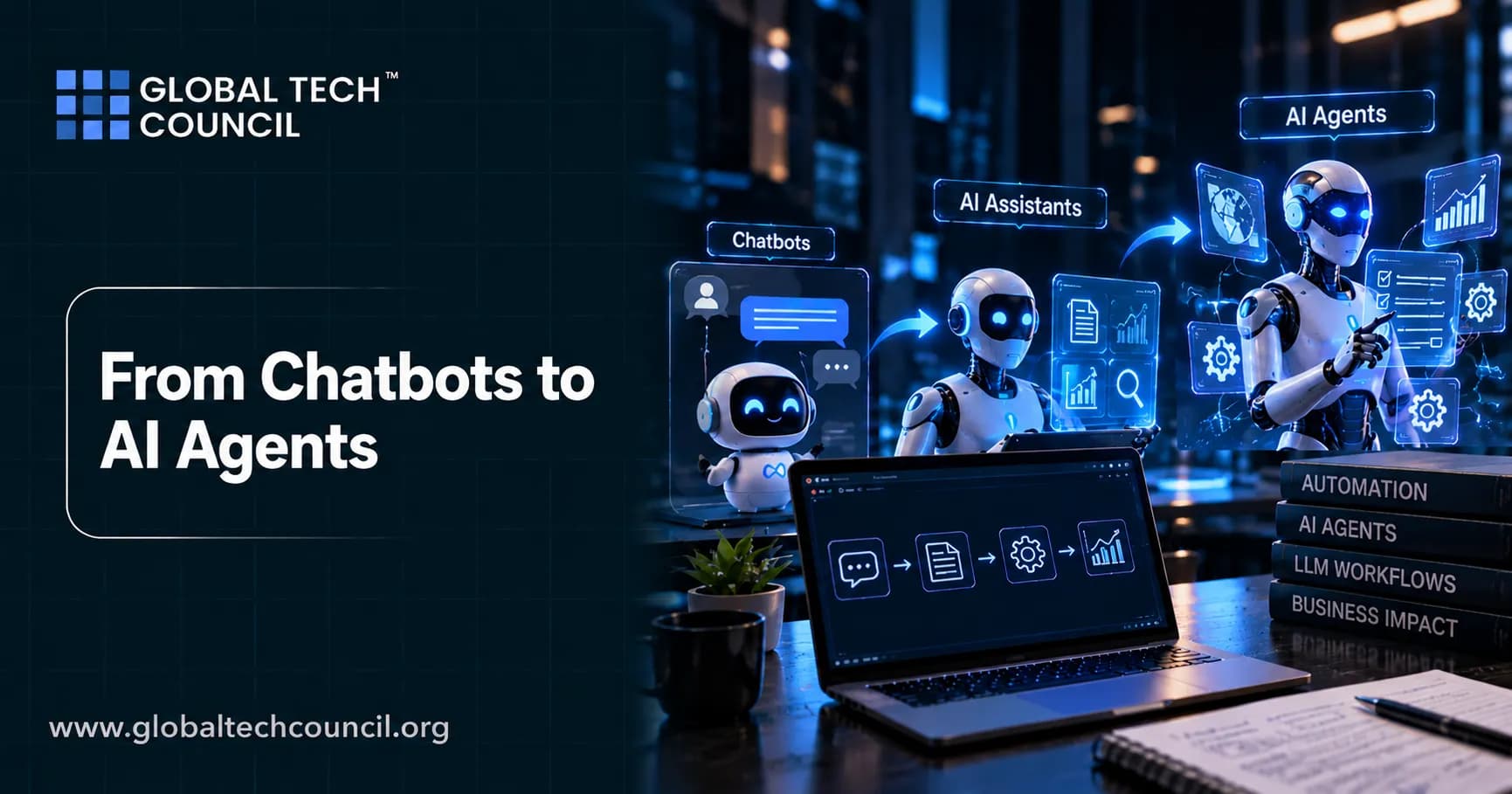
Agentic automation is moving enterprises beyond question-and-answer chatbots into autonomous AI agents that can reason, plan, and take action across business systems. Research from LangChain, Deloitte, PwC, McKinsey, and Gartner points to rapid growth in experimentation, alongside a persistent gap between pilots and production-scale deployments. This roadmap explains how to progress from conversational assistants to workflow agents and multi-agent systems in a controlled, measurable way. Professionals looking to strengthen their knowledge of autonomous AI systems can explore Certified Agentic AI Expert as a learning resource.
Chatbots vs AI Agents: The Conceptual Shift
Many organizations already use chat interfaces, but agentic automation requires a different mental model. The distinction is not only about better answers, it is about reliable action under governance. Those interested in building the technical skills needed to develop these systems can explore Certified Agentic AI Developer.

What Changes from Chatbots and RPA to Agentic Automation
Chatbots are typically reactive. They respond to prompts but do not control workflows or execute changes in external systems.
RPA bots automate deterministic steps in structured environments. They can be effective but often become brittle when interfaces or business rules change.
AI agents use a large language model or similar foundation model to determine control flow, plan multi-step tasks, and execute actions through tools and APIs with minimal human intervention. LangChain describes agents as systems where the model decides the control flow. Deloitte frames agentic AI as a shift from reactive prompting to autonomous systems that reason, plan, and execute toward defined goals.
In practice, agentic automation adds capabilities that most chatbot deployments lack: multi-tool orchestration across CRMs, ERPs, ticketing systems, and databases; adaptive planning; and, in advanced configurations, multi-agent collaboration where specialized agents delegate and validate work among themselves.
Agentic Automation Adoption: 2024 to 2026
Survey data indicates that large language model usage is now mainstream, while autonomous agent deployments are scaling unevenly across industries and functions.
LangChain's 2024 State of AI Agents survey of approximately 1,300 professionals reports about 51% using agents in production and 78% with plans to implement agents in production soon. Mid-sized companies were among the most aggressive adopters.
McKinsey's State of AI 2025 report notes 62% of organizations experimenting with AI agents, but only 11% running them in production, underscoring the pilot-to-production gap.
PwC's May 2025 survey of 300 US senior executives finds 79% reporting that AI agents are already being adopted within their companies, and 88% planning to increase AI budgets as a result of agentic AI capabilities.
Gartner predicts 40% of enterprise applications will include task-specific AI agents by the end of 2026.
The pattern is clear: strategic intent is strong, but execution requires workflow redesign, integration readiness, and governance that is more rigorous than what most chatbot programs demanded.
Where Businesses See Impact from Agentic Automation
PwC reports that among organizations adopting AI agents, 66% cite increased productivity, 57% report cost savings, 55% point to faster decision-making, and 54% describe improved customer experience. Many executives report achieving ROI within the first year, with revenue lifts typically in the mid-single digits for standard adopters and higher returns for top performers.
Cost benchmarks also shape adoption strategies:
Embedded productivity agents in platforms such as Microsoft 365 Copilot and Google Gemini for Business often start around $21 per user per month for SMB-class deployments.
Enterprise agent solutions can range from roughly $500 to $10,000 or more per month, depending on scale and complexity.
Custom production-grade agent development frequently requires investment in the range of $40,000 to $100,000 or more when multiple internal integrations, security controls, and reliability requirements are involved.
Common Use Cases That Map Well to the Roadmap
Organizations typically succeed by starting with bounded, measurable work before expanding the scope of autonomy.
Knowledge Work and Research
LangChain reports research and summarization as the most common agent use case, with 58% of respondents using agents for this purpose. Examples include literature reviews across internal and external sources, regulatory monitoring summaries, and executive briefings compiled from distributed data.
Personal Productivity Assistance
LangChain reports 53.5% using agents for personal productivity tasks such as drafting emails, summarizing meetings, and managing task queues. Embedded tools within productivity suites make this a low-friction entry point for most organizations.
Customer Service and Sales Operations
LangChain reports 45.8% using agents in customer service contexts. Common patterns include tier-1 ticket handling, escalation to human agents for complex cases, and CRM-integrated sales assistants that research prospects and prepare outreach materials.
Back-Office Operations
Finance, HR, procurement, and supply chain functions increasingly apply agentic patterns to document-heavy work such as invoice triage, expense categorization, candidate screening summaries, and initial contract review.
Software Engineering and IT Operations
Agents support code generation, refactoring, documentation, ticket triage, and runbook-based incident response under human validation. OpenAI enterprise data cited in industry analysis describes time savings of 40 to 60 minutes per day for tasks such as coding and structured data analysis.
A Step-by-Step Roadmap to Deploy Agentic Automation in Business
This staged approach synthesizes guidance from Deloitte, LangChain, and PwC, and aligns with the World Economic Forum's framework of discover, decide, and deliver.
Stage 0: Foundation and Principles
Before building agents, establish the constraints and controls that keep automation safe and auditable.
Clarify objectives and guardrails
Define goals across productivity, cost reduction, revenue impact, customer experience, and risk reduction.
Define constraints including regulatory requirements, data residency rules, acceptable failure modes, and escalation protocols.
Implement responsible AI governance
Establish data access policies, privacy rules, retention schedules, and model usage boundaries.
Specify human-in-the-loop requirements for high-stakes actions.
Require logging, monitoring, and auditability for every tool call and decision point.
Prepare data and integration readiness
Ensure stable APIs or integration paths exist for CRM, ERP, ticketing, knowledge bases, and document stores.
Resolve permissions and data quality issues before agent deployment, since agents rely on clean, permission-aware context to function reliably.
Teams often pair governance readiness with skills development through programs such as Global Tech Council's AI Governance certification track, Cybersecurity certifications for secure integration design, and Data Science credentials to improve data quality and evaluation practices.
Stage 1: Upgrade Chatbots into LLM-Enhanced Assistants
Objective: move from scripted intent bots to assistants that can answer, summarize, and retrieve knowledge reliably.
Deploy retrieval-augmented generation (RAG) over internal knowledge bases and policy documents.
Begin in low-risk domains such as internal FAQs, HR policy queries, and IT knowledge assistance.
Instrument escalation paths and capture query logs to identify high-value automation opportunities.
Outcome: improved coverage and a data-driven understanding of what users actually need before agents take action.
Stage 2: Single-Task AI Agents (Tool-Using Assistants)
Objective: create task-specific agents that can call tools and APIs within a narrow scope, with strong permissions and review controls.
Examples
A support triage agent that classifies tickets, drafts responses, and routes cases to the appropriate team.
A research agent that gathers sources and produces structured summaries for analysts.
Implementation checklist
Select one use case with clear metrics such as time-to-resolution, handle time, or document turnaround.
Define success criteria before deployment: minutes saved per case, error reduction rate, revenue influenced, or CSAT movement.
Constrain tool calling to explicit APIs with least-privilege access and approval gates for high-impact actions such as sending external communications or modifying financial records.
This is where agentic automation becomes tangible: the system decides when to use tools, not just what to say.
Stage 3: Workflow Agents (Multi-Step, Multi-Tool)
Objective: automate an end-to-end workflow with multiple steps, tools, and checkpoints.
Examples
A customer onboarding agent that collects information, generates documents, updates the CRM, and notifies relevant stakeholders.
A content production agent that researches a topic, drafts content, routes it for approval, publishes to a CMS, and generates derivative assets.
Design priorities
Use explicit state management and control flow, typically through graph-based orchestration or workflow engines integrated with LLM agents.
Decompose workflows into discrete steps and designate which require human review before proceeding.
Implement tracing and audit logs so every action is attributable and can be reviewed after the fact.
This stage frequently delivers the strongest ROI because it optimizes an entire process rather than a single isolated task. Organizations exploring the technical foundations behind autonomous workflows can also consider Deep Tech Certification as a learning resource.
Stage 4: Multi-Agent Systems and Cross-Functional Automation
Objective: coordinate multiple specialized agents across business functions where compounding value is possible.
Specialized roles: a research agent, a planner agent, and an executor agent that interacts directly with tools and external systems.
Agent-to-agent validation: agents verify each other's outputs before irreversible actions are taken.
Cross-functional workflows: for example, a quote-to-cash process where pricing, contract drafting, and order setup are coordinated across sales, legal, operations, and finance.
PwC highlights that relatively few companies connect agents across workflows today, even though cross-functional integration is where the most significant value tends to emerge. This stage requires mature orchestration frameworks, well-calibrated confidence thresholds, and clearly defined escalation paths.
Stage 5: Continuous Learning and Optimization
Objective: evolve from static deployments to monitored systems that improve safely over time.
Capture structured feedback loops including user ratings, exception reasons, and outcome metrics such as conversion rates, churn, and resolution time.
Iterate on prompts, retrieval sources, and escalation policies based on observed outcomes.
Run A/B tests on agent strategies and workflow variants before broad rollout.
Scale only after ROI is demonstrated, then expand deliberately to adjacent workflows.
Continuous improvement at this stage benefits from training in evaluation methods and MLOps-style monitoring, which aligns with Global Tech Council certifications in Machine Learning, Data Science, and Programming for production-grade automation environments.
Barriers That Block Scaling and How to Address Them
Research consistently shows that the hardest problems in agentic automation are operational rather than purely technical.
Mindset and change readiness: PwC identifies workforce engagement as a primary barrier to scaling. Address it with clear role definitions, targeted training, and transparent escalation paths so employees understand how agents augment rather than replace their work.
Fragmented data and systems: agents are only as reliable as the context and tools they can access. Prioritize stable integration APIs and permission-aware data access before expanding agent scope.
Weak success metrics: pilots stall when business value cannot be measured. Tie each agent deployment to outcomes that leadership tracks and cares about.
Over-reliance on conversational interfaces: question-and-answer interfaces are a useful starting point, but scalable agentic automation comes from redesigning workflows with agents as active participants rather than passive responders.
Assessing Candidates for Emerging AI Roles
Agentic AI systems can plan tasks, use tools, and execute multi-step workflows with varying degrees of autonomy. As organisations explore these capabilities, they also need professionals who can design, monitor, and evaluate such systems. HireValid can be explored by employers looking for structured ways to assess candidates for emerging technology roles.
Conclusion: A Practical Path from Chatbots to AI Agents
Moving from chatbots to AI agents is not a single leap, it is a staged transformation of how work gets done. Agentic automation starts with LLM-enhanced assistants, progresses to single-task tool-using agents, and then expands into workflow agents and multi-agent systems that coordinate across business functions. The strongest enterprise programs combine three disciplines: workflow design, integration readiness, and responsible governance. Organizations that demonstrate ROI in one workflow and then scale deliberately are best positioned to close the pilot-to-production gap and deploy agentic automation with measurable, sustained business impact. Businesses looking to complement their AI initiatives with marketing knowledge can explore Marketing Certification.
FAQs
1. What is the difference between chatbots and AI agents?
Chatbots primarily respond to user questions based on predefined rules or AI-generated answers. AI agents can go further by planning tasks, using tools, accessing approved data, and taking actions to achieve specific goals with varying levels of autonomy.
2. What is agentic automation in business?
Agentic automation uses AI agents to manage multistep business workflows. These agents can interpret requests, make decisions within defined boundaries, interact with business systems, and complete tasks while following organizational policies.
3. Why are businesses moving from chatbots to AI agents?
Businesses are exploring AI agents to automate complex workflows, reduce repetitive manual work, improve response times, and connect different business applications. Unlike basic chatbots, agents can coordinate multiple actions instead of simply answering questions.
4. How can a business identify the right workflow for AI agent deployment?
Start by identifying repetitive, time-consuming workflows with clear objectives and measurable outcomes. Customer support triage, lead qualification, document processing, internal knowledge retrieval, and report generation can be suitable starting points when the risks are manageable.
5. What is the first step in deploying agentic automation?
The first step is defining a specific business problem and establishing measurable goals. Determine what the agent should accomplish, which systems it needs to access, what decisions it can make, and when a human must review its work.
6. How should businesses assess their AI automation readiness?
Businesses should evaluate data quality, existing software integrations, workflow documentation, security controls, employee skills, and governance processes. This assessment helps identify technical gaps and determine whether a workflow is suitable for autonomous execution.
7. How can businesses choose between a chatbot and an AI agent?
A chatbot is often sufficient for frequently asked questions, simple guidance, and predictable interactions. An AI agent is more appropriate when a task requires multiple steps, tool usage, contextual decisions, or coordination across systems. Some workflows benefit from combining both approaches.
8. What is the role of business process mapping in agentic automation?
Business process mapping documents each step, decision point, input, output, and exception in a workflow. It helps teams identify opportunities for automation, define agent responsibilities, and establish clear escalation paths before deployment.
9. How can companies integrate AI agents with existing business systems?
AI agents can connect with CRM platforms, ERP systems, customer support software, databases, and collaboration tools through APIs, approved connectors, or controlled automation interfaces. Access permissions, data validation, error handling, and audit logging should be designed into these integrations.
10. What data is required to deploy AI agents effectively?
AI agents may need access to structured records, internal documents, knowledge bases, workflow rules, and relevant historical information. Data should be accurate, current, appropriately permissioned, and limited to what the agent needs to complete its assigned tasks.
11. How can businesses build a secure agentic automation system?
Businesses should apply least-privilege access, strong authentication, data encryption, input validation, activity logging, and restrictions on tool usage. High-impact actions should require additional checks, and agents must be protected against prompt injection and unauthorized data access.
12. Why is human oversight important in AI agent deployment?
Human oversight helps manage uncertainty, prevent costly mistakes, and ensure accountability. Businesses should define approval requirements for sensitive actions, such as financial transactions, external communications, account changes, and decisions involving legal or regulatory obligations.
13. How should businesses test AI agents before launching them?
Testing should cover routine tasks, unusual requests, incomplete data, conflicting instructions, security threats, and system failures. Teams should evaluate accuracy, task completion, policy compliance, reliability, and escalation behavior using realistic scenarios before granting access to live workflows.
14. What is the best way to start a pilot project for agentic automation?
Choose one clearly defined, low-risk workflow with sufficient historical data and an available human review process. Establish baseline performance, run the agent in a controlled environment, measure its results, collect employee feedback, and address failures before expanding deployment.
15. How can businesses measure the ROI of AI agents?
Businesses can measure return on investment by comparing implementation and operating costs against improvements in productivity, processing time, service quality, error rates, and revenue outcomes. Include integration, maintenance, human supervision, and model usage costs for a realistic assessment.
16. What are the biggest challenges in deploying agentic automation?
Common challenges include unreliable outputs, poor data quality, integration complexity, unclear accountability, security vulnerabilities, unpredictable costs, and employee resistance. A phased rollout, robust evaluation, clear governance, and continuous monitoring can help reduce these risks.
17. How can AI agents improve customer support operations?
AI agents can classify incoming requests, retrieve relevant information, summarize customer histories, recommend solutions, and execute approved actions. Complex, sensitive, or unresolved cases should be transferred to human support representatives with the relevant context preserved.
18. Can AI agents automate sales and marketing workflows?
Yes. AI agents can support lead research, prospect qualification, CRM updates, campaign reporting, content workflow coordination, and follow-up preparation. Human review remains valuable for messaging quality, customer relationships, brand consistency, and decisions with significant commercial consequences.
19. How can businesses scale agentic automation across departments?
After validating a pilot, organizations can standardize reusable integrations, access controls, evaluation methods, monitoring practices, and deployment guidelines. Each new workflow should be assessed independently for business value, risk, and readiness rather than assuming that one successful agent can handle every task.
20. What does the future of agentic automation look like for businesses?
Agentic automation is likely to develop toward more connected workflows, coordinated multi-agent systems, and deeper integration with enterprise applications. Successful adoption will depend not only on increasingly capable AI but also on reliable infrastructure, transparent oversight, strong security, and clearly defined business objectives.
Related Articles
View All
Agentic AI
From Chatbots to Agents: A Practical Roadmap to Upgrading LLM Apps into Agentic Workflows
A practical roadmap for moving from chatbots to agents by adding tools, workflows, planning, orchestration, and production guardrails for reliable agentic AI.

Agentic AI
Agentic AI Explained: How Autonomous AI Agents Plan, Act, and Learn in Real Time
Agentic AI enables autonomous systems to plan tasks, use tools, execute multi-step workflows, and adapt to real-time feedback. Discover how AI agents work, their real-world applications, key benefits, risks, governance practices, and the skills needed to build reliable agentic AI systems.

Agentic AI
Gen AI vs AI Agents vs Agentic AI
Generative AI creates content, AI agents complete tasks, and agentic AI manages whole workflows toward a goal. Learn the differences, see real examples, and find out how to choose the right approach.
Trending Articles
The Role of Blockchain in Ethical AI Development
How blockchain technology is being used to promote transparency and accountability in artificial intelligence systems.
AWS Career Roadmap
A step-by-step guide to building a successful career in Amazon Web Services cloud computing.
Top 5 DeFi Platforms
Explore the leading decentralized finance platforms and what makes each one unique in the evolving DeFi landscape.