

Human-in-the-Loop AI Agents: Guardrails, Approvals, and Audit Trails for Compliance
 Suyash Raizada
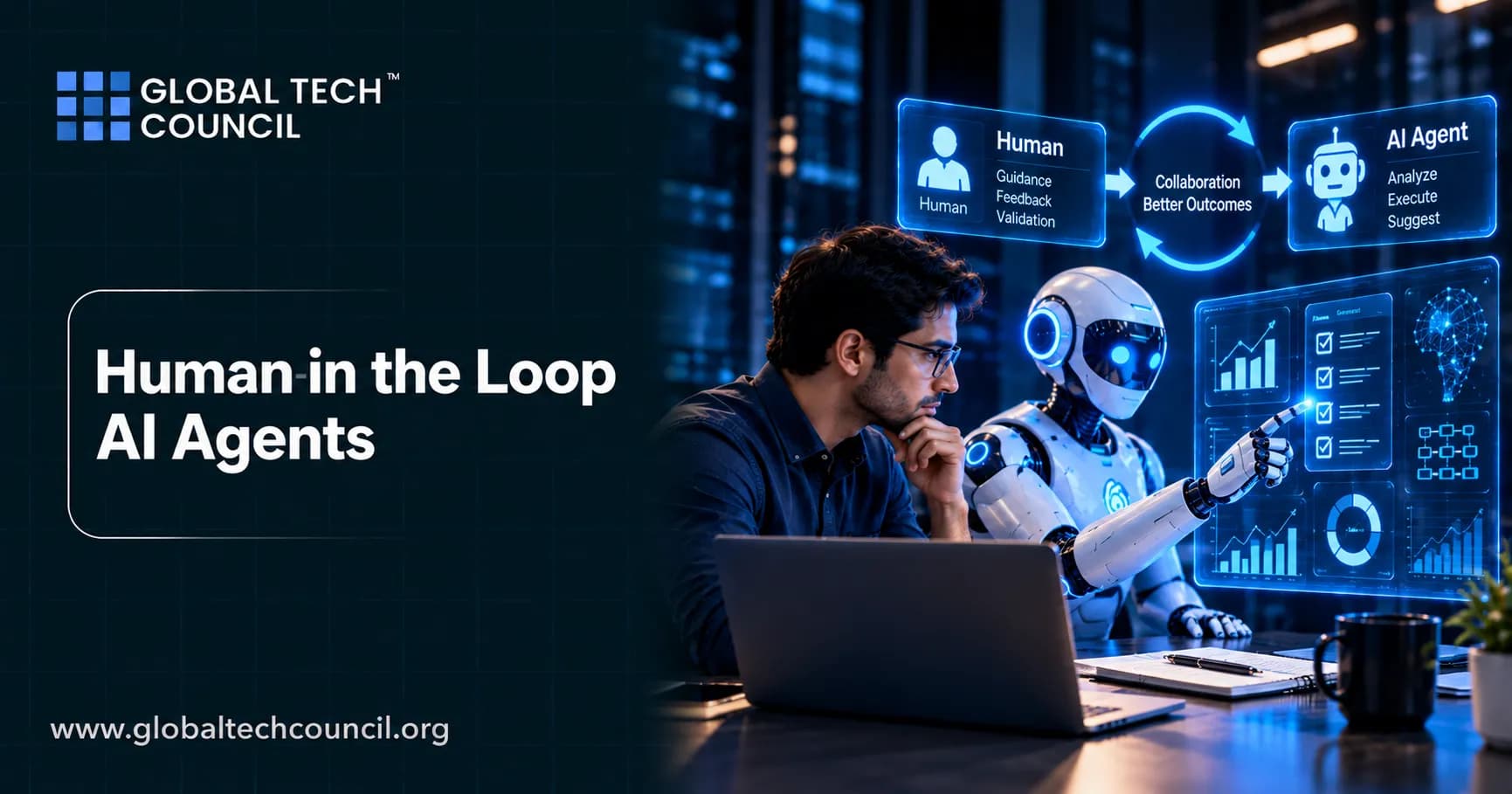
Human-in-the-loop AI agents are shifting from an informal review practice to a repeatable governance pattern for high-risk automation. As agentic systems begin to draft legal clauses, access sensitive records, modify infrastructure, or prepare payment releases, organizations need controls that do more than keep a human nearby. They need a design that can prove who approved what, when, and under which policy, with evidence that holds up to auditors and regulators. Professionals developing expertise in these systems can explore the Certified Agentic AI Expert certification to build relevant knowledge of agentic AI concepts and applications.
This article explains how to design guardrails, approval checkpoints, and immutable audit trails for human-in-the-loop AI agents, with practical patterns that align to modern AI governance expectations. These include the EU AI Act's human oversight requirements for high-risk systems and the NIST AI Risk Management Framework's emphasis on demonstrable oversight.

Why Human-in-the-Loop AI Agents Are Now a Control System
In earlier deployments, human-in-the-loop typically meant someone periodically sampling outputs or reviewing edge cases. With agentic AI, that approach breaks down because agents can initiate consequential actions, sometimes at machine speed. Current practitioner guidance frames human-in-the-loop as a production control system that defines:
Approval boundaries - what must pause for a human
Risk thresholds - what can run autonomously and what cannot
Access controls - what the agent can touch
Audit evidence - what must be recorded and retained
The outcome is not just safer automation. It is compliance readiness: oversight that is measurable, traceable, and enforceable through people, process, and technology.
The Compliance Driver: Proving Control, Not Claiming Review
Regulatory and enterprise governance expectations are converging on a simple standard: if an AI system is high-risk, you must demonstrate that oversight occurred and that it was effective. That typically requires:
Clear accountability via identity-bound approvals (named individuals, authenticated sessions)
Policy-driven enforcement (not optional review)
Traceability from prompt to decision to action
Reconstructable decision paths for internal investigations and external audits
In practice, this means designing human-in-the-loop AI agents with three integrated layers: guardrails, approvals, and audit trails.
Layer 1: Guardrails for Human-in-the-Loop AI Agents
Guardrails are the technical and procedural constraints that reduce the risk of unsafe, noncompliant, or unauthorized behavior before a human reviews anything. For human-in-the-loop AI agents, guardrails should be explicit, testable, and continuously enforced.
1) Policy Frameworks and Action Constraints
Start by defining what the agent may and may not do. Policies should cover:
Allowed tools and systems (for example, read-only CRM access, no direct database writes)
Data handling rules (regulated data, confidential data, retention constraints)
Prohibited actions (money movement, external commitments, credential access)
Output constraints (no personal data in summaries, no unverified claims in customer messages)
These policies should be implemented as enforceable rules, not just documentation.
2) Least Privilege, RBAC, and Identity Governance
Least-privilege access and role-based access control (RBAC) are consistently recommended as foundational guardrails. The agent should only hold the minimum permissions required for the current workflow and role. Common patterns include:
Scoped service accounts per agent and per environment
Time-bound credentials for elevated actions
Separation of duties so the same identity cannot propose and approve a high-risk action
Identity governance becomes the enforcement layer for agentic systems: permissions and approvals must be technically bound to authentication, authorization, and logging.
3) Automated Filters, DLP, and Risk Thresholds
Guardrails also include automated checks that operate at runtime:
Prompt and output filtering to block unsafe requests, sensitive data exposure, or policy violations
Data loss prevention (DLP) integration to detect and prevent leakage of regulated or confidential information
Risk thresholds that determine whether a task can proceed autonomously or must escalate to a human approval gate
Risk thresholds are particularly important for agentic AI because the same agent might perform low-risk actions (drafting an internal summary) and high-risk actions (sending external communications or initiating operational changes) within the same workflow.
Layer 2: Approvals and Checkpoints That Work in Production
Approvals are the mechanism that turns policy into operational control. Rather than informal review, modern human-in-the-loop AI agents use workflow-driven approval gates with defined roles, authority, and escalation rules.
Human-in-the-Loop vs. Human-on-the-Loop
Two oversight modes apply depending on risk level:
Human-in-the-loop: the agent must pause and obtain explicit approval before executing a defined high-risk action.
Human-on-the-loop: the agent proceeds for lower-risk tasks while humans monitor performance, exceptions, and alerts.
Many enterprises implement graduated autonomy: the higher the impact, the more explicit the approval requirement.
What Should Require Explicit Approval?
Approval checkpoints should be inserted before actions such as:
Money movement (payment releases, refunds, vendor disbursements)
External communications (customer emails, press statements, regulatory responses)
Legal commitments (contract clauses, terms acceptance, policy commitments)
Infrastructure or security changes (access policy updates, configuration changes, deployments)
Sensitive data access or disclosure (exporting reports, sharing datasets, retrieving regulated records)
Designing Effective Approval Workflows
Approvals fail when reviewers lack context or authority. A robust approval gate includes:
Reviewer authority: the reviewer must be empowered to approve, reject, or request changes.
Decision context: show the agent's rationale, retrieved evidence, policy checks, and predicted impact.
Structured escalation: clear escalation paths for exceptions (for example, supervisor approval above a defined threshold).
Abort criteria: conditions that force a stop, such as a policy violation, missing evidence, or an anomalous destination account.
For implementation, approval gates are typically embedded in business process tooling so an agent cannot bypass the checkpoint. Global Tech Council training in Agentic AI, AI Governance, and Cybersecurity can support teams designing these workflows as enforceable controls. Developers seeking to deepen their practical understanding of agent design and implementation can also explore the Certified Agentic AI Developer certification.
Layer 3: Immutable Audit Trails and Decision Lineage
Auditability is a core requirement because organizations must reconstruct what happened during an agent-driven decision. For human-in-the-loop AI agents, audit trails should capture both machine decisions and human approvals in a tamper-resistant way.
What to Log for Compliance-Grade Audit Trails
Every significant event should be recorded, including:
Inputs: prompts, system instructions, and relevant context identifiers
Retrieved evidence: sources, document IDs, database queries, and tool calls
Policy outcomes: which policies were evaluated and whether they passed or failed
Agent decisions: proposed action, rationale, and risk score or risk tier
Human actions: approval, rejection, override, comments, and requested changes
Identity binding: authenticated user ID, role, and authentication method
Timestamps: proposal time, approval time, and execution time
Execution status: completed, failed, rolled back, or canceled
Why Immutability and Identity Binding Matter
Audit logs should be immutable where possible so they can support internal investigations, external audits, and regulatory inquiries. Equally important, approvals must be bound to a specific authenticated individual rather than a generic queue. This preserves accountability and reduces the risk of rubber-stamping with unclear ownership.
Observability Dashboards and Continuous Monitoring
Beyond log retention, organizations should monitor trends over time using dashboards and alerts, tracking metrics such as:
Prompt-level exception patterns
Approval rates and rejection reasons
High-risk action frequency by workflow
Repeated policy failures or drift signals
This supports continuous policy enforcement and enables faster incident response when agent behavior deviates from approved thresholds. Organizations exploring broader technology governance and advanced technical capabilities may also consider Deep Tech Certification as part of their professional development planning.
Real-World Implementation Patterns
Finance and Payments
A common pattern is for an agent to prepare payment batches, flag anomalies, and hold exceptions for review. Only approved payments are released, and each approval is captured in the audit trail with identity binding and timestamps. This applies well to accounts payable, treasury operations, and expense reimbursements.
Vendor and Procurement Workflows
Agents can gather invoices and supporting documents, compare line items, identify mismatches, and propose a decision. The workflow then pauses for approval before vendor payment or contract execution, with escalation rules for higher amounts or elevated risk categories.
Sensitive Data Access and Regulated Workflows
When agents operate near confidential or regulated data, least privilege, RBAC, and DLP become the primary guardrails. Human approval gates can be required for data exports, sharing outside approved groups, or access to specific record types.
Assessing Candidates for Emerging AI Roles
Agentic AI systems can plan tasks, use tools, and execute multi-step workflows with varying degrees of autonomy. As organisations explore these capabilities, they also need professionals who can design, monitor, and evaluate such systems. HireValid can be explored by employers looking for structured ways to assess candidates for emerging technology roles.
A Practical Checklist for Deploying Human-in-the-Loop AI Agents
Classify the use case by risk and define which actions are high-impact.
Define permissions using least privilege, RBAC, and separation of duties.
Implement policy checks for data handling, tool usage, and prohibited actions.
Insert approval checkpoints for money movement, external commitments, legal actions, and sensitive data workflows.
Log all material events with identity binding and immutable storage where possible.
Operationalize monitoring with dashboards, alerts, and incident response playbooks.
Continuously tune thresholds based on exceptions, near-misses, and audit findings.
Teams that need stronger coverage across access controls, logging, and operational security can align skills development through Global Tech Council certifications in AI and Machine Learning, Data Science, and Cybersecurity.
Conclusion: Graduated Autonomy With Provable Oversight
The likely enterprise end state is not fully autonomous agents across every function. It is graduated autonomy, where low-risk tasks run with supervision and high-risk tasks require explicit, identity-bound approvals. The organizations that succeed with human-in-the-loop AI agents will treat oversight as a system: guardrails to prevent unsafe action, workflow approvals to enforce decision boundaries, and immutable audit trails to prove control end-to-end.
By designing these three layers together, teams can deploy agentic AI in high-impact environments while meeting governance expectations and maintaining audit readiness as regulatory scrutiny continues to increase. For professionals and organizations connecting technical governance with broader business capabilities, the Marketing Certification may complement wider professional development goals.
FAQs
1. What are human-in-the-loop AI agents?
Human-in-the-loop AI agents are AI systems that involve people in reviewing, guiding, approving, or correcting decisions and actions. This approach combines AI-driven automation with human judgment to improve reliability, accountability, and decision quality.
2. How do human-in-the-loop AI agents work?
These agents process information, analyze tasks, and recommend or perform actions within defined boundaries. When a task requires approval, involves uncertainty, or exceeds the agent's permissions, it requests human input before continuing.
3. Why is human oversight important in AI agents?
Human oversight helps identify errors, manage ambiguous situations, reduce harmful outcomes, and ensure decisions follow business policies. It is especially valuable when AI agents handle sensitive information or perform actions with financial, legal, or operational consequences.
4. What is the difference between autonomous AI agents and human-in-the-loop AI agents?
Autonomous AI agents can complete tasks independently within their assigned permissions. Human-in-the-loop AI agents incorporate human review or intervention at selected stages. The latter approach is useful when decisions require specialized expertise, accountability, or additional risk controls.
5. When should a human intervene in an AI agent's workflow?
Human intervention may be necessary when the agent encounters conflicting information, low confidence, unusual requests, policy violations, or high-impact decisions. Organizations should establish clear intervention rules based on the potential consequences of an incorrect action.
6. What are the main benefits of human-in-the-loop AI systems?
Key benefits include improved decision quality, greater accountability, stronger risk management, better handling of unusual cases, and opportunities for continuous improvement. Human review can also help organizations identify recurring errors and refine their AI workflows.
7. How are human-in-the-loop AI agents used in customer support?
In customer support, AI agents can categorize queries, retrieve information, draft responses, and recommend solutions. Human representatives can review sensitive responses, resolve complex complaints, and approve actions such as refunds or account changes when required.
8. How do human-in-the-loop AI agents improve business automation?
They automate repetitive tasks while reserving important decisions for human employees. For example, an agent can process invoices and flag discrepancies, while an authorized finance professional reviews exceptions before payment is released.
9. What is the role of confidence scores in human-in-the-loop AI?
Confidence scores can help determine when an agent should request human review. However, confidence scores are not always reliable measures of correctness. Businesses should combine them with validation rules, risk thresholds, and observed performance before using them to trigger escalation.
10. How can businesses design effective human approval workflows?
Businesses should define which actions require approval, who is authorized to provide it, what information reviewers need, and how rejected decisions are handled. Approval interfaces should present the agent's proposed action, supporting evidence, relevant risks, and available alternatives.
11. What are the common challenges of human-in-the-loop AI agents?
Common challenges include review delays, excessive approval requests, inconsistent human judgments, unclear responsibilities, and reviewer fatigue. Organizations can address these issues by prioritizing high-risk cases, simplifying review interfaces, and measuring both AI and human performance.
12. How does human feedback help AI agents improve?
Human feedback can identify incorrect outputs, missing context, poor recommendations, and policy violations. Teams can use this information to improve prompts, update knowledge bases, refine workflow rules, adjust evaluation criteria, or retrain models where appropriate.
13. What is the difference between human-in-the-loop, human-on-the-loop, and human-out-of-the-loop AI?
Human-in-the-loop systems require human input or approval at designated decision points. Human-on-the-loop systems allow AI to operate while people monitor performance and intervene when necessary. Human-out-of-the-loop systems operate without routine human intervention during execution, although broader governance and monitoring may still apply.
14. How can human-in-the-loop AI agents improve decision-making in finance?
Financial organizations can use these agents to flag suspicious transactions, review expense claims, analyze financial documents, and identify anomalies. Human experts can investigate flagged cases and approve high-impact decisions, helping balance automation efficiency with financial controls.
15. How can companies secure human-in-the-loop AI agents?
Companies should implement role-based access controls, secure authentication, audit logs, data protection measures, and strict limits on agent permissions. Human approval should not replace technical security controls, and reviewers must verify that requested actions are legitimate before authorizing them.
16. How do human-in-the-loop AI agents support healthcare workflows?
These agents can help organize medical records, summarize documentation, support administrative tasks, and surface information for clinical review. Qualified healthcare professionals should remain responsible for clinical decisions, with appropriate safeguards for patient privacy, accuracy, and regulatory compliance.
17. How can organizations measure the performance of human-in-the-loop AI agents?
Organizations can track task accuracy, escalation rates, human approval and rejection rates, resolution time, error severity, policy compliance, and cost per completed task. These metrics should be evaluated together because faster processing does not necessarily mean better or safer outcomes.
18. What skills do employees need to work with human-in-the-loop AI agents?
Employees benefit from critical thinking, AI literacy, domain expertise, data interpretation, risk assessment, and clear communication. They should also understand the agent's limitations, know how to verify its outputs, and recognize when a task requires escalation.
19. How can businesses implement human-in-the-loop AI agents successfully?
Businesses should start with a well-defined, manageable workflow and identify the decisions that need human involvement. They can then configure access permissions, establish approval rules, test realistic scenarios, train employees, and monitor results before expanding to more complex use cases.
20. What is the future of human-in-the-loop AI agents?
Human-in-the-loop AI agents are likely to become more integrated into enterprise workflows as organizations automate increasingly complex tasks. Their long-term effectiveness will depend on appropriate levels of autonomy, reliable evaluations, meaningful human oversight, transparent decision processes, and clear accountability.
Related Articles
View All
Agentic AI
Building Safe Agentic AI Systems: Guardrails, Permissions, and Human-in-the-Loop Patterns
Learn how to build safe agentic AI systems with multi-layer guardrails, tool-scoped permissions, and human-in-the-loop patterns that scale, stay auditable, and reduce risk.
Agentic AI
From Chatbots to AI Agents: A Step-by-Step Roadmap to Deploying Agentic Automation in Business
A step-by-step roadmap for agentic automation, showing how businesses evolve from chatbots to AI agents, workflow orchestration, multi-agent systems, and governed scaling.
Agentic AI
Securing AI Agents: Threat Models, Prompt Injection Defenses, and Least-Privilege Tooling
Learn how securing AI agents works in practice: agent threat models, layered prompt injection defenses, and least-privilege tooling to reduce blast radius.
Trending Articles
The Role of Blockchain in Ethical AI Development
How blockchain technology is being used to promote transparency and accountability in artificial intelligence systems.
AWS Career Roadmap
A step-by-step guide to building a successful career in Amazon Web Services cloud computing.
Top 5 DeFi Platforms
Explore the leading decentralized finance platforms and what makes each one unique in the evolving DeFi landscape.