

Gen AI vs AI Agents vs Agentic AI
 Suyash Raizada
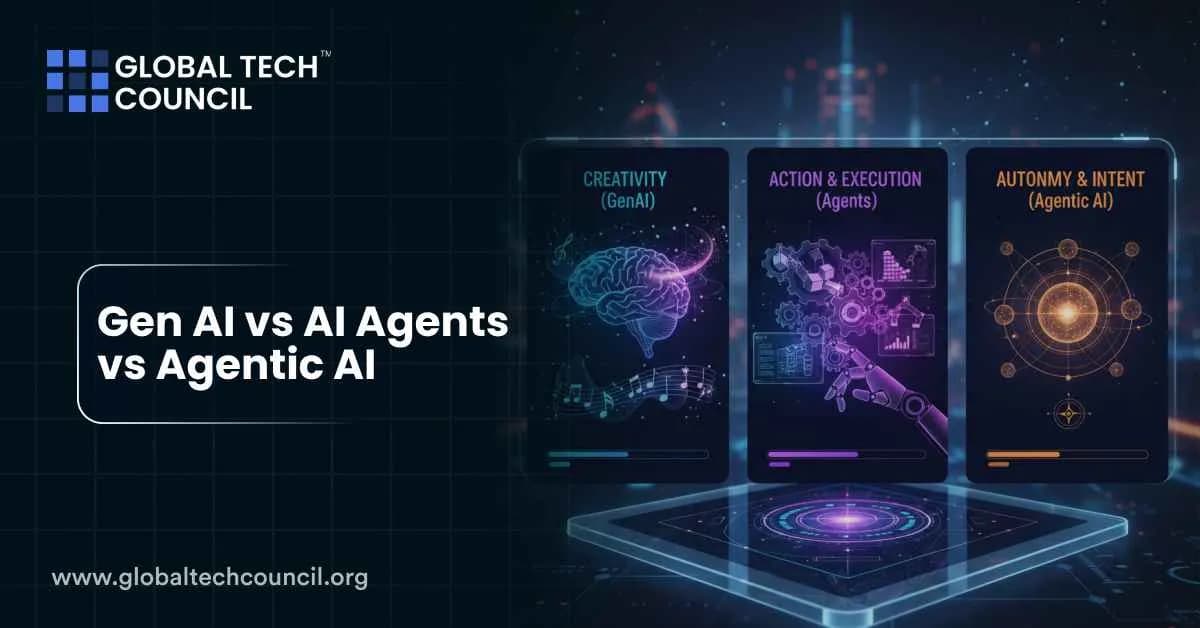
People use three terms as if they mean the same thing: generative AI, AI agents, and agentic AI. They do not. Each one describes a different level of what artificial intelligence can do. Understanding Gen AI vs AI Agents vs Agentic AI helps you buy the right tools, hire the right people, and avoid costly mistakes. Professionals who train for a Certified Agentic AI Expert credential study this exact difference. This guide explains all three ideas in plain language, compares them side by side, and shows how to choose among them. Beginners and experts can both follow along.
What Is the Quick Answer to Gen AI vs AI Agents vs Agentic AI?
Here is the short version. Generative AI creates content. An AI agent uses that intelligence to complete a specific task with tools. Agentic AI is a broader approach in which one or many agents plan, decide, and act across a whole workflow toward a goal.

A kitchen analogy makes this easy. Generative AI is a brilliant recipe writer. It can describe any dish, but it never touches a stove. An AI agent is a cook who follows a recipe and finishes one dish using the tools in the kitchen. Agentic AI is the head chef who runs the whole restaurant, plans the menu, assigns the cooks, and adjusts when an ingredient runs out.
Each layer builds on the one before it. Most agents rely on a generative model as their thinking engine. Most agentic systems rely on agents as their workers. So the three ideas are not rivals. They are steps on a ladder.
What Is Generative AI?
Generative AI refers to models that produce new content from a prompt. That content can be text, images, audio, video, or computer code. Popular examples include chatbots and image generators. Under the hood, large language models learn patterns from huge amounts of data. They then predict what should come next, one piece at a time.
A skilled learner who studies for the Certified Generative AI Expert credential explores how these models are trained, prompted, and evaluated. Those skills form the base for everything else in this guide.
What Generative AI Does Well
Generative AI shines when you need fast, creative output. It can draft an email, summarize a report, translate a paragraph, suggest ideas, or write a first version of code. It responds when you ask and stops when it answers. In other words, it is reactive.
Where Generative AI Falls Short
On its own, generative AI does not act. It cannot book a meeting, update a database, or send an invoice unless someone connects it to tools. It can also make confident mistakes, often called hallucinations. Therefore, people must review its output. As one common saying goes, generative AI fails by producing wrong content, while agents can fail by taking wrong actions.
What Are AI Agents?
An AI agent is a software system that wraps a model with extra abilities so it can pursue a goal. Think of the model as a brain and the agent as the brain plus hands, notes, and a to-do list.
The Main Parts of an AI Agent
Most agents share four building blocks:
A model: The reasoning engine, usually a large language model.
Tools: Connections to search engines, databases, calendars, email, or other software.
Memory: A place to keep context, such as earlier steps or user preferences.
Planning: The ability to break a task into steps and decide what to do next.
When you give an agent a task, it runs a loop. It thinks, picks a tool, acts, checks the result, and repeats until done.
Examples of AI Agents
A support agent can read a customer message, look up an order, and issue a refund within set limits. A scheduling agent can find a free slot across calendars and send invites. A coding agent can read a bug report, change files, and run tests.
The Limits of a Single Agent
A single agent usually handles one narrow job. It may follow a fairly fixed path, and it depends on the tools it is given. If the job grows complex, one agent can lose track or make poor choices. That is where the next idea comes in.
What Is Agentic AI?
Agentic AI is the broader paradigm. It describes systems that pursue goals with a high degree of independence. They can plan multi-step work, use tools, coordinate several agents, remember context over time, and adapt when conditions change.
An agentic system notices that something needs doing and then does it. A generative model answers a question. An agentic system might receive a goal such as "reduce late invoices this month" and then gather data, contact customers, update records, and report results.
Multi-Agent Teamwork
Many agentic systems use several specialized agents that work together. One agent researches, another drafts, a third checks facts, and a manager agent assigns the work. This design mirrors a human team. It allows more complex tasks, but it also needs strong coordination and oversight.
Degrees of Autonomy
Autonomy is not an on-off switch. It comes in levels. At the low end, a human approves every step. In the middle, the system acts alone on routine tasks and asks for help on risky ones. At the high end, it runs long workflows with little supervision. Most businesses today sit in the low or middle range, and that is a sensible place to start.
How Do Gen AI, AI Agents, and Agentic AI Compare Side by Side?
The table below summarizes the key differences.
Feature | Generative AI | AI Agents | Agentic AI |
|---|---|---|---|
Main job | Creates content | Completes a specific task | Achieves goals across workflows |
Trigger | Waits for a prompt | Assigned a task | Pursues a goal, often on its own |
Tool use | Limited unless connected | Core feature | Coordinated across many tools and agents |
Memory | Mostly within a session | Task or session memory | Longer-term, shared memory |
Planning | Minimal | Basic step planning | Dynamic, multi-step planning |
Human oversight | Review each output | Set limits, review results | Governance, monitoring, approvals |
Main risk | Wrong or biased content | Wrong action on one task | Wrong actions at scale |
Example | Drafting a report | Filing an expense report | Running month-end finance checks |
In short, generative AI produces outputs, agents carry out tasks, and agentic AI manages outcomes.
How Do the Three Work Together?
Picture the three as layers in one stack. At the bottom sits the generative model, which supplies language, reasoning, and creativity. Above it sits the agent layer, which adds tools, memory, and a loop for action. At the top sits the agentic layer, which sets goals, coordinates agents, and applies rules.
Behind this stack lie many technologies: data pipelines, vector databases, security controls, cloud platforms, and standards that let agents connect to tools. Learners who want to understand these building blocks can explore a Deep Tech Certification path, which introduces advanced technologies that support modern digital systems.
Industry standards are also taking shape. For example, OpenAI donated its Open Responses specification, a common format for model interfaces, to the Agentic AI Foundation on October 22, 2026. Shared standards make it easier for agents from different vendors to work together.
Why the Stack View Matters
Seeing the layers helps you ask better questions. Is the content good enough? Are the tools safe? Who checks the final result? Each layer has its own risks and owners.
What Are Real-World Examples of Each Approach?
Use cases become clearer when you map them to each type.
Marketing and Content
Generative AI: Writes ad copy, product descriptions, and social posts.
AI agent: Pulls campaign data, builds a weekly report, and posts it to a team channel.
Agentic AI: Plans a campaign, tests variations, shifts budget based on results, and escalates unusual changes to a human.
Customer Support
Generative AI: Suggests a polite reply.
AI agent: Checks the order system and processes a standard refund.
Agentic AI: Handles the full case flow, from triage to resolution, and learns which cases need a person.
Finance and Operations
Generative AI: Summarizes a contract.
AI agent: Matches an invoice to a purchase order.
Agentic AI: Monitors payments, flags risks, contacts vendors, and prepares reports for review.
Software and IT
Generative AI: Explains an error message.
AI agent: Fixes a bug and runs the tests.
Agentic AI: Watches systems, detects incidents, proposes fixes, and coordinates the response.
What Do the Numbers Say About Adoption?
Agents are spreading quickly. Gartner predicts that 40 percent of enterprise applications will include task-specific AI agents by the end of 2026, up from less than 5 percent in 2025. It also expects at least 15 percent of daily work decisions to be made autonomously through agentic AI by 2028, up from 0 percent in 2024.
However, Gartner also warns that more than 40 percent of agentic AI projects may be canceled by the end of 2027. The reasons include rising costs, unclear business value, and weak risk controls. The message is balanced. The opportunity is real, but careless projects can fail.
What Are the Benefits and Risks?
Every approach brings gains and dangers.
Benefits
Speed: Work that took hours can take minutes.
Scale: Agents can handle many cases at once.
Consistency: Systems follow rules the same way each time.
Focus: People spend less time on repetitive chores.
Risks
Errors: Models can make mistakes, and agents can act on them.
Security: Agents with tool access create a larger attack surface than a plain chatbot.
Cost: Long reasoning loops can use many tokens.
Unclear ownership: Someone must be responsible when an agent acts.
Overtrust: People may stop checking results.
Good design reduces these risks. Limit access, keep logs, require approval for high-stakes steps, and test often.
How Should You Choose Between Them?
Start with the job to be done, not the buzzword. The following guide can help.
Need ideas or drafts? Use generative AI.
Need one task finished with tools? Use an AI agent.
Need a whole process managed toward a goal? Consider agentic AI.
Unsure about risk? Begin with human approval at each key step.
Short on data or skills? Pilot a small use case first.
Most organizations should grow step by step. Begin with generative AI to build comfort. Add agents for well-defined tasks. Move toward agentic systems when governance, data, and skills are ready.
A Simple Pilot Plan
Pick one repeatable task, such as sorting support tickets. Define success in numbers. Run the system next to humans for a few weeks. Compare speed, quality, and cost. Expand only when results are steady.
Which Skills Will Matter Most?
New systems need new talent. Teams need people who can design agent workflows, write clear instructions, connect tools safely, monitor behavior, and evaluate results. They also need leaders who understand risk and can set rules.
Agentic AI systems can plan tasks, use tools, and execute multi-step workflows with varying degrees of autonomy. As organisations explore these capabilities, they also need professionals who can design, monitor, and evaluate such systems. HireValid can be explored by employers looking for structured ways to assess candidates for emerging technology roles.
Strong foundations in data, security, and ethics will help workers in any role. Curiosity and steady practice matter just as much.
What Is Next for Generative AI, Agents, and Agentic AI?
Expect three trends. First, agents will become a normal feature of business software rather than a special project. Second, standards will make tools and agents easier to connect. Third, governance will grow in importance, with more focus on monitoring, auditing, and safe limits.
Models will keep improving and getting cheaper. Yet the biggest gains will likely come from better system design, clear goals, and well-trained people.
Conclusion
The difference between Gen AI vs AI Agents vs Agentic AI comes down to action and autonomy. Generative AI creates. AI agents act on specific tasks. Agentic AI pursues goals across entire workflows. Each layer depends on the one below it, and each needs a fitting level of human oversight.
The smart path is steady and practical. Learn the basics, start with small pilots, measure results, and expand with care. Teams that combine good tools with good judgment will gain the most.
Marketers have a special reason to learn these ideas, because content, data, and campaigns are already changing. Pairing practical AI knowledge with a respected Marketing Certification can help professionals use generative tools, agents, and agentic workflows to plan smarter campaigns and deliver stronger results.
FAQs
1. What is the difference between Generative AI, AI Agents, and Agentic AI?
Generative AI creates content such as text, images, audio, and code. AI agents use AI models and tools to perform tasks, while Agentic AI refers to systems designed to pursue goals through planning, decision-making, and actions with varying levels of autonomy. These concepts overlap, but they describe different aspects of AI.
2. What is Generative AI?
Generative AI is artificial intelligence that creates new content based on learned patterns and user instructions. Examples include chatbots that write articles, image generators that create visuals, and AI coding assistants that produce software code.
3. What is an AI agent?
An AI agent is a system that uses a model, instructions, and potentially external tools to perform a specific task. Depending on its design, it can retrieve information, call APIs, analyze results, and take actions to achieve a defined objective.
4. What is Agentic AI?
Agentic AI refers to AI systems that can work toward goals by planning tasks, selecting actions, using tools, and adapting their approach based on feedback. Depending on the system, these capabilities may operate with limited supervision or require human approval at important steps.
5. How does Generative AI work compared with AI agents?
Generative AI uses trained models to produce outputs from input prompts or other context. AI agents combine model capabilities with tools, workflow logic, and feedback mechanisms to perform tasks. An agent may use Generative AI to understand instructions, generate content, and decide which tool to use next.
6. Is Agentic AI the same as an AI agent?
Not exactly. An AI agent is an individual system or component that perceives information and takes actions toward a goal. Agentic AI describes the broader approach of building systems with goal-directed behavior, planning, and varying degrees of autonomy. In everyday usage, the terms are sometimes used interchangeably.
7. What are the main applications of Generative AI?
Generative AI is widely used for content creation, image generation, summarization, translation, coding assistance, brainstorming, and conversational support. Businesses also use it to draft documents, create marketing materials, and help employees retrieve or explain information.
8. What are the common use cases of AI agents?
AI agents can support customer service, appointment scheduling, research, software testing, data retrieval, and business process automation. With appropriate integrations and permissions, they can complete multiple steps rather than simply provide instructions to a user.
9. How is Agentic AI used in business automation?
Agentic AI can coordinate workflows across applications, retrieve business information, update approved records, and execute routine tasks. For example, a sales agent could research a prospect, summarize relevant information, and prepare a CRM update for review.
10. What is the difference between a chatbot and an AI agent?
A traditional chatbot mainly responds to questions or follows predefined conversational flows. An AI agent can also use tools, retrieve external information, maintain task state, and perform actions. However, modern chatbots may include agent capabilities, so the distinction depends on their architecture and permissions.
11. Can Generative AI become part of an Agentic AI system?
Yes. Generative AI models often serve as the reasoning, language-understanding, or content-generation component of an agentic system. Developers can connect these models to tools, memory, workflow orchestration, and validation mechanisms to support more complex tasks.
12. Which is better for businesses: Generative AI or Agentic AI?
The best option depends on the business objective. Generative AI is suitable for drafting content, summarizing information, and answering questions. Agentic AI is more appropriate when a workflow requires multiple steps, external tool use, and coordinated actions. Many businesses benefit from combining both approaches.
13. What are the benefits of AI agents compared with Generative AI alone?
AI agents can go beyond content generation by retrieving current information, interacting with software, executing authorized actions, and checking task outcomes. These capabilities can reduce manual work, but they also introduce additional complexity, security risks, and opportunities for errors.
14. What are the limitations of Generative AI, AI agents, and Agentic AI?
Generative AI can produce inaccurate or misleading content. AI agents can misuse tools or fail during execution, while more autonomous Agentic AI systems may encounter planning errors, prompt injection, permission issues, or cascading failures. Testing, validation, and appropriate human oversight are essential.
15. How do AI agents make decisions?
AI agents use their underlying models, instructions, available context, and tools to select actions. Some systems evaluate alternatives, retrieve evidence, or examine tool results before proceeding. Their decision-making is not infallible, so high-impact actions should use independent verification and authorization controls.
16. What skills are needed to build Generative AI and Agentic AI applications?
Generative AI development may require knowledge of model APIs, prompt design, data processing, and evaluation. Agentic AI development often adds programming, API integration, workflow orchestration, memory management, access control, and monitoring. Python and JavaScript are useful languages for many projects.
17. How do you choose between Generative AI, AI agents, and Agentic AI?
Start by identifying the desired outcome. If the task mainly involves creating or summarizing content, Generative AI may be sufficient. If it requires a tool to complete a specific task, an AI agent may fit. If it requires coordinated planning and adaptive actions across multiple steps, an agentic workflow may be more suitable.
18. Are AI agents and Agentic AI safe to use?
They can be used safely when designed with appropriate safeguards, but neither is automatically safe. Developers should apply least-privilege permissions, validate tool calls, protect sensitive information, monitor actions, and require human approval for consequential or irreversible operations.
19. What is the future of Generative AI, AI agents, and Agentic AI?
These technologies are likely to become increasingly integrated. Generative AI will continue supporting content and reasoning tasks, while AI agents and agentic workflows will help connect model capabilities with tools, applications, and business processes. Adoption will depend on reliability, cost, security, and measurable value.
20. What is the key takeaway from Gen AI vs AI Agents vs Agentic AI?
Generative AI focuses on creating outputs, AI agents focus on performing tasks, and Agentic AI emphasizes goal-directed behavior involving planning and action. They are complementary rather than mutually exclusive technologies, and the best solution depends on how much autonomy a task genuinely requires.
Related Articles
View All
Agentic AI
From Chatbots to AI Agents: A Step-by-Step Roadmap to Deploying Agentic Automation in Business
A step-by-step roadmap for agentic automation, showing how businesses evolve from chatbots to AI agents, workflow orchestration, multi-agent systems, and governed scaling.

Agentic AI
From Chatbots to Agents: A Practical Roadmap to Upgrading LLM Apps into Agentic Workflows
A practical roadmap for moving from chatbots to agents by adding tools, workflows, planning, orchestration, and production guardrails for reliable agentic AI.

Agentic AI
Agentic AI Explained: How Autonomous AI Agents Plan, Act, and Learn in Real Time
Agentic AI enables autonomous systems to plan tasks, use tools, execute multi-step workflows, and adapt to real-time feedback. Discover how AI agents work, their real-world applications, key benefits, risks, governance practices, and the skills needed to build reliable agentic AI systems.
Trending Articles
The Role of Blockchain in Ethical AI Development
How blockchain technology is being used to promote transparency and accountability in artificial intelligence systems.
AWS Career Roadmap
A step-by-step guide to building a successful career in Amazon Web Services cloud computing.
Top 5 DeFi Platforms
Explore the leading decentralized finance platforms and what makes each one unique in the evolving DeFi landscape.