

Agentic AI Explained: How Autonomous AI Agents Plan, Act, and Learn in Real Time
 Suyash Raizada
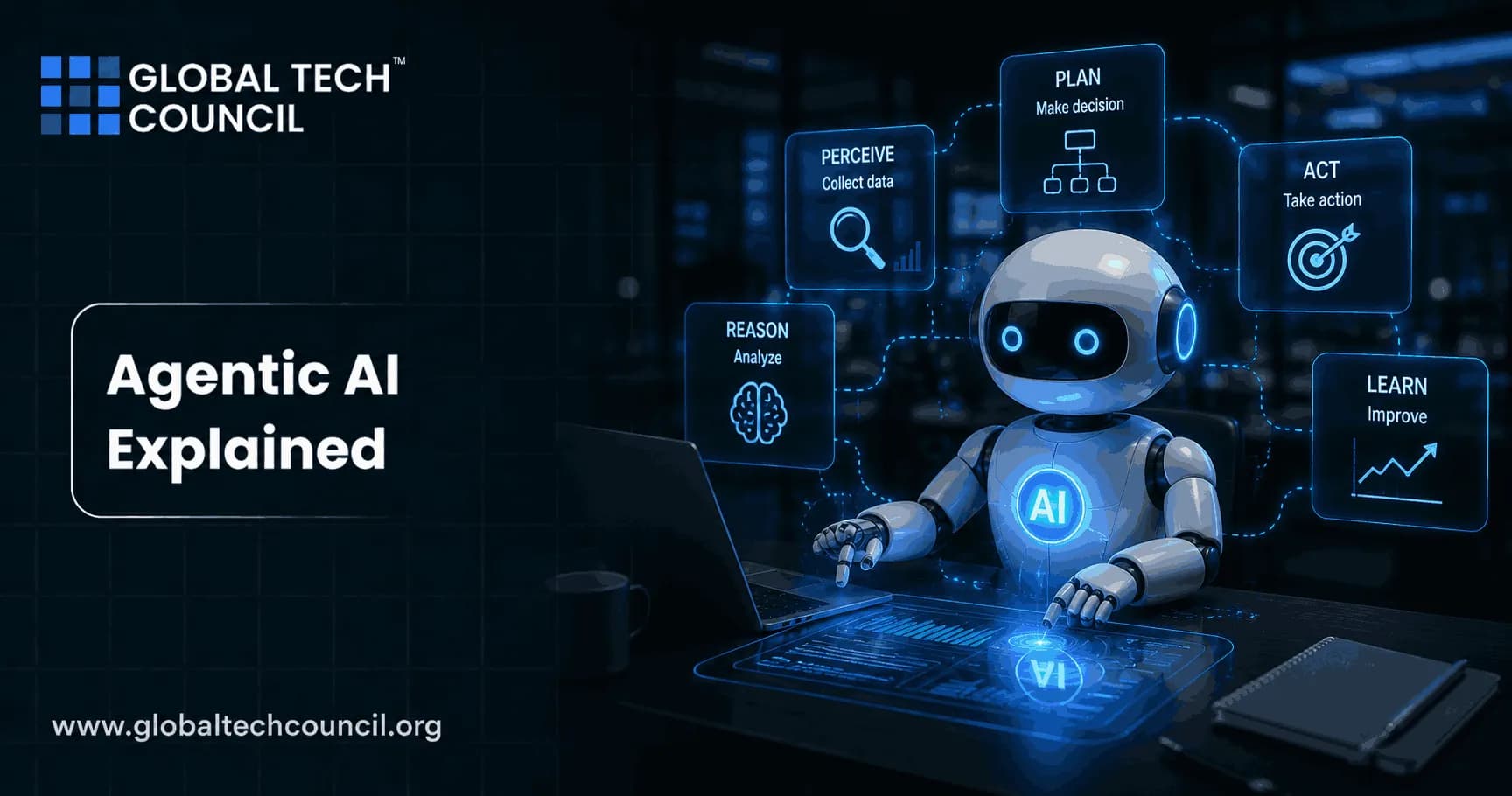
Agentic AI is reshaping how organizations think about automation. Instead of stopping at chat-style answers, agentic systems can plan a multi-step approach, act using tools like APIs and databases, and adapt based on feedback and fresh data. In practice, this turns AI from a conversational layer into a goal-driven system that can execute real work across software and workflows with reduced human intervention. Professionals looking to deepen their understanding of these systems can explore Certified Agentic AI Expert to develop knowledge relevant to agentic AI concepts and applications.
What Is Agentic AI?
Agentic AI refers to AI systems that can autonomously perform tasks on a user's behalf by deciding how to proceed, selecting tools, and interacting with real-world systems beyond static training data. Most industry definitions converge on a few core characteristics:

Autonomy toward a goal: the system pursues an objective rather than only generating text.
Workflow design and decision-making: it can choose and sequence steps without being explicitly scripted for each situation.
Tool and environment interaction: it can call APIs, query databases, search the web, or monitor live data streams.
A practical mental model is a continuous loop: goal setting, planning, tool use, state tracking, and adaptation. This is also why agentic AI is increasingly discussed as a shift from isolated prompts to agentic workflows that run across multiple steps. Developers building these applications can also explore Certified Agentic AI Developer for structured learning relevant to developing and deploying agentic AI systems.
How Autonomous AI Agents Work in Real Time
Most autonomous AI agents today are built by combining a large language model (LLM) with external tools and an orchestration layer. The LLM provides flexible reasoning and language understanding, while tools provide precise actions such as database lookups, calculations, retrieval, and workflow execution. This hybrid approach is essential because many enterprise tasks require deterministic behavior in sensitive steps, including access control, financial calculations, and change management.
The Agent Loop: Interpret, Plan, Act, Observe, Adapt
In real deployments, agentic behavior follows an iterative cycle:
Interpret the goal: understand what success looks like (for example, "resolve this incident" or "prepare a weekly sales summary").
Decompose into subtasks: break the objective into smaller actions such as gathering data, validating inputs, updating systems, and communicating results.
Select tools: choose the APIs, databases, search interfaces, ticketing systems, or internal platforms needed to proceed.
Execute actions: call tools, fetch live information, write updates, trigger workflows, or generate reports.
Observe results: read responses, logs, and system states to determine what changed and what remains unresolved.
Revise the plan: adjust next steps based on failures, missing data, or new inputs.
Continue until completion: stop when acceptance criteria are met, or escalate to a human when guardrails require it.
This cycle is what makes agentic AI valuable for dynamic work. The system is not limited to a single response. It can operate over time, integrate fresh context, and maintain state across steps.
Single-Agent vs. Multi-Agent Architectures
Some systems use one agent that plans and executes end-to-end. Others use multiple specialized agents coordinated by an orchestrator, where each agent handles a specific function - for example, one for retrieval, one for compliance checks, and one for action execution. This modularity can improve reliability and makes it easier to constrain sensitive operations to audited tools.
Planning, Acting, and Learning: What These Mean in Agentic AI
Agentic AI is often summarized as systems that can plan, act, and learn. Each term has a specific meaning in current production-oriented systems.
Planning: Turning Goals into Executable Steps
Planning is the agent's ability to convert a high-level goal into a structured approach: identifying dependencies, choosing an order of operations, and determining what information is needed before acting. In enterprise settings, planning often incorporates constraints such as access permissions, change windows, and required approvals.
Acting: Tool Use That Changes Real Systems
Acting means the agent executes steps through external tools and integrations. Common actions include:
API calls to internal services and SaaS platforms
Database queries to fetch records, metrics, or histories
Web search and retrieval for up-to-date information
Monitoring of data streams such as IoT telemetry or social signals
Workflow execution such as creating tickets, updating CRM fields, or initiating runbooks
The ability to interact with systems beyond training data is central to the real-time value proposition of agentic AI.
Learning: Controlled Adaptation, Not Open-Ended Self-Improvement
Learning in agentic systems is typically bounded. In most practical designs, it takes the following forms:
Feedback-driven refinement: improving future actions based on user corrections and outcome signals.
Memory and retrieval updates: storing useful context, decisions, and preferences for later sessions.
Model updates through fine-tuning or prompt and workflow iteration, typically under human governance.
Unrestricted, autonomous self-improvement without oversight is not a characteristic of typical enterprise production systems today. A more accurate description is controlled autonomy with explicit guardrails.
Why Agentic Workflows Are Accelerating Now
The move from isolated prompting to agentic workflows that combine tool use, orchestration, and iteration is being reinforced by two practical platform developments:
Models tuned for tool use: newer models and evaluation methods increasingly emphasize function calling, structured outputs, and computer-use capabilities.
Enterprise integration: organizations are connecting agents to live systems where retrieval and real-time action create measurable business value.
Industry evidence suggests that workflow design can drive significant performance gains. One widely cited example from industry commentary is that an agentic workflow, paired with the right model and design, can raise benchmark task performance from approximately 67% to approximately 95% in certain scenarios. The practical implication is that agent behavior, tool selection, and iteration patterns can matter as much as the underlying model itself.
Real-World Use Cases for Autonomous AI Agents
Agentic AI fits best when work is multistep, data-dependent, and changing in real time. Common enterprise use cases include:
IT Operations and Incident Response
Monitor alerts across systems
Correlate signals to identify likely root causes
Initiate approved remediation steps
Document actions and update incident tickets
Customer Service and Support Automation
Retrieve customer context from CRM and prior tickets
Search knowledge bases for relevant procedures
Propose resolution steps and draft responses
Update ticket status and route escalations when needed
Sales Operations and Account Intelligence
Pull live account health metrics
Summarize recent activity and renewal risks
Create structured notes and update CRM fields
Research and Analysis
Collect information across multiple sources
Track changes over time with periodic monitoring
Synthesize findings into briefings and reports
Workflow Orchestration Across Tools
Many organizations use agents to coordinate work across systems: creating tasks, notifying stakeholders, generating summaries, and keeping state synchronized. The strongest fit is not simple question-and-answer interactions, but ongoing processes that benefit from continuous observation and adaptation.
Risks, Limitations, and Governance Considerations
Greater autonomy introduces new failure modes. The practical risks of agentic AI typically fall into three categories: reliability, security, and governance.
Key Limitations to Plan For
Tool and data dependency: if APIs are unavailable, data is stale, or permissions are incomplete, the agent may fail or produce partial results.
Planning errors: the agent may choose an inefficient sequence, miss prerequisites, or mishandle edge cases.
Unsafe actions: without guardrails, agents can take actions that are incorrect, non-compliant, or operationally risky.
Need for deterministic controls: security-critical and calculation-heavy steps often require deterministic logic and explicit approvals rather than model-generated reasoning.
Practical Guardrails for Enterprise Deployments
Least-privilege access and scoped credentials for all tools
Human-in-the-loop approvals for high-impact actions
Audit logs of tool calls, decisions, and data access
Sandboxed execution and safe test environments for agent actions
Clear stop conditions and escalation rules
These patterns align with the broader industry emphasis on operating agents in secure environments and treating autonomy as a capability to be engineered, monitored, and governed rather than assumed.
Future Outlook: From Copilots to Operational Agents
Based on current industry direction, a practical near-term forecast looks like this:
Short term: copilots evolve into task-executing agents that can retrieve live data and complete bounded workflows.
Medium term: multi-agent systems become common inside enterprise processes, with orchestrators coordinating specialized agents across functions.
Longer term: agents operate across software environments while humans focus on exceptions, approvals, and governance rather than individual steps.
Growing public-sector attention to AI safety and accountability suggests that governance frameworks and policy standards will mature alongside adoption. Professionals exploring advanced technology concepts can also consider Deep Tech Certification as a learning resource related to emerging technologies and their technical foundations.
Building Skills for Agentic AI Systems
Agentic AI sits at the intersection of AI engineering, software architecture, data access, and security. Teams adopting agentic workflows typically benefit from strengthening competencies across four areas:
LLM application development: prompt design, structured outputs, evaluation, and tool calling
API and integration engineering: reliable connectors, error handling, idempotency, and observability
Data governance: access control, lineage, retention, and privacy
Cybersecurity fundamentals: threat modeling for autonomous actions and secure execution patterns
Global Tech Council programs in AI and Machine Learning, Data Science, Cybersecurity, and Programming address these disciplines and provide structured pathways for professionals building expertise in agentic system design and deployment.
Assessing Candidates for Emerging Technology Roles
Agentic AI systems can plan tasks, use tools, and execute multi-step workflows with varying degrees of autonomy. As organisations explore these capabilities, they also need professionals who can design, monitor, and evaluate such systems. HireValid can be explored by employers looking for structured ways to assess candidates for emerging technology roles.
Conclusion
Agentic AI is best understood as goal-driven AI that can plan a multi-step approach, act through tools and integrations, track state, and adapt using feedback and real-time data. The shift from chat responses to agentic workflows is not simply a model upgrade. It is an architectural change that blends LLM flexibility with the precision and governance of traditional software. Organizations that treat autonomy as a controlled, engineered capability, supported by strong guardrails, audit trails, and human oversight, are best positioned to capture productivity gains while managing security and reliability risks responsibly.
For professionals and organizations looking to broaden their understanding of technology-led innovation, Marketing Certification can also provide a learning pathway relevant to communicating and positioning technology solutions in the market.
FAQs
1. What is Agentic AI?
Agentic AI refers to artificial intelligence systems that can pursue goals, plan tasks, use tools, and take actions with varying levels of autonomy. Unlike systems that only respond to individual prompts, agentic AI can manage multistep workflows and adjust its approach based on results and feedback.
2. How do autonomous AI agents work?
Autonomous AI agents typically receive a goal, gather relevant information, develop a plan, execute actions through available tools, and evaluate the results. They may repeat this cycle until they complete the task, encounter a limitation, or require human approval.
3. How do AI agents plan, act, and learn in real time?
AI agents can break a goal into smaller tasks, choose actions based on available information, observe the outcomes, and revise their plans when necessary. Some systems also use memory or feedback to improve future decisions, although continuous learning during operation is not a capability of every AI agent.
4. What is the difference between Agentic AI and generative AI?
Generative AI primarily creates content such as text, images, audio, or code in response to instructions. Agentic AI focuses on achieving goals by planning and taking actions. An agentic system may use a generative AI model as its reasoning or content-generation component.
5. What are the main components of an Agentic AI system?
The main components commonly include an AI model, goal definition, planning and reasoning mechanisms, tool integrations, memory or context management, and feedback loops. Safety controls, permission management, and monitoring help ensure that the system operates within its intended boundaries.
6. What are the key benefits of Agentic AI?
Agentic AI can automate multistep tasks, reduce repetitive manual work, coordinate complex workflows, and respond to changing information. It can also help organizations improve productivity by connecting AI reasoning with software tools and business processes.
7. How is Agentic AI used in business automation?
Businesses use agentic AI to support customer service, research, document processing, sales operations, reporting, and internal workflow management. Agents can retrieve information, update records, draft responses, and coordinate tasks across applications when they have the appropriate integrations and permissions.
8. How does Agentic AI make decisions?
Agentic AI systems use their underlying models, instructions, available data, and planning mechanisms to select actions. Some systems evaluate multiple options or use external tools to verify information. Their decisions can still be incorrect, so validation and human oversight are important for high-impact tasks.
9. What role does memory play in Agentic AI?
Memory helps AI agents retain or retrieve relevant information across steps or interactions. Short-term memory can maintain the current task's context, while longer-term memory may store useful preferences, past results, or learned information. Memory design varies across systems and must account for privacy and accuracy.
10. Can Agentic AI learn from its mistakes?
Agentic AI can use feedback, task outcomes, stored examples, and evaluation mechanisms to adjust its approach. However, an agent correcting its actions within a workflow does not necessarily mean its underlying AI model is learning or changing its parameters. Persistent learning requires additional system capabilities.
11. What is the difference between Agentic AI and traditional AI automation?
Traditional automation usually follows predefined rules, scripts, and workflows. Agentic AI can use model-based reasoning to select actions, handle some unexpected situations, and adapt its plan. Traditional automation remains useful for predictable tasks, while agentic systems can help with more variable workflows.
12. How does Agentic AI use external tools and APIs?
AI agents can connect to external tools and APIs to search for information, retrieve data, execute code, send approved requests, or update business systems. Tool permissions and validation determine what an agent can actually do, and sensitive actions may require explicit human authorization.
13. What are some real-world examples of Agentic AI?
Examples include customer support agents that investigate issues, coding agents that test and revise software, research agents that gather information, and business agents that process documents. Other applications include scheduling, inventory monitoring, and coordinating tasks across enterprise systems.
14. How can Agentic AI improve customer service?
Agentic AI can retrieve relevant account information, classify enquiries, recommend solutions, draft responses, and perform permitted support actions. It can help resolve routine requests more efficiently, while complex complaints, sensitive information, and unusual cases may need escalation to human representatives.
15. What are the biggest challenges of Agentic AI?
Major challenges include inaccurate reasoning, unpredictable actions, limited context, tool failures, data privacy risks, security vulnerabilities, and difficulties evaluating performance. Organizations also need clear accountability and safeguards to prevent agents from exceeding their authorized scope.
16. Is Agentic AI safe to use in business?
Agentic AI can be used responsibly when organizations implement appropriate security and governance controls. These include restricted permissions, human approval for consequential actions, audit logs, output validation, monitoring, and procedures for stopping or reversing unwanted operations.
17. How does Agentic AI support software development?
Agentic AI can help developers explore codebases, generate code, identify bugs, run tests, investigate failures, and propose fixes. Its ability to iterate based on test results can streamline development, but developers should review changes, test edge cases, and verify security before deployment.
18. What is the future of Agentic AI?
Agentic AI is likely to become more integrated with business software, research tools, personal assistants, and enterprise workflows. Future systems may coordinate multiple specialized agents, use tools more reliably, and handle longer tasks with less supervision, subject to technical, economic, and safety constraints.
19. How can businesses implement Agentic AI successfully?
Businesses should start with a well-defined, measurable use case and provide the agent with appropriate tools, data, and permissions. They should test the system in a controlled environment, measure accuracy and cost, establish escalation rules, and expand deployment only when performance and safety meet requirements.
20. What skills are needed to build Agentic AI systems?
Building agentic AI systems can require knowledge of large language models, prompt engineering, Python or another programming language, API integrations, workflow orchestration, data management, and evaluation methods. Security, privacy, and human-computer interaction skills are also valuable for developing reliable AI agents.
Related Articles
View All
Agentic AI
Building Autonomous AI Agents with LLMs: Tool Use, Planning, and Memory Explained
Learn how to build autonomous AI agents with LLMs using tool calling, planning loops, and memory systems like RAG, plus safety and evaluation best practices.
Agentic AI
From Chatbots to AI Agents: A Step-by-Step Roadmap to Deploying Agentic Automation in Business
A step-by-step roadmap for agentic automation, showing how businesses evolve from chatbots to AI agents, workflow orchestration, multi-agent systems, and governed scaling.

Agentic AI
From Chatbots to Agents: A Practical Roadmap to Upgrading LLM Apps into Agentic Workflows
A practical roadmap for moving from chatbots to agents by adding tools, workflows, planning, orchestration, and production guardrails for reliable agentic AI.
Trending Articles
The Role of Blockchain in Ethical AI Development
How blockchain technology is being used to promote transparency and accountability in artificial intelligence systems.
AWS Career Roadmap
A step-by-step guide to building a successful career in Amazon Web Services cloud computing.
Top 5 DeFi Platforms
Explore the leading decentralized finance platforms and what makes each one unique in the evolving DeFi landscape.