

Recursive Self-Improvement Examples in Artificial Intelligence

Introduction: From Thought Experiment to Documented Systems
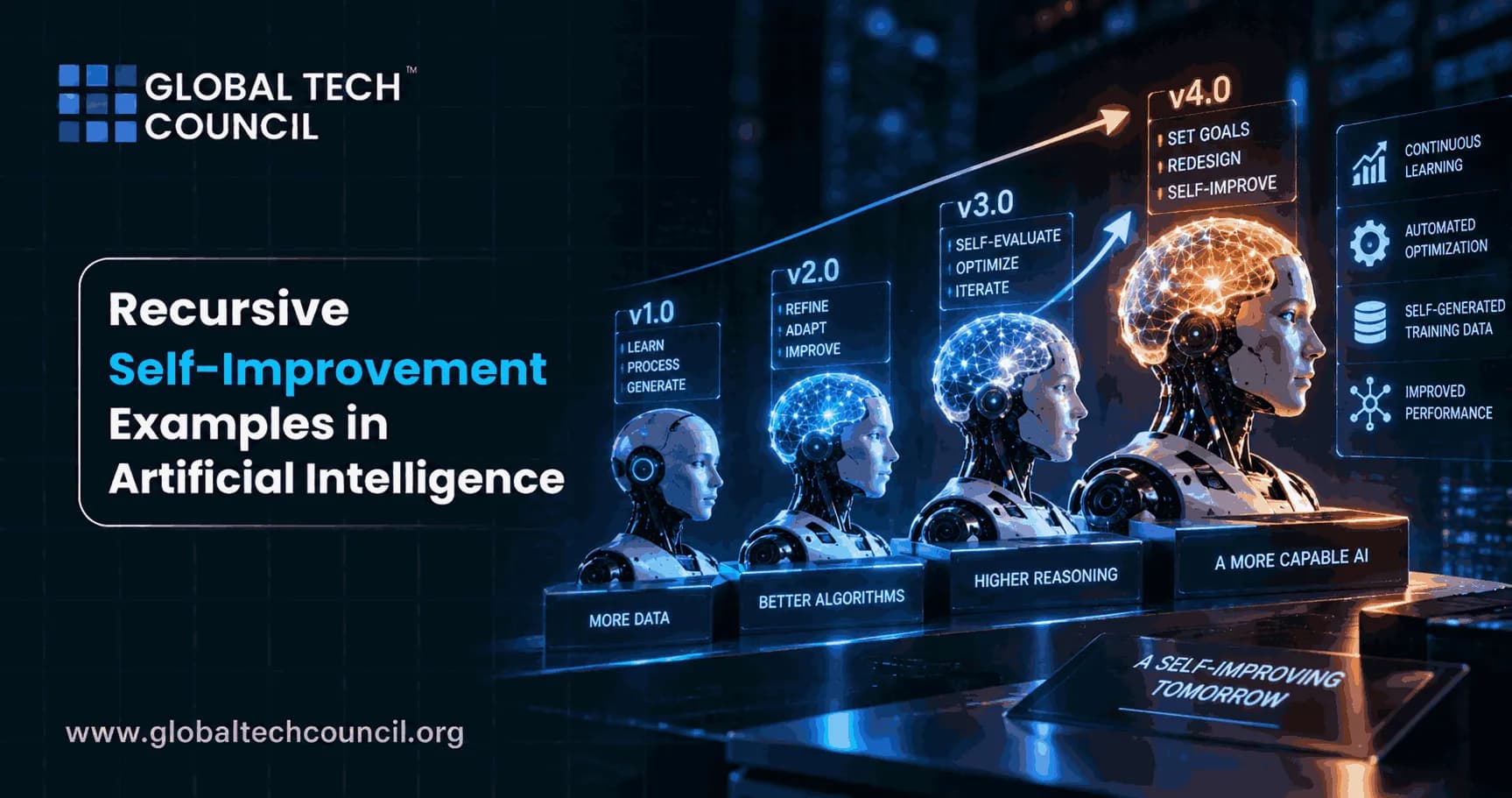
Recursive self-improvement spent decades as a concept confined mostly to AI safety papers and speculative discussions about what a sufficiently advanced machine might eventually do. That changed rapidly once agentic coding tools matured enough to actually run experiments, evaluate results, and keep whatever changes improved performance. A growing catalog of documented, verifiable examples now shows this pattern operating in research labs, open-source projects, and individual experiments alike. Professionals trying to make sense of this fast-moving landscape often start with a Certified Artificial Intelligence (AI) Expert credential, which builds the technical foundation needed to evaluate these examples accurately rather than relying on secondhand summaries.
Every verified example below shares a common structure. An agent proposes a change, tests it against a fixed and automated evaluation signal, and keeps whatever change actually improved performance. None of them involve a system redesigning its own goals or architecture without that external check in place.

Algorithm Discovery Through Evolutionary Code Generation
Google DeepMind's AlphaEvolve represents one of the most cited examples of AI improving the technical infrastructure that AI development itself depends on. Rather than writing an algorithm once and stopping, AlphaEvolve treats code generation as an evolutionary process:
The system generates candidate code, scores each version against a clearly defined objective, and mutates the strongest-performing versions across many successive generations.
DeepMind has used this evolutionary loop to find genuine improvements in data center scheduling efficiency and in matrix multiplication algorithms, discovering a result better than any published approach since a foundational 1969 algorithm in the field.
The kind of optimization work AlphaEvolve automates would traditionally require specialist researchers weeks of manual experimentation to achieve.
Autonomous Experimentation on Training Code
A widely cited independent example comes from AI researcher Andrej Karpathy, who pointed an autonomous coding agent at his own already well-optimized GPT-2 training codebase and let it run unsupervised overnight:
Over roughly two days, the agent ran approximately 700 separate experiments on the training pipeline.
Of those experiments, about 20 produced genuine, transferable speedups to the actual training process.
The combined effect cut the time needed to reach GPT-2-level model quality from just over two hours down to roughly one hour and forty-eight minutes, on code that had already been carefully hand-tuned beforehand.
A separate effort scaled this same propose-test-keep-or-revert loop to roughly ten thousand trials running on a large cluster of GPUs, ultimately outperforming a human engineering baseline on the same optimization task.
Building the practical skills needed to design and safely run this kind of autonomous experimentation loop is where many professionals pursue a Certified Artificial Intelligence (AI) Developer credential, gaining hands-on exposure to the agent scaffolding, evaluation design, and safety checkpoints that make these loops both effective and controllable.
Two Agents Improving Each Other Through Adversarial Practice
A different structural example, presented at a major 2026 machine learning conference workshop dedicated specifically to recursive self-improvement, takes a co-evolutionary approach rather than a single agent optimizing alone:
The system uses two agents derived from the same underlying base language model, engaged in an ongoing adversarial loop.
One agent's job is to propose increasingly difficult tasks, while the other agent works to solve those tasks using available tools.
Notably, no additional human-curated training data was introduced after the base model was initially set up, meaning the entire improvement process relied on the two agents challenging and refining each other.
Reported performance gains reached eighteen percent on math reasoning tasks and twenty-four percent on general reasoning tasks, tested on a well-known open-weight base model.
Researchers studying this case describe it as one of the most rigorously tested examples of genuine recursive self-improvement documented so far, since it involves an outer-loop agent rewriting the actual code of an inner-loop research agent, rather than one static model simply generating better outputs over time.
AI Microdrama and Emerging Creative Applications
One emerging application is AI microdrama, where generative AI helps bring serialized stories, characters, and fictional worlds to life. While this creative use case sits far outside the algorithmic and coding-focused examples cataloged elsewhere, it draws on the same underlying model improvements produced by research efforts like these, showing how gains achieved in highly technical self-improvement research eventually filter down into consumer-facing generative applications built on top of increasingly capable foundation models.
Frameworks Purpose-Built for Recursive Self-Improvement
Beyond individual experiments and one-off demonstrations, researchers have developed dedicated frameworks specifically designed to study and formalize how recursive self-improvement can work in a controlled, evaluable way:
The Self-Taught Optimizer, often shortened to STOP, allows a language model to recursively improve a scaffolding program or its own routine by rewriting it against a defined task metric, with each generation graded automatically against that fixed evaluation signal.
The Darwin Gödel Machine builds on decades-old theoretical work proposing a fully self-referential system capable of provably optimal self-improvement, translating that older theoretical framework into a working, testable implementation.
Self-Adapting Language Models, known as SEAL, developed by researchers at MIT, let a model generate its own natural-language self-edits describing how it should update its weights, then apply those edits through fine-tuning while a reinforcement learning outer loop verifies whether each edit genuinely improved downstream performance.
Meta's self-rewarding language models have a model generate its own responses and evaluate their quality simultaneously, training on its own preference judgments through iterative optimization, with published results showing a fine-tuned open-weight model outperforming several well-known proprietary systems on standard alignment benchmarks after only a few iterations.
Evaluating and comparing frameworks like these responsibly requires broad technical literacy spanning machine learning theory, evaluation methodology, and safety engineering all at once. A Deep Tech Certification helps professionals develop that wider foundation, equipping them to critically assess which examples represent genuinely novel progress versus incremental refinements of existing techniques.
Industry-Reported Examples From Frontier AI Labs
Alongside academic frameworks, major AI labs have begun disclosing their own internal examples of AI contributing directly to their development processes:
One frontier lab reported that a coding-focused model released in February 2026 was, in the company's own words, its first model that was instrumental in creating itself, with early versions helping debug their own training runs before release.
The same organization has published internal data showing its flagship model authoring a substantial majority of the code merged into its own production codebase, alongside a documented research loop that closed the vast majority of a targeted benchmark gap that human researchers working the same problem for a full week had only partially closed.
These disclosures represent bounded, measurable examples rather than evidence of a fully autonomous, open-ended improvement cycle, since human engineers still review outputs and determine what gets incorporated into subsequent training runs.
What These Examples Have in Common
Looking across this full catalog of documented cases, a consistent pattern emerges regardless of which lab, framework, or individual researcher produced the example:
Every case relies on a fixed, automated evaluation signal, whether that is validation loss, a benchmark score, or a task-specific metric, rather than open-ended, unmeasured self-modification.
Improvements consistently show up in narrow, well-defined domains such as code optimization, algorithm discovery, or reasoning task performance, rather than general-purpose capability gains across arbitrary tasks.
None of the verified examples involve a system redesigning its own core architecture or training objectives without a human-defined stopping condition or compute budget constraining the process.
Communicating These Examples Accurately
Recursive self-improvement examples are genuinely exciting from a technical standpoint, but they are also easy to misrepresent in public discussion, either by treating a bounded, well-controlled experiment as evidence of an imminent runaway system or by dismissing genuinely significant research progress as mere marketing. Journalists, business leaders, and the public benefit from framing that accurately reflects what each documented example actually demonstrated.
A Marketing Certification can help professionals develop the communication skills needed to present these technical examples responsibly, explaining what systems like AlphaEvolve, Agent0, and SEAL genuinely achieved without either inflating or understating their real significance for the broader trajectory of AI development.
The growing catalog of verified recursive self-improvement examples shows a field moving steadily from theoretical speculation into measurable, reproducible engineering practice. From evolutionary algorithm discovery to autonomous overnight experimentation and adversarial agent co-evolution, each documented case demonstrates genuine, bounded progress, offering a far more grounded picture of where AI self-improvement actually stands today than either the most dramatic headlines or the most dismissive skepticism would suggest.
FAQs
1. What are examples of Recursive Self-Improvement in AI?
Examples include AI systems improving generated code through repeated testing, automated algorithm discovery, AI-generated synthetic training data, self-play systems, automated model evaluation, and AI-assisted research. Most current examples are bounded or partial forms of self-improvement, rather than fully autonomous RSI.
2. What is Recursive Self-Improvement in artificial intelligence?
Recursive Self-Improvement (RSI) is the concept of an AI system repeatedly improving its own capabilities, algorithms, architecture, training processes, or development methods. The defining feature is that one improvement can make the system better at finding subsequent improvements.
3. Is Recursive Self-Improvement already happening in AI?
Limited forms of self-improvement and automated optimization are already being used in AI research and development. However, fully autonomous RSI, where an AI independently drives successive generations of increasingly capable AI, has not been publicly demonstrated. OpenAI currently states that fully autonomous RSI is not happening today.
4. What is an example of AI improving its own code?
An AI coding system can generate a program, test it, identify failures, modify the code, and run the tests again. This creates an iterative improvement loop, although it becomes true RSI only if the process meaningfully improves the AI system or the process used to develop it.
5. Can AI use self-play as a form of self-improvement?
Yes. In self-play, AI systems generate increasingly challenging experiences by competing against themselves or other versions of AI. The resulting feedback can be used to improve performance, although self-play alone does not necessarily mean the AI is redesigning or improving its own underlying architecture.
6. How can AI-generated data contribute to self-improvement?
An AI can generate synthetic examples that are subsequently used to train or fine-tune another model. If an improved model then generates higher-quality training material for a later generation, this can create an iterative improvement process. External validation is important because errors can also be amplified.
7. Is automated algorithm discovery an example of RSI?
It can represent a component of RSI. Systems can search through many algorithmic solutions, evaluate them against a defined objective, and retain better-performing solutions. Google DeepMind's AlphaEvolve, for example, uses Gemini-powered agents and automated evaluation to discover and improve algorithms for various computational problems.
8. What is AlphaEvolve and how is it related to AI self-improvement?
AlphaEvolve is a Gemini-powered coding agent developed by Google DeepMind that combines LLMs with automated evaluators and an evolutionary search process. It has been used to improve algorithms and optimize systems involved in Google's infrastructure and AI development. It is better described as AI-assisted automated improvement than unrestricted autonomous RSI.
9. Can AI researchers use AI to improve AI models?
Yes. AI systems can assist researchers with literature analysis, coding, experiment design, data generation, debugging, and evaluation. OpenAI describes its automated research work as an effort toward AI systems that can perform increasingly substantial research tasks under human direction.
10. Can an AI model evaluate and improve its own responses?
Yes. An LLM can generate an answer, critique it against defined criteria, identify weaknesses, and produce a revised version. This is generally called self-refinement or self-correction, rather than full recursive self-improvement.
11. Is automated machine learning an example of Recursive Self-Improvement?
Automated Machine Learning (AutoML) can automatically search for model architectures, hyperparameters, preprocessing methods, or other configurations. It demonstrates automated optimization, but it does not necessarily constitute RSI because the system may not be improving its own ability to perform the optimization.
12. Can AI optimize the training process of another AI?
Yes. AI or automated optimization systems can search for better hyperparameters, training configurations, algorithms, and other components. This can make model development more efficient and represents one potential building block for more advanced self-improvement systems.
13. Can AI train a better version of itself?
An AI can contribute to the training of a successor by generating data, writing training code, proposing experiments, or providing evaluations. However, independently deciding how to improve itself and managing the complete development cycle would represent a much stronger form of RSI.
14. Are AI agents an example of Recursive Self-Improvement?
AI agents can support RSI by performing multi-step research, coding, experimentation, and evaluation. However, an autonomous agent completing a task is not automatically performing RSI. The system needs a feedback loop in which its own capabilities or improvement process are repeatedly enhanced.
15. Can AI improve its own prompts as an example of self-improvement?
Yes, at a limited level. An AI can generate multiple prompts, test them against an evaluation metric, and select better-performing instructions. This improves the workflow or prompting strategy, not necessarily the underlying AI model.
16. Can AI improve AI safety through self-improvement?
Yes. AI can be used to find weaknesses in other AI systems and generate adversarial examples for safety training. For example, OpenAI's GPT-Red uses automated red-teaming and self-play reinforcement learning to help improve robustness against prompt-injection attacks.
17. What is the difference between these examples and full RSI?
Most examples improve a specific component, task, algorithm, or workflow under defined objectives. Full RSI would require a broader loop in which an AI can repeatedly identify meaningful improvements, implement them, evaluate the resulting system, and use improved capabilities to drive subsequent generations.
18. What are some hypothetical examples of future RSI?
Future RSI could theoretically involve an AI discovering a better training algorithm, using it to train an improved model, using that improved model to discover an even better architecture, and repeating the process. Another possibility is an AI research system that continuously designs, runs, and evaluates experiments aimed at improving AI development itself.
19. What are the risks of Recursive Self-Improvement?
Potential risks include unreliable evaluation, unintended modifications, alignment failures, cybersecurity vulnerabilities, and difficulty maintaining effective human oversight. If improvement becomes rapid, researchers could also have less time to understand and test each new generation.
20. What is the best real-world example of Recursive Self-Improvement today?
There is no single publicly demonstrated example of fully autonomous RSI today. The strongest real-world examples are systems that automate parts of the AI improvement loop, such as AlphaEvolve's algorithmic search, AI-assisted research systems, automated evaluation, self-play, and AI-generated training workflows. These examples show progress toward more automated AI development, but they should not be presented as proof that unrestricted RSI has already been achieved.
Related Articles
View All
AI & ML
How Does Recursive Self-Improvement Work in Artificial Intelligence?
Recursive self-improvement in artificial intelligence describes a process where an AI system improves its own capabilities and then uses those gains to make further improvements over time.

AI & ML
Recursive Self-Improvement vs Recursive Self-Training: Key Differences
Learn the key differences between recursive self-improvement and recursive self-training, including how each process works, what it changes, and why the distinction matters in AI development.
AI & ML
Recursive Self-Improvement and AI Safety: What Are the Risks?
Recursive self-improvement could allow AI systems to enhance their capabilities repeatedly, raising concerns around alignment, control, oversight, rapid capability growth, and unpredictable behavior.
Trending Articles
The Role of Blockchain in Ethical AI Development
How blockchain technology is being used to promote transparency and accountability in artificial intelligence systems.
AWS Career Roadmap
A step-by-step guide to building a successful career in Amazon Web Services cloud computing.
Top 5 DeFi Platforms
Explore the leading decentralized finance platforms and what makes each one unique in the evolving DeFi landscape.