

Deep Learning Fundamentals: Concepts Every ML Beginner Should Know
 Suyash Raizada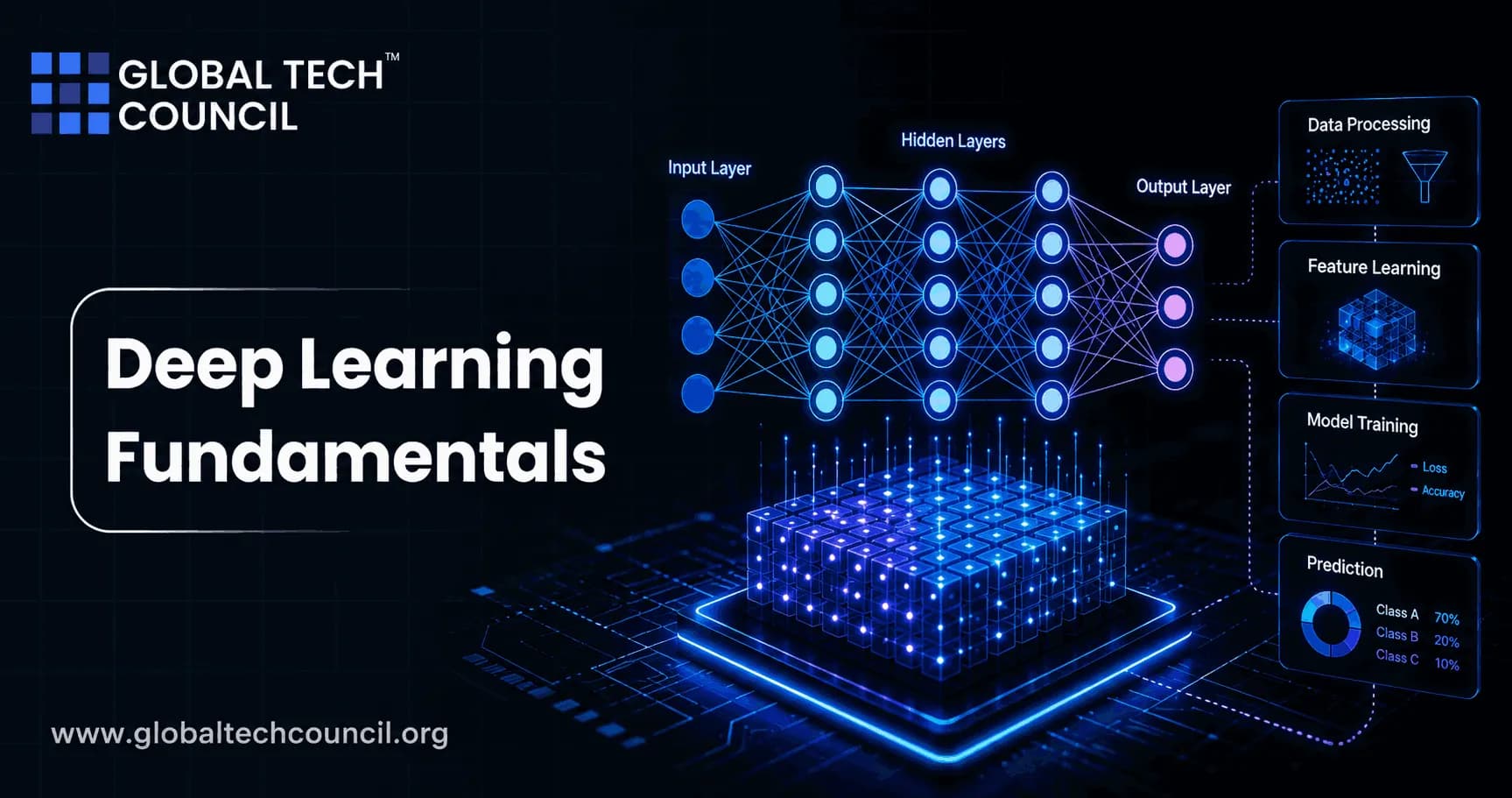
Deep learning fundamentals start with one idea: a neural network learns useful representations from data by adjusting many small numerical parameters. That sounds simple. It is not magic, and it is not just bigger machine learning. Once you understand layers, loss functions, gradients, data quality, and deployment constraints, modern AI systems become much easier to build and debug.
Deep learning now powers image recognition, speech transcription, language models, recommendation systems, medical imaging workflows, and autonomous systems. MIT's 2024 Introduction to Deep Learning course, 6.S191, still begins with the basics: neural networks, backpropagation, optimization, convolutional networks, and transformers. That curriculum choice tells you something. Beginners do not need to start with trillion-parameter models. You need the mechanics first.

Building a strong foundation in neural networks, optimization, and model evaluation is essential for anyone pursuing practical AI development. A Certified Machine Learning Expert credential helps professionals strengthen these core skills, making it easier to design, train, and evaluate machine learning models that perform reliably in real-world applications.
What Is Deep Learning?
Deep learning is a subfield of machine learning that uses multi-layer artificial neural networks to learn patterns from data. Traditional machine learning often depends on hand-crafted features. Deep learning models learn many of those features automatically.
In a computer vision model, early layers may detect edges and textures. Middle layers may detect shapes. Later layers may identify objects such as a tire, a face, or a tumor boundary. In a language model, layers learn relationships between tokens, grammar, context, and meaning. The same broad idea applies across images, text, audio, time series, and sensor data.
That is why deep learning became the dominant method for many complex AI tasks. It handles unstructured data well, provided you have enough data, compute, and engineering discipline.
As deep learning models move from experimentation into production, managing the complete model lifecycle becomes increasingly important. A Certified MLOps Expert credential helps professionals develop practical skills in experiment tracking, deployment automation, monitoring, and reproducible workflows, ensuring that deep learning systems remain dependable after deployment.
Neural Networks: The Core Building Block
A neural network is a computational graph made of layers. Each layer usually applies a linear transformation, then a nonlinear activation function. In practical terms, the model multiplies inputs by weights, adds biases, passes the result through an activation, and repeats this process through the network.
A simple multilayer perceptron, or MLP, uses fully connected layers. Every neuron in one layer connects to every neuron in the next. With only linear activations, an MLP collapses into a linear model. Add nonlinear activations such as ReLU, tanh, sigmoid, or GELU, and the model can approximate far more complex functions.
For tabular data, an MLP may be enough. For images, use a convolutional neural network first. For language tasks, transformers are usually the right starting point. Do not reach for a transformer on every small dataset just because it sounds current. It can be expensive, slow, and easy to overfit.
Forward Pass, Loss, and Backpropagation
Training has two main phases. The forward pass sends input data through the network to produce predictions. The model then compares predictions with true labels using a loss function. The backward pass, known as backpropagation, computes gradients that show how each parameter should change to reduce the loss.
Optimizers such as stochastic gradient descent, SGD with momentum, Adam, and AdamW use these gradients to update model weights. Adam is often forgiving for beginners. AdamW is usually better when you need decoupled weight decay, especially in transformer training.
A common beginner mistake in PyTorch is using torch.nn.CrossEntropyLoss after applying softmax manually. Do not do that. CrossEntropyLoss expects raw logits and class indices. Another classic error is a shape mismatch such as RuntimeError: mat1 and mat2 shapes cannot be multiplied (32x784 and 128x10). That usually means your flattened input size does not match the first linear layer. Print tensor shapes. It saves hours.
Activation Functions and Gradient Problems
Activation functions give neural networks their nonlinear power. ReLU is popular because it is simple and works well in many feedforward and convolutional networks. GELU is common in transformer architectures, including many BERT-style models.
Sigmoid and tanh still matter, but they can suffer from vanishing gradients when networks get deep. Vanishing gradients make earlier layers learn slowly. Exploding gradients do the opposite, producing unstable updates and sometimes nan loss values. If your loss suddenly becomes nan, check the learning rate first. A learning rate of 1e-1 that works for a tiny demo can wreck a deeper model. For Adam, 1e-3 is a safer first try, though not a rule.
Loss Functions and Metrics Are Not the Same
The loss function is what the model optimizes. The metric is what you use to judge whether the model is useful.
Mean squared error is common for regression.
Cross entropy is standard for classification.
Accuracy works when classes are balanced.
Precision, recall, and F1 score are better when false positives and false negatives have different costs.
ROC AUC is useful for ranking binary classifiers across thresholds.
BLEU and related scores are used in some language generation and translation tasks, though human evaluation is often still needed.
Here is the blunt version: accuracy can lie. If only 1 percent of transactions are fraudulent, a model that predicts "not fraud" every time reaches 99 percent accuracy and is useless. Use the metric that matches the business or safety requirement.
Regularization, Normalization, and Generalization
Overfitting happens when your model memorizes training data and fails on new data. You catch it by using a validation set and watching the gap between training and validation performance.
Common fixes include:
Weight decay, which discourages overly large weights.
Dropout, which randomly disables neurons during training.
Early stopping, which stops training when validation performance stops improving.
Data augmentation, especially for images, audio, and text.
Batch normalization, often used in CNNs.
Layer normalization, widely used in transformers.
Batch normalization can behave differently with tiny batch sizes. If you train with batches of 2 or 4, expect noisy statistics. In that case, layer normalization or group normalization may be a better choice.
Key Deep Learning Architectures
Convolutional Neural Networks
Convolutional neural networks, or CNNs, use local receptive fields and shared weights. They are efficient for images and video because neighboring pixels carry local structure. CNNs still matter in medical imaging, industrial inspection, satellite imagery, and embedded vision.
Recurrent Neural Networks
RNNs, LSTMs, and GRUs process sequences step by step. They are less dominant in natural language processing than they once were, but they remain useful for some time series and low-latency streaming tasks.
Transformers
Transformers use attention mechanisms to model relationships across long contexts. They power most modern large language models and are now common in vision, audio, code generation, and multimodal AI. They are powerful, but costly. For a small classification problem, fine-tuning a compact encoder may beat training a large model from scratch.
Autoencoders and Variational Autoencoders
Autoencoders compress inputs into latent representations and reconstruct them. They are used for denoising, anomaly detection, dimensionality reduction, and generative modeling. Variational autoencoders add a probabilistic structure to the latent space.
Data and Compute Matter More Than Beginners Expect
Deep learning is hungry. It needs clean data, careful labels, and enough compute. A model trained on mislabeled data will not become reliable because you added more layers.
Your training pipeline should include:
Data cleaning and deduplication.
Train, validation, and test splits.
Class imbalance checks.
Feature scaling where appropriate.
Experiment tracking.
Model monitoring after deployment.
Specialized hardware is now part of the field. NVIDIA introduced the Blackwell B200 GPU in 2024, with a transformer engine designed for large language model workloads and roughly 20 petaflops of AI performance under supported precision modes. At the other end, compact models such as Microsoft's Phi-3 Mini, a 3.8 billion parameter model, show how capable systems can run closer to edge and mobile environments.
Do not ignore inference cost. Training gets attention, but production inference can dominate the bill if your model serves millions of requests.
Building enterprise-scale deep learning solutions also requires expertise in cloud computing, distributed systems, software engineering, and cybersecurity. A Deep Tech Certification helps professionals develop these advanced technical capabilities, supporting the creation of scalable, secure, and high-performance AI infrastructure for modern organizations.
Where Deep Learning Is Used
Deep learning is strongest when large volumes of structured or unstructured data contain patterns that are hard to describe manually. Common applications include:
Medical image analysis and radiology support.
Object detection for manufacturing quality inspection.
Speech recognition and call center transcription.
Search ranking and document summarization.
Recommendation systems for retail, streaming, and advertising.
Autonomous vehicle perception and driver assistance.
Robotics for navigation and manipulation.
Generative AI for images, text, audio, and code.
Market estimates vary because analysts define the category differently, but they agree on direction. Some reports value the deep learning market at tens of billions of US dollars in 2024 and 2025, with high double-digit growth forecasts in several segments. Software and services currently hold a large share, while AI accelerator hardware is projected to grow quickly as demand for training and inference capacity rises.
Ethics, Interpretability, and Regulation
Deep learning models can be accurate and still unsafe. Bias, privacy risk, poor documentation, weak monitoring, and opaque decision logic can create real harm in healthcare, finance, hiring, education, and public services.
Learn model cards, dataset documentation, fairness testing, privacy basics, and audit trails early. If your model affects people, measure more than loss and accuracy. Ask who is underrepresented in the training data. Ask how errors are handled. Ask whether a simpler model would be easier to justify.
How to Learn Deep Learning Fundamentals the Right Way
Start small. Build an MLP on tabular data, then train a CNN on an image dataset, then fine-tune a transformer for text classification. Use Python 3.12, PyTorch or TensorFlow, NumPy, pandas, and scikit-learn. Track experiments with a simple spreadsheet at first, then move to tools such as MLflow or Weights & Biases when projects grow.
If you want a structured path, pair hands-on practice with formal study. Global Tech Council programs worth looking at include the Certified Machine Learning Expert™, Certified Artificial Intelligence (AI) Expert™, and Certified Python Developer™. If your goal is enterprise deployment, add data governance and cybersecurity basics as well.
Next Step
Pick one problem this week: classify images, predict churn, or fine-tune a small text classifier. Keep the model simple. Log your loss, validation metric, learning rate, batch size, and errors. Once you can explain why the model failed and how you fixed it, you are no longer just reading about deep learning fundamentals. You are practicing them.
Delivering successful AI projects also depends on explaining technical outcomes in terms that business leaders can understand. A Marketing & Business Certification helps professionals strengthen their communication and strategic thinking skills, enabling them to connect deep learning initiatives with organizational objectives and demonstrate measurable business value.
FAQs
1. What is deep learning?
Deep learning is a specialized branch of machine learning that uses artificial neural networks with multiple layers to learn complex patterns from data. It has become a key technology for applications such as computer vision, natural language processing, speech recognition, recommendation systems, and generative AI.
2. How is deep learning different from machine learning?
Machine learning is a broad field that includes many algorithms for learning from data, while deep learning is a subset that relies on multi-layer neural networks. Traditional machine learning often requires manual feature engineering, whereas deep learning models can automatically learn hierarchical representations from large datasets.
3. What is an artificial neural network?
An artificial neural network (ANN) is a computational model inspired by the structure of biological neurons. It consists of interconnected nodes, or neurons, organized into layers that process information and learn relationships by adjusting weighted connections during training.
4. What are the input, hidden, and output layers?
The input layer receives data, hidden layers perform mathematical transformations to learn patterns, and the output layer produces the final prediction or classification. Deep learning models typically contain multiple hidden layers, enabling them to capture increasingly complex relationships within the data.
5. What are weights and biases?
Weights determine the strength of connections between neurons, while biases allow neurons to adjust their activation independently of the input values. During training, both weights and biases are updated to reduce prediction errors and improve model performance.
6. What are activation functions?
Activation functions introduce nonlinearity into neural networks, allowing them to model complex relationships beyond simple linear patterns. Common activation functions include ReLU, sigmoid, tanh, softmax, and GELU, with the choice depending on the network architecture and task.
7. What is forward propagation?
Forward propagation is the process of passing input data through the layers of a neural network to generate predictions. Each layer applies mathematical transformations before passing the output to the next layer until the final prediction is produced.
8. What is a loss function?
A loss function measures the difference between a model's predictions and the correct target values. During training, optimization algorithms seek to minimize the loss so the model gradually improves its predictive performance.
9. What is backpropagation?
Backpropagation is the algorithm used to calculate how much each model parameter contributes to prediction errors. These calculated gradients are then used to update weights and biases, enabling the neural network to learn more effectively over successive training iterations.
10. What is gradient descent?
Gradient descent is an optimization method that adjusts model parameters to reduce the loss function. Popular variants include Stochastic Gradient Descent (SGD), Mini-Batch Gradient Descent, Adam, AdamW, and RMSprop, each offering different tradeoffs in convergence speed and stability.
11. What are epochs, batches, and iterations?
An epoch represents one complete pass through the entire training dataset, a batch is a subset of the data processed together, and an iteration refers to a single parameter update during training. Mini-batch training is commonly used because it balances computational efficiency with stable learning.
12. What are convolutional neural networks (CNNs)?
Convolutional Neural Networks are deep learning architectures specifically designed for image and spatial data analysis. CNNs automatically learn visual features such as edges, textures, and shapes, making them widely used for image classification, object detection, and medical imaging.
13. What are recurrent neural networks (RNNs)?
Recurrent Neural Networks are designed to process sequential data by maintaining information from previous inputs. While they have historically been used for language and time-series tasks, many modern applications now use transformer architectures for improved scalability and performance.
14. What are transformers?
Transformers are deep learning architectures that use attention mechanisms to process relationships between elements in a sequence efficiently. They form the foundation of many modern large language models (LLMs) and are widely used for text, vision, speech, and multimodal AI applications.
15. What challenges do beginners face in deep learning?
Common challenges include selecting suitable model architectures, obtaining sufficient high-quality data, tuning hyperparameters, preventing overfitting, managing computational requirements, understanding optimization techniques, and interpreting complex model behavior.
16. What tools are commonly used for deep learning?
Popular deep learning frameworks include TensorFlow, Keras, PyTorch, JAX, ONNX, Hugging Face Transformers, and Lightning. Development often involves Python along with libraries such as NumPy, Pandas, Matplotlib, and cloud-based notebook environments.
17. What are best practices for learning deep learning?
Build a strong foundation in Python, mathematics, and classical machine learning before exploring neural networks. Start with small projects, experiment with public datasets, monitor training carefully, document experiments, and gradually progress toward more advanced architectures and real-world applications.
18. How does deep learning fit into MLOps?
Deep learning models are managed through MLOps practices that include experiment tracking, automated training pipelines, model versioning, deployment, monitoring, retraining, and governance. These practices help maintain reliability, reproducibility, and scalability throughout the model lifecycle.
19. What trends are shaping deep learning in 2025-2026?
Major trends include multimodal foundation models, parameter-efficient fine-tuning, retrieval-augmented generation (RAG), AI agents, edge AI, distributed training, energy-efficient model optimization, synthetic data, explainable AI, and stronger governance frameworks for responsible AI deployment.
20. What is the future of deep learning?
Deep learning is expected to remain a central technology driving advances in artificial intelligence across industries, from healthcare and finance to robotics and scientific research. Future progress will likely focus on more efficient models, improved reasoning capabilities, responsible AI practices, and broader accessibility through cloud and edge computing. Every groundbreaking neural network still begins with randomly initialized numbers making gloriously unhelpful guesses, which is a comforting reminder that expertise usually starts with being spectacularly wrong.
Related Articles
View All
Machine Learning
Top 10 Deep Learning Algorithms You Should Know in
In scientific computing, deep learning has gained immense popularity, and its algorithms are commonly used by companies that solve complex problems. In order to perform complex functions, all deep learning algorithms use multiple forms of neural networks. This article discusses virtual artificial…

Machine Learning
Machine Learning vs Deep Learning: Which Approach Should You Use?
Machine learning vs deep learning explained with practical guidance on data size, interpretability, compute, use cases, and when each approach fits best.

Machine Learning
Linear Regression in Machine Learning: Concepts, Assumptions, and Examples
Learn linear regression in machine learning, including key concepts, assumptions, diagnostics, examples, and when to use simpler models over complex ones.
Trending Articles
The Role of Blockchain in Ethical AI Development
How blockchain technology is being used to promote transparency and accountability in artificial intelligence systems.
AWS Career Roadmap
A step-by-step guide to building a successful career in Amazon Web Services cloud computing.
Top 5 DeFi Platforms
Explore the leading decentralized finance platforms and what makes each one unique in the evolving DeFi landscape.