

K-Nearest Neighbors (KNN) Explained: A Simple Guide with Examples
 Suyash Raizada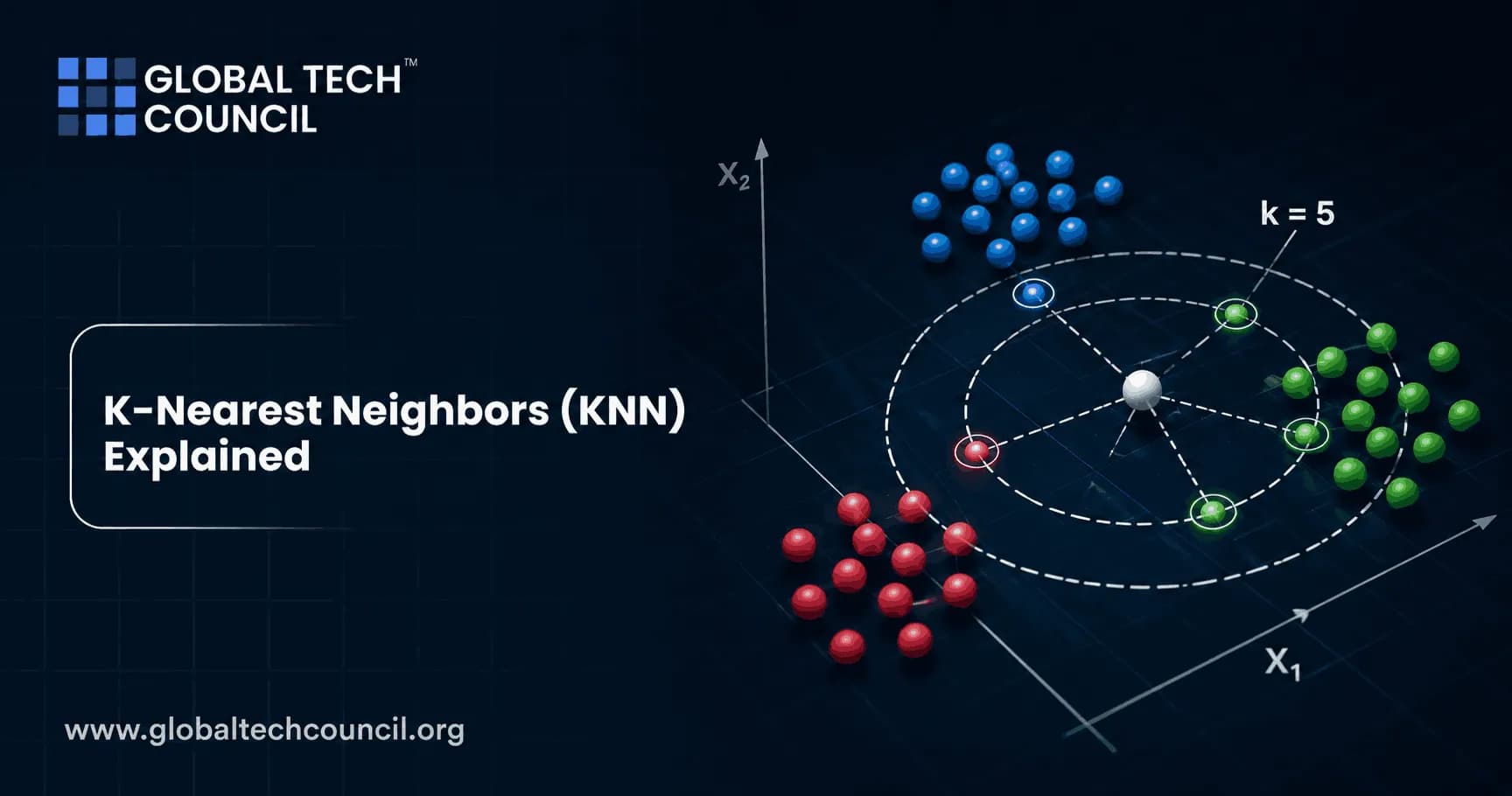
K-Nearest Neighbors (KNN) is one of the clearest supervised machine learning algorithms you can learn, and it still matters in 2026. It predicts a class or numeric value by finding the closest examples in your training data. Simple idea. Real consequences. The same pattern sits behind spam filters, recommendation engines, vector search, and retrieval-augmented generation systems.
If you are learning machine learning for certification, KNN is worth more than a quick chapter skim. It teaches you how distance metrics, feature scaling, bias, variance, class imbalance, and data representation affect model behavior. Those ideas come back in almost every applied ML project.

Developing a strong understanding of algorithms like KNN is an important step toward building practical machine learning expertise. A Certified Machine Learning Expert credential helps professionals strengthen their knowledge of supervised learning, feature engineering, model evaluation, and algorithm selection, creating a solid foundation for solving real-world AI problems.
What Is K-Nearest Neighbors?
KNN is a supervised, non-parametric, instance-based algorithm used for classification and regression. Supervised means it learns from labeled examples. Non-parametric means it does not assume a fixed equation for the data. Instance-based means it keeps the training examples and uses them at prediction time.
For classification, KNN looks at the K closest labeled points and predicts the most common class. For regression, it averages the values of the K closest points.
Say you want to classify a professional profile as Developer or Data Scientist using two features: years of coding experience and math background score. If K is 5, the algorithm finds the five nearest profiles. If four are labeled Data Scientist and one is labeled Developer, the prediction is Data Scientist.
That is the full mental model. The hard part is making distance mean something useful.
As machine learning applications continue to evolve, professionals increasingly need to understand how traditional algorithms such as KNN complement modern AI techniques, including deep learning and vector-based retrieval systems. A Certified AI & Machine Learning Expert credential provides this broader perspective, helping practitioners select the most suitable methods for different data types and business use cases.
How KNN Works Step by Step
Given a training dataset with inputs and labels, KNN follows this process:
Represent each example as a feature vector. A house might use square footage, bedrooms, age, and location score. An email might use word counts or embeddings.
Measure distance between the new data point and every training point.
Select the K nearest neighbors. These are the closest records under the chosen distance metric.
Vote or average. Classification uses majority voting. Regression uses the mean, or sometimes a weighted mean.
The most common distance metric is Euclidean distance:
d(x, xi) = sqrt(sum((xj - xij)^2))
Euclidean distance works well when features are numeric and similarly scaled. Manhattan distance can help when movement is grid-like or features contain outliers. Cosine similarity is common in text and embedding systems because it compares direction rather than raw magnitude.
One practical warning. If one feature is salary in dollars and another is years of experience, salary will dominate Euclidean distance unless you scale the data. This mistake is easy to make and hard to spot from accuracy alone.
A Small KNN Example in Python
Here is a minimal example using scikit-learn. The important part is the scaler. Do not skip it unless you have a good reason.
from sklearn.neighbors import KNeighborsClassifier
from sklearn.preprocessing import StandardScaler
from sklearn.pipeline import make_pipeline

X = [[2, 40], [3, 45], [8, 80], [9, 85], [7, 78]]
y = [0, 0, 1, 1, 1]

model = make_pipeline(
    StandardScaler(),
    KNeighborsClassifier(n_neighbors=3)
)

model.fit(X, y)
print(model.predict([[4, 50]]))
In scikit-learn, KNeighborsClassifier defaults to n_neighbors=5, weights='uniform', and metric='minkowski' with p=2, which is Euclidean distance. That default catches beginners. If your training fold has fewer than 5 samples, you may see an error like ValueError: Expected n_neighbors <= n_samples_fit. It usually shows up during cross-validation on a small dataset.
To be blunt, many bad KNN results are preprocessing errors wearing a model-problem costume.
Choosing K: The Hyperparameter That Changes Everything
The value of K controls the shape of the decision boundary.
K = 1: very flexible, but sensitive to noise and mislabeled data.
Small K: can capture local patterns, but may overfit.
Large K: smoother and more stable, but can blur class boundaries.
A common starting point is to test odd values such as 3, 5, 7, 9, and 11 with cross-validation. Odd values reduce ties in binary classification. Some research proposes practical rules, such as choosing K based on the number of classes or limiting K to around the square root of the training sample count. Treat those as starting points, not laws.
Other KNN Settings You Should Tune
Distance metric: Euclidean, Manhattan, cosine, or a domain-specific metric.
Neighbor weighting: uniform voting gives each neighbor equal power. Distance-weighted voting gives closer points more influence.
Feature scaling: standardization or normalization is often required.
Class imbalance handling: weighted voting or resampling can help minority classes.
Dimensionality reduction: PCA or feature selection can cut noisy dimensions.
If you are preparing for a machine learning exam or a Global Tech Council certification path in machine learning, data science, or AI, expect questions that test these trade-offs rather than just the definition of KNN.
KNN for Classification and Regression
Classification Example: Spam Detection
In spam filtering, each email can be converted into a vector using word counts, TF-IDF, or embeddings. KNN compares the new email to labeled spam and non-spam emails. If the nearest neighbors are mostly spam, the new email is flagged.
This works for small experiments, but it is not usually the first choice for production email security. Modern systems often use boosted trees, neural models, reputation signals, and rule engines. KNN is still useful as a baseline because it shows whether similar messages cluster in feature space.
Regression Example: House Price Prediction
For house prices, KNN finds similar homes and averages their sale prices. If the five nearest homes sold for 410,000, 430,000, 425,000, 440,000, and 420,000 dollars, the prediction is 425,000 dollars.
This is easy to explain to a business stakeholder. But watch location. A numeric ZIP code is not a distance-aware geographic feature. Treating 10001 and 10002 as simple numbers is usually wrong.
Strengths of KNN
Easy to understand: the prediction can be explained by showing the nearest examples.
No training phase in the usual sense: KNN stores data rather than fitting many parameters.
Works for multi-class problems: voting naturally supports more than two classes.
Good baseline: it quickly reveals whether features contain useful similarity signals.
Limitations of KNN
Slow prediction at scale: naive KNN compares a query with every training point.
High memory use: the training data must be stored and searched.
Sensitive to irrelevant features: noisy columns distort distance.
Weak in high dimensions: as dimensions grow, distances often become less meaningful. This is the curse of dimensionality.
That last point is why plain KNN over raw high-dimensional data is rarely the final design in production. You usually need better representations, indexing, or both.
KNN in 2026: Where It Shows Up in Real Systems
KNN is still taught as a core algorithm, but industry now uses the idea mostly through nearest neighbor search. Amazon SageMaker, for example, offers a managed k-NN algorithm that uses index-based methods for classification and regression rather than a slow full scan. Vector databases and search libraries use the same core idea at much larger scale.
In retrieval-augmented generation, documents are embedded into vectors. A user query is embedded too. The system retrieves the nearest document vectors and passes those documents to a language model as context. That retrieval step is KNN-like, even when the implementation uses approximate nearest neighbor algorithms rather than exact KNN.
The same pattern appears in:
Product recommendations
Image similarity search
Code search
Anomaly detection
Customer segmentation
Modern tools often use FAISS, HNSW-based indexes, Annoy, ScaNN, Milvus, Pinecone, Weaviate, or cloud search services to avoid brute-force comparisons.
Deploying similarity search and machine learning systems at scale also requires expertise in cloud infrastructure, distributed computing, software engineering, and cybersecurity. A Deep Tech Certification helps professionals build these advanced technical capabilities, enabling them to design secure, scalable, and high-performance AI solutions for enterprise environments.
Recent Research Directions
A 2024 review in the Journal of Big Data described many KNN indexing structures, including iDistance, VA-file methods, array-index methods, and tree-based approaches. The goal is clear. Reduce search cost while keeping neighbor quality high.
Adaptive K is another active area. Instead of using one global K, newer methods adjust neighborhood size based on local data structure. For dense, smooth regions, a larger K can be safe. Near sharp class boundaries, a smaller K may preserve detail.
Fairness and imbalance-aware KNN variants also matter. Research on methods such as GWKNN has explored improved distance reconstruction and inverse class frequency voting, so majority classes do not drown out minority classes. That matters in fraud detection, medical triage, and risk modeling, where the rare class is often the class you care about most.
Best Practices When You Use KNN
Scale your features. Start with
StandardScalerfor numeric tabular data.Compare distance metrics. Do not assume Euclidean distance is correct.
Use cross-validation to choose K. Plot validation score against K values.
Check class imbalance. Accuracy can look fine while minority recall is poor.
Remove irrelevant features. More columns can make KNN worse.
Use approximate search for large data. Exact KNN can become too slow.
My default advice: use KNN early as a sanity baseline. If it performs well, your feature space has useful neighborhood structure. If it performs badly, inspect scaling, feature noise, and label quality before blaming the algorithm.
What to Learn Next
K-Nearest Neighbors is not just a beginner algorithm. It is a doorway into similarity learning, vector search, recommendation systems, and RAG pipelines. Learn it properly, then build a small project: classify text with TF-IDF and KNN, compare cosine and Euclidean distance, and measure how scaling changes results.
If you want a structured path, pair this topic with Global Tech Council learning resources in machine learning, data science, AI, and Python programming. Focus next on model evaluation, feature engineering, dimensionality reduction, and vector databases. Those skills turn KNN from a classroom concept into a practical engineering tool.
Successfully applying machine learning extends beyond model development to communicating technical findings in ways that support business objectives. A Marketing & Business Certification helps professionals strengthen their strategic thinking and communication skills, making it easier to present AI insights, align technical initiatives with organizational goals, and drive informed decision-making.
FAQs
1. What is the K-Nearest Neighbors (KNN) algorithm?
K-Nearest Neighbors (KNN) is a supervised machine learning algorithm used for classification and regression tasks. It predicts the output for a new data point by examining the most similar examples in the training dataset, making it one of the simplest and most intuitive machine learning algorithms.
2. Why is KNN important?
KNN is popular because it is easy to understand, requires minimal assumptions about the data, and often provides strong baseline performance. It is commonly used in education, research, and practical applications involving pattern recognition, recommendation systems, and anomaly detection.
3. How does the KNN algorithm work?
KNN stores the training data without building an explicit predictive model. When a new data point is presented, the algorithm calculates its distance to existing data points, identifies the K nearest neighbors, and predicts the class or value based on those neighboring observations.
4. What does the value of K represent?
The value of K specifies how many neighboring data points are considered when making a prediction. A smaller K may produce more flexible but noisier predictions, while a larger K generally creates smoother decision boundaries but may overlook local patterns.
5. How do you choose the best value of K?
The optimal value of K is usually determined through experimentation using techniques such as cross-validation. Factors including dataset size, feature distributions, and the desired balance between bias and variance influence the most suitable choice.
6. What distance metrics does KNN use?
KNN commonly uses Euclidean distance for continuous numerical features, but other metrics such as Manhattan distance, Minkowski distance, Hamming distance, and Cosine similarity may be appropriate depending on the dataset and application.
7. Why is feature scaling important for KNN?
Because KNN relies on distance calculations, features with larger numerical ranges can disproportionately influence predictions. Scaling methods such as standardization or normalization help ensure that all features contribute more equally to distance measurements.
8. Can KNN perform both classification and regression?
Yes. For classification, KNN predicts the most common class among the nearest neighbors. For regression, it estimates a numerical value by averaging or weighting the target values of nearby data points.
9. What are the advantages of KNN?
KNN is simple to implement, easy to interpret, requires no explicit training phase, supports multiclass classification, adapts to complex decision boundaries, and performs well on smaller datasets with meaningful feature representations.
10. What are the limitations of KNN?
KNN can become computationally expensive for large datasets because it must calculate distances for every prediction. It is also sensitive to irrelevant features, feature scaling, noisy data, class imbalance, and high-dimensional datasets.
11. What is the curse of dimensionality in KNN?
As the number of features increases, distances between data points become less meaningful, making it more difficult for KNN to identify truly similar neighbors. Feature selection and dimensionality reduction techniques can help address this challenge.
12. How does KNN compare with other machine learning algorithms?
Compared with algorithms such as logistic regression or decision trees, KNN requires little model training but can have slower prediction times. It performs best when similar observations are located close together in feature space and the dataset is of manageable size.
13. What are common applications of KNN?
KNN is used for image classification, recommendation systems, medical diagnosis support, fraud detection, document classification, customer segmentation, handwriting recognition, anomaly detection, and predictive analytics across various industries.
14. Which industries use KNN?
Industries including healthcare, finance, retail, manufacturing, education, telecommunications, cybersecurity, marketing, logistics, and scientific research use KNN for classification, similarity search, and decision-support applications.
15. Which Python libraries support KNN?
Popular libraries include Scikit-learn, NumPy, Pandas, SciPy, TensorFlow, PyTorch, OpenCV, Matplotlib, and Yellowbrick. Scikit-learn provides optimized implementations for both KNN classification and regression with configurable distance metrics and neighbor search algorithms.
16. What common mistakes should beginners avoid?
Common mistakes include skipping feature scaling, choosing K without validation, using irrelevant features, ignoring class imbalance, evaluating only training performance, failing to address missing values, and applying KNN to extremely large datasets without optimization.
17. What are best practices for using KNN?
Best practices include cleaning and scaling data, selecting meaningful features, tuning the value of K through cross-validation, testing multiple distance metrics, evaluating performance with appropriate metrics, and comparing KNN with alternative algorithms before deployment.
18. How does KNN fit into the machine learning lifecycle?
KNN is often used during model experimentation, benchmarking, and production for suitable datasets. It can be integrated into reproducible machine learning pipelines that include preprocessing, feature engineering, evaluation, deployment, monitoring, and periodic updates as new data becomes available.
19. What trends are shaping KNN in 2025-2026?
Current trends include accelerated nearest-neighbor search using approximate algorithms, GPU-assisted similarity computation, vector databases, hybrid AI systems, edge AI deployments, AutoML integration, and scalable implementations for large datasets and embedding-based applications.
20. What is the future of KNN?
KNN is expected to remain a valuable algorithm for educational purposes, similarity-based learning, and applications where interpretability and simplicity are important. Although newer machine learning methods continue to evolve, KNN remains a reliable baseline and an effective solution for many structured data and nearest-neighbor search problems. Sometimes the best prediction comes from simply asking the closest neighbors instead of assembling an unnecessarily dramatic committee of algorithms.
Related Articles
View All
Machine Learning
Machine Learning Algorithms Explained: A Simple Guide
Machine learning has become one of the most talked-about areas in technology, yet many people still see it as confusing or overly technical. In reality, the central idea is straightforward. Machine learning allows computers to learn patterns from data and use those patterns to make predictions,…
Machine Learning
Logistic Regression Explained: Classification Made Simple
Logistic regression explained in clear terms, with practical examples, Python tips, use cases, metrics, and guidance for machine learning learners.

Machine Learning
Machine Learning Algorithms Explained: A Practical Beginner Guide
A practical beginner guide to Machine Learning Algorithms, covering supervised, unsupervised, ensemble, neural network, and reinforcement learning methods.
Trending Articles
The Role of Blockchain in Ethical AI Development
How blockchain technology is being used to promote transparency and accountability in artificial intelligence systems.
AWS Career Roadmap
A step-by-step guide to building a successful career in Amazon Web Services cloud computing.
Top 5 DeFi Platforms
Explore the leading decentralized finance platforms and what makes each one unique in the evolving DeFi landscape.